Yuan Shao's Faction · General
Zhang He
courtesy name 俊乂 · –231
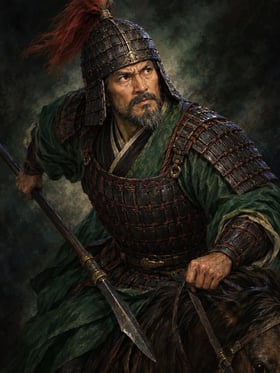
Zhang He understood the shifts of circumstance, was skilled at arranging camps and formations, and could reckon the momentum of battle and the lay of the terrain; though a military man, he loved and delighted in Confucian scholars, and judged the enemy with clear discernment. Brave and ready to fight, fierce and unbending, he could weigh the times and turn to a worthier lord. Yet at times he also showed impatience, combativeness, and obstinacy—even a hot temper and a self-regard for his own loyalty and duty.

Life
In the novel: 22 chapters · In the Records: 20 volumes
Life?–231
200 CE (Jian'an 5)
- Battle of GuanduGuanduWarrior
201 CE (Jian'an 6)
- Battle of CangtingCangtingWarrior
- Battle of RangshanMount RangWarrior
13 more events
209 CE (Jian'an 14)
210 CE (Jian'an 15)
214 CE (Jian'an 19)
215 CE (Jian'an 20)
218 CE (Jian'an 23)
- Hanzhong CampaignHanzhongWarrior
219 CE (Jian'an 24)
228 CE (Taihe 2)
- First Northern ExpeditionMount QiWarrior
- Battle of JietingJietingCommander
- Zhuge Liang's Northern ExpeditionsMount QiCommander
- Battle for ChencangChencangWarrior
231 CE (Taihe 5)
- Zhang He Shot Dead at MumendaoMumenKilled in action
- Zhuge Liang's Fourth Northern ExpeditionMount QiKilled in action
- Cao Wei
- Yuan Shao's Faction
- Hatched: dated by chapter
- Life event
- Death
List all 12 stops
- Hejian StateBirthplace
- Guandu200Battle of Guandu
- Cangting201Battle of Cangting
- Mount Rang201Battle of Rangshan
- Mount Tianzhu209Battle of Tianzhushan
- Ye210Bronze Bird Terrace Inauguration Ceremony
- Fuhan214Xiahou Yuan's Campaign Against Baohan
- Dangqu215Battle of Baxi
- Chencang228Battle for Chencang
- Jieting228Battle of Jieting
- Mount Qi228–231First Northern Expedition+2 more
- Mumen231Died hereZhang He Shot Dead at Mumendao
On the boards
Compare with someone →Where this person ranks on each board.
Who they were
Character profile
- Character
- Zhang He understood the shifts of circumstance, was skilled at arranging camps and formations, and could reckon the momentum of battle and the lay of the terrain; though a military man, he loved and delighted in Confucian scholars, and judged the enemy with clear discernment. Brave and ready to fight, fierce and unbending, he could weigh the times and turn to a worthier lord. Yet at times he also showed impatience, combativeness, and obstinacy—even a hot temper and a self-regard for his own loyalty and duty.
- Manner of speech
- Zhang He spoke in decisive terms, often opening his arguments with judgments such as 'my lord's troops are elite,' 'Lord Cao's camp is secure,' or 'a renowned general of the state,' and frequently using the word 'surely' in his reckonings. In the Romance he at times raged and hurled insults, volunteering for battle with 'I willingly accept the penalty of military law,' and at other times was cautious and steady, urging a firm defense.
- Life
- Zhang He was a native of Mo in Hejian. At the end of the Han he enlisted to fight the Yellow Turbans, then joined Yuan Shao; at the Battle of Guandu, fearing Guo Tu's slanders, he surrendered to Cao Cao. He campaigned under Cao Cao for many years, repeatedly winning merit, and rose to General of Chariots and Cavalry Who Campaigns in the West, enfeoffed as Marquis of Mo. In the end, during Zhuge Liang's northern campaigns, he died struck by a hidden crossbow bolt on the Mumen Road.
- Weapons
- The weapon Zhang He used was the spear.
- Anecdotes
- Chen Shou appraised Zhang He as 'renowned for his skillful adaptability.' At the Battle of Guandu he led his men to surrender to Cao along with Gao Lan, and afterward became a famed general of Cao Wei, holding offices such as General of the Left and General of the Right.
Historical Record
Zhang He, courtesy name Junyi, was from Mo in Hejian. At the end of the Han, he answered a call to arms to suppress the Yellow Turbans and served as an Army司马; he was successively under Han Fu and Yuan Shao. After Yuan Shao’s defeat, he brought his troops over to Cao Cao. During the Battle of Guandu, Yuan Shao sent Chunyu Qiong to guard Wuchao, and Cao Cao launched a surprise attack by night. Zhang He judged that Cao Cao’s elite troops would certainly be able to defeat Chunyu Qiong and urged Yuan Shao to send aid at once. He also pointed out that Cao Cao’s camps were strongly fortified and would be difficult to capture; if Wuchao fell, their side would be in dire straits. Yuan Shao accepted Guo Tu’s proposal to attack Cao Cao’s camp. After Wuchao fell, Zhang He defected to Cao Cao because Guo Tu had slandered him, and was appointed General of the Vehement Might and enfeoffed as Marquis of Duting. Sources cited in Pei Songzhi’s annotations give differing accounts of when he surrendered to Cao Cao; Chen Shou’s original biography records that Zhang He joined Cao Cao after Guo Tu’s false accusation.
After joining Cao Cao, Zhang He campaigned with the army, taking part in the attack on Ye, the campaign against Yuan Tan, the expedition to Liucheng, and the pacification of Donglai, as well as campaigns against Chen Lan and Mei Cheng. He also took part in defeating Ma Chao and Han Sui, suppressing Liang Xing, and campaigning against the Di of Wudu. During Cao Cao's Campaign Against Zhang Lu, he once led troops ahead to clear the way, then remained to guard Hanzhong, repelled Liu Bei, and led troops in subduing the two commanderies of Badong and Ba. When Liu Bei attacked Hanzhong, Zhang He met him with his personal troops at Guangshi, where Liu Bei failed to take the position. After Xiahou Yuan was killed in battle, Guo Huai and others nominated Zhang He to command the army. He reorganized the troops and set up camp, taking charge of the various generals and stabilizing morale.
During the reign of Emperor Wen of Wei, Zhang He served as General of the Left and was promoted to Marquis of Mo. When Zhuge Liang advanced from Mount Qi, Zhang He cut off Ma Su’s access to water at Jieting and inflicted a major defeat on the Shu army. When Zhuge Liang attacked Chencang again, Zhang He judged that the Shu army was short of food and could not maintain a prolonged siege. He immediately set out for Nanzheng, and Zhuge Liang did indeed withdraw. Zhang He was renowned for adapting well to changing circumstances and for his knowledge of formations and terrain; Zhuge Liang was wary of him as well. Zhang He also recommended a fellow townsman, Bei Zhan, whom the court appointed as a Gentleman of the Palace. Later, when Zhuge Liang again advanced from Mount Qi, Zhang He pursued him to Mumen and engaged the enemy, where he was struck by an arrow and killed. He was given the posthumous title Marquis Zhuang. The Wei Lue, cited in Pei Songzhi’s annotations, gives a different account: Sima Yi ignored Zhang He’s advice not to pursue the withdrawing army, forcing Zhang He to give chase and fall into an ambush. The main text of Zhang He’s biography in the Records of the Three Kingdoms does not mention this advice.
In the Novel
The Romance of the Three Kingdoms portrays Zhang He as a valiant general under Yuan Shao, emphasizing that he fought Zhang Liao to a draw and presenting him as a commander able to assess a situation and speak frankly. When Wuchao was attacked, he advocated rescuing Chunyu Qiong and opposed Guo Tu’s proposal to attack Cao Cao’s camp in a “besiege Wei to rescue Zhao” strategy. After Cao Cao’s camp held firm and Wuchao fell, Zhang He and Gao Lan failed in their attack on the camp, then surrendered to Cao Cao after Guo Tu falsely accused them. The novel has Cao Cao welcome him with the words “Weizi left Yin; Han Xin joined Han,” echoing Cao Cao’s assessment of Zhang He in the historical accounts. But the specific sequence in the novel—the failed attack, retreat, and decision to surrender after an envoy is killed—is not recorded in such detail in the historical accounts.
After Zhang He joined Cao Cao, the novel has him take part in the ten-sided ambush at Cangting, the pursuit of Liu Bei at Runan, the interception of Zhao Yun at Changban, and the rearguard action during the retreat from Chibi. It also has him hit the bull’s-eye at the Bronze Sparrow Terrace and compete for a brocade robe. These episodes show him in action as a veteran general of Cao Cao’s army, but should not be confused with the campaigns recorded in the Records of the Three Kingdoms.
Key Relationships
Yuan Shao and Guo Tu: Zhang He was originally a subordinate of Yuan Shao. At Guandu, he and Guo Tu disagreed over whether to rescue Wuchao or attack Cao Cao’s camp. After Wuchao fell, Guo Tu further accused Zhang He of “rejoicing in the army’s defeat,” leaving him in a perilous position and ultimately leading him to join Cao Cao. The novel elaborates on the episode, having Guo Tu frame him first and Yuan Shao send an envoy to call him to account, after which Zhang He and Gao Lan defect to Cao Cao. The specific incident of killing the envoy appears only in the novel.
Cao Cao: After accepting Zhang He, Cao Cao appointed him General of the Vehement Might and Marquis of Duting, and entrusted him with troops. Through Cao Cao’s words, “Weizi left Yin; Han Xin joined Han,” the novel presents Zhang He’s surrender as a scene of recognizing talent and submitting to a worthy ruler.
Xiahou Yuan, Guo Huai, and Liu Bei: Zhang He and Xiahou Yuan jointly defended Hanzhong. After Xiahou Yuan was killed in battle, Guo Huai and others put Zhang He in charge of military affairs; the generals accepted his command and morale stabilized. Liu Bei once launched a night attack on Guangshi, which Zhang He was guarding, but failed to win. Zhang He, however, was defeated in battle against Zhang Fei at Dangqu and withdrew to Nanzheng.
Zhuge Liang and Ma Su: Zhang He defeated Ma Su at Jieting, becoming the key Wei general in Zhuge Liang’s setback during his first northern expedition. Later, when Zhuge Liang advanced from Mount Qi, Zhang He pursued him and engaged the enemy at Mumen, where he was struck by an arrow and killed. The historical accounts describe him as skilled at judging the course of battle and as a man Zhuge Liang feared.
Notable Scenes
The debate over Wuchao: Zhang He did not speak only of personal valor in battle; he focused on the consequences that would follow from the course of the campaign. He predicted that Cao Cao would defeat Chunyu Qiong, urged Yuan Shao to send aid quickly, and pointed out that Cao Cao’s camp would be difficult to take. Yuan Shao did not follow his advice, and after Wuchao fell, the situation collapsed. This episode also marked the turning point that led Zhang He to leave Yuan Shao and join Cao Cao. The novel further shapes the strategic debate, the failed attack on Cao Cao’s camp, and Guo Tu’s slander into a continuous dramatic conflict.
Restoring morale in Hanzhong: After Xiahou Yuan was killed, the troops in Hanzhong were alarmed and afraid. Guo Huai and others nominated Zhang He to command the army. He stepped forward to put the troops in order and arrange their formations; the generals followed his direction, and only then did the army settle down. The scene highlights that he could not only fight, but also steady morale when the commander was suddenly lost.
Cutting off the water supply at Jieting: Ma Su took up a position on the southern mountain but failed to hold the city. Zhang He cut off his access to water, then inflicted a major defeat on the Shu army. The historical account records this outcome in concise terms, showing how Zhang He saw through his opponent’s deployment and recognized the weakness in his supply lines.
Struck by an arrow at Mumen: After Zhuge Liang withdrew, Zhang He pursued him to Mumen and engaged the Shu army, where he was struck by an arrow and killed. The Wei Lue, cited in Pei Songzhi’s annotations, gives the ending a more tragic cast: Zhang He had tried to dissuade Sima Yi from pursuing, arguing that the siege should be lifted to leave the enemy a route of retreat and that they should not give chase. In the end, he was still ordered forward and was struck by an arrow from an ambush. This advice is found only in the passage cited in Pei Songzhi’s annotations.
Quotes
38 lines in the books · 3 featured
「人皆怕張飛,吾視之如小兒耳!此去必擒之!」
This line displays Zhang He's arrogance and self-confidence, a classic portrayal of his character.
「今將軍當於何處進兵?」
Before the Battle of Jieting, this question by Zhang He accentuates his military insight, a key foreshadowing for the battle.
「比臣未到,亮已走矣;屈指計亮糧不至十日。」
Recorded in the official histories, this line precisely predicts Zhuge Liang's withdrawal once his provisions ran out, reflecting his strategic vision.
- Family
- Lord & vassal
- Friends
- Enemies
- Teacher & student
- Other
History vs. novel
7 points · 2 novel-only
| History | Novel |
|---|---|
| Guandu surrenderSources disagree | |
Zhang He urged Yuan Shao to rush to Wuchao’s aid, but Yuan Shao did not take his advice. After Wuchao fell, Guo Tu again spread slander, and Zhang He, fearing for his life, surrendered to Cao Cao. The Records of the Three Kingdoms also notes that accounts differ on the order in which the relevant surrenders to Cao Cao took place. vol. 17 | Zhang He and Gao Lan were ordered to attack Cao Cao’s camp. When they heard that Wuchao had fallen, Guo Tu falsely accused them, and Yuan Shao wanted to have them killed; the two therefore surrendered to Cao Cao of their own accord. ch. 30 |
| Clash before GuanduNovel only | |
| — | The novel depicts Zhang He fighting Zhang Liao for forty or fifty bouts without either gaining the upper hand, to Cao Cao’s astonishment; Xu Chu and Gao Lan then join the battle. ch. 30 |
| Clash at ChangbanNovel only | |
| — | The novel depicts Zhang He blocking Zhao Yun at Changban. The two fight for more than ten bouts, but Zhao Yun refuses to engage further and forces his way through. ch. 41 |
| Clash at DangquNovel embellishes | |
Zhang He advanced on Dangqu but was repulsed by Liu Bei’s general Zhang Fei, after which he retreated to Nanzheng. The historical accounts do not say that he underestimated Zhang Fei or suffered a crushing defeat and lost his camp. vol. 17 | The novel depicts Zhang He boasting that he does not fear Zhang Fei, then losing three camps in succession at Dangqu and suffering heavy casualties before retreating to Wako Pass, presenting a dramatic account of defeat brought on by underestimating the enemy. ch. 70 |
| Battle of JietingNovel embellishes | |
Ma Su set up camp on a mountain rather than occupying a city. Zhang He cut off his water supply and defeated him, pacifying the three commanderies that had responded to Zhuge Liang. vol. 17 | The novel elaborates on Sima Yi’s plans to surround the mountain and cut off the water supply, while Zhang He leads another force to intercept Wang Ping; the Shu army is thus trapped, and Jieting falls. ch. 95 |
| Death at MumenNovel embellishes | |
Zhang He pursued the Shu army to Mumen and engaged it in battle. He was struck in the right knee by a stray arrow and died. Pei Songzhi’s quotation from the Weilue gives a different account, saying he was struck in the thigh and that Sima Yi ordered him to pursue the enemy. vol. 17 | The novel depicts Zhang He pursuing the retreating Shu army and being shot dead by an ambush, but does not elaborate on the historical account’s detail that he was struck in the right knee. ch. 101 |
| Crossing the river at JianglingHistory only | |
Zhang He accompanied Xiahou Shang in attacking Jiangling and led other troops across the river, capturing the fortified camp on an island in the river. vol. 17 | — |
- Guandu surrenderSources disagree
- History
Zhang He urged Yuan Shao to rush to Wuchao’s aid, but Yuan Shao did not take his advice. After Wuchao fell, Guo Tu again spread slander, and Zhang He, fearing for his life, surrendered to Cao Cao. The Records of the Three Kingdoms also notes that accounts differ on the order in which the relevant surrenders to Cao Cao took place.
vol. 17
- Novel
Zhang He and Gao Lan were ordered to attack Cao Cao’s camp. When they heard that Wuchao had fallen, Guo Tu falsely accused them, and Yuan Shao wanted to have them killed; the two therefore surrendered to Cao Cao of their own accord.
ch. 30
- Clash before GuanduNovel only
- Novel
The novel depicts Zhang He fighting Zhang Liao for forty or fifty bouts without either gaining the upper hand, to Cao Cao’s astonishment; Xu Chu and Gao Lan then join the battle.
ch. 30
- Clash at ChangbanNovel only
- Novel
The novel depicts Zhang He blocking Zhao Yun at Changban. The two fight for more than ten bouts, but Zhao Yun refuses to engage further and forces his way through.
ch. 41
- Clash at DangquNovel embellishes
- History
Zhang He advanced on Dangqu but was repulsed by Liu Bei’s general Zhang Fei, after which he retreated to Nanzheng. The historical accounts do not say that he underestimated Zhang Fei or suffered a crushing defeat and lost his camp.
vol. 17
- Novel
The novel depicts Zhang He boasting that he does not fear Zhang Fei, then losing three camps in succession at Dangqu and suffering heavy casualties before retreating to Wako Pass, presenting a dramatic account of defeat brought on by underestimating the enemy.
ch. 70
- Battle of JietingNovel embellishes
- History
Ma Su set up camp on a mountain rather than occupying a city. Zhang He cut off his water supply and defeated him, pacifying the three commanderies that had responded to Zhuge Liang.
vol. 17
- Novel
The novel elaborates on Sima Yi’s plans to surround the mountain and cut off the water supply, while Zhang He leads another force to intercept Wang Ping; the Shu army is thus trapped, and Jieting falls.
ch. 95
- Death at MumenNovel embellishes
- History
Zhang He pursued the Shu army to Mumen and engaged it in battle. He was struck in the right knee by a stray arrow and died. Pei Songzhi’s quotation from the Weilue gives a different account, saying he was struck in the thigh and that Sima Yi ordered him to pursue the enemy.
vol. 17
- Novel
The novel depicts Zhang He pursuing the retreating Shu army and being shot dead by an ambush, but does not elaborate on the historical account’s detail that he was struck in the right knee.
ch. 101
- Crossing the river at JianglingHistory only
- History
Zhang He accompanied Xiahou Shang in attacking Jiangling and led other troops across the river, capturing the fortified camp on an island in the river.
vol. 17
Combat
On the field
Duels, kills and executions as the texts tell them, counted separately for the Records and the Romance.
Duel themRecords
- Duels
- 0W 0L 0D
DeathKilled by Zhuge LiangStruck down · Juan 17
Romance
- Duels
- 4W 5L 1D
DeathKilled by an unnamed handStruck down · Ch. 101
- RecordsJuan 17Struck downZhuge LiangLost「飛矢中郃右膝,薨」
- RomanceCh. 30DuelZhang LiaoDraw40 bouts「二將鬥了四五十合,不分勝負」
- RomanceCh. 31DuelZhao YunLost30 bouts「郃與雲戰三十餘合,撥馬敗走」
- RomanceCh. 41DuelZhao YunWon10 bouts「約十餘合,雲不敢戀戰,奪路而走」
- RomanceCh. 58DuelMa ChaoLost20 bouts「張郃出迎,戰二十合亦敗走」
- RomanceCh. 67DuelYang AngWon「兩個交手,被張郃殺死」
All encounters (24)
Loading…
Battles in command
Battles this person commanded in, with the outcome as each text tells it.
- Records
- 2W 1L 0D 2 undecided
- Romance
- 3W 3L 0D 0 undecided
- Records215Battle of BaxiLostvs Shu armyJuan 36「飛遂破郃」
- Romance215Battle of BaxiLostvs Shu armyCh. 70「郃棄馬上山,尋逕而逃,方得走脫」
- Romance215Battle of Yangping PassWonvs Zhang Wei's armyCh. 67「曹操遂得陽平關並諸寨」
- Records228First Northern ExpeditionWonvs Shu armyJuan 3「右將軍張郃擊亮於街亭,大破之。亮敗走,三郡平」
- Records228Battle of JietingWonvs Shu armyJuan 17「郃絶其汲道,擊,大破之」
- Romance228First Northern ExpeditionWonvs Shu troopsCh. 95「叡曰:「今日復得隴西諸郡,皆卿之功也。」」
All battles (11)
Loading…
Stratagems
Plans this person devised or saw through, as the texts tell them.
- Records
- 1 carried out · 1 worked · 0 turned down · 0 seen through
- Romance
- 1 carried out · 0 worked · 0 turned down · 0 seen through
- RecordsCut Off the Water Supply RouteSiegeWorkedJuan 17「郃絶其汲道,擊,大破之」
- RomanceLure the EnemyLureSeen throughagainst Shu troopsCh. 70「我詐敗,張飛必然趕來,汝等就截其歸路」
Events
Events (26)
Battles and events the texts place this person in, by date.
Battles
- 200Battle of GuanduWarrior
- 201Battle of CangtingWarrior
- 201Battle of RangshanWarrior
- 208Cao Cao's Southern Campaign Against Jing Province
- 208Battle of Red Cliffs
- 208Battle of Changban
- 209Battle of TianzhushanWarrior
- 211Battle of Tong Pass
All 20
- 215Battle of BaxiCommander
- 215Battle of Yangping PassWarrior
- 216Battle of Ruxu (217)
- 218Hanzhong CampaignWarrior
- 219Battle of Mount DingjunWarrior
- 219Battle of Han RiverWarrior
- 222Three-Pronged Campaign against Wu
- 228First Northern ExpeditionWarrior
- 228Battle of JietingCommander
- 228Zhuge Liang's Northern ExpeditionsCommander
- 229Zhuge Liang's Third Northern Expedition
- 231Zhuge Liang's Fourth Northern ExpeditionKilled in action
Other events
- 208Zhao Yun Rescues His Lord on a Single Horse
- 210Bronze Bird Terrace Inauguration CeremonyWarrior
- 214Xiahou Yuan's Campaign Against BaohanWarrior
- 215Cao Cao's Campaign Against Zhang LuWarrior
- 228Battle for ChencangWarrior
- 231Zhang He Shot Dead at MumendaoKilled in action
Places
- Native of
- Hejian StateRecords
- Was at
- Jing ProvinceRecords
- NanzhengRecords
- HanzhongRecords
- ChencangRecords
- Died at
- MumenRecords
Continue
The Battle of Guandu in 3D
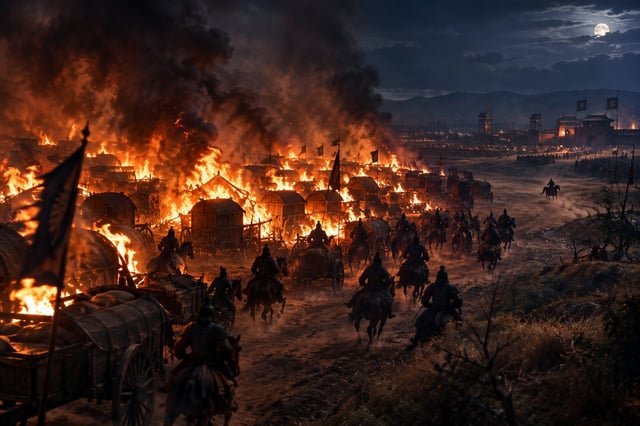
Replay the Battle of Guandu phase by phase on real terrain: troop strengths, movements and turning points at a glance, each marked as coming from the Records of the Three Kingdoms or the Romance.
Relationship timeline36 entries ▸
History · vol. 1
- Cao Cao§51
Defected to
surrendered with Gao Lan upon hearing of Qiong’s defeat
History · vol. 3
Fights
General of the Right Zhang He attacked Liang at Jieting and decisively defeated him
History · vol. 17
- Gongsun Zan§21
Enemy
as a Colonel under Yuan Shao, resisted him; after Zan was defeated, was promoted to General of the Household for Ningguo for his many achievements
- Yuan Shao§21
Rival
At Guandu, urged Shao to hurry to Wuchao's aid; slandered by Guo Tu, became afraid and went over to Taizu
- Yuan Tan§22
Enemy
Joined the attack at Bohai.
- Tadun§22
Enemy
Joined the campaign against Liucheng and served as a vanguard alongside Zhang Liao
- Chen Lan§22
Enemy
campaigned with Zhang Liao against Chen Lan, Mei Cheng, and others
- Ma Chao§22
Enemy
defeated him at Weinan; also defeated Ma Chao
- Han Sui§22
Enemy
defeated him at Weinan
- Yang Qiu§22
Enemy
besieged Anding and forced him to surrender
- Liang Xing§22
Enemy
attacked Liang Xing, a bandit in Fucheng, with Xiahou Yuan
- Zhang Lu§22
Enemy
When Taizu campaigned against Zhang Lu, He first commanded the various armies in attacking Dou Mao, king of the Di of Xinghe
- Zhang Fei§22
Enemy
Advanced to Dangqu, was repulsed by Fei, and withdrew to Nanzheng
- Liu Bei§22
Enemy
was stationed at Guangshi; Bei attacked He at night with more than ten thousand elite troops divided into ten units, He led his personal troops in fierce combat, and Bei could not overcome him
- Guan Cheng§22
Enemy
A separate expedition attacked him in Donglai
- Song Jian§22
Enemy
Pacified Song Jian
- Zhuge Liang§23
Enemy
Repelled Ma Su, a general of Liang, at Jieting; of Liang, “[they] all feared him”; at Chencang, predicted, “Liang has already left”; when Liang came out again, commanded the western advance as far as Lueyang; pursued him at Mumen and was struck by a flying arrow in the right knee
- Ma Su§23
Enemy
Turned him back at Jieting; cut off his water supply and attacked, decisively defeating him
- Liu E§23
Enemy
attacked him, pursued him to Qikou, and defeated him
- Bei Zhan§24
Student
fellow townsmen; recommended Bei Zhan as learned in the classics and exemplary in conduct; an edict promoted him to Erudite
- Zhang Xiong§25
Child
Son; succeeded him
All 36
Loading…
Inner monologues · AI-generated3 monologues ▸
- I am Zhang He, courtesy name Junyi. I was ordered to lead the generals west toward Lueyang. When I heard that Zhuge Lian
- When the fire broke out at Wuchao, Yuan Shao’s army was already wavering. I had long known that Cao Cao’s troops were hi
- I am Zhang He, courtesy name Junyi, a native of Hejian. The realm was already in turmoil when I was young, and fighting