Cao Wei · Army Commandant
Yu Jin
courtesy name 文则 · –221
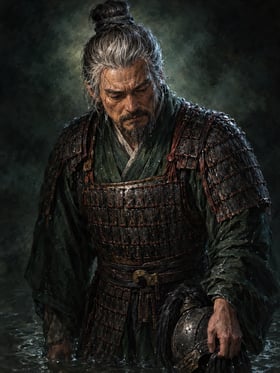
He governed his troops with strict order and never took captured goods for himself, ruling his subordinates by the law—though for this he did not much win the soldiers' hearts. Loyal and righteous, he did not spare even old associates: he once beheaded Chang Xi. In the Romance he is given a character of jealousy toward the worthy and able, entrenching himself behind the King of Wei's cautionary edict.

Life
In the novel: 27 chapters · In the Records: 15 volumes
Life?–221
189 CE (Zhongping 6)
192 CE (Chuping 3)
193 CE (Chuping 4)
6 more events
197 CE (Jian'an 2)
201 CE (Jian'an 6)
- Battle of CangtingCangtingWarrior
203 CE (Jian'an 8)
- Yu Jin Executes Chang XiDonghaiCommander
209 CE (Jian'an 14)
219 CE (Jian'an 24)
- Yu Jin Surrenders to Guan YuFanchengVictim
- Guan Yu's Northern CampaignFanchengKilled in action
219 CE (Jian'an 24)
- Execution of Pang DeFanchengWitness
- Flooding of the Seven ArmiesFanchengCommander
Allegiance
- Cao Wei
- Hatched: dated by chapter
- Life event
- Death
List all 9 stops
- Taishan CommanderyBirthplace
- Chenliu189Cao Cao Raises an Army
- Jibei192Cao Cao Defeats the Qingzhou Yellow Turbans
- Xu Province193Cao Cao's Campaign Against Xu Province
- Shouchun197Cao Cao's Campaign Against Yuan Shu
- Cangting201Battle of Cangting
- Donghai203Yu Jin Executes Chang Xi
- Mount Tianzhu209Battle of Tianzhushan
- Fancheng219Execution of Pang De+3 more
On the boards
Compare with someone →Where this person ranks on each board.
- Most Battles Lost: #10Records
- Most Betrayed: #10Records
- Most Battles Won: #19Romance
- Most Executions Ordered: #20Records
9 more boards
- Most Battles: #32of 230Both
- Most Generals Slain: #33of 64Romance
- Best Connected: #36of 2000Records
- Most Advisors: #42of 88Romance
- Most Foes Defeated: #44of 78Romance
- Master Strategists: #79of 220Romance
- Most Talkative: #97of 777Both
- Novel Embellished: #163of 2139Both
- Overlooked by the Novel: #182of 2139Both
Who they were
Character profile
- Character
- He governed his troops with strict order and never took captured goods for himself, ruling his subordinates by the law—though for this he did not much win the soldiers' hearts. Loyal and righteous, he did not spare even old associates: he once beheaded Chang Xi. In the Romance he is given a character of jealousy toward the worthy and able, entrenching himself behind the King of Wei's cautionary edict.
- Manner of speech
- He settled matters by invoking 'the Excellency's standing orders' and 'observing the law and carrying out commands, the duty of serving one's superior,' often overriding debate with rhetorical rebuttal.
- Life
- Yu Jin was a man of Juping in Mount Tai. During the Yellow Turban Rebellion he attached himself to Bao Xin, and later went over to Cao Cao, repeatedly achieving distinction in battle and rising to General of the Left with the authority of the tally and axe. In the twenty-fourth year of Jian'an he aided Cao Ren in campaigning against Guan Yu at Fancheng; when the Han River overflowed and the seven armies were all engulfed, he surrendered to Guan Yu. Afterward he was sent back by Sun Quan, and upon seeing a mural painting he fell ill from shame and indignation and died.
- Anecdotes
- Chen Shou appraised him as 'the most renowned for firmness and gravity, yet unable to see it through to the end.' In the Romance he was one of the vanguard commanders in the campaign against Xu Province, and later, at the Battle of Fancheng, he sounded the gongs to recall his troops, and was brought before Lord Guan to prostrate himself and beg for mercy.
Historical Record
Yu Jin, courtesy name Wenze, was from Juping County, Taishan Commandery. When the Yellow Turban uprising began, he followed Bao Xin. After Cao Cao took control of Yanzhou, Yu Jin and his companions joined him. Yu Jin initially served as a duobo under Wang Lang. Impressed by his ability, Wang Lang recommended him to Cao Cao. After meeting him, Cao Cao appointed him a military adjutant and sent him to fight in Xu Province. Yu Jin later held posts including Commandant Who Breaks the Enemy’s Line and Colonel Who Pacifies the Rebellious, and repeatedly accompanied Cao Cao on campaigns against Lü Bu, the Yellow Turban Army, Zhang Xiu, and others.
When Zhang Xiu rebelled again and Cao Cao’s forces retreated in defeat, Yu Jin led several hundred men in fighting their way back, all the while keeping his troops in order. Along the way, he encountered wounded soldiers who had been robbed by Qing Province troops. He first restored order in his ranks and built a camp, and only afterward explained the circumstances to Cao Cao. Cao Cao praised him for rallying his troops amid the chaos and holding a fortified position against the enemy, and enfeoffed him as Marquis of Yishou Village. Around the time of the Battle of Guandu, Yu Jin held Yan Ford and once led troops with Yue Jin to burn more than thirty of Yuan Shao’s encampments. When Chang Xi rebelled once more, he surrendered because of his old ties with Yu Jin. Yu Jin, however, invoked the rule that “those who surrender after being surrounded are not pardoned,” personally saw him off, and had him executed. Pei Songzhi criticized this, arguing that since Chang Xi had surrendered, escorting him to Cao Cao would not have violated orders.
Cao Cao valued Yu Jin for his strict discipline and for not keeping captured goods for himself. Yu Jin was also once ordered to seize Zhu Ling’s camp. Yet the historical account also notes that he governed his subordinates by strict enforcement of the law and did not win the hearts of the soldiers. He later rose to General of the Left and was granted authority to wield the axe of state. In the twenty-fourth year of Jian’an, Cao Cao ordered him to reinforce Cao Ren at Fancheng. In autumn, torrential rains caused the Han River to flood, and all seven armies under Yu Jin’s command were lost. Yu Jin surrendered to Guan Yu, while Pang De refused to submit and was killed. On hearing the news, Cao Cao sighed deeply, lamenting that after knowing Yu Jin for thirty years, he had never expected him to prove inferior to Pang De in a moment of crisis.
After Sun Quan captured Guan Yu, Yu Jin remained in Wu territory. When Emperor Wen of Wei ascended the throne, Sun Quan sent Yu Jin back to Wei. Emperor Wen comforted him with the story of Xun Linfu and Meng Mingshi, who had been reinstated after suffering defeat, and appointed him General Who Pacifies Afar. But he also ordered a scene painted in the sleeping quarters at Gaoling depicting Guan Yu victorious, Pang De enraged, and Yu Jin surrendering. After seeing the painting, Yu Jin fell ill from shame and anger and died. He was posthumously titled Marquis Li.
In the Novel
Romance of the Three Kingdoms portrays Yu Jin as a military officer under Cao Cao. The novel says that he arrived with several hundred men and, because he was skilled with bow and horse, was appointed Commandant of the Palace Guard. This account of his first appearance differs from the process of his joining Cao Cao described in the historical records. During the campaign against Xu Province, he is named as a vanguard officer and fights Zhang Fei for several bouts before fleeing. The novel also has Yu Jin propose the plan for Cao Cao’s night raid on Lü Bu’s western camp. Though the camp is briefly captured, Cao Cao’s forces eventually withdraw after Lü Bu’s counterattack.
The novel also expands the story of the Qing Province troops’ looting and Yu Jin’s decision to build a camp before reporting to Cao Cao into a dramatic episode. Yu Jin first builds a camp, then attacks Zhang Xiu’s forces, and explains to Cao Cao why he dealt with the Qing Province troops as he did. Cao Cao praises him for restoring order amid chaos and bearing blame and hardship, rewards him with gold vessels, and enfeoffs him as Marquis of Yishou Village. This broadly follows the historical account, but the novel adds narrative details such as the counterattack and pursuit. In later episodes, Yu Jin also serves as Guan Yu’s deputy on a campaign against Runan. After learning that Liu Bei is in Hebei, he reports this to Cao Cao. These events are part of the novel’s portrayal and have no corresponding record in the historical account.
Key Relationships
In his early years, Yu Jin was recommended by Wang Lang and appointed by Cao Cao after an audience. He campaigned for Cao Cao for many years and earned his trust through his strict military discipline. Yu Jin had old ties with Chang Xi, yet still dealt with his surrender according to military orders. This reveals the tension between his obedience to the law and his personal connections. Pei Songzhi’s criticism of the decision also makes Yu Jin’s adherence to orders a matter of controversy.
At the Battle of Fancheng, Yu Jin was an enemy of Guan Yu and was ultimately captured and forced to surrender by the flood. Sun Quan later released him and sent him back to Wei. Emperor Wen of Wei restored his official rank, yet also made him view a mural depicting his surrender, making his return an ending entwined with humiliation and regret. The novel additionally depicts Zhang Fei defeating Yu Jin, Yu Jin proposing a night raid, and Yu Jin accompanying Cao Cao to see Guan Yu off. These relationships and scenes belong to the novel and should not be confused with the historical account.
Signature Scenes
Rallying his troops before making his case amid a rout. As Cao Cao’s forces retreated, Yu Jin led his men in fighting as they withdrew. When he encountered wounded soldiers who had been robbed by Qing Province troops, he did not immediately go to see Cao Cao. Instead, he first built a camp and prepared to meet the enemy, then reported what had happened. Cao Cao praised his ability to restore order amid chaos. The novel expands this event into a complete dramatic episode in which Yu Jin leads his troops in driving back Zhang Xiu, then receives a reward and a noble title.
Chang Xi surrenders, but Yu Jin still enforces the law. Chang Xi had long been on friendly terms with Yu Jin, but surrendered after being surrounded. Yu Jin insisted on enforcing the military order that he not be pardoned and personally executed him in tears. Pei Songzhi, however, pointed out that escorting a man who had surrendered would not have violated orders.
The Han River rises, and the seven armies are lost. Yu Jin and the other generals climbed to higher ground and watched the floodwaters, with no way forward or back. Guan Yu attacked by boat, and Yu Jin surrendered. Later, the mural in Emperor Wen of Wei’s sleeping quarters depicted this surrender, becoming the direct cause of Yu Jin’s illness from shame and anger.
Quotes
18 lines in the books · 3 featured
「今賊在後,追至無時,不先爲備,何以待敵?且公聰明,譖訴何緣!」
These words embody Yu Jin's composure in the face of peril and his regard for the greater good, an important expression of his character.
「諸君不知公常令乎!圍而後降者不赦。夫奉法行令,事上之節也。豨雖舊友,禁可失節乎!」
This line displays Yu Jin's strict adherence to military discipline and refusal to bend to personal favor, representative of his image of "rigorous in law and order."
「緊行無好步,當緩圖之。」
These words reflect Yu Jin's prudence and seasoned maturity in military judgment, embodying his steady manner of action.
- Family
- Enemies
- Teacher & student
- Other
Who is Yu Jin connected to?
Pick someone to see how many steps lie between them and Yu Jin.
History vs. novel
7 points · 3 novel-only
| History | Novel |
|---|---|
| First Joining Cao CaoNovel embellishes | |
Yu Jin followed Bao Xin in his early years, then joined Cao Cao along with his troops. Cao Cao appointed him Army Commander. The Records of the Three Kingdoms does not mention that he was appointed Commandant of the Palace Guard because of his outstanding martial skills. vol. 17 | Yu Jin came to join Cao Cao with several hundred men. The novel says he was skilled with the bow and horse and excelled in martial arts, so Cao Cao appointed him Commandant of the Palace Guard. ch. 10 |
| Fighting Zhang FeiNovel only | |
| — | Yu Jin fought Zhang Fei in the area around Xu Province. After exchanging several blows, Yu Jin fled, and Zhang Fei pursued him to the walls of Xu Province. ch. 11 |
| Conflict with Qing Province SoldiersNovel embellishes | |
Yu Jin discovered Qing Province soldiers looting and injuring wounded men, so he attacked them and demanded an explanation. He first established camp and prepared for battle, and only afterward reported what had happened to Cao Cao. vol. 17 | Yu Jin led his own troops in putting down Qing Province soldiers who were looting local households, and calmed the villagers. In response to questions from Cao Cao's side, he first established camp, then personally went into battle and drove off Zhang Xiu's pursuing forces. ch. 16 |
| Warning at Bowang SlopeNovel only | |
| — | During the battle at Bowang Slope, Yu Jin and Li Dian noticed that the road was narrow and the vegetation dense, and warned Xiahou Dun to be wary of a fire attack. Their warning was heeded, but Cao Cao's army was still routed by fire. ch. 39 |
| After Hitting Guan Yu with an ArrowNovel only | |
| — | After Pang De hit Guan Yu with an arrow, he wanted to press the advantage and pursue, but Yu Jin feared that Pang De would outshine him by winning merit, so he ordered the troops to retreat by sounding the gong, disguising his motive as caution. ch. 74 |
| Flooding of the Seven ArmiesNovel embellishes | |
The Han River rose dramatically, and the water on level ground reached several zhang in depth, flooding the seven armies including Yu Jin's. Guan Yu attacked by boat; Yu Jin surrendered, while Pang De refused to yield and died. vol. 17 | The novel elaborates on Yu Jin's refusal to move camp and the army's subsequent entrapment by floodwaters, and says that he surrendered to Guan Yu because there was no way to escape. Guan Yu had him taken into custody, while Pang De refused to surrender and was executed. ch. 74 |
| Seeing the Painting in the MausoleumNovel embellishes | |
Cao Pi ordered a scene of Guan Yu victorious, Pang De angrily refusing to yield, and Yu Jin surrendering to be painted in the mausoleum chamber at Gaoling. After seeing the painting, Yu Jin died of illness brought on by shame and anger. vol. 17 | The novel says that while Yu Jin was overseeing work on Cao Cao's mausoleum under orders, he saw a mural depicting Guan Yu seated above, Pang De refusing to yield, and Yu Jin prostrate and begging for mercy. Overcome with shame and anger, he fell ill and died not long afterward. ch. 79 |
- First Joining Cao CaoNovel embellishes
- History
Yu Jin followed Bao Xin in his early years, then joined Cao Cao along with his troops. Cao Cao appointed him Army Commander. The Records of the Three Kingdoms does not mention that he was appointed Commandant of the Palace Guard because of his outstanding martial skills.
vol. 17
- Novel
Yu Jin came to join Cao Cao with several hundred men. The novel says he was skilled with the bow and horse and excelled in martial arts, so Cao Cao appointed him Commandant of the Palace Guard.
ch. 10
- Fighting Zhang FeiNovel only
- Novel
Yu Jin fought Zhang Fei in the area around Xu Province. After exchanging several blows, Yu Jin fled, and Zhang Fei pursued him to the walls of Xu Province.
ch. 11
- Conflict with Qing Province SoldiersNovel embellishes
- History
Yu Jin discovered Qing Province soldiers looting and injuring wounded men, so he attacked them and demanded an explanation. He first established camp and prepared for battle, and only afterward reported what had happened to Cao Cao.
vol. 17
- Novel
Yu Jin led his own troops in putting down Qing Province soldiers who were looting local households, and calmed the villagers. In response to questions from Cao Cao's side, he first established camp, then personally went into battle and drove off Zhang Xiu's pursuing forces.
ch. 16
- Warning at Bowang SlopeNovel only
- Novel
During the battle at Bowang Slope, Yu Jin and Li Dian noticed that the road was narrow and the vegetation dense, and warned Xiahou Dun to be wary of a fire attack. Their warning was heeded, but Cao Cao's army was still routed by fire.
ch. 39
- After Hitting Guan Yu with an ArrowNovel only
- Novel
After Pang De hit Guan Yu with an arrow, he wanted to press the advantage and pursue, but Yu Jin feared that Pang De would outshine him by winning merit, so he ordered the troops to retreat by sounding the gong, disguising his motive as caution.
ch. 74
- Flooding of the Seven ArmiesNovel embellishes
- History
The Han River rose dramatically, and the water on level ground reached several zhang in depth, flooding the seven armies including Yu Jin's. Guan Yu attacked by boat; Yu Jin surrendered, while Pang De refused to yield and died.
vol. 17
- Novel
The novel elaborates on Yu Jin's refusal to move camp and the army's subsequent entrapment by floodwaters, and says that he surrendered to Guan Yu because there was no way to escape. Guan Yu had him taken into custody, while Pang De refused to surrender and was executed.
ch. 74
- Seeing the Painting in the MausoleumNovel embellishes
- History
Cao Pi ordered a scene of Guan Yu victorious, Pang De angrily refusing to yield, and Yu Jin surrendering to be painted in the mausoleum chamber at Gaoling. After seeing the painting, Yu Jin died of illness brought on by shame and anger.
vol. 17
- Novel
The novel says that while Yu Jin was overseeing work on Cao Cao's mausoleum under orders, he saw a mural depicting Guan Yu seated above, Pang De refusing to yield, and Yu Jin prostrate and begging for mercy. Overcome with shame and anger, he fell ill and died not long afterward.
ch. 79
Combat
On the field
Duels, kills and executions as the texts tell them, counted separately for the Records and the Romance.
Duel them- RecordsJuan 17ExecutionChang XiWon「隕涕而斬之」
- RomanceCh. 11DuelZhang FeiLost「戰到數合,玄德掣雙股劍麾兵大進,于禁敗走」
- RomanceCh. 11DuelLü BuLost「于禁、樂進雙戰呂布不住」
- RomanceCh. 41ExecutionLiu CongWon「軍士殺死劉琮及蔡夫人」
- RomanceCh. 41ExecutionLady CaiWon「軍士殺死劉琮及蔡夫人」
- RomanceCh. 41Struck downWang WeiWon「王威忿怒,奮力相鬥,竟被眾軍所殺」
All encounters (8)
Loading…
Battles in command
Battles this person commanded in, with the outcome as each text tells it.
- Records
- 0W 1L 0D 0 undecided
- Romance
- 1W 0L 0D 0 undecided
- Romance197Battle of WanchengWonvs Zhang Xiu's armyCh. 16「繡軍大敗,追殺百餘里。繡勢窮力孤,引敗兵投劉表去了」
- Records202Fire Attack at BowangLostvs Liu Bei's armyJuan 32「惇等追之,為伏兵所破」
Stratagems
Plans this person devised or saw through, as the texts tell them.
- Romance
- 1 carried out · 0 worked · 0 turned down · 0 seen through
- RomanceRaid the CampOtherSeen throughagainst Lü BuCh. 11「今夜彼將謂我軍敗走,必不準備,可引兵擊之」
Events
Events (25)
Battles and events the texts place this person in, by date.
Battles
- 197Battle of Wancheng
- 200Battle of Guandu
- 201Battle of CangtingWarrior
- 201Battle of Rangshan
- 202Fire Attack at Bowang
- 208Cao Cao's Southern Campaign Against Jing Province
- 208Borrowing Arrows with Straw Boats
- 208Battle of Red Cliffs
All 11
- 209Battle of TianzhushanWarrior
- 211Battle of Tong Pass
- 219Guan Yu's Northern CampaignKilled in action
Other events
- 189Cao Cao Raises an ArmyWarrior
- 192Cao Cao Defeats the Qingzhou Yellow TurbansWarrior
- 193Cao Cao's Campaign Against Xu ProvinceWarrior
- 194Lü Bu's Seizure of Yanzhou
- 197Zhang Xiu's Night Raid on Wancheng
- 197Cao Cao's Campaign Against Yuan ShuWarrior
- 200Guan Yu Hangs Up His Seal and Returns the Gold
- 200Guan Yu Takes the Robe at Ba Bridge
All 14
- 203Yu Jin Executes Chang XiCommander
- 208Liu Cong's Surrender to Cao Cao
- 219Yu Jin Surrenders to Guan YuVictim
- 219Execution of Pang DeWitness
- 219Flooding of the Seven ArmiesCommander
- 219Retreat to Mai Castle
Places
- Native of
- Taishan CommanderyRecords
Continue
The Guan Yu's Northern Campaign in 3D
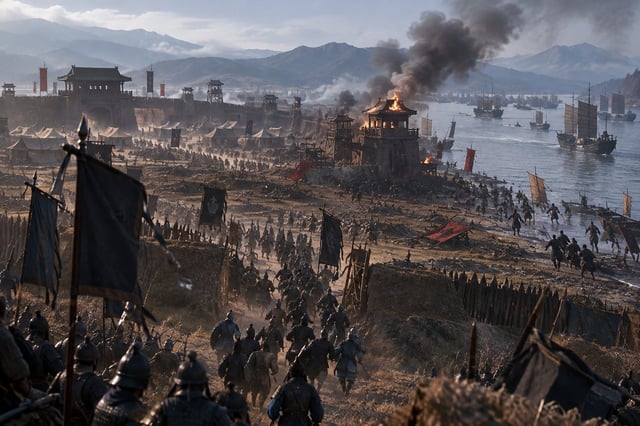
Replay the Guan Yu's Northern Campaign phase by phase on real terrain: troop strengths, movements and turning points at a glance, each marked as coming from the Records of the Three Kingdoms or the Romance.
Relationship timeline19 entries ▸
History · vol. 17
Enemy
joined Zang Ba and others in attacking him; Cheng pretended to surrender to Yu Jin
- Zhang Xiu§15
Enemy
surrendered at Wancheng; rebelled again and dealt Taizu a great defeat; followed him in the attack at Rang
- Lü Bu§15
Enemy
Joined the campaign against Lü Bu at Puyang; captured Lü Bu at Xiapi
- Huang Shao§15
Enemy
was stationed at Banliang; Shao launched a night attack but was defeated and beheaded
- Qiao Rui§15
Enemy
Joined the siege of Qiao Rui at Ku and killed four generals.
- Sui Gu§15
Enemy
attacked Sui Gu at Shequan together with Shi Huan and Cao Ren, defeated him, and killed him
- Gao Ya§15
Enemy
A separate force defeated Gao Ya at Xuchang
- Yuan Shao§16
Enemy
defended Yan Jin against him; burned more than thirty fortified settlements with Yue Jin
- Chang Xi§16
Enemy
attacked him; Hou Xi went to Yu Jin and surrendered; Yu Jin wept as he executed him, saying, "Those who surrender only after being surrounded are not pardoned"
- Zhu Ling§16
Rival
carrying the order, went straight to Ling's camp and took over his troops; appointed Ling a subordinate commander under Jin
- He Mao§16
Enemy
Surrendered to him
- Wang Mo§16
Enemy
Surrendered to him
- Yu Gui§17
Child
Son; succeeded to the title of Marquis of Yishou Pavilion
All 19
Loading…
Inner monologues · AI-generated3 monologues ▸
- I am Yu Jin, courtesy name Wenze. In the twenty-fourth year of Jian’an, by the command of the Grand Ancestor, I went to
- I am Yu Jin, courtesy name Wenze. Looking back on my life, I see not only the advances and retreats of war, but also mom
- I am Yu Jin, courtesy name Wenze, from Juping in Taishan. As the Yellow Turbans rose everywhere, unrest spread through t