Way of the Five Pecks of Rice · General
Pang De
courtesy name 令明 · –219
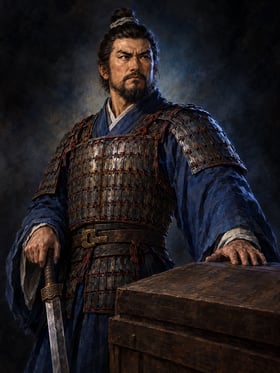
Pang De wore a green robe and silver armor, rode a white horse, wielded a steel blade, and was skilled with a carved bow and stealthy arrows.

Life
In the novel: 11 chapters · In the Records: 4 volumes
Life?–219
211 CE (Jian'an 16)
214 CE (Jian'an 19)
219 CE (Jian'an 24)
- Execution of Pang DeFanchengKilled in action
- Flooding of the Seven ArmiesFanchengKilled in action
Allegiance
- Cao Wei
- Way of the Five Pecks of Rice· Undated
- Xiliang Army· Undated
- Hatched: dated by chapter
- Life event
- Death
List all 4 stops
- Nan'anBirthplace
- Tong Pass211Cao Cao Cuts His Beard and Discards His Robe+1 more
- Chengdu214Ma Chao's Surrender to Liu Bei
- Fancheng219Died hereExecution of Pang De+1 more
On the boards
Compare with someone →Where this person ranks on each board.
Who they were
Character profile
- Appearance
- Pang De wore a green robe and silver armor, rode a white horse, wielded a steel blade, and was skilled with a carved bow and stealthy arrows.
- Character
- Pang De's valor was foremost among all the armies; he broke enemy lines and drove back foes, unafraid of death, loyal and steadfast, swearing by the words, "A good general does not shrink from death to save himself; a man of honor does not betray his principles to preserve his life." Resourceful and decisive, loyal and brave unto death, he would not bend his integrity.
- Manner of speech
- Pang De's speech was impassioned and decisive, terse and heroic, customarily opening with "I have received the King of Wei's generous favor" and closing with an oath to fight to the death, as in "If I do not kill Yu this year, Yu will kill me" and "I would rather be a ghost of the state than a general of the rebels."
- Life
- In his youth Pang De was a commandery clerk. During the Chuping era he followed Ma Teng in striking rebellious Qiang and Di tribes, and later followed Ma Chao to resist Guo Yuan and Gao Gan, beheading Guo Yuan himself. After Ma Teng was summoned to be Commandant of the Guards, Pang De remained under Ma Chao, later followed Ma Chao in joining Zhang Lu, and finally surrendered to Cao Cao, who appointed him General Who Establishes Righteousness and enfeoffed him as Marquis of Guanmen Precinct. He once joined Cao Ren in attacking Wan and beheaded Hou Yin; later, at Fancheng, he campaigned against Guan Yu, but after being struck by an arrow he fell into the water and was captured, and because he would not submit, he was killed by Guan Yu.
- Weapons
- The weapons Pang De used included bow and arrows, short arms, a treasured blade, a steel blade, and a carved bow with stealthy arrows.
- Anecdotes
- Pang De's son Pang Hui was brave and fierce, bearing his father's spirit, rising to General of the Capital Guard and being enfeoffed as a full marquis. Pang De once carried a coffin as he went forth to fight to the death; after being captured he "glared with raised brows and furious eyes, standing and refusing to kneel," and Emperor Wen ordered his likeness of wrath to be painted.
Historical Record
Pang De, courtesy name Lingming, was from Huan Dao, Nan'an. In his youth, he served as a commandery clerk and an aide in the provincial office. During the Chuping era, he followed Ma Teng in campaigns against rebellious Qiang and Di, repeatedly distinguishing himself in battle and gradually rising to the rank of Colonel. During the Jian'an era, he followed Ma Chao to meet Guo Yuan and Gao Gan at Pingyang, serving as the vanguard. He defeated the enemy and personally killed Guo Yuan. He later accompanied Ma Teng in a campaign against Zhang Baiqi. After Ma Teng entered the court and took up the post of Palace Attendant, Pang De remained under Ma Chao's command. Ma Chao was defeated by Cao Cao at Weinan, and Pang De followed him through Hanyang and Hanzhong before later surrendering to Cao Cao along with Zhang Lu. Cao Cao had long heard of his valor and appointed him General Who Establishes Righteousness, enfeoffing him as Marquis of Guanmen Village with a fief of three hundred households.
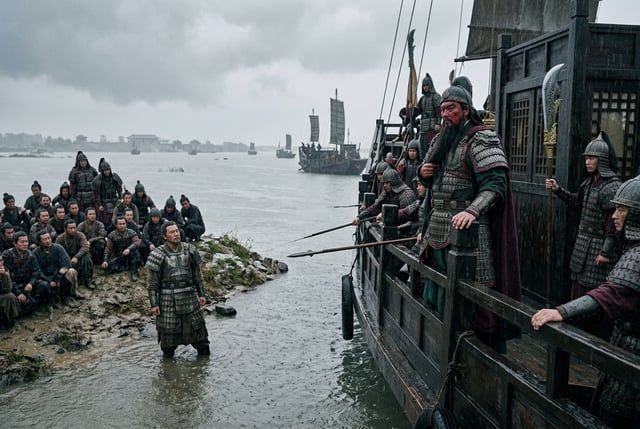
After surrendering to Cao Cao, Pang De joined Cao Ren in capturing the rebel-held Wancheng, killing Hou Yin and Wei Kai, and then campaigned south to Fancheng. When Guan Yu attacked Fancheng, Pang De declared that he had received the state's favor and was willing to serve it unto death. He personally fought Guan Yu and shot him in the forehead. When the Han River flooded, Pang De and the other generals withdrew to an embankment, where they continued to meet the enemy in armor, bows in hand. His officers Dong Heng and Dong Chao wished to surrender, so Pang De had them seized and executed. When his arrows ran out, he fought the enemy at close quarters and told his commander Cheng He plainly that a good general should not fear death and seek to save himself through cowardice, and that a man of principle should not betray his integrity to stay alive. The waters continued to rise, and the soldiers surrendered one after another. Pang De tried to return to Cao Ren's camp in a small boat, but the boat overturned and he was captured by Guan Yu. Even after being taken prisoner, he stood upright and refused to kneel or heed entreaties to surrender, declaring that he would rather be a ghost of the state than a general of bandits. He was then killed. When Cao Cao heard the news, he was overcome with grief and wept for him, and enfeoffed Pang De's two sons as marquises.
After the Emperor Wen assumed the throne, he sent an envoy to Pang De's tomb to bestow the posthumous title “Marquis Zhuang,” praising his resolute courage in the face of danger and his sacrifice of life for his principles. He also granted titles as marquises within the Passes to Pang De's son Pang Hui and three others. Later, the Wei court included Pang De among the meritorious officials worshipped alongside the Grand Ancestor in the imperial temple, referring to him as “Pang De, General Who Establishes Righteousness.”
In the Novel
The Romance of the Three Kingdoms portrays Pang De as a trusted colonel under Ma Chao, emphasizing his resourcefulness, bravery, and loyalty. In Ma Chao's Xiliang Army, he interprets a dream about a group of tigers in the snow, then proposes a plan to besiege Chang'an and feign retreat, causing the defenders to lower their guard. He then attacks through the western gate at night, kills Zhong Jin, and opens the gate to let the army in. These details belong to the novel and are not recorded in the Records of the Three Kingdoms. In the Battle of Tong Pass, the novel also has him set an ambush with Ma Chao and Ma Dai to defeat Cao Hong and Xu Huang, and rescue Han Sui when Cao Cao is in dire peril. His heroic image as a man who “leaps out of a horse-trapping pit and fights on foot to save his lord” is likewise a literary embellishment.
The novel presents Pang De's later departure from Zhang Lu and surrender to Cao Cao as a tale of interwoven stratagems and choices. He fights Zhang He, Xiahou Yuan, Xu Huang, and Xu Chu without fear, prompting Cao Cao to devise a way to win him over. Yang Song accepts bribes and speaks slanderously of him, causing Zhang Lu to grow suspicious of Pang De. Pang De is then captured in a pit and ultimately accepts Cao Cao's offer. These details differ from the brief historical account, which says only that he “surrendered along with the others.” In the Battle of Fancheng, the novel has Cao Cao briefly doubt Pang De's loyalty because his brother Pang Rou and former lord Ma Chao are both with Shu Han. Pang De removes his hat, bows repeatedly until his forehead bleeds, and explains that the old bonds have been severed and that he wishes to repay Cao Cao's great kindness. This exchange between lord and subject reinforces his literary image of resolute loyalty and courage.
Key Relationships
- Ma Teng and Ma Chao: Pang De followed Ma Teng in battle in his early years. After Ma Teng entered the court, Pang De remained under Ma Chao's command. When Ma Chao was defeated and fled, Pang De accompanied him through various places, and later surrendered to Cao Cao along with Zhang Lu. The novel more often places him among Ma Chao's core subordinates, depicting him offering advice and rescuing Ma Chao, and remaining in Hanzhong due to illness when Ma Chao went to Yi Province. The novel's account of Pang De severing ties with his elder brother Pang Rou and declaring that his “old bonds” with Ma Chao were over is unique to the Romance.
- Cao Cao and Cao Ren: Historical records state that after surrendering to Cao Cao, Pang De joined Cao Ren in capturing Wancheng and then defended Fancheng. When Cao Cao heard that he had died refusing to yield, he mourned him deeply. The novel adds scenes in which Cao Cao personally urges him to surrender, places his trust in him, and appoints him as a vanguard.
- Guan Yu: Historical records state that the two fought at Fancheng, where Pang De shot Guan Yu in the forehead. After being captured amid the flood, he refused to surrender and was killed. The novel continues the story of his refusal to yield and uses such imagery as the white horse and his setting out with a coffin to heighten his determination to die in battle; the coffin detail is unique to the Romance.
- Pang Hui: Pang Hui inherited his father Pang De's valor and later rose to the rank of General of the Central Army and was enfeoffed as a marquis.
Signature Scenes
1. Killing Guo Yuan at Pingyang: Pang De followed Ma Chao to confront Guo Yuan and Gao Gan. Serving as the vanguard, he defeated the enemy and personally took Guo Yuan's head. This was a major source of his early fame for bravery.
2. Defending Fancheng on a white horse and refusing to surrender in the flood: Pang De often rode a white horse, and Guan Yu's army called him the “White Horse General.” After the Han River flooded, he fought on the embankment with his bow in hand, and continued fighting even after his arrows ran out. When captured, he stood upright rather than kneeling and chose death over surrender. This scene is clearly recorded in the historical accounts and is central to his image of loyalty and integrity.
3. Feigned retreat to capture Chang'an: Pang De advises Ma Chao to withdraw temporarily, luring Zhong Yao into relaxing the city's defenses. They then launch a night attack on the western gate, kill Zhong Jin, and open the city gates. This stratagem is unique to the Romance.
4. Captured in a pit and joining Cao Cao: The novel has Pang De fall into a pit through Cao Cao's ruse while pursuing him, after which Cao Cao personally frees him and urges him to surrender. The Records of the Three Kingdoms says only that Pang De later surrendered along with Zhang Lu, and does not record these events.
Quotes
27 lines in the books · 3 featured
「吾受魏王厚恩,誓以死報。今去樊城,與關某決戰,我若不能殺彼,必為彼所殺;即不為彼所殺,我亦當自殺:故先備此櫬,以示無空回之理。」
This line's allusion to 'carrying his coffin to fight to the death' displays Pang De's loyal valor and has circulated widely.
「吾奉魏王旨,特來取汝首!恐汝不信,備櫬在此。汝若怕死,早下馬受降!」
This line is the classic scene of Pang De bearing his coffin into battle against Guan Yu, shaping his image of loyalty and courage.
「吾寧死於刀下,豈降汝耶!」
This line displays Pang De's loyal and righteous integrity in choosing death over surrender, a core trait of his character.
- Family
- Lord & vassal
- Enemies
- Other
Who is Pang De connected to?
Pick someone to see how many steps lie between them and Pang De.
History vs. novel
8 points · 4 novel-only
| History | Novel |
|---|---|
| A Stratagem at Chang'anNovel only | |
| — | Pang De proposed exploiting Chang'an’s shortage of water and firewood and the famine among its soldiers and civilians to make the defenders let down their guard. He then beheaded Zhong Jin, helping Ma Chao break into the city. ch. 58 |
| Breaking Out of the PitNovel only | |
| — | During the fighting at Weinan, the iron cavalry under Pang De fell into Cao Cao’s horse-trapping pits. Pang De leapt out, fought his way through on foot, then seized a horse and rescued Han Sui. ch. 58 |
| Captured and SurrenderingSources disagree | |
After Cao Cao pacified Hanzhong, Pang De surrendered along with the others. Having long heard of his bravery, Cao Cao appointed him General Who Establishes Righteousness and enfeoffed him as a Marquis of a Ting. vol. 18 | When Cao Cao attacked Hanzhong, he captured Pang De alive in a pit and personally untied him. Pang De considered Zhang Lu unkind and then surrendered. ch. 67 |
| Rescuing Cao CaoNovel only | |
| — | During a clash at Xie Valley, Wei Yan shot Cao Cao. Pang De stepped forward, drove Wei Yan back in battle, and escorted Cao Cao to safety. ch. 72 |
| Setting Out with a CoffinNovel only | |
| — | Before setting out for Fancheng, Pang De ordered a wooden coffin made and carried along, vowing that if he failed to kill Guan Yu, he would repay Cao Cao with his life. ch. 74 |
| Clash with Guan YuNovel embellishes | |
Pang De personally fought Guan Yu and shot him in the forehead with an arrow. He often rode a white horse, so Guan Yu’s troops called him the “General of the White Horse.” vol. 18 | The Romance of the Three Kingdoms says Pang De first fought Guan Ping for thirty bouts without either gaining the upper hand, then fought Guan Yu for over a hundred bouts. He also shot Guan Yu and wounded him. ch. 74 |
| Swept Away by the Flood and CapturedNovel embellishes | |
After the Han River swelled, Pang De fought fiercely on the embankment. When his arrows ran out, he fought at close quarters. His small boat capsized, and he fell into the water and was captured by Guan Yu, yet he remained standing and refused to kneel. vol. 18 | The Romance of the Three Kingdoms says that after Pang De fell into the water, Zhou Cang, who was a skilled swimmer, captured him alive. When brought before Guan Yu, he still refused to kneel, cursed him, and would not surrender; in the end, he was beheaded. ch. 74 |
| Cao Cao’s Lament over Yu JinNovel embellishes | |
On hearing that Pang De had died unyielding, Cao Cao lamented for a long time and remarked that Yu Jin had proved less steadfast than Pang De in the face of danger. vol. 17 | The Romance of the Three Kingdoms says that after learning Yu Jin had been captured and Pang De beheaded, Cao Cao also lamented that Yu Jin, who had followed him for many years, had proved less steadfast than Pang De in the face of danger. ch. 75 |
- A Stratagem at Chang'anNovel only
- Novel
Pang De proposed exploiting Chang'an’s shortage of water and firewood and the famine among its soldiers and civilians to make the defenders let down their guard. He then beheaded Zhong Jin, helping Ma Chao break into the city.
ch. 58
- Breaking Out of the PitNovel only
- Novel
During the fighting at Weinan, the iron cavalry under Pang De fell into Cao Cao’s horse-trapping pits. Pang De leapt out, fought his way through on foot, then seized a horse and rescued Han Sui.
ch. 58
- Captured and SurrenderingSources disagree
- History
After Cao Cao pacified Hanzhong, Pang De surrendered along with the others. Having long heard of his bravery, Cao Cao appointed him General Who Establishes Righteousness and enfeoffed him as a Marquis of a Ting.
vol. 18
- Novel
When Cao Cao attacked Hanzhong, he captured Pang De alive in a pit and personally untied him. Pang De considered Zhang Lu unkind and then surrendered.
ch. 67
- Rescuing Cao CaoNovel only
- Novel
During a clash at Xie Valley, Wei Yan shot Cao Cao. Pang De stepped forward, drove Wei Yan back in battle, and escorted Cao Cao to safety.
ch. 72
- Setting Out with a CoffinNovel only
- Novel
Before setting out for Fancheng, Pang De ordered a wooden coffin made and carried along, vowing that if he failed to kill Guan Yu, he would repay Cao Cao with his life.
ch. 74
- Clash with Guan YuNovel embellishes
- History
Pang De personally fought Guan Yu and shot him in the forehead with an arrow. He often rode a white horse, so Guan Yu’s troops called him the “General of the White Horse.”
vol. 18
- Novel
The Romance of the Three Kingdoms says Pang De first fought Guan Ping for thirty bouts without either gaining the upper hand, then fought Guan Yu for over a hundred bouts. He also shot Guan Yu and wounded him.
ch. 74
- Swept Away by the Flood and CapturedNovel embellishes
- History
After the Han River swelled, Pang De fought fiercely on the embankment. When his arrows ran out, he fought at close quarters. His small boat capsized, and he fell into the water and was captured by Guan Yu, yet he remained standing and refused to kneel.
vol. 18
- Novel
The Romance of the Three Kingdoms says that after Pang De fell into the water, Zhou Cang, who was a skilled swimmer, captured him alive. When brought before Guan Yu, he still refused to kneel, cursed him, and would not surrender; in the end, he was beheaded.
ch. 74
- Cao Cao’s Lament over Yu JinNovel embellishes
- History
On hearing that Pang De had died unyielding, Cao Cao lamented for a long time and remarked that Yu Jin had proved less steadfast than Pang De in the face of danger.
vol. 17
- Novel
The Romance of the Three Kingdoms says that after learning Yu Jin had been captured and Pang De beheaded, Cao Cao also lamented that Yu Jin, who had followed him for many years, had proved less steadfast than Pang De in the face of danger.
ch. 75
Combat
On the field
Duels, kills and executions as the texts tell them, counted separately for the Records and the Romance.
Duel themRecords
- Duels
- 1W 0L 0D
By their troops 1Executions 2
DeathKilled by Guan YuExecution · Juan 18
Romance
- Duels
- 2W 0L 1D
Executions 2
DeathKilled by an unnamed handExecution · Ch. 74
- RecordsJuan 18Struck downGuo YuanWon「大破之,親斬援首」
- RecordsJuan 18Struck downWei KaiWon「共攻拔宛,斬音、開」
- RecordsJuan 18DuelGuan YuWon「後親與羽交戰,射羽中額」
- RecordsJuan 18ExecutionDong HengWon「德皆收斬之」
- RecordsJuan 18ExecutionDong ChaoWon「德皆收斬之」
- RecordsJuan 18ExecutionGuan YuLost「遂為羽所殺」
All encounters (23)
Loading…
Stratagems
Plans this person devised or saw through, as the texts tell them.
- Romance
- 2 carried out · 2 worked · 0 turned down · 0 seen through
- RomanceFeign Retreat to Capture the CityDeceptionWorkedCh. 58「只須如此如此,長安唾手可得」
- RomanceDragging-Blade StratagemLureWorkedagainst Guan Yu's armyCh. 74「原來龐德虛作拖刀勢,卻把刀就鞍鞽挂住,偷拽雕弓,搭上箭,射將來」
Events
Events (12)
Battles and events the texts place this person in, by date.
Battles
Other events
- 211Cao Cao Cuts His Beard and Discards His RobeWarrior
- 211Xu Chu Fights Ma Chao Bare-ChestedWarrior
- 211Jia Xu Sows Discord Between Ma Chao and Han Sui
- 214Ma Chao's Surrender to Liu BeiWitness
- 215Cao Cao's Campaign Against Zhang Lu
- 219Yu Jin Surrenders to Guan Yu
- 219Execution of Pang DeKilled in action
- 219Flooding of the Seven ArmiesKilled in action
Places
Continue
Last scene: Flooding of the Seven Armies
Relationship timeline22 entries ▸
History · vol. 17
- Guan Yu§17
Enemy
Died without compromising his integrity
History · vol. 18
- Ma Teng§54
Lord
During the Chuping era, followed Ma Teng in attacking rebellious Qiang and renegade Di
- Guo Yuan§54
Fights
In the campaign at Pingyang, personally cut off Guo Yuan’s head
- Ma Chao§54
Lord
When Ma Teng was summoned to serve as Commandant of the Guards, De stayed behind under Ma Chao; later fled with Ma Chao to Hanyang and defended Jicheng, then fled to Hanzhong
- Zhang Lu§54
Lord
Followed Ma Chao in fleeing to Hanzhong and joining Zhang Lu
- Cao Cao§54
Lord
When Taizu pacified Hanzhong, De surrendered along with the others
- Cao Ren§55
Commands
captured Wan together with Cao Ren, killing Hou Yin and Wei Kai; later stationed at Fan to campaign against Guan Yu
- Guan Yu§55
Slayer
was stationed at Fancheng to attack Yu; personally fought Yu and shot him in the forehead; when the Han River suddenly overflowed, was captured and refused to kneel, and was killed by Yu
All 22
Loading…
Inner monologues · AI-generated3 monologues ▸
- My name is Pang De, and my courtesy name is Lingming. The records at hand do not say much about my family or hometown wh
- The sound of the water still seems to ring in my ears. For more than ten days, unrelenting rain swelled the Han River un
- I am Pang De, courtesy name Lingming, from Huandao in Nanan. In my youth, I served as a commandery clerk and then as an