Overview
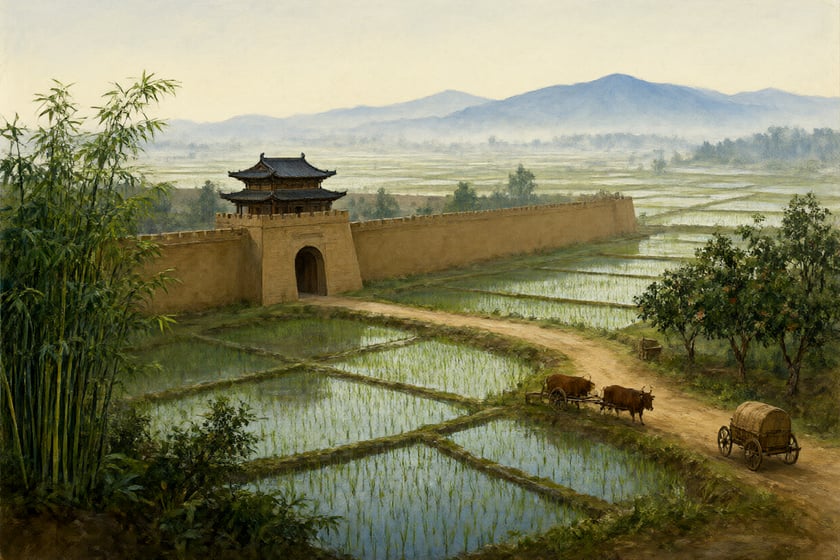
Chengdu was a county in Shu Commandery, Yi Province, during the Eastern Han, located in the old urban district of present-day Chengdu, Sichuan. In the late Eastern Han, Liu Yan moved the seat of Yi Province there. Liu Yan and his son Liu Zhang controlled Yi Province for more than twenty years. In the nineteenth year of Jian’an (214), Liu Bei took Chengdu; in the first year of Zhangwu (221), he proclaimed himself emperor there. From then on, Chengdu served as the capital of Shu Han for more than forty years, until the sixth year of Jingyao (263), when the Later Lord Liu Shan surrendered to Deng Ai.
History
Liu Yan and Liu Zhang
When Liu Yan served as governor of Yi Province, the original seat was struck by a great fire that destroyed the city and all its vehicles and equipment. He therefore moved the seat to Chengdu. In the first year of Xingping (194), Liu Yan died of a carbuncle on his back, and senior officials in the province, including Zhao Wei, installed his son Liu Zhang. Later, Zhao Wei rebelled in response to popular resentment. Shu Commandery, Guanghan, and Qianwei all joined him. Liu Zhang hurried into Chengdu and held the city, while the Eastern Province troops fought desperately and crushed the rebels.
In the summer of the nineteenth year of Jian’an (214), Liu Bei captured Luocheng and besieged Chengdu for several dozen days. Ma Chao came over to Liu Bei’s side and stationed troops north of the city. Panic seized those within, and Chengdu fell in less than ten days. At the time, the city still had thirty thousand elite troops and enough grain and silk to last a year, and officials and commoners alike were willing to fight to the death. Liu Zhang, however, said that his family had been in Yi Province for more than twenty years without showing kindness to the people, and that he could not bear to make them fight on his behalf any longer. He therefore opened the gates and surrendered. Liu Bei sent Jian Yong into the city to negotiate. Liu Zhang left the city in the same carriage as Jian Yong and submitted.
Capital of Shu Han
After entering the city, Liu Bei held a great banquet for his troops, distributed the city’s gold and silver to his officers and men, returned its grain and silk, and assumed the post of governor of Yi Province. Zhuge Liang became General of the Army and handled the affairs of the Left General’s Office. When Liu Bei was away on campaign, Zhuge Liang often remained in Chengdu to defend it and ensure adequate provisions and troops. In the twenty-fourth year of Jian’an (219), after Liu Bei Proclaims Himself King of Hanzhong, he returned to Chengdu, where more than four hundred lodgings, pavilions, and fortifications were built along the route from Chengdu to Baishui Pass. In the first year of Zhangwu (221), Liu Bei took the imperial throne south of Wudan Hill in Chengdu. Pei Songzhi noted that Wudan was the name of a hill northwest of Chengdu. In the winter, tenth month of the second year of Zhangwu (222), Liu Bei ordered Zhuge Liang to build the southern and northern suburban altars in Chengdu.
In the winter, twelfth month of the second year of Zhangwu (222), Huang Yuan, Administrator of Hanjia, heard that Liu Bei was gravely ill and raised troops in rebellion. The following spring, Zhuge Liang traveled east to Yongan to visit the ailing Liu Bei, leaving Chengdu undefended. Huang Yuan became even bolder and attacked Linqiong in the third month. After his defeat, his bodyguards bound him and took him to Chengdu, where he was beheaded. In the fifth month of that year, Liu Shan ascended the throne in Chengdu at the age of seventeen. In the second year of Jianxing (224), the Wu envoy Zhang Wen came on a diplomatic visit. The officials held a farewell banquet for him, and Qin Mi’s exchanges with Zhang Wen flowed like a rapid stream, earning Zhang Wen’s great admiration. In the fourteenth year of Jianxing (236), Shu Han relocated Fu Jian, king of the Di in Wudu, along with more than four hundred Di households, to Chengdu. In the fourteenth year of Yanxi (251), the Grand General Fei Yi returned to Chengdu. A geomancer said that the capital had no place for a chancellor, and that winter Fei Yi again stationed himself in the north at Hanshou.
The Fall of Shu and Zhong Hui's Rebellion
In the sixth year of Jingyao (263), Deng Ai’s forces reached Chengdu. Liu Chen, Prince of Beidi, first killed his wife and children, then took his own life in the service of his state. Liu Shan, accompanied by the crown prince, the other princes, and more than sixty officials, went to Deng Ai’s camp with his hands bound behind him and a coffin on his carriage to surrender. Deng Ai, acting with imperial authority, appointed Liu Shan General of the Agile Cavalry. In the first month of the first year of Xianxi (264), Deng Ai was arrested and sent back in a caged cart. Zhong Hui brought Jiang Wei and others to Chengdu, declared himself governor of Yi Province, and raised a rebellion. Outraged, the Wei troops mutinied and killed Zhong Hui and Jiang Wei. The mutineers looted the city, leaving the dead and wounded scattered everywhere; order was not restored for several days. Liu Xuan, the crown prince of Shu Han; Jiang Bin, son of Jiang Wan; and the veteran general Zhang Yi all died in the turmoil. In the sixth month of that year, Wei Guan reported that troops from Yong Province had found a jade disc and a jade seal in Chengdu County, with seal characters resembling “Cheng Xin.” Sun Sheng believed that they had been made in the early Eastern Han, when Gongsun Shu occupied Chengdu and called his state “Cheng”.
People
- Natives: Zhang Yi was from Chengdu in Shu Commandery and was well versed in the Gongyang Commentary on the Spring and Autumn Annals. When Liu Bei besieged the city, Zhang Yi was sent on a mission by Liu Zhang. Liu Bei promised to treat Liu Zhang with courtesy and reassure the people, and only after Zhang Yi returned to the city did its gates open. Du Qiong was also from Chengdu. He studied under Ren An, excelled in divination, and rose to the post of Grand Master of Ceremonies under the Later Lord.
- Former magistrates of Chengdu: Under Liu Zhang, Dong He served as magistrate of Chengdu. The local customs were extravagant, so he set an example with frugal clothing and food, helping reform local habits. Li Yan also served as magistrate of Chengdu under Liu Zhang and gained a reputation for competence. After Liu Bei entered Shu, Ma Su and Li Fu also served as magistrates of Chengdu. He Zhi served as magistrate of Chengdu and concurrently administered Pi County. He was skilled at exposing wrongdoing and uncovering hidden crimes, and people thought he had supernatural abilities.
- Xu Jing: He was Liu Zhang’s Administrator of Shu Commandery. During Liu Bei’s siege, he tried to climb over the city wall and surrender, but his plan was exposed and came to nothing. Liu Bei therefore looked down on him, but later, after Fa Zheng urged him to do so, he treated Xu Jing with great courtesy.
- Zhuge Liang: He once submitted a memorial to the Later Lord, saying that his family had eight hundred mulberry trees and fifteen qing of poor farmland in Chengdu, enough to provide for his children’s clothing and food, and that when he died he would leave no surplus wealth at home. This proved to be exactly the case. After his death, someone asked to build a temple for him in Chengdu, but the Later Lord refused. It was not until the sixth year of Jingyao that a temple was built for him in Mianyang.
- Liu Feng: Liu Bei’s adopted son, he fled back to Chengdu after losing Shangyong. Liu Bei reproached him for mistreating Meng Da and failing to rescue Guan Yu, then ordered him to take his own life.
- Ma Zhong: In the seventh year of Yanxi (244), when Fei Yi went north to repel the Wei forces, he left Ma Zhong in Chengdu to oversee the affairs of the Secretariat.
Differences Between Historical Record and Fiction
In Romance of the Three Kingdoms, Huang Zhong accompanies Liu Bei on the campaign against Wu in the second year of Zhangwu, is struck by an arrow and dies, and Liu Bei orders him buried in Chengdu. The Biography of Huang Zhong in the Records of the Three Kingdoms merely says that he died the year after Liu Bei Proclaims Himself King of Hanzhong; it does not say that he died in battle against Wu. In chapter 85 of the novel, Wei launches a Five-Route Invasion of Shu, and Zhuge Liang shuts himself inside the chancellor’s residence in Chengdu to watch fish. The Later Lord personally visits to ask for advice, and only then does Zhuge Liang reveal that four of the routes have already withdrawn and that he is waiting only to persuade Wu. The Five-Route Invasion of Shu is not recorded in the Records of the Three Kingdoms. The novel also says that after Zhao Yun’s death, an imperial order was issued to bury him east of Mount Jinping in Chengdu, and that when Zhuge Liang died, the Later Lord dreamed that Mount Jinping in Chengdu had collapsed. These are all events from the novel and are not recorded in the Records of the Three Kingdoms.
Today
Today, Chengdu is the capital of Sichuan Province. Chengdu’s Wuhou Shrine, which combines Liu Bei’s Huiling Mausoleum with the shrine to Zhuge Liang, is a joint memorial temple honoring ruler and minister and one of the most famous sites commemorating figures of the Three Kingdoms.