Overview
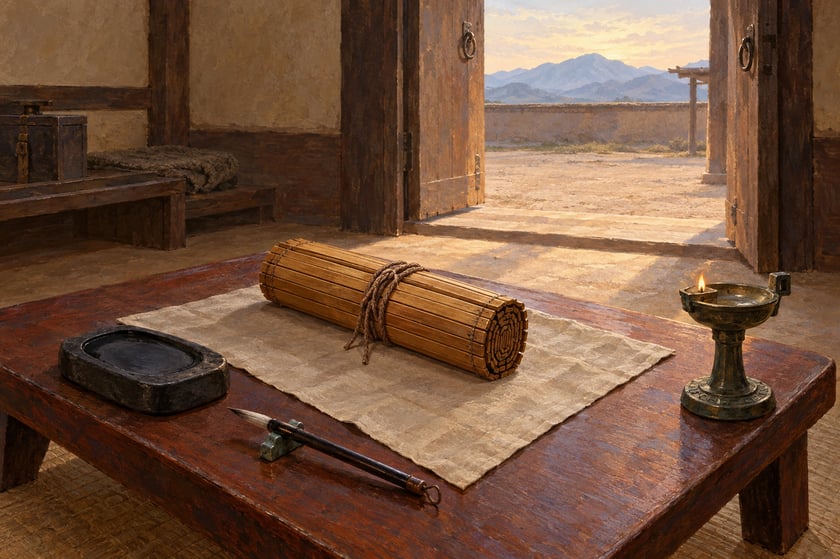
The Memorial on Sending Out the Troops comprises two memorials that Zhuge Liang submitted to Liu Shan, the Later Lord of Shu Han, concerning his northern campaigns. Later generations distinguished them as the Former Memorial on Sending Out the Troops and the Latter Memorial on Sending Out the Troops. Both Records of the Three Kingdoms and Romance of the Three Kingdoms include their texts. Records of the Three Kingdoms did not use the title “Memorial on Sending Out the Troops”: the former memorial appeared in the main text of the biography of Zhuge Liang, described only as having been “submitted as a memorial”; the latter appeared in the Han Jin chunqiu quoted in Pei Songzhi's commentary, described only as having been “presented to the throne”. Romance of the Three Kingdoms, by contrast, explicitly calls it the Memorial on Sending Out the Troops, and also uses that title for the latter memorial in chapter 97.
The former memorial asks His Majesty to entrust Zhuge Liang with the task of suppressing the rebels and restoring the Han, stating that weighing what should be removed or added and offering loyal counsel to the fullest are “the responsibilities of Youzhi, Yi, and Yun.” It urges His Majesty to “examine and accept sound counsel” and “deeply heed the late emperor’s final edict,” and ends with “As I face this memorial, tears fall; I do not know what I am saying”. The latter memorial begins with “The Han and the rebels cannot coexist; the royal enterprise cannot rest content with dominion over one corner.” Responding to those who argue that a northern expedition is ill-advised, it lists six points that Zhuge Liang “cannot understand.” Its final section contains the words “I shall bow myself to the task and exert all my strength, ceasing only at death,” and it ends with “As for success or failure, advantage or difficulty, these are beyond my understanding to foresee”.
Origins
According to the biography of Zhuge Liang in Records of the Three Kingdoms, in Jianxing 5 (227), Zhuge Liang led his armies north to garrison Hanzhong. Before departing, he submitted a memorial—the former memorial; see Former Memorial on Sending Out the Troops. In the spring of Jianxing 6 (228), after defeat at the Battle of Jieting, Zhuge Liang withdrew to Hanzhong. In the eleventh month of that year, he heard that Sun Quan had defeated Cao Xiu, that Wei troops had moved east, and that Guanzhong was weak. He then submitted another memorial—the latter memorial—as related in the Han Jin chunqiu quoted in Pei Songzhi's commentary; see Latter Memorial on Sending Out the Troops. Pei Songzhi's commentary stated that this memorial was absent from the Zhuge Liang ji and came from Zhang Yan’s Moji, and that the campaign at Sanguan followed its submission.
In Romance of the Three Kingdoms, Zhuge Liang steps out from the ranks at the Later Lord’s morning court audience and publicly presents the former memorial. The latter memorial is delivered to court by Yang Yi on the chancellor’s orders, and the Later Lord opens and reads it at his imperial desk.
History and the Romance
Wording: The former memorial in Romance of the Three Kingdoms begins with “Your servant Liang speaks”; these words were absent from the version in Records of the Three Kingdoms. The former memorial’s closing sentence in the Records read, “As I face this memorial, tears fall; I do not know what I am saying,” while the novel gives, “As I face this memorial, I weep; I do not know what I am saying”. In the latter memorial, the version quoted in Pei Songzhi's commentary read, “allowing Sun Ce to grow powerful unopposed,” while the novel gives, “allowing Sun Quan to grow powerful unopposed”. Where Pei Songzhi's commentary had “I shall bow myself to the task and exert all my strength, ceasing only at death,” the novel gives, “I shall bow myself to the task and exhaust all my strength, ceasing only at death.” Thereafter, both versions of the latter memorial end with “As for success or failure, advantage or difficulty, these are beyond my understanding to foresee”.
Delivery: Romance of the Three Kingdoms depicts Yang Yi delivering the latter memorial to court on orders; Records of the Three Kingdoms does not record this episode.
Scholarship
According to later scholarship, the Former Memorial on Sending Out the Troops was written in Jianxing 5 (227) and is included in volume 35 of Records of the Three Kingdoms.
According to later scholarship, the Latter Memorial on Sending Out the Troops is absent from both the main text of Records of the Three Kingdoms and the Zhuge Liang ji compiled by Chen Shou. One view holds that Zhuge Liang may not have been its author. Such doubts date back to the Qing dynasty: in his Sanguozhi bianyi, Qian Dazhao suspected that it was a later forgery.