Overview
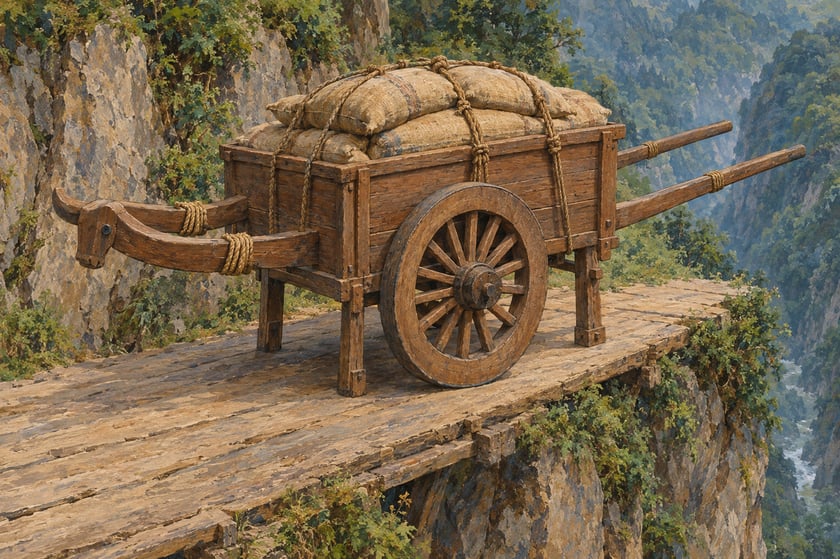
The Wooden Ox and Flowing Horse were devices used by Zhuge Liang to transport military grain during his northern expeditions. The Records of the Three Kingdoms says that Zhuge Liang excelled at ingenious designs and that the Wooden Ox and Flowing Horse “both sprang from his ideas”. In the Records, the Wooden Ox and the Flowing Horse were two distinct devices, used respectively in the campaigns of Jianxing 9 (231) and Jianxing 12 (234). Romance of the Three Kingdoms, however, calls them collectively the “Wooden Ox and Flowing Horse” and has them built and used together in chapter 102, though its construction instructions still describe the two separately.
Origins
According to the biography of the Later Lord in the Records of the Three Kingdoms, in the second month of spring in Jianxing 9 (231), Zhuge Liang again sent troops to besiege Mount Qi and “first used wooden oxen for transport”. The biography of Zhuge Liang likewise recorded that he advanced on Mount Qi again that year and used wooden oxen to transport grain; see Wooden Ox and Flowing Horse. In Jianxing 10 (232), Zhuge Liang rested his soldiers and encouraged farming at Huangsha, “completed the construction of flowing horses and wooden oxen,” and drilled his troops in military skills. In the second month of spring in Jianxing 12 (234), Zhuge Liang marched out through Xie Valley and “first used flowing horses for transport”. His biography recorded that on this expedition he led his entire army through Xie Valley, transported grain with flowing horses, occupied the Wuzhang Plains in Wugong, and confronted Sima Yi south of the Wei River—the biography called him “Sima, King Xuan”—in what became the Battle of Wuzhang Plains.
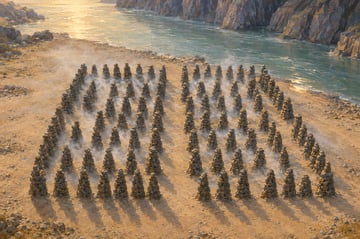
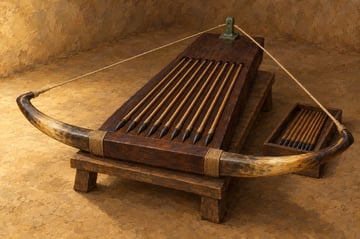
The construction instructions for the Wooden Ox and Flowing Horse in the Liang ji, quoted in Pei Songzhi's commentary, described the Wooden Ox as having “a square belly and a curved head, one leg and four feet,” with its head drawn into its neck and its tongue attached to its belly. It carried a heavy load but covered little ground, was suited to use in large numbers rather than individually, and could travel several dozen li alone or twenty li a day in a group. It could carry a year's grain rations and travel twenty li a day without greatly tiring its operator. The Flowing Horse's ribs were three chi five cun long, three cun wide, and two cun two fen thick. It had two square plank containers, each holding two hu three dou of rice. The same passage in Zhuge Liang's biography also stated that he improved the Zhuge Crossbow, called the “repeating crossbow” in the biography, and developed military formations to create the Stone Sentinel Maze.
In chapter 102 of Romance of the Three Kingdoms, Zhuge Liang surveys the terrain before Mount Qi and discovers a gourd-shaped valley. He orders the subordinate generals Du Rui and Hu Zhong to gather more than a thousand craftsmen accompanying the army and enter the valley to build the Wooden Ox and Flowing Horse. He also orders Ma Dai to guard the valley entrance with troops and forbid the craftsmen from entering or leaving. When Chief Clerk Yang Yi reports that all the grain is at Jianmen Pass and difficult to transport, Zhuge Liang replies that he has already used stockpiled timber and large logs purchased in Xichuan to build the Wooden Ox and Flowing Horse, saying, “Neither the oxen nor the horses drink water or eat.” He then writes out the construction instructions himself for the generals to inspect. The novel says that several days later all the devices are complete, “just like living creatures,” and can climb mountains and cross ridges with ease. Zhuge Liang orders General of the Right Gao Xiang to lead a thousand soldiers driving them to carry grain from Jianmen Pass to the main camp at Mount Qi.
Provenance
In Romance of the Three Kingdoms, Sima Yi devises a plan to seize the Wooden Ox and Flowing Horse, sending Zhang Hu and Yue Chen to capture several. He then has more than a hundred skilled craftsmen dismantle them in his presence and copy their dimensions. In less than half a month, they build more than two thousand devices that can likewise move. Zhuge Liang has anticipated that Sima Yi will copy them and devises a Wooden Ox and Flowing Horse stratagem, ordering Wang Ping to seize the devices built by the Wei army. Once the tongues in their mouths are twisted, the oxen and horses cannot move; twisting them back allows them to be driven again. Thus, when Guo Huai arrives, he cannot get them to move.
In chapter 103, Zhang Ni drives the Wooden Ox and Flowing Horse to the Shu camp and hands them over, securing more than ten thousand shi of grain. The Romance also relates that Xiahou Hui and Xiahou He split their forces to intercept the Shu soldiers driving the devices. The Shu soldiers flee in defeat, and all the devices are captured and taken to Sima Yi's camp. Zhuge Liang then orders Gao Xiang to feign transporting grain, driving the Wooden Ox and Flowing Horse back and forth within Shangfang Valley. Xiahou Hui and the others repeatedly intercept and attack them, winning several engagements within half a month. This is the prelude to the Fire Attack at Shangfang Valley.
Notable Episodes
In chapter 109 of Romance of the Three Kingdoms, Sima Zhao hears that Shu troops are using the Wooden Ox and Flowing Horse to transport grain behind Mount Tielong and orders Xu Zhi to launch a night raid to cut their supply route. Xu Zhi intercepts the Shu grain convoy, whose soldiers abandon the grain and flee. As he pursues them, he comes under fire attack and is then defeated by Liao Hua and Zhang Yi attacking from two directions. During his flight, Xu Zhi encounters Jiang Wei; his horse is stabbed and brought down, and he dies beneath a flurry of blades.
Pei Songzhi's commentary, quoting the Shu ji, recorded that the Jin General Who Guards the South, Liu Hong, visited Zhuge Liang's former residence at Longzhong to pay his respects and commissioned Li Xing to compose a stele inscription. It included the line, “As for the ingenuity of the wooden ox, even Ban could not match it”.
History and the Romance
Number of devices and chronology: In the Records of the Three Kingdoms, the Wooden Ox and the Flowing Horse were two distinct devices. Zhuge Liang “used wooden oxen for transport” when besieging Mount Qi in Jianxing 9 (231), and “used flowing horses for transport” when marching through Xie Valley in Jianxing 12 (234). Between these campaigns, he completed the flowing horses and wooden oxen at Huangsha in Jianxing 10 (232). Romance of the Three Kingdoms calls them collectively the Wooden Ox and Flowing Horse and places their construction during the campaign of Jianxing 12 (234). In chapter 102, they are built together in Gourd Valley and used together, although the construction instructions remain divided into two sections, “Method for Constructing the Wooden Ox” and “Method for Constructing the Flowing Horse”.
Construction: The novel's instructions for building the Wooden Ox read “a square belly and curved shanks, one belly and four feet” and “those traveling in groups cover thirty li,” whereas the Liang ji, quoted in Pei Songzhi's commentary, read “a square belly and a curved head, one leg and four feet” and “those traveling in groups cover twenty li”. For the thickness of the Flowing Horse, the novel gives two cun five fen, while the Liang ji gave two cun two fen.
Plot: Sima Yi's capture and replication of the Wooden Ox and Flowing Horse, Wang Ping's twisting of their tongues, supernatural soldiers driving them away, and their use to lure the enemy into Shangfang Valley are all episodes in the novel; the Records of the Three Kingdoms does not record them.
Scholarship
According to the Song scholar Gao Cheng's Shiwu jiyuan, “The wooden ox is today's small cart with front shafts; the flowing horse is today's cart pushed by one person.” Chen Shidao's Houshan congtan also described small carts in Shu pushed by one person, with “fronts resembling ox heads.”
Later scholars have proposed various reconstructions, including four-legged and single-wheeled designs. The Zibo Museum displays a reconstructed model.