Sima clan · King of Jin
Sima Zhao
courtesy name 子上 · 211–265
Not to be confused with Sima Zhao (司马肇) — Sima Zhao, son of Cao Wei official Sima Qi, served as Jizhou governor and Shangshu during the Jin Taikang era, records say.
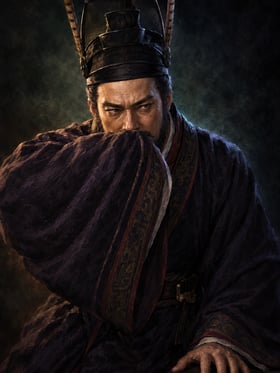
'Sima Zhao's intent is known even to the passerby.' He went out and in always attended by three thousand mailed and valiant officers, and matters were settled at his chancellery without being reported to the court—signs of his overweening power. He was suspicious yet a good judge of men, skilled in stratagem: he made use of Zhong Hui's schemes and could anticipate the minds of others.

Life
In the novel: 19 chapters · In the Records: 11 volumes
Life211–265
234 CE (Qinglong 2)
249 CE (Jiaping 1)
- The Sima Clan's Seizure of PowerLuoyangInstigator
251 CE (Jiaping 3)
- Three Rebellions in ShouchunShouchunCommander
1 more event
257 CE (Ganlu 2)
- Zhuge Dan's RebellionShouchunCommander
260 CE (Jingyuan 1)
- Ganlu IncidentLuoyangInstigator
264 CE (Xianxi 1)
- Zhong Hui's RebellionChengduInstigator
On the boards
Compare with someone →Where this person ranks on each board.
Who they were
Character profile
- Character
- 'Sima Zhao's intent is known even to the passerby.' He went out and in always attended by three thousand mailed and valiant officers, and matters were settled at his chancellery without being reported to the court—signs of his overweening power. He was suspicious yet a good judge of men, skilled in stratagem: he made use of Zhong Hui's schemes and could anticipate the minds of others.
- Manner of speech
- He compared himself to King Wen and to Cao Cao to mask his intent to usurp, and descended from the hall with a cold laugh. He argued by quoting the old adage, 'A defeated general cannot speak of valor; a minister of a fallen state cannot plan for survival.'
- Life
- After Sima Shi's death, Sima Zhao became Grand General and Overseer of the Masters of Writing in the second year of the Zhengyuan era. In the third year of the Ganlu era he took Shouchun and beheaded Zhuge Dan; in the fifth year of Ganlu, after the Duke of Gaogui District was assassinated, he set up the Prince of Chenliu. In the first year of the Xianxi era he was advanced in rank to King of Jin, and he died in the second year of the Xianxi era.
- Anecdotes
- He was the second son of Sima Yi and the younger brother of Sima Shi. Succeeding his brother in control of the government, he held such offices as General of the Guards, Grand General, Grand Commander-in-chief, Chancellor, Duke of Jin, and King of Jin. He once tearfully entreated his brother Sima Shi, but was refused.
Historical Record
Sima Zhao, courtesy name Zishang, was the son of Sima Yi and younger brother of Sima Shi. When Sima Shi led an eastern campaign against Guanqiu Jian and Wen Qin, Sima Zhao commanded the army’s rear contingent. After Sima Shi died in Xu Chang, the Wei court appointed Sima Zhao Grand General and Director of the Imperial Secretariat, and he thereby took control of the government. Thereafter, he was granted further powers and honors, including the title of Grand Commander, the privilege of submitting memorials without stating his name, and the authority to wield the imperial yellow battle-axe.
In the third year of the Ganlu era, Zhuge Dan occupied Shouchun and rebelled. Sima Zhao led 260,000 troops from the central and regional armies to suppress him, surrounding the city while preparing for an army from Wu to come to its aid. With Shouchun under siege for a long time, Sima Zhao wore down the defenders by maintaining a tight encirclement, and used a scheme to sow discord, prompting Quan Yi and others to surrender. After the city fell, he executed Zhuge Dan and pardoned the sons of Wen Qin who had surrendered. He rejected a proposal to press the advantage and advance deep into Wu, and settled the soldiers who had defected from Wu in nearby commanderies.
Cao Mao, Duke of Gaogui, resented Sima Zhao’s usurpation of power. He once said, “Sima Zhao’s intentions are known to everyone in the streets,” and then led his attendants out of the palace to attack him, only to be assassinated by Cheng Ji, a subordinate of Jia Chong. Sima Zhao memorialized the throne that he had strictly ordered that the emperor not be harmed, and dealt with Cheng Ji and his family; nevertheless, the incident left him bearing the stigma of regicide. He was subsequently promoted to Chancellor and enfeoffed as Duke of Jin, then elevated to King of Jin; the Wei court also granted him the ceremonial regalia of the Son of Heaven. After the Conquest of Shu by Wei, Zhong Hui rebelled in Shu, and Sima Zhao sent troops to deal with him. In the eighth month of the first year of the Xianxi era, he died as King of Jin, and Sima Yan succeeded him.
In the Novel
The Romance of the Three Kingdoms portrays Sima Zhao as Sima Yi’s second son, often accompanying his father on campaigns with his elder brother Sima Shi. It presents him as a young general well versed in the art of war and bold in judging the right moment to act. During the Battle of Jieting, he scouts the road ahead at night and points out that the Shu army is camped only on the mountain and has built no barriers across the main road. Later, he and Sima Yi lay an ambush to intercept Wei Yan. The novel also has him question his father’s retreat during the Empty Fort Strategy, highlighting the contrast between him and the shrewd, seasoned Sima Yi.
The novel further has him take part in the campaign against Wu at Dongxing as Grand Commander, where he is defeated by a surprise attack from Wu’s forces. Later, during a campaign against Shu, Jiang Wei lures him into the Iron Cage Mountain, where he is trapped without water and nearly driven to desperation. These details of the battles are fictional inventions and should not be conflated with historical accounts. Whereas the historical record shows Sima Zhao later becoming the de facto ruler of Wei, King of Jin, and directing affairs after the conquest of Shu, the novel initially focuses on his experiences campaigning with the army and facing danger, and later depicts him sharing control of the court with Sima Shi.
Key Relationships
- Sima Shi: His elder brother and predecessor in power. After Sima Shi’s death, Sima Zhao was appointed Grand General and Director of the Imperial Secretariat, and went on to take charge of the Wei court’s affairs.
- Sima Yi: His father. The novel depicts Sima Zhao accompanying his father on campaigns in his youth, repeatedly taking orders and offering advice in battle; these early interactions are fictional episodes.
- Cao Mao: The Cao Wei emperor whose conflict with Sima Zhao over power ultimately led to the regicide. Cao Mao died near the palace gates after taking up arms, and although Sima Zhao dealt with Cheng Ji afterward, he could not dispel the political shadow of the incident.
- Zhuge Dan: A powerful Huainan general who rebelled. Sima Zhao besieged Shouchun and, after Zhuge Dan ran out of provisions and relief failed to arrive, captured the city and executed him.
- Zhong Hui: A trusted subordinate of Sima Zhao who took part in suppressing Zhuge Dan's Rebellion. Zhong Hui later rebelled in Shu, and Sima Zhao ordered him and Wei Guan to advance and deal with the situation.
Signature Scenes
- The Siege of Shouchun: Sima Zhao did not rush into a frontal assault. Instead, he hemmed Zhuge Dan in behind deep moats and high ramparts, waiting until outside relief was thwarted and the city ran out of provisions, then used a scheme to sow discord among the defenders before finally capturing Shouchun. The campaign shows his emphasis on sustained control and weighing risks.
- Cao Mao’s Attack: Cao Mao led his attendants out of the palace and personally resisted with a sword; Cheng Ji assassinated the emperor. On hearing the news, Sima Zhao submitted a memorial to explain himself and pushed for Cheng Ji to be dealt with. The shock and protest recorded in the historical accounts, set against the subsequent expansion of his power as King of Jin, make this the most controversial episode of his career.
- Trapped on Iron Cage Mountain (Novel Only): The novel recounts that Jiang Wei ambushed and routed Sima Zhao’s army, forcing Sima Zhao to retreat to Iron Cage Mountain, where his six thousand troops ran short of water. He looked up to the heavens and lamented, “I shall die here!” He then escaped after praying and seeing a spring gush forth. The episode portrays him as a general who can be driven to the brink, yet find a way to survive danger.
Quotes
60 lines in the books · 3 featured
「頗思蜀否?」
This line is the origin of the allusion 'so happy as to forget Shu' (le bu si Shu), and is highly recognizable culturally.
「昔文王三分天下有其二,以服事殷,故聖人稱為至德。魏武帝不肯受禪於漢,猶吾之不肯受禪於魏也。」
This remark uses the past to comment on the present, hinting at his ambition to usurp Wei—a footnote to the saying 'Sima Zhao's intent is known to every passerby.'
「朝臣皆言蜀未可伐,是其心怯:若使強戰,必敗之道也。今鍾會獨建伐蜀之策,是其心不怯:心不怯,則破蜀必矣;蜀既破,則蜀人心膽已裂。『敗軍之將,不可以言勇;亡國之大夫,不可以圖存。』會即有異志,蜀人安能助之乎?至若魏人得勝思歸,必不從會而反,更不足慮耳。此言乃吾與汝知之,切不可泄漏。」
This remark displays Sima Zhao's far-sighted scheming and his insight into human nature, an expression of his political skill.
- Family
- Lord & vassal
- Friends
- Enemies
- Other
History vs. novel
8 points · 2 novel-only
| History | Novel |
|---|---|
| Jieting assessmentNovel only | |
| — | The novel says that Sima Zhao, acting on his father’s orders, scouted Jieting and found the Shu army camped on a mountain. He judged the position easy to capture, prompting Sima Yi to go and inspect it. ch. 95 |
| Escape from Tielong MountainNovel only | |
| — | The novel says that Jiang Wei surrounded Sima Zhao at Tielong Mountain, where the spring was running dry. After Sima Zhao prayed, water suddenly gushed forth from the spring, allowing him to break free. ch. 109 |
| Taking over his brother’s authorityNovel embellishes | |
After Sima Shi died in Xu Chang, the Wei court appointed Sima Zhao Grand General and Director of the Imperial Secretariat, succeeding to his elder brother’s authority. vol. 4 | The novel says that as Sima Shi lay dying, he handed his seals and ribbons of office to Sima Zhao and charged him to inherit his authority. After Sima Zhao returned to Luoyang, he was appointed Grand General and Director of the Imperial Secretariat, with all affairs, great and small, under his control. ch. 110 |
| Besieging ShouchunNovel embellishes | |
Sima Zhao believed that Shouchun’s walls were strong and its garrison numerous, and that a hasty assault would exhaust his own troops. He therefore adopted a strategy of digging deep trenches and building high ramparts, laying siege and waiting for events to turn; in the end, he won without having to storm the city. vol. 28 | The novel says that Sima Zhao personally led a large army to punish Zhuge Dan. Following Zhong Hui’s advice, he withdrew the guards from the south gate, enticing the enemy to leave on their own before seizing an opportunity to win. ch. 112 |
| Mercy toward Wu soldiersNovel embellishes | |
After Shouchun was pacified, Sima Zhao opposed burying the Wu soldiers alive, arguing that only the chief offenders needed to be executed. None of the surrendered soldiers were killed; they were settled in various commanderies near the Sanhe region. vol. 28 | The novel says that Pei Xiu advocated burying the Wu soldiers alive, while Zhong Hui urged that they be sent back to Jiangnan. Sima Zhao accepted Zhong Hui’s advice and sent the Wu soldiers home, while Tang Zi remained in Wei service. ch. 112 |
| The death of Cao MaoNovel embellishes | |
According to historical records, Sima Zhao said that Cao Mao had led troops forward with drawn blades, and that he had ordered them not to harm anyone. Cheng Ji nevertheless charged into the ranks and killed Cao Mao; Sima Zhao then submitted a request to punish Cheng Ji’s family. vol. 4 | The novel recounts in detail how Sima Zhao pressured Cao Mao to accept the title of Duke of Jin and the addition of the Nine Bestowments. Cao Mao raised troops in resistance but was killed by Cheng Ji. Sima Zhao pretended to weep, then executed Cheng Ji and his clan. ch. 114 |
| Campaign against Shu and Zhong HuiNovel embellishes | |
Sima Zhao ordered Deng Ai to be summoned in a caged cart and directed Zhong Hui to continue the advance. He foresaw that Zhong Hui might rebel and said that he could deal with him once he reached Chang'an. Zhong Hui later did indeed rebel. vol. 28 | The novel says that Sima Zhao sent Zhong Hui and Deng Ai to campaign against Shu. When he learned that Zhong Hui had rebelled, he personally led a large army toward Chang'an. On hearing that Sima Zhao was approaching, Zhong Hui hastened to launch his uprising. ch. 118 |
| Elevation to Prince of JinHistory only | |
Sima Zhao was elevated to Prince of Jin and granted ten commanderies. That same year, his father Sima Yi was posthumously given the title King Xuan of Jin, and his elder brother Sima Shi the title King Jing of Jin. vol. 4 | — |
- Jieting assessmentNovel only
- Novel
The novel says that Sima Zhao, acting on his father’s orders, scouted Jieting and found the Shu army camped on a mountain. He judged the position easy to capture, prompting Sima Yi to go and inspect it.
ch. 95
- Escape from Tielong MountainNovel only
- Novel
The novel says that Jiang Wei surrounded Sima Zhao at Tielong Mountain, where the spring was running dry. After Sima Zhao prayed, water suddenly gushed forth from the spring, allowing him to break free.
ch. 109
- Taking over his brother’s authorityNovel embellishes
- History
After Sima Shi died in Xu Chang, the Wei court appointed Sima Zhao Grand General and Director of the Imperial Secretariat, succeeding to his elder brother’s authority.
vol. 4
- Novel
The novel says that as Sima Shi lay dying, he handed his seals and ribbons of office to Sima Zhao and charged him to inherit his authority. After Sima Zhao returned to Luoyang, he was appointed Grand General and Director of the Imperial Secretariat, with all affairs, great and small, under his control.
ch. 110
- Besieging ShouchunNovel embellishes
- History
Sima Zhao believed that Shouchun’s walls were strong and its garrison numerous, and that a hasty assault would exhaust his own troops. He therefore adopted a strategy of digging deep trenches and building high ramparts, laying siege and waiting for events to turn; in the end, he won without having to storm the city.
vol. 28
- Novel
The novel says that Sima Zhao personally led a large army to punish Zhuge Dan. Following Zhong Hui’s advice, he withdrew the guards from the south gate, enticing the enemy to leave on their own before seizing an opportunity to win.
ch. 112
- Mercy toward Wu soldiersNovel embellishes
- History
After Shouchun was pacified, Sima Zhao opposed burying the Wu soldiers alive, arguing that only the chief offenders needed to be executed. None of the surrendered soldiers were killed; they were settled in various commanderies near the Sanhe region.
vol. 28
- Novel
The novel says that Pei Xiu advocated burying the Wu soldiers alive, while Zhong Hui urged that they be sent back to Jiangnan. Sima Zhao accepted Zhong Hui’s advice and sent the Wu soldiers home, while Tang Zi remained in Wei service.
ch. 112
- The death of Cao MaoNovel embellishes
- History
According to historical records, Sima Zhao said that Cao Mao had led troops forward with drawn blades, and that he had ordered them not to harm anyone. Cheng Ji nevertheless charged into the ranks and killed Cao Mao; Sima Zhao then submitted a request to punish Cheng Ji’s family.
vol. 4
- Novel
The novel recounts in detail how Sima Zhao pressured Cao Mao to accept the title of Duke of Jin and the addition of the Nine Bestowments. Cao Mao raised troops in resistance but was killed by Cheng Ji. Sima Zhao pretended to weep, then executed Cheng Ji and his clan.
ch. 114
- Campaign against Shu and Zhong HuiNovel embellishes
- History
Sima Zhao ordered Deng Ai to be summoned in a caged cart and directed Zhong Hui to continue the advance. He foresaw that Zhong Hui might rebel and said that he could deal with him once he reached Chang'an. Zhong Hui later did indeed rebel.
vol. 28
- Novel
The novel says that Sima Zhao sent Zhong Hui and Deng Ai to campaign against Shu. When he learned that Zhong Hui had rebelled, he personally led a large army toward Chang'an. On hearing that Sima Zhao was approaching, Zhong Hui hastened to launch his uprising.
ch. 118
Combat
On the field
Duels, kills and executions as the texts tell them, counted separately for the Records and the Romance.
- RecordsJuan 4Struck downZhuge DanWon「大將軍司馬文王陷壽春城,斬諸葛誕」
- RomanceCh. 114ExecutionCheng JiWon「成濟大逆不道,可剮之,滅其三族」
- RomanceCh. 114ExecutionCheng CuiWon「弟成倅亦斬於市,盡滅三族」
- RomanceCh. 114ExecutionWang JingWon「王經母子含笑受刑」
- RomanceCh. 115ExecutionDeng DunWon「叱武士推出斬之」
- RomanceCh. 119ExecutionHuang HaoWon「令武士押出市曹,凌遲處死」
Battles in command
Battles this person commanded in, with the outcome as each text tells it.
- Romance
- 0W 1L 0D 0 undecided
- Romance252Battle of DongxingLostvs Wu troopsCh. 108「司馬昭、王昶、毌丘儉聽知東興兵敗,亦勒兵而退」
Stratagems
Plans this person devised or saw through, as the texts tell them.
- Records
- 2 carried out · 2 worked · 0 turned down · 0 seen through
- Romance
- 1 carried out · 0 worked · 0 turned down · 2 seen through
- RecordsPardon Yang Hu to Pacify the PeoplePersuasionWorkedagainst those within the cityJuan 28「使將兵數百騎馳巡城,呼語城內云:「文欽之子猶不見殺,其餘何懼?」」
- RecordsBesiege and Tie Them DownSiegeWorkedagainst the Three RebelsJuan 28「六軍按甲,深溝高壘,而誕自困,竟不煩攻而克」
- RomanceSummon Him and Eliminate HimDeceptionSeen throughCh. 111「誕得了詔書,已知是賈充告變」
- RomanceAttack from Inside and OutsideOtherSaw throughagainst Wei troopsCh. 112「此欲與朱異內外夾攻,以破我軍也」
- RomanceTeach the Later Lord to Long for ShuDeceptionSaw throughagainst JinCh. 119「何乃似郤正語耶」
Events
Events (20)
Battles and events the texts place this person in, by date.
Battles
Other events
- 228Empty Fort Strategy
- 234Fire Attack at Shangfang ValleyWarrior
- 249The Sima Clan's Seizure of PowerInstigator
- 249Incident at the Gaoping Tombs
- 251Three Rebellions in ShouchunCommander
- 253Zhuge Ke's Siege of Hefei Xincheng
- 257Zhuge Dan's RebellionCommander
- 260Ganlu IncidentInstigator
Famous objects
Those who met it
Places
Continue
The Sima Clan's Seizure of Power
Relationship timeline15 entries ▸
History · vol. 4
- Zhuge Dan§57
Enemy
Captured Shouchun city and executed Dan
History · vol. 28
- Zhuge Dan§29
Enemy
Commanded 260,000 troops, both within and outside the capital, and advanced to the Huai River to campaign against him; defeated and killed him
Novel · ch. 94
- Sima Yi§14
Kin
Sima Yi's second son, courtesy name Zishang; well versed in military texts
Novel · ch. 95
- Sima Yi§6
Kin
father and son; personally reconnoitered Jieting and saw through Ma Su's decision to camp on the mountain
Novel · ch. 102
- Sima Yi§11
Kin
Second son; joined his elder brother in leading troops to reinforce the forward camp
Novel · ch. 104
- Sima Yi§29
Kin
Second son; urged the army to pursue Shu
Novel · ch. 106
- Sima Yi§9
Kin
Second son; joined his father in surrounding Gongsun Yuan
Novel · ch. 107
- Sima Yi§1
Kin
Escorted his father out of the city to camp at the pontoon bridge over the Luo River
All 15
Loading…
Inner monologues · AI-generated3 monologues ▸
- My courtesy name was Zishang. I remember when I was young, my father was in Wancheng and heard that the Wei army had suf
- After Shouchun fell, what I relied on was not a momentary assault, but caution and waiting for events to change. At firs
- I am Sima Zhao, courtesy name Zishang. Shouchun had fallen, but the banners had not yet been furled, and the sounds of w