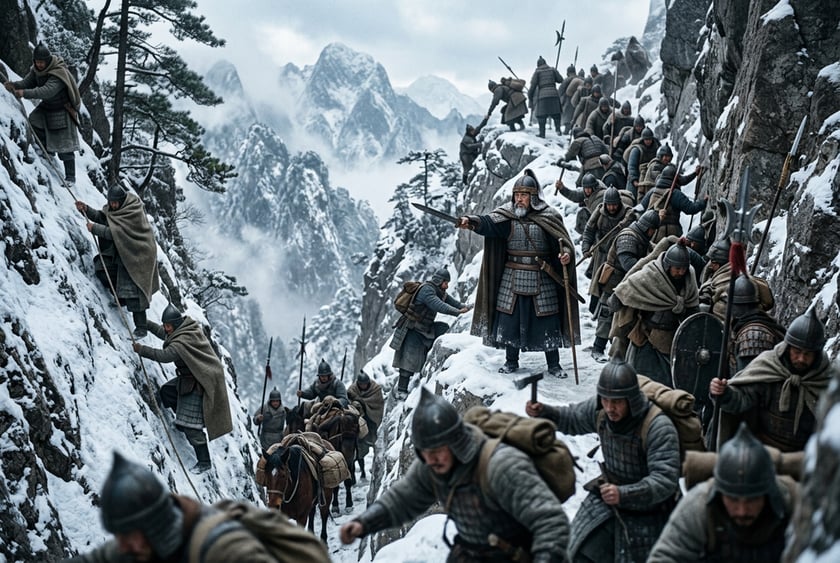
In the tenth month of the fourth year of Wei's Jǐngyuán era (the sixth year of Shuhan's Jǐngyào era, 263), Wei's General Who Conquers the West, Deng Ai, led roughly thirty thousand elite troops out of Longright by way of the obscure Yinping trail. Crossing more than seven hundred li of uninhabited terrain around Motian Ridge and Mianzhu Valley, they cut passages through cliffs and built plank roads over ravines; soldiers wrapped themselves in felt and rolled down precipices, or clawed their way along ledges tree by tree, advancing single-file. Reaching Jiangyou first, the Shuhan garrison commander Ma Miao surrendered. Deng Ai then met Shuhan's Guard General Zhuge Zhan, Secretary Zhang Zun, Huang Chong, and their forces in a decisive engagement at Mianzhu, killing Zhuge Zhan and his son along with several thousand of Shuhan's finest troops. Deng Ai pressed his advantage straight toward Chengdu, and the last ruler Liu Chan, following the counsel of Qiao Zhou, "presented a letter of submission," bringing Shuhan to an end. Coordinated with Zhong Hui's main force pinning the enemy at Jiange, this surprise assault stands as a classic example in Chinese military history of a lone army destroying a state through a long-range deep raid.
The Records of the Three Kingdoms only records that Deng Ai traveled more than seven hundred li through uninhabited territory along the Yinping road, cut a path through the mountains, wrapped himself in felt, and rolled down the slopes; he then reached Jiangyou first and fought Zhuge Zhan at Mianzhu, killing him. The battle details are mostly given in the style of a military report, with no private scenes such as dreams or family conversations.
Romance
Around Chapter 117, the novel expands on scenes such as Deng Ai's dream omen, "Water on the mountain is called Jian," Ma Miao and his wife talking over drinks, and Zhuge Zhan and his son's final letters at Mianzhu. It builds up the course of the campaign as a dramatic narrative colored by fate, reinforcing the view that "the Wei army had Heaven's mandate, while Shu Han collapsed on its own."
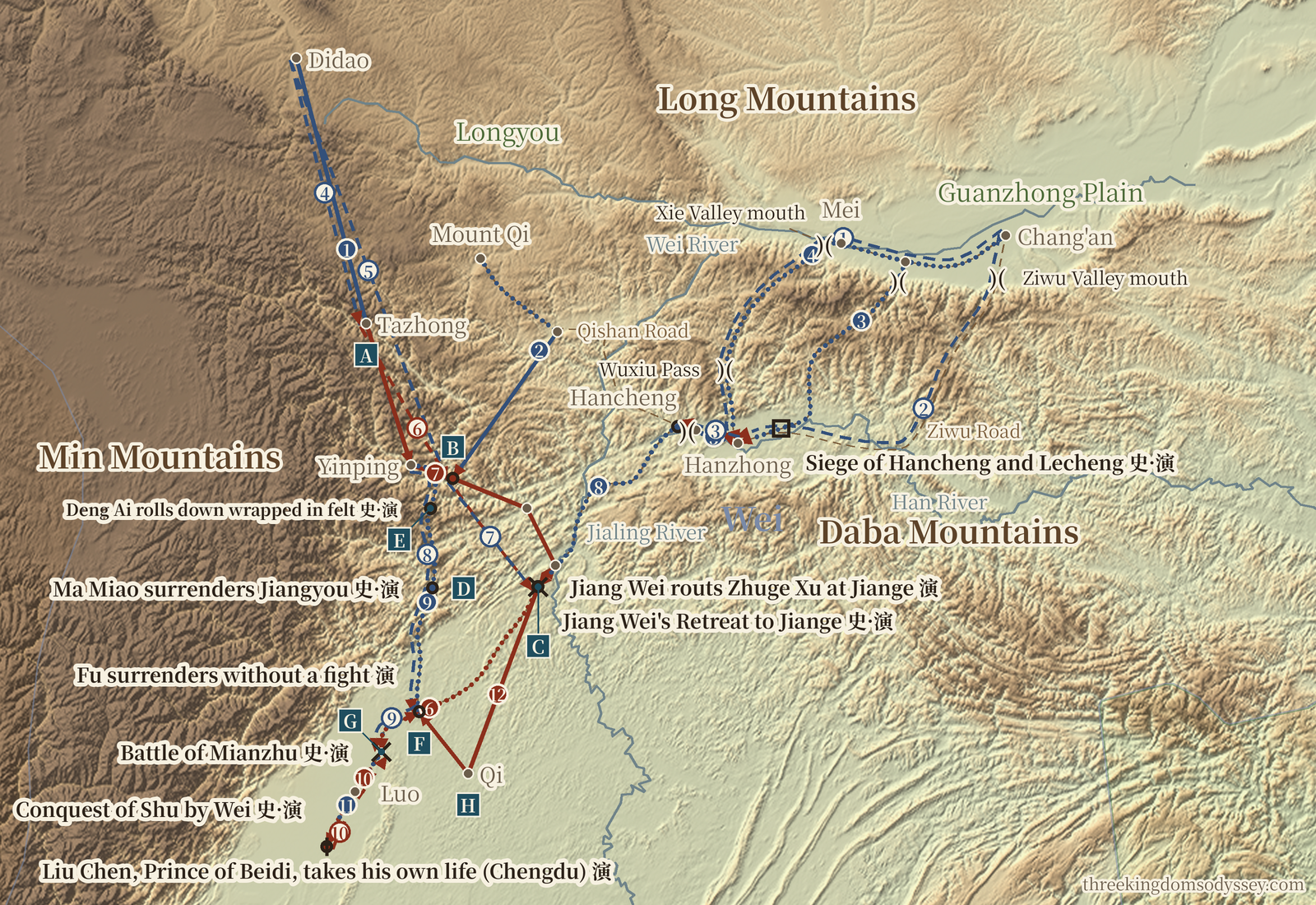
In winter, Deng Ai leads Wei's elite troops along a narrow path in Yinping, cutting a route through the mountains. Some soldiers wrap themselves in felt blankets and roll down steep cliffs; others climb trees and advance in single file, struggling through uninhabited terrain.
1Deng Ai marches on Yinpingover 30,000 menHist.Records of the Three Kingdoms, juan 28魏灭蜀之战(维基百科)
2Zhuge Xu meets the enemy at Yinping Bridgeheadover 30,000 menHist.Records of the Three Kingdoms, juan 28Records of the Three Kingdoms, juan 4魏灭蜀之战(维基百科)
3Zhong Hui marches on Hanzhongover 100,000 (by the Xie and Luo valleys)Hist.Records of the Three Kingdoms, juan 4Records of the Three Kingdoms, juan 28
4Zhong Hui marches on HanzhongRecords of the Three Kingdoms, juan 28
5Hu Lie, sent by Zhong Hui, marches on Yangping PassRecords of the Three Kingdoms, juan 28Records of the Three Kingdoms, juan 44
6Zhang Yi and Dong Jue reinforces HanshouRecords of the Three Kingdoms, juan 44
7Jiang Wei and Liao Hua falls back to JiangeRecords of the Three Kingdoms, juan 28Records of the Three Kingdoms, juan 44
8Zhong Hui marches on JiangeRecords of the Three Kingdoms, juan 28Records of the Three Kingdoms, juan 44Romance of the Three Kingdoms, ch. 117
9Deng Ai marches on MianzhuRecords of the Three Kingdoms, juan 28Records of the Three Kingdoms, juan 35
10Zhuge Zhan and Huang Chong marches on FuRecords of the Three Kingdoms, juan 35Records of the Three Kingdoms, juan 43Records of the Three Kingdoms, juan 28
11Deng Ai marches on ChengduRecords of the Three Kingdoms, juan 28Romance of the Three Kingdoms, ch. 117
12Jiang Wei and Zhang Yi and Liao Hua and Dong Jue falls back to Fu40,000–50,000 foot and horseHist.Records of the Three Kingdoms, juan 28Records of the Three Kingdoms, juan 44Records of the Three Kingdoms, juan 45
In the Romance
1Zhong Hui and Xu Yi marches on Hanzhongover 100,000NovelRomance of the Three Kingdoms, ch. 116
2Zhong Hui's force marches on HanzhongRomance of the Three Kingdoms, ch. 116
3Zhong Hui marches on Yangping PassRomance of the Three Kingdoms, ch. 116
4Deng Ai marches on Tazhong30,000NovelRomance of the Three Kingdoms, ch. 116
5Zhuge Xu, sent by Deng Ai, meets the enemy at Yinping Bridgehead15,000NovelRomance of the Three Kingdoms, ch. 116
6Jiang Wei falls back to JiangeRomance of the Three Kingdoms, ch. 116
7Zhuge Xu marches on JiangeRomance of the Three Kingdoms, ch. 117
8Deng Ai and Deng Zhong marches on Fuover 2,000 menNovelRomance of the Three Kingdoms, ch. 117
9Shi Zuan and Deng Zhong, sent by Deng Ai, marches on MianzhuRomance of the Three Kingdoms, ch. 117
10Zhuge Zhan and Zhuge Shang marches on Mianzhu70,000NovelRomance of the Three Kingdoms, ch. 117
Deng Ai rolling downhill in felt is not the novel's invention: the Sanguozhi biography of Deng Ai has it. The name Motian Ridge comes from the novel.
The books mostly say only where an army set out and arrived: a Records line is solid between the places they name and dotted where it follows a reconstructed road between them; an open ring marks an end the books don't give.
Why these routes
AWei's plan: Deng Ai pins Jiang Wei at Tazhong, Zhuge Xu blocks his way home at the bridgehead, and Zhong Hui's main army walks into Hanzhong by the Xie and Luo valleys.Hist.Records of the Three Kingdoms, juan 28
BThe bridgehead was Jiang Wei's only way home. He feinted north through the Konghan valley, Zhuge Xu fell back thirty li, and Jiang Wei doubled back across, a day ahead of him.Hist.Records of the Three Kingdoms, juan 28
CJiange sits astride the Jinniu Road. Zhong Hui could not take it, and with his grain hauled from so far he was already talking of going home.Hist.Records of the Three Kingdoms, juan 28Records of the Three Kingdoms, juan 44
DDeng Ai's reasoning: a side path from Yinping comes out 100 li west of Jiange, toward Fu. If Jiange's garrison turns back, Zhong Hui marches in; if not, Fu is weak.Hist.Records of the Three Kingdoms, juan 28
EOver 700 li of empty country, roads cut and plank bridges built. Deng Ai rolling down the slope in felt is already in his Sanguozhi biography, not only in the novel.BothRecords of the Three Kingdoms, juan 28Romance of the Three Kingdoms, ch. 117
FHuang Chong kept urging Zhuge Zhan to seize the passes before the enemy reached the flat land; Zhan lingered at Fu, and when his vanguard broke he fell back to Mianzhu.Hist.Records of the Three Kingdoms, juan 43Records of the Three Kingdoms, juan 35
GThe Mianzhu on this map is the Han–Jin city, at today's Huangxu in Deyang, more than 30 km from the modern city of Mianzhu.Schol.三国旅游|四川绵竹故城
HAfter Mianzhu fell, Jiang Wei left Jiange eastward into Ba and went by Qi to learn what was true; only on Liu Shan's order did he surrender to Zhong Hui at Fu.Hist.Records of the Three Kingdoms, juan 28Records of the Three Kingdoms, juan 44
Base map: Natural Earth; terrain: AWS Terrain Tiles (SRTM and others). Roads and marches reconstructed from the sources listed; positions approximate.
The 263 campaign to destroy Shu was Sima Zhao's last large-scale external use of force before replacing Wei, designed to establish legitimacy for usurpation through a single decisive act of state extinction. The Wei army's overall plan called for Zhong Hui's main force of more than a hundred thousand to advance south along the Hanzhong-Jiange axis, while Deng Ai and Zhuge Xu pinned Jiang Wei from the Longright flank. Under the original plan, Zhong Hui's main force would break through Jiange and drive straight on Chengdu, with Deng Ai and Zhuge Xu acting only as flanking support; but when Zhong Hui was firmly nailed in place before Jiange by Jiang Wei — with supply pressure so acute that withdrawal was under consideration — the entire campaign faced stagnation. Deng Ai's Yinping surprise infiltration was the unorthodox solution proposed precisely against the background of the main-axis advance having stalled.
Force Dispositions
On the Wei side, Deng Ai's force numbered approximately thirty thousand — the full mobile strength available from the Longright direction. He chose to shed his supply train and heavy equipment, taking only dry rations, ropes, and a small body of elite troops — a deployment that in essence staked the entire campaign risk on a single success rate for penetrating seven hundred-plus li of uninhabited terrain. On the Shuhan side, the main force had been concentrated by Jiang Wei at Jiange, and the passes along the Yinping route such as Jiangyou had been left ungarrisoned by Liu Chan for years; the thousand-man garrison that should have been stationed there did not in fact exist. Ma Miao as Jiangyou's defending officer had long since lost the will to fight, relying on the assumption that "Jiang Wei has held Jiange with the full army" to avoid making battle preparations. Zhuge Zhan, as a member of Shuhan's royal clan and the son of the Chancellor, had been hastily recalled from Fucheng to organize the Mianzhu defense with only enough time to assemble a scratch force.
Critical Decision Points
The first decision point was Deng Ai's internal rallying cry of "advance and live, retreat and die". This was not merely a morale booster — it was an accurate strategic assessment: once the Yinping trail was half-traversed, the cost of turning back equaled the cost of pressing forward; the gamble of the entire army's possible destruction had to be placed on a single success. This was the classic "smash the cauldrons and sink the boats" gamble. The second decision point came at the Battle of Mianzhu. After an unfavorable initial engagement, Deng Ai's son Deng Zhong and Shi Zuan reported back that "the enemy cannot be struck"; Deng Ai furiously reprimanded them and threatened to have them executed, forcing both back to the battle line, and ultimately overwhelmed the Shu army through sheer ferocity. This moment displayed the hallmark of a top-tier commander in an unfavorable situation: refusing to allow subordinates to use "difficulty" as justification for retreat. The third decision point was in the Chengdu court. When Deng Ai's forces reached the outskirts of Chengdu and the assembled ministers urged either flight to Wu or flight to Nanzhong, the later ruler Liu Chan ultimately accepted Qiao Zhou's recommendation to "submit with a letter of surrender" — a choice that transformed state extinction from a military question into a political one, avoiding a battle beneath the walls, but also permanently terminating Shuhan's political existence.
Outcome and Aftermath
At the campaign level, Deng Ai extinguished a state in two months with thirty thousand men — an extreme case in Chinese military history of defeating the greater with the lesser, of overcoming the near with the far. At the political level, the destruction of Shuhan brought Wei's national power to its zenith but simultaneously ignited an internal power reckoning within Wei: Deng Ai was accused by Sima Zhao, Zhong Hui, and Wei Guan of unauthorized usurpation of authority; he was ultimately pursued and killed — father and son together — by Tian Xu, dispatched by Wei Guan. Zhong Hui then used the opportunity to rebel, joining forces with Jiang Wei in a move against Wei, and both perished in the subsequent chaos. The two principal commanders who by rights should have been rewarded for destroying Shu both died within the same year — a chain of events Sima Zhao found entirely welcome, as it eliminated two powerful generals who might have threatened Simashi's future project of replacing Wei. At the level of strategic thought, the Yinping infiltration established the classic paradigm of "main force pins while a flank detachment infiltrates by surprise" in mountain warfare, a model repeatedly drawn upon by later generations from the Mongol destruction of Song to modern mountain operations.
Counterfactual Analysis
Had Shuhan during the Jingao years not disbanded the Jiangyou garrison of a thousand men, Deng Ai's infiltrating force would have faced a prepared and defended pass upon reaching Jiangyou; thirty thousand famished and exhausted troops would very likely have collapsed before Jiangyou, the Yinping surprise would have ended in disaster, and Zhong Hui's main force would also have been forced to withdraw — Shuhan could have held on at least several more years. Had Deng Ai chosen to retreat to the Yinping trail after the initial setback at Mianzhu, the result would have been supply exhaustion and the annihilation of the entire force. Had Liu Chan adopted the "flee to Nanzhong" or "flee to Wu" option, Shuhan's regime might have survived in exile, but Chengdu's population and material wealth would have been heavily consumed by the fighting, making the subsequent Western Jin takeover more difficult. The historical significance of the Yinping infiltration lies in this: through a gamble that was nearly suicidal, it shattered once and for all the founding premise of Shuhan's existence — that geographical barriers could protect a state. Henceforth, no regime relying on natural barriers could take "the barriers are impassable" as the sole pillar of its long-term strategy.