Shu Han · Emperor
Liu Shan
courtesy name 公嗣 · also called 阿斗 · 207–271
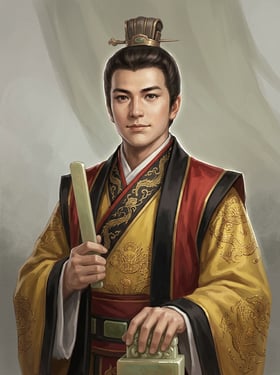
Liu Shan was by nature benevolent and quick-witted, humane and filial. In his early years he relied on the Chancellor Zhuge Liang for decisions and accepted the counsel of the northern campaigns. In his later years he indulged in wine and women, trusted the eunuch Huang Hao, and grew irresolute, in the end displaying a character content merely to muddle through and survive, mediocre and forgetful of his fallen homeland.

Life
In the novel: 34 chapters · In the Records: 15 volumes
Life207–271
208 CE (Jian'an 13)
212 CE (Jian'an 17)
219 CE (Jian'an 24)
15 more events
221 CE (Huangchu 2)
222 CE (Huangchu 3)
223 CE (Huangchu 4)
227 CE (Taihe 1)
228 CE (Taihe 2)
229 CE (Taihe 3)
- Chen Zhen's Mission to WuWuchangWitness
- Death of Zhao YunChengduWitness
231 CE (Taihe 5)
258 CE (Ganlu 3)
262 CE (Jingyuan 3)
263 CE (Jingyuan 4)
263 CE (Jingyuan 4)
264 CE (Xianxi 1)
- Zhong Hui's RebellionChengduWitness
List all 12 stops
- Xinye207Birthplace
- Linqiong222Rebellion of Huang Yuan
- Baidicheng223Liu Bei's Deathbed Entrustment at Baidi
- Chengdu223–228Liu Shan's Accession to the Throne+3 more
- Mount Qi228Zhuge Liang's Northern Expeditions
- Wuchang229Chen Zhen's Mission to Wu
- Chengdu229Death of Zhao Yun
- Hanzhong231Li Yan Dismissed for Failing to Deliver Supplies on Time
- Chengdu258Huang Hao's Usurpation of Power
- Tazhong262Jiang Wei's Agricultural Garrison at Tazhong to Avoid Trouble
- Chengdu263–264Conquest of Shu by Wei+1 more
- Luoyang271Died here
On the boards
Compare with someone →Where this person ranks on each board.
Who they were
Character profile
- Character
- Liu Shan was by nature benevolent and quick-witted, humane and filial. In his early years he relied on the Chancellor Zhuge Liang for decisions and accepted the counsel of the northern campaigns. In his later years he indulged in wine and women, trusted the eunuch Huang Hao, and grew irresolute, in the end displaying a character content merely to muddle through and survive, mediocre and forgetful of his fallen homeland.
- Life
- Liu Shan, styled Gongsi, was the son of Liu Bei, and was established as crown prince in the first year of Zhangwu. In the fifth month of the third year of Zhangwu he succeeded to the throne at Chengdu at the age of seventeen, honored the empress as empress dowager, and proclaimed a general amnesty and a change of reign title. In the first year of Yanxing, on Qiao Zhou's counsel, he surrendered to Deng Ai, and afterward his whole household was moved east to Luoyang, where he was enfeoffed as Duke of Anle County; in the seventh year of Taishi he died at Luoyang.
- Anecdotes
- Liu Shan was the second emperor of Shu Han and its last. He had once been rescued by Zhao Yun, and his childhood name was Adou.
Historical Record
Liu Shan, courtesy name Gongsi, was Liu Bei’s son. In the twenty-fourth year of Jian’an, when Liu Bei became King of Hanzhong, he made Liu Shan heir apparent. In the third year of Zhangwu (223), Liu Bei died, and Liu Shan ascended the throne in Chengdu at the age of seventeen. He honored Empress Wu as empress dowager, granted a general amnesty, and changed the era name. On his deathbed, Liu Bei charged him to serve Chancellor Zhuge Liang as a father. While Zhuge Liang assisted in governing, he decided all affairs of state, great and small. Liu Shan continued to rule as sovereign of Shu Han; historical accounts record that he traveled to Jian County and climbed Guanban to view the Min River, among other events.
After Zhuge Liang’s death, Jiang Wan, Fei Yi, and others governed in succession. In Shu Han’s later years, Huang Hao gained Liu Shan’s trust and came to power. Liu Shan’s younger half-brother Liu Yong detested Huang Hao and was slandered by him; for more than ten years afterward, Liu Yong was not permitted to attend court. The historical account thus shows Liu Shan’s decisions being influenced by those close to him. In the sixth year of Jingyao (263), Wei forces invaded Shu along several routes. Deng Ai advanced through Yinping and defeated Zhuge Zhan at Mianzhu. Liu Shan adopted Qiao Zhou’s plan and sent an envoy bearing a letter and seals of office to surrender. The Prince of Beidi, Liu Chen, urged him to make a last stand with his back to the city, but Liu Shan refused to accept the proposal, and Liu Chen killed himself. Liu Shan then had a coffin carried before him and bound himself as he went to Deng Ai’s camp gate. Deng Ai freed him from his bonds, burned the coffin, and, acting with delegated authority, appointed him General of Agile Cavalry. Liu Shan also ordered the garrisons throughout the land to surrender. Later, Zhong Hui rebelled in Chengdu, and troops in Shu briefly looted the city; order was restored only after several days.
Liu Shan and his entire family moved east to Luoyang, where he was enfeoffed as Duke of Anle County, with a fief of ten thousand households. The Annals of Han and Jin, quoted in Pei Songzhi’s commentary, records that when Sima Zhao hosted Liu Shan at a banquet and had music and dances from Shu performed, those present were overcome with sadness, but Liu Shan remained cheerful and composed. Asked by Sima Zhao whether he missed Shu, he replied, “It is pleasant here; I do not think of Shu.” This is an anecdote preserved in Pei Songzhi’s commentary and should not be conflated with the chronological events in Liu Shan’s biography. Liu Shan died in Luoyang in the seventh year of Taishi; the Record of Shu, quoted in Pei Songzhi’s commentary, says that his posthumous title was Duke Si.
In the Novel
Romance of the Three Kingdoms begins its portrayal of Liu Shan in his infancy. The novel says that his childhood name was A Dou, and depicts the life-or-death drama of his early years in the story of Zhao Yun carrying the infant lord at Changban and breaking through the encirclement. After Liu Bei took the child back, he tossed A Dou down, reassuring Zhao Yun with the words, “You nearly cost me one of my finest generals.” These dramatic details appear in the novel. The historical account says only that, when Lady Gan and the future lord were trapped at Changban, Zhao Yun protected them and brought them to safety; it does not mention Liu Bei tossing his son.
The novel also depicts Lady Sun trying to take the seven-year-old A Dou back to Eastern Wu. Zhao Yun boards her ship and takes the boy back, and Zhang Fei and Zhao Yun ultimately protect A Dou while letting Lady Sun leave. This episode is unique to the novel. After ascending the throne, Liu Shan in the novel often calls Zhuge Liang “Father Chancellor” and relies on his judgment whenever important military or state affairs arise. During the Five-Route Invasion of Shu, Liu Shan goes in person to the chancellor’s residence to ask for advice; after hearing Zhuge Liang lay out his plans one by one, he turns from worry to relief. The novel chiefly portrays Liu Shan as a mild-mannered ruler with little independent judgment who depends on a wise chancellor. Historical accounts confirm that during Zhuge Liang’s regency, all affairs of state were decided by him, but this does not warrant treating the novel’s specific dialogue and scenes as historical fact.
In its account of Shu’s fall, the novel follows the historical framework of Liu Shan’s surrender to Wei, but its particular presentation is literary in character. It emphasizes that Liu Shan heeds Qiao Zhou’s advice and sends a letter to surrender, using the Prince of Beidi, Liu Chen, who dies in grief for his state, to highlight the choice between surrender and battle. Liu Shan later watches performances of Shu music at a banquet in Luoyang and replies, “It is pleasant here; I do not think of Shu.” The novel inherits this anecdote from Pei Songzhi’s commentary and further reinforces the image of Liu Shan as content with his circumstances and little given to thoughts of his former state.
Key Relationships
- Liu Bei: Father and sovereign. Liu Bei made Liu Shan heir apparent, entrusted Zhuge Liang with assisting him on his deathbed, and ordered Liu Shan to serve the chancellor with the respect due a father. The novel also uses the scene of Liu Bei tossing A Dou to comfort Zhao Yun to show Liu Bei’s esteem for his generals. (The tossing scene is unique to the novel.)
- Zhuge Liang: Trusted minister charged with the young ruler’s care and chancellor assisting in government. Historical accounts say that from the first year of Jianxing onward, Zhuge Liang decided all affairs, great and small. The novel portrays Liu Shan as a young ruler who frequently seeks the advice of “Father Chancellor” and relies on his counsel.
- Qiao Zhou: Shu Han official. Before Shu’s fall, Liu Shan adopted Qiao Zhou’s plan and surrendered to Deng Ai. By contrast, the Prince of Beidi, Liu Chen, advocated making a last stand with their backs to the city, but his proposal was rejected.
- Deng Ai: Wei general who received Liu Shan’s surrender. Liu Shan went in person to the gate of his camp to surrender; Deng Ai freed him from his bonds, burned the coffin, and appointed him to office. Liu Shan then ordered the garrisons throughout the land to surrender.
- Liu Yong and Huang Hao: Liu Yong was Liu Shan’s younger half-brother. Because Liu Yong detested Huang Hao, Huang Hao slandered him to Liu Shan, and Liu Yong was kept at a distance for a long time. This account illustrates the influence of relationships with court intimates on Liu Shan’s decisions.
Notable Scenes
- Escape at Changban: Historical accounts briefly record that Liu Bei was trapped at Changban, Dangyang, and that Lady Gan and the future lord were abandoned but escaped harm thanks to Zhao Yun’s protection. The novel expands this into tense scenes of Zhao Yun carrying A Dou through the encirclement and Lady Mi entrusting the child to him before throwing herself into a well. The latter details are unique to the novel.
- Surrender at Chengdu: After Mianzhu fell, Liu Shan sent a letter to surrender, then had a coffin carried before him and bound himself as he went to Deng Ai’s camp gate. Deng Ai freed him from his bonds and burned the coffin, after which Liu Shan ordered the garrisons at all the encampments to surrender. This was a decisive moment in the end of the Shu Han regime and shows that he chose submission to avoid further fighting.
- Banquet in Luoyang: Liu Shan was enfeoffed as Duke of Anle County in Luoyang. An account quoted in Pei Songzhi’s commentary says that he watched music and dances from Shu, remained cheerful and composed, and replied to Sima Zhao that he did not think of Shu. The novel adopts this story and uses it as a concluding portrayal of his character.
Quotes
36 lines in the books · 3 featured
「此間樂,不思蜀也。」
This phrase, 'so happy he does not miss Shu,' has become an idiom, profoundly shaping Liu Shan's image of muddled incompetence.
「朕年幼無知,惟相父斟酌行之。」
It reflects Liu Shan's extreme dependence on Zhuge Liang, a portrayal of his image as 'the hopeless Adou who cannot be propped up.'
「今大臣皆議當降,汝獨仗血氣之勇,欲令滿城流血耶?」
It reflects Liu Shan's cowardly mindset in choosing surrender over resistance at the moment of national peril.
- Family
- Lord & vassal
- Teacher & student
- Other
History vs. novel
7 points · 3 novel-only
| History | Novel |
|---|---|
| Liu Shan's Accession to the ThroneNovel embellishes | |
After Liu Bei's death, Liu Shan acceded to the throne in Chengdu at the age of seventeen and honored Empress Wu as Empress Dowager; the Records of the Three Kingdoms does not record him going out of the city to welcome the coffin. vol. 33 | The novel depicts Liu Shan going out of the city to welcome Liu Bei's coffin, then acceding to the throne with the ministers' support and adopting the Jianxing era name. ch. 85 |
| Zhuge Liang Assumes the RegencyNovel embellishes | |
After Liu Shan acceded to the throne, Zhuge Liang was enfeoffed as Marquis of Wuxiang, established an office to administer affairs, and served as governor of Yi Province; he rendered decisions on all matters of state, great or small. vol. 35 | The novel depicts all court matters, from laws to money and grain, as being handled by Zhuge Liang, and portrays him as a regent capable of arranging Liu Shan's marriage. ch. 85 |
| Five Armies Threaten the BordersNovel only | |
| — | Liu Shan goes in person to the chancellor's residence, sees Zhuge Liang watching fish by the pond, and asks about the five armies. After hearing the plan to repel them, he marvels that his Chancellor-Father possesses unfathomable, almost supernatural insight. ch. 85 |
| The Entrustment on His DeathbedNovel embellishes | |
As he lay dying, Liu Bei ordered Liu Shan to serve Zhuge Liang as he would his own father; after Liu Bei's death, Liu Shan succeeded to the throne. vol. 35 | The novel also depicts Liu Bei entrusting Liu Shan to Zhuge Liang and Liu Shan's accession to the throne, while further elaborating on Liu Shan's reliance on Zhuge Liang: during the southern campaign, he says that he is young and ignorant and that only his Chancellor-Father can weigh what should be done. ch. 87 |
| Welcoming Zhuge Liang's Triumphant ReturnNovel only | |
| — | The novel depicts Liu Shan going thirty li out of the city to welcome Zhuge Liang after he pacifies the south. He waits after alighting from his carriage, then rides back to the city in the same carriage as Zhuge Liang. ch. 91 |
| Surrender of ChengduNovel embellishes | |
When Shu fell, Liu Shan surrendered on Qiao Zhou's advice. He led the crown prince, the princes, and more than sixty ministers to Deng Ai's camp gate, with their hands bound behind them and a coffin in tow. vol. 33 | The novel depicts Liu Shan heeding Qiao Zhou's advice to surrender, while Liu Chen urges him to fight a last stand behind the city walls, to no avail. The next day, Liu Shan leads his people out of the city to surrender; the basic events accord with the historical record. ch. 118 |
| So Happy He Forgot ShuNovel only | |
| — | The novel depicts Liu Shan watching Shu music at a banquet in Luoyang with an untroubled expression. When Sima Zhao asks whether he misses Shu, Liu Shan replies, “I am happy here and do not think of Shu.” ch. 119 |
- Liu Shan's Accession to the ThroneNovel embellishes
- History
After Liu Bei's death, Liu Shan acceded to the throne in Chengdu at the age of seventeen and honored Empress Wu as Empress Dowager; the Records of the Three Kingdoms does not record him going out of the city to welcome the coffin.
vol. 33
- Novel
The novel depicts Liu Shan going out of the city to welcome Liu Bei's coffin, then acceding to the throne with the ministers' support and adopting the Jianxing era name.
ch. 85
- Zhuge Liang Assumes the RegencyNovel embellishes
- History
After Liu Shan acceded to the throne, Zhuge Liang was enfeoffed as Marquis of Wuxiang, established an office to administer affairs, and served as governor of Yi Province; he rendered decisions on all matters of state, great or small.
vol. 35
- Novel
The novel depicts all court matters, from laws to money and grain, as being handled by Zhuge Liang, and portrays him as a regent capable of arranging Liu Shan's marriage.
ch. 85
- Five Armies Threaten the BordersNovel only
- Novel
Liu Shan goes in person to the chancellor's residence, sees Zhuge Liang watching fish by the pond, and asks about the five armies. After hearing the plan to repel them, he marvels that his Chancellor-Father possesses unfathomable, almost supernatural insight.
ch. 85
- The Entrustment on His DeathbedNovel embellishes
- History
As he lay dying, Liu Bei ordered Liu Shan to serve Zhuge Liang as he would his own father; after Liu Bei's death, Liu Shan succeeded to the throne.
vol. 35
- Novel
The novel also depicts Liu Bei entrusting Liu Shan to Zhuge Liang and Liu Shan's accession to the throne, while further elaborating on Liu Shan's reliance on Zhuge Liang: during the southern campaign, he says that he is young and ignorant and that only his Chancellor-Father can weigh what should be done.
ch. 87
- Welcoming Zhuge Liang's Triumphant ReturnNovel only
- Novel
The novel depicts Liu Shan going thirty li out of the city to welcome Zhuge Liang after he pacifies the south. He waits after alighting from his carriage, then rides back to the city in the same carriage as Zhuge Liang.
ch. 91
- Surrender of ChengduNovel embellishes
- History
When Shu fell, Liu Shan surrendered on Qiao Zhou's advice. He led the crown prince, the princes, and more than sixty ministers to Deng Ai's camp gate, with their hands bound behind them and a coffin in tow.
vol. 33
- Novel
The novel depicts Liu Shan heeding Qiao Zhou's advice to surrender, while Liu Chen urges him to fight a last stand behind the city walls, to no avail. The next day, Liu Shan leads his people out of the city to surrender; the basic events accord with the historical record.
ch. 118
- So Happy He Forgot ShuNovel only
- Novel
The novel depicts Liu Shan watching Shu music at a banquet in Luoyang with an untroubled expression. When Sima Zhao asks whether he misses Shu, Liu Shan replies, “I am happy here and do not think of Shu.”
ch. 119
Combat
On the field
Duels, kills and executions as the texts tell them, counted separately for the Records and the Romance.
- RomanceCh. 115ExecutionLiu YanWon「遂斬劉琰」
Events
Events (32)
Battles and events the texts place this person in, by date.
Battles
Other events
- 208Liu Bei's Retreat with Refugees across the River
- 208Zhao Yun Rescues His Lord on a Single HorseVictim
- 212Seizing Liu Shan on the RiverVictim
- 219Liu Bei's Elevation to King of HanzhongWitness
- 221Liu Bei Proclaims Himself EmperorWitness
- 222Rebellion of Huang YuanWitness
- 223Liu Shan's Accession to the ThroneCommander
- 223Deng Zhi's Mission to Wu
All 24
- 223Liu Bei's Deathbed Entrustment at Baidi
- 225Seven Captures of Meng Huo
- 227Former Memorial on Sending Out the TroopsWitness
- 228Latter Memorial on Sending Out the TroopsWitness
- 228Execution of Ma SuWitness
- 229The Wu-Shu Alliance Oath to Divide the Realm in Three
- 229Chen Zhen's Mission to WuWitness
- 229Death of Zhao YunWitness
- 231Li Yan Dismissed for Failing to Deliver Supplies on Time
- 234Rebellion of Wei Yan
- 258Huang Hao's Usurpation of PowerWitness
- 262Jiang Wei's Agricultural Garrison at Tazhong to Avoid TroubleWitness
- 263Conquest of Shu by WeiVictim
- 263Deng Ai's Surprise Attack Through YinpingVictim
- 264Zhong Hui's RebellionWitness
- 280Reunification of the Three Kingdoms under Jin
Famous objects

Places
Continue
The Zhuge Liang's Northern Expeditions in 3D
Replay the Zhuge Liang's Northern Expeditions phase by phase on real terrain: troop strengths, movements and turning points at a glance, each marked as coming from the Records of the Three Kingdoms or the Romance.
Relationship timeline17 entries ▸
History · vol. 4
- Deng Ai§84
Betrayer
went to Ai and surrendered; Ba and Shu were both pacified
History · vol. 28
- Deng Ai§53
Betrayer
Bound himself and had a coffin carried to the army’s gate to request surrender
History · vol. 33
- Liu Yao§19
Child
In Yanxi year 1, was made King of Anding
- Liu Xuan§19
Child
In Yanxi year 1, was made crown prince
- Liu Xun§39
Child
In Yanxi year 2, was made King of Xinxing
- Liu Chen§39
Child
In Yanxi year 2, was made King of Beidi; on the day Shu fell, first killed his wife and children, then took his own life
- Deng Ai§43
Betrayer
followed Qiao Zhou’s advice and surrendered to Ai; brought a coffin, bound himself, and went to the entrance of the military camp
History · vol. 34
- Liu Xuan§36
Child
the Later Lord's crown prince
All 17
Loading…
Inner monologues · AI-generated3 monologues ▸
- Now I am in Luoyang, enfeoffed as the Duke of Anle, with my lodging, food, and clothing all provided by the Wei court. I
- I inherited the work of the late emperor. The realm over which I presided was not merely a palace or a city; it also enc
- I was born in Jing Province. While I was still young, my father was already struggling through the turmoil and upheaval.