Zhang Shao
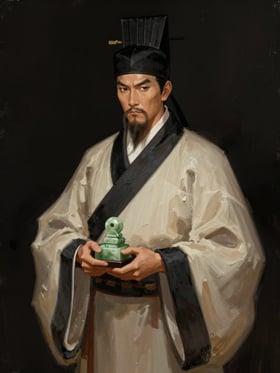
Zhang Shao, Zhang Fei’s second son, appears in histories surrendering to Deng Ai; Romance adds his defense of Langzhong and jade-seal mission.
Appearances
In the novel: 3 chapters · In the Records: 2 volumes
By chapter (5)
Novel
- 81
- 118
- 119
Records
- 33
- 36
On the boards
Compare with someone →Where this person ranks on each board.
Historical Record
Zhang Shao was Zhang Fei’s second son. After his elder brother Zhang Bao died young, Zhang Shao succeeded to the family line. He rose to the senior offices of Attendant-in-Ordinary and Vice Director of the Secretariat, becoming a high-ranking official in the Shu Han court. The account of Zhang Shao in the Records of the Three Kingdoms is brief and does not describe his early life, specific achievements, or personal words and actions; it focuses mainly on his family background and official posts. Near the end of Shu Han, the Later Lord Liu Shan ordered Zhang Shao, an Attendant-in-Ordinary appointed by private authority, to accompany Qiao Zhou and Deng Liang in presenting the seals and ribbons of office and asking Deng Ai for terms of surrender. The letter of surrender, written on behalf of Shu, described the two sides as cut off from one another and expressed willingness to obey, adding that government stores had not been destroyed and the people still had surplus grain; it pleaded with Wei to show mercy and spare the people. This passage shows Zhang Shao taking part as an envoy in the transfer of power, but the Records of the Three Kingdoms does not detail his personal position or role in the surrender discussions. After Shu fell, he accompanied Liu Shan to Luoyang; the Records of the Three Kingdoms also records that he was later enfeoffed as a marquis.
In the Novel
Romance of the Three Kingdoms places Zhang Shao in two episodes: the defense of Langzhong after Zhang Fei’s death, and the surrender negotiations at the end of Shu Han. After the Assassination of Zhang Fei, the novel says Zhang Shao was ordered to remain and defend Langzhong, while his elder brother Zhang Bao went to report the news to Liu Bei; this specific division of duties belongs to the novel’s narrative and is not recorded in the Records of the Three Kingdoms. As Shu Han nears its fall, the novel says Liu Shan accepted Qiao Zhou’s advice, ordered Qiao Zhou to draft a letter of surrender, and sent Zhang Shao, Deng Liang, and Qiao Zhou with the jade seal to Luocheng to surrender to Deng Ai. This accords with the historical account of Zhang Shao presenting the seals and ribbons of office with Qiao Zhou and Deng Liang to ask for terms; the novel, however, gives more detail about the jade seal, Luocheng, and the court’s internal disputes.
The novel also says that after accepting the surrender, Deng Ai made arrangements for the civil and military officials and sent Zhang Jun and Zhang Shao to pacify the people and troops of the various commanderies; at this point, Zhang Shao is called the Assistant to the Governor of Yi Province. Later, the novel says Liu Shan moved to Luoyang, accompanied by Zhang Shao, an Attendant-in-Ordinary, along with Fan Jian, Qiao Zhou, Xi Zheng, and others. These episodes further portray Zhang Shao as an official responsible for negotiations, pacification, and accompanying the court around the time the regime fell. The specific duties and course of the pacification of the various commanderies are elaborations unique to Romance of the Three Kingdoms and should not be treated as part of the historical record.
Key Relationships
- Zhang Fei and Zhang Shao: Zhang Shao was Zhang Fei’s second son. After his elder brother Zhang Bao died young, Zhang Shao succeeded to the family line. After Zhang Fei’s death, Zhang Shao inherited his family position and title, and later rose to become an Attendant-in-Ordinary and Vice Director of the Secretariat.
- Liu Shan and Zhang Shao: The historical account says Liu Shan sent Zhang Shao to present the seals and ribbons of office and take part in asking for terms of surrender; the novel further specifies that Zhang Shao was ordered to accompany Qiao Zhou and Deng Liang with the jade seal on their mission.
- Qiao Zhou, Deng Liang, and Zhang Shao: The three served as envoys in Shu Han’s negotiations to surrender to Wei. The historical account says Zhang Shao accompanied the other two in presenting the seals and ribbons of office to ask for terms; the novel depicts them as a delegation carrying the jade seal to Luocheng.
- Zhang Shao and Deng Ai: Zhang Shao represented Shu Han in asking Deng Ai for terms of surrender; the novel also says he took part in pacifying the people and troops of the various commanderies after the surrender. The specific account of the pacification is unique to Romance of the Three Kingdoms.
Signature Episodes
- Presenting the seals and ribbons of office to ask for terms: Near the end of Shu Han, Zhang Shao, as an Attendant-in-Ordinary appointed by private authority, accompanied Qiao Zhou and Deng Liang in presenting the seals and ribbons of office and asking Wei for terms. The historical surrender letter stressed obedience, noted that government stores had not been destroyed, and asked that the people be spared; it places Zhang Shao among the key envoys involved in the transfer of power from Shu Han.
- Taking the jade seal to Luocheng: In Romance of the Three Kingdoms, the surrender mission follows a scene of confrontation at court: Liu Shan orders Qiao Zhou to draft a letter of surrender, and Zhang Shao and Deng Liang accompany Qiao Zhou with the jade seal to meet Deng Ai at Luocheng. This specific scene of taking the jade seal to Luocheng is unique to the novel.
- Defending Langzhong and accompanying the move to Luoyang: The novel says Zhang Shao remained to defend Langzhong after Zhang Fei’s death, and later says he accompanied Liu Shan to Luoyang after Shu fell. The first arrangement is unique to Romance of the Three Kingdoms; the move to Luoyang with Liu Shan accords with the historical account.
- Family
- Lord & vassal
- Other
Who is Zhang Shao connected to?
Pick someone to see how many steps lie between them and Zhang Shao.
History vs. novel
6 points · 2 novel-only
| History | Novel |
|---|---|
| Ordered to SurrenderNovel embellishes | |
Liu Shan sent Zhang Shao, Qiao Zhou, and Deng Liang to present the seals and credentials and request permission from Wei to surrender. vol. 33 | Liu Shan ordered Qiao Zhou to write a letter of surrender and sent Zhang Shao, Deng Liang, and Qiao Zhou together with the imperial jade seal to Luocheng to surrender. ch. 118 |
| Contents of the Letter of SurrenderHistory only | |
The letter stated that Shu Han and Wei had long been cut off from one another, that Shu Han was unable to resist, and that it was willing to obey Wei’s commands and spare the people. It asked Wei to decide the fate of Shu Han. vol. 33 | — |
| Presentation of the Seals and CredentialsNovel embellishes | |
Historical records state that Zhang Shao and the others presented the seals and credentials and asked Wei to decide the fate of Shu Han. vol. 33 | The novel describes the seals and credentials as an imperial jade seal, and says that Zhang Shao and the others carried it to Luocheng to surrender. ch. 118 |
| Qiao Zhou Urges SurrenderNovel embellishes | |
The letter of surrender was presented by Zhang Shao, Qiao Zhou, and Deng Liang, but the quoted historical account does not say that Qiao Zhou urged surrender or wrote the letter. vol. 33 | Seeing that the situation was dire, Qiao Zhou submitted another memorial urging surrender. Liu Shan accepted his advice and ordered him to write a letter of surrender. ch. 118 |
| Liu Chen Resists SurrenderNovel only | |
| — | Liu Chen denounced Qiao Zhou and advocated resisting with Chengdu’s garrison and Jiang Wei’s relief force. When Liu Shan refused to heed him, he wept and declared that he would rather die than surrender. ch. 118 |
| Liu Chen’s FateNovel only | |
| — | Liu Shan rebuked Liu Chen for failing to recognize the times and ordered his attendants to escort him out of the palace gates. ch. 118 |
- Ordered to SurrenderNovel embellishes
- History
Liu Shan sent Zhang Shao, Qiao Zhou, and Deng Liang to present the seals and credentials and request permission from Wei to surrender.
vol. 33
- Novel
Liu Shan ordered Qiao Zhou to write a letter of surrender and sent Zhang Shao, Deng Liang, and Qiao Zhou together with the imperial jade seal to Luocheng to surrender.
ch. 118
- Contents of the Letter of SurrenderHistory only
- History
The letter stated that Shu Han and Wei had long been cut off from one another, that Shu Han was unable to resist, and that it was willing to obey Wei’s commands and spare the people. It asked Wei to decide the fate of Shu Han.
vol. 33
- Presentation of the Seals and CredentialsNovel embellishes
- History
Historical records state that Zhang Shao and the others presented the seals and credentials and asked Wei to decide the fate of Shu Han.
vol. 33
- Novel
The novel describes the seals and credentials as an imperial jade seal, and says that Zhang Shao and the others carried it to Luocheng to surrender.
ch. 118
- Qiao Zhou Urges SurrenderNovel embellishes
- History
The letter of surrender was presented by Zhang Shao, Qiao Zhou, and Deng Liang, but the quoted historical account does not say that Qiao Zhou urged surrender or wrote the letter.
vol. 33
- Novel
Seeing that the situation was dire, Qiao Zhou submitted another memorial urging surrender. Liu Shan accepted his advice and ordered him to write a letter of surrender.
ch. 118
- Liu Chen Resists SurrenderNovel only
- Novel
Liu Chen denounced Qiao Zhou and advocated resisting with Chengdu’s garrison and Jiang Wei’s relief force. When Liu Shan refused to heed him, he wept and declared that he would rather die than surrender.
ch. 118
- Liu Chen’s FateNovel only
- Novel
Liu Shan rebuked Liu Chen for failing to recognize the times and ordered his attendants to escort him out of the palace gates.
ch. 118
Events
Events (1)
Battles and events the texts place this person in, by date.
Other events
Continue
Zhang Fei
Parent
Relationship timeline2 entries ▸
Inner monologues · AI-generated1 monologue ▸
- When I, Zhang Shao, was ordered to serve as an envoy, the burden I carried was not a matter of personal honor or disgrac