Shu Han · Acting General Who Guards the Army
Zhuge Zhan
courtesy name 思远 · 227–263
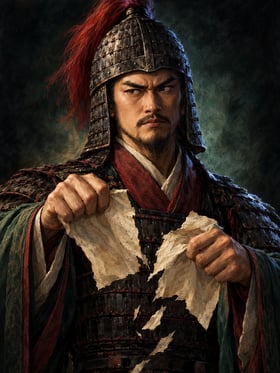
From childhood Zhuge Zhan was clever and read widely in military texts. He feigned illness and stayed away from office to resist Huang Hao's grip on power. On hearing the imperial edict he wept at once, declaring that even were his body ground to pulp he could not repay it. Faced with Deng Ai's offer of surrender, he tore the letter to pieces and beheaded the envoy; in the end, struck by an arrow, he fell from his horse and cried out, 'My strength is spent! I must repay the state with my death,' then drew his sword and cut his own throat.

Life
In the novel: 3 chapters · In the Records: 7 volumes
Life227–263
263 CE (Jingyuan 4)
- Battle of MianzhuMianzhuKilled in action
- Conquest of Shu by WeiChengduKilled in action
- Deng Ai's Surprise Attack Through YinpingYinpingKilled in action
Appearances
By chapter (10)
Outlined chapters have spoken lines; tap one to read them.
Novel
- 105
- 117
- 118
Records
- 28
- 33
- 35
- 36
- 43
- 44
- 45
- Shu Han· Undated
- Life event
- Death
List all 4 stops
On the boards
Compare with someone →Where this person ranks on each board.
10 more boards
- Most Advisors: #31of 98Records
- Died Youngest: #31of 182Records
- Plans That Worked: #55of 159Romance
- Master Strategists: #79of 220Romance
- Most Battles: #84of 230Both
- Best Connected: #128of 2446Both
- Longest Lived: #149of 182Records
- Most Talkative: #221of 607Romance
- Overlooked by the Novel: #239of 2139Both
- Novel Embellished: #241of 2139Both
Who they were
Character profile
- Character
- From childhood Zhuge Zhan was clever and read widely in military texts. He feigned illness and stayed away from office to resist Huang Hao's grip on power. On hearing the imperial edict he wept at once, declaring that even were his body ground to pulp he could not repay it. Faced with Deng Ai's offer of surrender, he tore the letter to pieces and beheaded the envoy; in the end, struck by an arrow, he fell from his horse and cried out, 'My strength is spent! I must repay the state with my death,' then drew his sword and cut his own throat.
- Anecdotes
- Zhuge Zhan was the son of Zhuge Liang, his mother a daughter of Huang Chengyan. He held the posts of Army Escort General and Guard General, and was Commandant of the Imperial Son-in-law (fuma duwei) to the Later Ruler, first taking charge of court affairs. In the end he was defeated by Deng Ai at the Battle of Mianzhu, and after his defeat was beheaded.
Historical Record
Zhuge Zhan, courtesy name Siyuan, was the son of Zhuge Liang and served Shu Han. In the twelfth year of Jianxing, when Zhuge Liang led an army to Wugong, he wrote to his elder brother Zhuge Jin, saying that Zhan was only eight years old, clever and endearing, but that he feared the boy’s precociousness might keep him from becoming a person of great ability. At seventeen, Zhan married a princess and was appointed Cavalry Commandant. He later held posts including Gentleman of the Imperial Guards, Colonel of the Archers, Palace Attendant, and Vice Director of the Imperial Secretariat, and was additionally appointed General of the Army. He was skilled at calligraphy and painting and had a strong memory. The people of Shu remembered Zhuge Liang and admired Zhan’s talent and quick wit. Whenever the court enacted good policies, the people often credited Zhan with them, even when he had not proposed them. As a result, his reputation exceeded his actual achievements. In the fourth year of Jingyao, Zhan served as Acting General Who Protects the Army and, together with Dong Jue, managed the affairs of the Imperial Secretariat.
In the winter of the sixth year of Jingyao, Deng Ai advanced from Yinping, and the Shu army went out to meet him. Zhan led his troops to Fu County, where they halted. After the vanguard was defeated, they withdrew to Mianzhu. Huang Chong urged him to advance quickly, seize the high ground, and block the enemy, but Zhan did not take his advice. Deng Ai was thus able to press forward unchecked. Deng Ai sent a letter urging Zhan to surrender, promising to submit a memorial recommending that Zhan be made King of Langya if he did so. Enraged, Zhan had the envoy beheaded. He then fought and suffered a crushing defeat, dying in battle at the age of thirty-seven. His eldest son, Zhuge Shang, also died alongside him. The historian Gan Bao commented that although Zhan lacked the wisdom and courage to save the state from peril and repel the enemy, he did not betray the state outwardly or abandon his father’s resolve inwardly; he embodied both loyalty and filial piety.
The Records of the Three Kingdoms records that after Deng Ai defeated Zhan at Mianzhu, he advanced to Luo, where the Later Lord Liu Shan sent an envoy bearing the imperial seal and ribbons to request surrender. After Zhan’s death, his second son, Zhuge Jing, and others moved to Hedong. Zhuge Jing later served as Prefect of Mei and eventually rose to become Inspector of Jiangzhou.
In the Novel
The Romance of the Three Kingdoms recasts the historical commander defending against the enemy as a loyal and noble figure who inherits the Marquis of Wu’s prestige and takes up arms in a crisis. The novel portrays Zhuge Zhan as clever from an early age and as marrying a daughter of the Later Lord. The literary additions of Lady Huang’s mother’s talents and learning, her final instructions, and Zhan’s feigning illness and staying away from court because Huang Hao held power are all inventions of the novel; the historical biographies contain no corresponding accounts. When summoned by the Later Lord, Zhan says that father and son have received the late emperor’s great favor and that he is willing to lead the troops in a decisive battle. His son Zhuge Shang volunteers to serve as the vanguard, underscoring the family’s devotion to the state.
The Battle of Mianzhu is greatly expanded in the novel. Zhan first places a wooden statue of Kongming on a four-wheeled cart, leading the Wei army to believe that Zhuge Liang is still alive; he then takes advantage of their confusion to drive the enemy back. The statue’s rout of the enemy is a plot element unique to the novel. The novel also has Zhuge Shang charge into battle, and Zhan defeat Deng Ai’s officers twice. Later, after beheading an envoy and refusing to surrender, he is defeated by an ambush and withdraws to defend Mianzhu. When the city is besieged, Zhan rides out to fight. Struck by an arrow and thrown from his horse, he takes his own life. Seeing his father dead, Shang also goes out to fight and is killed. The historical record says only that Zhan and Shang both died; it does not mention Zhan taking his own life, Shang watching the fighting from atop the city wall, or the earlier battlefield victories and defeats.
Key Relationships
Zhuge Liang was Zhuge Zhan’s Zhi Fu and the source of his reputation: the people of Shu cherished Zhan because they remembered Zhuge Liang, and even credited good policies of the court to “Lord Ge.” The novel further turns “carrying on his father’s resolve” into the dramatic heart of the Battle of Mianzhu, using a wooden carving of Kongming to create a deceptive show of force. This episode is fictional and should not be confused with the actual events recorded in the histories.
Zhuge Shang was Zhan’s eldest son; the historical biography records that he died alongside his father. The novel portrays him as volunteering to fight as the vanguard and depicts father and son dying one after the other. Dong Jue served alongside Zhan in managing the affairs of the Imperial Secretariat. Huang Chong, Li Qiu, and others accompanied the army in resisting Deng Ai. Huang Chong strongly urged Zhan to seize the high ground first, and ultimately died in battle on Zhan’s side. Deng Ai was Zhan’s opponent. He tried to induce Zhan to surrender by promising him a royal title, but Zhan refused; the Wei army ultimately defeated the Shu army at Mianzhu.
Signature Scenes
The scene that best conveys Zhuge Zhan’s predicament in the historical record is his hesitation and withdrawal between Fu County and Mianzhu. Huang Chong urged him to seize the high ground first, but Zhan did not take his advice. After the vanguard was defeated, the Shu army withdrew to Mianzhu. Deng Ai then tried to tempt Zhan into surrender with the promise of a high rank. Zhan beheaded the envoy and went into battle, only to be defeated and killed. This outcome shows both his firm refusal to surrender and the Shu army’s failure to turn the tide in the face of disaster.
The novel’s signature scenes are the wooden statue that frightens the Wei army into retreat and the father and son dying in succession. The former turns Zhuge Liang’s lingering fame into a tactical stratagem; the latter brings Zhuge Zhan’s image as a loyal and noble figure to its dramatic peak. The statue rout, Zhan taking his own life, and Shang following his father to his death are all literary inventions of the novel. The historical record confirms that Zhan died in battle and that Shang died alongside him, but not the specific events depicted in the novel.
Quotes
4 lines in the books · 2 featured
「臣父子蒙先帝厚恩,陛下殊遇,雖肝腦塗地,不能補報。願陛下盡發成都之兵,與臣領去決一死戰。」
It expresses the loyalty of Zhuge Zhan and his son to Shu Han and their resolve to serve their country.
「吾力竭矣!當以一死報國!」
It portrays Zhuge Zhan's tragic, heroic willingness to die for his country, a core trait of his character.
- Family
- Lord & vassal
- Enemies
- Other
Who is Zhuge Zhan connected to?
Pick someone to see how many steps lie between them and Zhuge Zhan.
History vs. novel
7 points · 4 novel-only
| History | Novel |
|---|---|
| Madam Huang and Her Son's UpbringingNovel only | |
| — | The Romance adds that Zhuge Zhan's mother was Huang Chengyan's daughter. Though said to be unattractive, she was well versed in astronomy, geography, and military strategy, and on her deathbed urged her son to be loyal and filial. ch. 117 |
| Feigning Illness to Avoid Huang HaoNovel only | |
| — | The Romance portrays Zhuge Zhan as feigning illness and staying away when Huang Hao held power, thereby expressing his disapproval of Huang Hao's influence over state affairs; the Records of the Three Kingdoms does not mention this. ch. 117 |
| Summoned to Decide the BattleNovel only | |
| — | The Romance says that the Later Lord sent three successive edicts summoning Zhuge Zhan to the palace. Zhuge Zhan wept as he asked to mobilize all of Chengdu's troops and volunteered to lead them in a fight to the death. The Later Lord assigned him seventy thousand men. ch. 117 |
| Zhuge Shang Volunteers to Lead the VanguardNovel only | |
| — | The Romance says that after Zhuge Zhan set out with his troops, he asked who would volunteer to lead the vanguard. His eldest son, Zhuge Shang, stepped forward and offered to fight. The novel also says that he was nineteen, had thoroughly studied military texts, and had trained in martial arts. ch. 117 |
| How They Died at MianzhuNovel embellishes | |
Historical accounts record that Zhuge Zhan retreated to defend Mianzhu and was routed after engaging Deng Ai in battle. He died fighting at the age of thirty-seven; the specific manner of his death is not described. vol. 35 | The Romance elaborates that Zhuge Zhan pursued the enemy outside the city and fell into an ambush. After killing several hundred enemy soldiers, he was struck by an arrow and fell from his horse, then drew his sword and took his own life to repay his country. ch. 117 |
| Zhuge Shang Dies for His CountryNovel embellishes | |
Historical accounts briefly record that Zhuge Shang died in battle alongside his father. A lament quoted in the Huayang Guo Zhi says that he went to meet the Wei army and died because father and son had not eliminated Huang Hao sooner. vol. 35 | The Romance says that Zhuge Shang watched his father die in battle from atop the city wall. Ignoring Zhang Zun's attempts to stop him, he rode out to fight and ultimately died in the thick of battle. It heightens the tragedy with his lament that his family, across three generations, had received the state's favor. ch. 117 |
| The People Credit Zhuge ZhanHistory only | |
Historical accounts say that the people of Shu cherished Zhuge Zhan because they remembered Zhuge Liang. Whenever the court enacted good policies or accomplished worthy deeds, the people often said that Ge Hou had done it, even if he had not proposed it. As a result, his reputation exceeded his actual achievements. vol. 35 | — |
- Madam Huang and Her Son's UpbringingNovel only
- Novel
The Romance adds that Zhuge Zhan's mother was Huang Chengyan's daughter. Though said to be unattractive, she was well versed in astronomy, geography, and military strategy, and on her deathbed urged her son to be loyal and filial.
ch. 117
- Feigning Illness to Avoid Huang HaoNovel only
- Novel
The Romance portrays Zhuge Zhan as feigning illness and staying away when Huang Hao held power, thereby expressing his disapproval of Huang Hao's influence over state affairs; the Records of the Three Kingdoms does not mention this.
ch. 117
- Summoned to Decide the BattleNovel only
- Novel
The Romance says that the Later Lord sent three successive edicts summoning Zhuge Zhan to the palace. Zhuge Zhan wept as he asked to mobilize all of Chengdu's troops and volunteered to lead them in a fight to the death. The Later Lord assigned him seventy thousand men.
ch. 117
- Zhuge Shang Volunteers to Lead the VanguardNovel only
- Novel
The Romance says that after Zhuge Zhan set out with his troops, he asked who would volunteer to lead the vanguard. His eldest son, Zhuge Shang, stepped forward and offered to fight. The novel also says that he was nineteen, had thoroughly studied military texts, and had trained in martial arts.
ch. 117
- How They Died at MianzhuNovel embellishes
- History
Historical accounts record that Zhuge Zhan retreated to defend Mianzhu and was routed after engaging Deng Ai in battle. He died fighting at the age of thirty-seven; the specific manner of his death is not described.
vol. 35
- Novel
The Romance elaborates that Zhuge Zhan pursued the enemy outside the city and fell into an ambush. After killing several hundred enemy soldiers, he was struck by an arrow and fell from his horse, then drew his sword and took his own life to repay his country.
ch. 117
- Zhuge Shang Dies for His CountryNovel embellishes
- History
Historical accounts briefly record that Zhuge Shang died in battle alongside his father. A lament quoted in the Huayang Guo Zhi says that he went to meet the Wei army and died because father and son had not eliminated Huang Hao sooner.
vol. 35
- Novel
The Romance says that Zhuge Shang watched his father die in battle from atop the city wall. Ignoring Zhang Zun's attempts to stop him, he rode out to fight and ultimately died in the thick of battle. It heightens the tragedy with his lament that his family, across three generations, had received the state's favor.
ch. 117
- The People Credit Zhuge ZhanHistory only
- History
Historical accounts say that the people of Shu cherished Zhuge Zhan because they remembered Zhuge Liang. Whenever the court enacted good policies or accomplished worthy deeds, the people often said that Ge Hou had done it, even if he had not proposed it. As a result, his reputation exceeded his actual achievements.
vol. 35
Combat
On the field
Duels, kills and executions as the texts tell them, counted separately for the Records and the Romance.
Records
- Duels
- 0W 0L 0D
DeathKilled by Deng ZhongStruck down · Juan 28
- RecordsJuan 28Struck downDeng ZhongShi ZuanLost「斬瞻及尚書張遵等首」
- RecordsJuan 28Struck downDeng ZhongShi ZuanLost「斬瞻及尚書張遵等首」
Battles in command
Battles this person commanded in, with the outcome as each text tells it.
- Records
- 0W 1L 0D 0 undecided
- Romance
- 0W 1L 0D 0 undecided
- Records263Battle of MianzhuLostvs Wei's armyJuan 35「遂戰,大敗,臨陣死,時年三十七」
- Romance263Battle of MianzhuLostvs Wei troopsCh. 117「蜀兵寡,魏兵眾,三人亦皆戰死,艾因此得了綿竹」
Stratagems
Plans this person devised or saw through, as the texts tell them.
- Romance
- 1 carried out · 1 worked · 0 turned down · 0 seen through
- RomanceCarve a Wooden Statue of Zhuge LiangDeceptionWorkedagainst Wei troopsCh. 117「車上坐者乃木刻孔明遺像也」
Events
Events (4)
Battles and events the texts place this person in, by date.
Battles
- 234Battle of Wuzhang Plains
- 263Battle of MianzhuKilled in action
Other events
- 263Conquest of Shu by WeiKilled in action
- 263Deng Ai's Surprise Attack Through YinpingKilled in action
Places
- Died at
- MianzhuRecords
Continue
Last scene: Conquest of Shu by Wei
Relationship timeline5 entries ▸
History · vol. 35
- Deng Ai§50
Fights
led the troops to Fu and halted; the vanguard was defeated, and they retreated to Mianzhu; Ai sent a letter to entice Zhan, saying, “I will certainly recommend you as Prince of Langya”; Zhan angrily killed Ai’s envoy, then was soundly defeated in battle and died on the battlefield
- Deng Ai§50
Slayer
Died in battle at the Battle of Mianzhu.
- Dong Jue§50
Commands
In the fourth year of Jingyao, jointly managed the affairs of the Secretariat with Dong Jue
Novel · ch. 117
- Liu Shan§14
Lord
The Later Lord's Commandant of the Household for the Imperial Son-in-Law; upon hearing the three edicts, immediately went up to the hall and tearfully petitioned for troops to fight to the death
- Zhuge Shang§15
Child
father and son; volunteered to serve as the vanguard
Inner monologues · AI-generated1 monologue ▸
- When word came that Fucheng had fallen, I was ordered to lead the army out. At this moment, surely everyone in Chengdu i