Overview
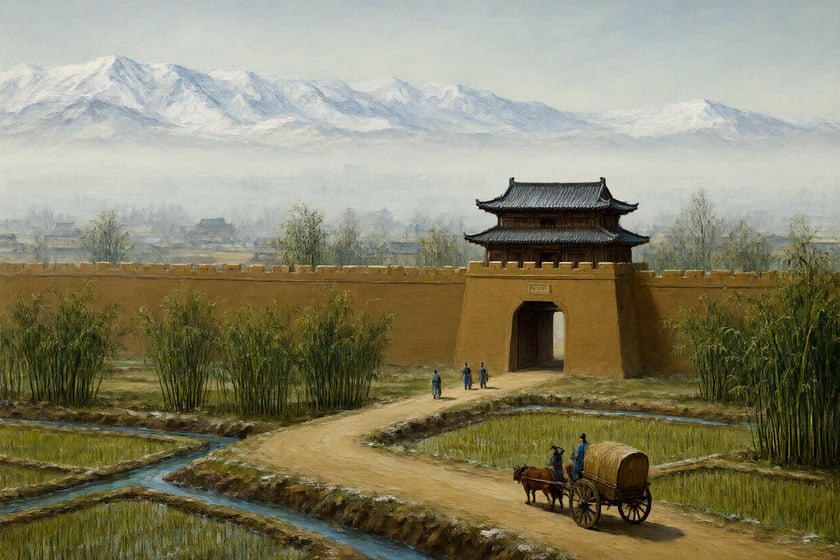
Mianzhu was a county under Guanghan Commandery in Yi Province during the Eastern Han dynasty. Its old city stood in present-day Deyang, Sichuan, on the plain between Fuxian and Chengdu. In the late Eastern Han, Liu Yan made it the seat of Yi Province. In the eighteenth year of Jian’an (213), Liu Bei and Liu Zhang went to war, and Liu Zhang’s forces surrendered there. In the first year of Yanxing (263), Deng Ai defeated Zhuge Zhan there and advanced swiftly into Chengdu. Once Mianzhu was lost, Shu Han’s demise was assured.
History
In the fifth year of Zhongping (188), Ma Xiang and Zhao Zhi proclaimed themselves Yellow Turbans in Mianzhu County, gathering people worn down by corvée labor. Within a day or two, they had amassed several thousand followers. They first killed Li Sheng, the magistrate of Mianzhu, then captured Luoxian and killed Xi Jian, the Inspector of Yi Province. After the provincial clerk Jia Long defeated Ma Xiang, he welcomed Liu Yan, who moved the provincial seat to Mianzhu. He won over the scattered population, appearing generous while secretly harboring other designs. Later, a heavenly fire burned down Mianzhu’s city walls, destroying the carriages and equipment Liu Yan had made and spreading to civilian homes. He therefore moved the provincial seat to Chengdu. He died of illness in the first year of Xingping (194), and his son Liu Zhang succeeded him.
In the seventeenth year of Jian’an (212), Liu Bei and Liu Zhang became enemies, and Liu Bei advanced to occupy Fucheng. Liu Zhang sent Liu Gui, Leng Bao, Zhang Ren, Deng Xian, and others to meet him at Fucheng, but they were all defeated and fell back to Mianzhu. In the eighteenth year of Jian’an (213), Liu Zhang again sent his general Li Yan to command the troops at Mianzhu. Li Yan instead led his men in surrendering to Liu Bei, and Fei Guan, who was serving in the same army, surrendered as well. Fei Shi, then magistrate of Mianzhu, had already surrendered the city. Liu Bei’s forces grew stronger as a result and went on to besiege Luocheng.
During Shu Han, in the fifth year of Jianxing (227), Zhuge Liang took up a northern position at Hanzhong. Zhang Mu and others in the mountains of Mianzhu raided military supplies and seized officials and commoners. The Commandant Zhang Ni pretended to make peace with them, then killed Zhang Mu and more than fifty others at a banquet. In the seventeenth year of Yanxi (254), Jiang Wei advanced north into Longxi and relocated the residents of Didao, He Guan, and Lintao counties, settling them in Mianzhu and Fan County.
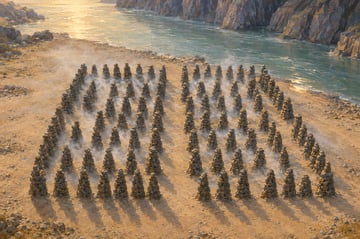
In the winter of the sixth year of Jingyao (263), the Wei general Deng Ai crossed more than seven hundred li of uninhabited land along a narrow path through Yinping and captured Jiangyou. The General of the Guards, Zhuge Zhan, withdrew from Fucheng and drew up his forces at Mianzhu. Deng Ai sent a letter urging him to surrender, promising to recommend him for the title of Prince of Langya. Zhuge Zhan flew into a rage and executed the messenger. Deng Ai’s son Deng Zhong and Shi Zuan attacked from two wings. Their first assault went badly, and they fell back, saying, “The enemy cannot yet be attacked.” Deng Ai angrily rebuked them and threatened to execute them. They turned back and fought again, routing the Shu forces. Zhuge Zhan, the Minister Zhang Zun, and others were killed in battle. The Shu army then disintegrated. The Later Lord Liu Shan followed Qiao Zhou’s advice and surrendered to Deng Ai; that same year, the era name was changed to Yanxing. Deng Ai then raised a high platform at Mianzhu as a monument to his victory, displaying his military achievement; the Wei soldiers killed in battle were buried together with the Shu troops. Later, the Prince of Jin, Sima Zhao, sent a letter to the ruler of Wu, Sun Hao, and still invoked the warning that “those who fought at Mianzhu, from the commander-in-chief on down, were all executed”.
In the first year of Xianxi (264), Zhong Hui rebelled in Chengdu and was killed. The soldiers of Deng Ai’s original camp caught up with the prison cart carrying him and tried to bring him back. The Inspector of the Army, Wei Guan, sent Tian Xu and others to intercept them; west of Mianzhu, they killed Deng Ai and his son Deng Zhong.
People
Native of the area: Qin Mi, a native of Mianzhu in Guanghan, was talented and learned from a young age. When the province and commanderies summoned him, he declined on the grounds of illness.
Former county magistrates: Li Sheng was killed when Ma Xiang rose in rebellion. Fei Shi served as county magistrate under Liu Zhang and later became an Army Inspector under Liu Bei. He was once ordered to persuade Guan Yu to accept the post of General of the Vanguard. After Liu Bei pacified Shu, Ma Su, Lü Yi, and Wang Fu all served as magistrate of Mianzhu. Ma Su entered Shu with Liu Bei and served as magistrate of Mianzhu and Chengdu; Zhuge Liang later held him in high regard. While in office, Lü Yi showed concern for the common people, and his administrative record was the best among the cities of the province. He later rose to the post of Minister over the Masters of Writing. Wang Fu later served as a Discussion Officer in Jing Province. He accompanied Liu Bei in the campaign against Wu, was defeated at Zigui, and was killed.
Killed in the Battle of Mianzhu: Zhuge Zhan, Zhuge Liang’s son, was thirty-seven at the time. His eldest son, Zhuge Shang, died alongside his father. Zhang Zun, Zhang Fei’s grandson, was then serving as a Minister. Huang Chong, son of Huang Quan, repeatedly urged Zhuge Zhan at Fuxian to seize the strategic high ground without delay. Zhuge Zhan hesitated and refused; Huang Chong wept as he remonstrated. After reaching Mianzhu, he encouraged the soldiers and was killed in battle. Li Qiu, nephew of Li Hui, was then serving as Director of the Right Division of the Feathered Forest Guard.
Differences in the historical novel
In Romance of the Three Kingdoms, after Liu Bei captures Luocheng, a Shu defector says that Mianzhu is the only place before Chengdu with a strong garrison. In the novel, Fei Guan defends Mianzhu and, after hearing Li Yan’s advice, opens the gates and surrenders. In the Records of the Three Kingdoms, Fei Guan is an officer who surrenders alongside Li Yan, while the one who surrenders the city is Fei Shi, magistrate of Mianzhu. The novel also says that Liu Bei orders Liu Feng back to defend Mianzhu, an event not recorded in the Records of the Three Kingdoms.
For the Battle of Mianzhu, the novel says Zhuge Zhan deploys the Eight Trigrams formation and brings out a four-wheeled cart bearing a wooden statue of Zhuge Liang. Shi Zuan and Deng Zhong, frightened into thinking Kongming is still alive, retreat without fighting. The Records of the Three Kingdoms says only that their first attack went badly. The Records of the Three Kingdoms also records the deaths of Zhang Zun, Huang Chong, and Li Qiu at Mianzhu. The novel merely has them lead separate units in a charge after Zhuge Zhan and his son are killed, only to die outnumbered; only then does Deng Ai capture Mianzhu.
Today
The old city of Mianzhu stood around present-day Huangxu Town in Jingyang District, Deyang, Sichuan. Today’s Mianzhu City retains the name of this ancient county and lies northwest of the old city.