Shu Han · Minister of Agriculture
Qin Mi
courtesy name 子敕 · –226
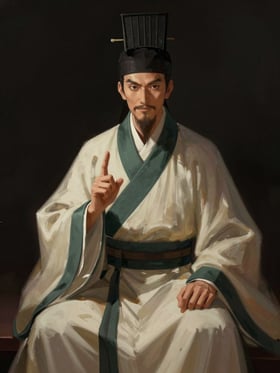
Shu Han scholar Qin Mi opposed Liu Bei's Eastern Campaign (Battle of Xiaoting) and bested Wu envoy Zhang Wen.

Life
In the novel: 4 chapters · In the Records: 4 volumes
Life?–226
223 CE (Huangchu 4)
224 CE (Huangchu 5)
- Shu Han· Undated
- Life event
List all 3 stops
On the boards
Compare with someone →Where this person ranks on each board.
Historical Record
Qin Mi, courtesy name Zichi, was from Mianzhu, Guanghan. He was talented and learned from a young age. When the province and commanderies summoned him to office, he often declined, claiming illness. Early in his career, he submitted a memorandum to Liu Yan, governor of Yi Province, recommending the Confucian scholar Ren An. Citing the examples of Baili Xi and Jian Shu, as well as Gan Luo and Zi Qi, he argued that selecting able men should not be constrained by age, so that the realm might be saved from disorder. He also exchanged letters with Wang Shang about his wish to live in seclusion, comparing himself to Xu You and Zhuang Zhou and declaring that contentment in one’s station was happiness, and freedom from worry was good fortune. This shows that he was neither short of opinions nor lacking in literary skill, but made his own choices about entering public service.
During Liu Zhang’s time, Qin Mi remained known for guarding his independence in seclusion. When Wang Shang urged him to enter office, he replied that a man of lofty character did not seek to flaunt himself. After the Former Lord pacified Yi Province, Xiahou Zuan, Administrator of Guanghan, invited him to serve as Master of Ceremonies and Adviser, overseeing the Five Offices, and addressed him respectfully as “Father Zhong.” Qin Mi claimed illness and stayed at home. Later, he took up the post of Libationer in the Yi Province Secretariat. After Liu Bei Proclaims Himself Emperor, he prepared to campaign east against Wu. Qin Mi advised that the heavens offered no favorable signs for the campaign, and was consequently imprisoned and held in confinement; he was later released. In the second year of Jianxing, Zhuge Liang became governor of Yi Province and appointed Qin Mi as his aide-de-camp. Not long afterward, he was appointed Left Gentleman of the Household and Colonel of the Changshui.
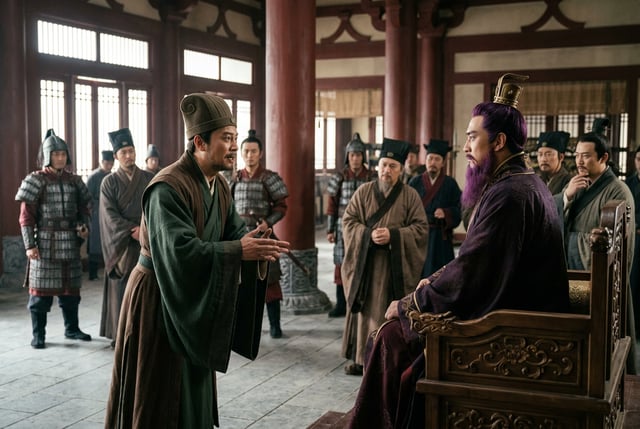
When the Wu envoy Zhang Wen came to visit, Qin Mi initially did not attend the farewell banquet, and Zhuge Liang sent people to urge him several times. Once there, Qin Mi answered Zhang Wen’s questions from the classics: whether Heaven had a head, ears, feet, or a surname, and why the sun rose in the east. He cited lines from the Book of Odes and responded to each question as swiftly as an echo, winning Zhang Wen’s deep admiration. Qin Mi was later promoted to Grand Minister of Agriculture and died in the fourth year of Jianxing. The Records of the Three Kingdoms praises his elegant and splendid rhetoric and reasoning.
In the Novel
Romance of the Three Kingdoms retains Qin Mi’s image as a man famed for his learning and quick wit, while also portraying him as a forthright speaker who advances the plot on several occasions. In Chapter 65, he rebukes Jian Yong for his arrogance while serving Liu Zhang, a scene that the novel uses to show him defending the dignity of figures from Shu. Neither this scene nor his conflict with Jian Yong is recorded in the Records of the Three Kingdoms.
Chapter 80 includes Qin Mi among the officials urging Liu Bei to proclaim himself emperor. In Chapter 81, as Liu Bei prepares to attack Wu, Qin Mi throws himself to the ground to remonstrate. His words enrage Liu Bei, and he narrowly escapes execution; he is saved after the officials plead for him and Zhuge Liang submits a memorial. The Records of the Three Kingdoms does record that Qin Mi opposed the eastern campaign and was imprisoned as a result, but not the specific events in the novel: the order to execute him in court, the officials’ pleas for his life, or Zhuge Liang’s memorial that saves him.
Chapter 86 expands Zhang Wen’s questioning into a debate at a banquet. Qin Mi not only answers each question about whether Heaven has a head, ears, feet, or a surname, but also asks how Zhang Wen would explain Heaven’s tilt toward the northwest, leaving him speechless. This exchange about Gonggong striking the mountain and Heaven tilting as the earth sank is an addition in the novel. The historical account gives a briefer exchange, recording that Qin Mi answered as swiftly as an echo and won Zhang Wen’s admiration, but not this rebuttal.
Key Relationships
Liu Yan and Ren An: Qin Mi recommended Ren An to Liu Yan, arguing that in troubled times, appointments should take both virtue and ability into account. Material in Pei Songzhi’s annotations to the Records of the Three Kingdoms also records Ren An’s summary of his own strengths as “remembering the good in others and forgetting their faults.”
Wang Shang: Wang Shang wrote to urge Qin Mi to enter office. Qin Mi compared himself to Xu You and Zhuang Zhou, expressing his contentment with a life of seclusion. The two also later exchanged letters about establishing shrines to Yan Junping, Li Hong, and Sima Xiangru.
Liu Bei and Zhuge Liang: Qin Mi opposed Liu Bei’s Eastern Campaign, showing his courage in remonstrating against the prevailing course. After his release, he was appointed aide-de-camp during Zhuge Liang’s administration of Shu, and later held posts as a gentleman and colonel.
Zhang Wen: Their exchange, centered on citing the classics and responding with quick wit, is the clearest historical record of Qin Mi’s skill in diplomatic debate. The novel builds on this account by adding Qin Mi’s question about Heaven’s tilt toward the northwest. (This counter-question is unique to the novel.)
Signature Scene
The historical scene that best captures Qin Mi’s style is his exchange with the Wu envoy Zhang Wen, who asked, “Does Heaven have a head?” Qin Mi avoided empty, abstruse talk. Citing “He turns his gaze toward the west,” he concluded that Heaven’s head was in the west. He then cited “The crane cries in the deep marsh; its call is heard in Heaven” to show that Heaven could hear, and “Heaven’s steps are difficult” to show that it had feet. When asked about Heaven’s surname, he answered that the Son of Heaven’s surname was Liu. The exchange took the classics as its foundation, with Qin Mi meeting each question in turn, showcasing his quick-witted eloquence and skill with analogy.
Another scene is his remonstration against the eastern campaign. The historical account merely records that Qin Mi argued the timing was inauspicious, and that he was released after being held in confinement. The novel turns this remonstration into a confrontation between life and death, highlighting his courage in standing by his judgment despite the ruler’s fury. Both versions underscore his forthright character, but the dramatized details of his imminent execution and rescue belong to the novel and should not be confused with the historical record.
Quotes
26 lines in the books · 3 featured
「陛下舍萬乘之軀,而徇小義,古人所不取也:願陛下思之。」
This line admonishes Liu Bei not to raise an army out of private sentiment, embodying Qin Mi's loyal candor and foresight.
「蜀中三尺小童,尚皆就學,何況於我?」
This line displays Qin Mi's erudition and confidence, the classic opening of his debate with Zhang Wen.
「先生東吳名士,既以天事下問,必能深明天之理。昔混沌既分,陰陽剖判;輕清者上浮而為天,重濁者下凝而為地;至共工氏戰敗,頭觸不周山,天柱折,地維缺;天傾西北,地陷東南。天既輕清而上浮,何以傾其西北乎?又未知輕清之外,還有何物?願先生教我。」
This line is the crux of Qin Mi's debate with Zhang Wen, embodying his extraordinary eloquence and wit.
- Lord & vassal
- Friends
- Enemies
- Other
Who is Qin Mi connected to?
Pick someone to see how many steps lie between them and Qin Mi.
History vs. novel
6 points · 2 novel-only
| History | Novel |
|---|---|
| Scolding Jian YongNovel only | |
| — | When Jian Yong entered the city arrogantly, Qin Mi drew his sword and rebuked him, defending the dignity of the people of Shu. The Records of the Three Kingdoms do not record this incident. ch. 65 |
| Remonstrating against the eastern campaignNovel embellishes | |
After Liu Bei Proclaims Himself Emperor, he planned to campaign east against Wu. Qin Mi advised him that the timing was inauspicious, and was consequently imprisoned in confinement. He was later released. vol. 38 | Qin Mi urged Liu Bei not to send troops to avenge Guan Yu. Liu Bei angrily ordered him executed, but even in the face of danger Qin Mi predicted that the newly founded regime would fall. He was later imprisoned, and Zhuge Liang submitted a memorial to secure his release. ch. 81 |
| Debating the nature of Heaven at a banquetNovel embellishes | |
Zhang Wen asked whether Heaven had a head, ears, feet, and a surname. Qin Mi answered by citing the Book of Songs, then replied that the sun rises in the east and sets in the west. Zhang Wen was deeply impressed. vol. 38 | The Romance of the Three Kingdoms retells the exchange in which Qin Mi cites the Book of Songs to answer questions about whether Heaven has a head, ears, feet, and a surname, as well as about sunrise and sunset. It also depicts him arriving at the banquet drunk and astonishing everyone with his answers. ch. 86 |
| Turning the question back on Zhang WenNovel only | |
| — | Qin Mi asked in return: if Heaven is light and clear and floats above, why does it slope toward the northwest, and what is there beyond the light and clear? Zhang Wen had no answer, withdrew from his seat, and offered his thanks. ch. 86 |
| Refusing to lend Strategies of the Warring StatesHistory only | |
Li Quan asked to borrow Qin Mi's copy of Strategies of the Warring States. Qin Mi refused, arguing that the stratagems of the Warring States were of no use. The novel's account does not include this incident. vol. 38 | — |
| Defending his literary talentHistory only | |
Someone questioned why Qin Mi, if he wished to emulate a hermit, would reveal his literary talent. Citing Confucius, Jieyu, and the Fisherman, he argued that writing and literary talent were innate and had their value. The novel's account does not record this incident. vol. 38 | — |
- Scolding Jian YongNovel only
- Novel
When Jian Yong entered the city arrogantly, Qin Mi drew his sword and rebuked him, defending the dignity of the people of Shu. The Records of the Three Kingdoms do not record this incident.
ch. 65
- Remonstrating against the eastern campaignNovel embellishes
- History
After Liu Bei Proclaims Himself Emperor, he planned to campaign east against Wu. Qin Mi advised him that the timing was inauspicious, and was consequently imprisoned in confinement. He was later released.
vol. 38
- Novel
Qin Mi urged Liu Bei not to send troops to avenge Guan Yu. Liu Bei angrily ordered him executed, but even in the face of danger Qin Mi predicted that the newly founded regime would fall. He was later imprisoned, and Zhuge Liang submitted a memorial to secure his release.
ch. 81
- Debating the nature of Heaven at a banquetNovel embellishes
- History
Zhang Wen asked whether Heaven had a head, ears, feet, and a surname. Qin Mi answered by citing the Book of Songs, then replied that the sun rises in the east and sets in the west. Zhang Wen was deeply impressed.
vol. 38
- Novel
The Romance of the Three Kingdoms retells the exchange in which Qin Mi cites the Book of Songs to answer questions about whether Heaven has a head, ears, feet, and a surname, as well as about sunrise and sunset. It also depicts him arriving at the banquet drunk and astonishing everyone with his answers.
ch. 86
- Turning the question back on Zhang WenNovel only
- Novel
Qin Mi asked in return: if Heaven is light and clear and floats above, why does it slope toward the northwest, and what is there beyond the light and clear? Zhang Wen had no answer, withdrew from his seat, and offered his thanks.
ch. 86
- Refusing to lend Strategies of the Warring StatesHistory only
- History
Li Quan asked to borrow Qin Mi's copy of Strategies of the Warring States. Qin Mi refused, arguing that the stratagems of the Warring States were of no use. The novel's account does not include this incident.
vol. 38
- Defending his literary talentHistory only
- History
Someone questioned why Qin Mi, if he wished to emulate a hermit, would reveal his literary talent. Citing Confucius, Jieyu, and the Fisherman, he argued that writing and literary talent were innate and had their value. The novel's account does not record this incident.
vol. 38
Events
Events (4)
Battles and events the texts place this person in, by date.
Battles
Other events
- 221Liu Bei Proclaims Himself Emperor
- 223Deng Zhi's Mission to WuAdvisor
- 224Qin Mi's Debate with Zhang WenAdvisor
Places
- Native of
- MianzhuRecords
Continue
Deng Zhi's Mission to Wu
Relationship timeline8 entries ▸
History · vol. 38
- Liu Yan§33
Advised
sent a memorandum to the governor of Yi Province recommending the Confucian scholar Ren Dingzu
- Ren An§35
Friend
Recommended him, believing that his benevolence, righteousness, and upright conduct had made his name known far and wide
- Wang Shang§36
Friend
Wang Shang sent a letter urging him to come out; Mi answered with his aspiration to live in lofty seclusion; later they also discussed establishing a shrine
- Xiahou Zuan§43
Lord
Zuan requested that he serve as libationer for tutors and friends and hold the office of Chief Clerk of the Five Offices, and addressed him as “Second Father”
- Liu Bei§47
Advised
When the Lord planned to campaign east against Wu, Mi stated that the timing could bring no advantage; he was imprisoned and confined for this
- Zhang Wen§47
Advised
Answered the question about whether Heaven had a head, ears, feet, and a surname; Wen Da greatly admired and respected him
Novel · ch. 65
- Jian Yong§20
Rival
In segment 20, drew his sword and shouted, rebuking him for his arrogant sidelong glances
Novel · ch. 81
- Liu Bei§4
Advised
tried to dissuade him from the eastern campaign and was nearly executed; the First Lord ordered him imprisoned
Inner monologues · AI-generated1 monologue ▸
- I am Qin Mi, courtesy name Zichi. When Zhang Wen, an envoy from Eastern Wu, arrived in Shu, the officials went to see hi