Eastern Wu · General-in-Chief
Zhuge Jin
courtesy name 子瑜 · 174–241
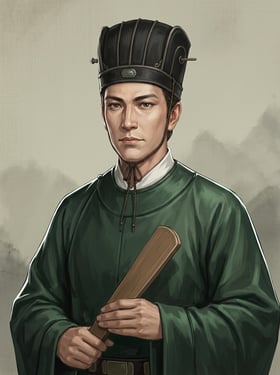
Zhuge Jin had a dignified appearance and thoughtful bearing; the men of his time admired his broad-minded refinement, and his face was long.

Life
In the novel: 19 chapters · In the Records: 15 volumes
Life174–241
208 CE (Jian'an 13)
222 CE (Huangchu 3)
223 CE (Huangchu 4)
1 more event
229 CE (Taihe 3)
234 CE (Qinglong 2)
236 CE (Qinglong 4)
Allegiance
- Sun Quan's Faction
- Eastern Wu
- Hatched: dated by chapter
- Life event
On the boards
Compare with someone →Where this person ranks on each board.
9 more boards
Who they were
Character profile
- Appearance
- Zhuge Jin had a dignified appearance and thoughtful bearing; the men of his time admired his broad-minded refinement, and his face was long.
- Character
- He was broad-minded and unhurried by nature, pursuing reason and following his plans, without any knack for meeting sudden turns of fortune. He was cautious and shunned suspicion, once counseling his younger brother with the parable of Boyi and Shuqi.
- Manner of speech
- He cited the ancients to convey feeling, mild and roundabout; at times he would provoke Kongming through family matters, and he would also argue by invoking the principle of weighing the light against the heavy, the great against the small.
- Life
- At the end of the Han he fled the turmoil to the region east of the Yangtze. After Sun Ce's death, Hong Zi—the husband of Sun Quan's elder sister—recommended him to Sun Quan, and he was received as an honored guest alongside Lu Su and others. Learned and versatile, he served his mother with the utmost filial devotion.
- Anecdotes
- He was the elder brother of Zhuge Liang and a senior minister of Eastern Wu, serving as Grand General, Left Protector, and acting Governor of Yu Province. Lu Su once said, 'Day by day I look forward to meeting you, sir.'
Historical Record
Zhuge Jin, courtesy name Ziyu, was from Yangdu, Langya. At the end of the Han dynasty, he fled the disorder and went east of the Yangtze. After Sun Ce’s death, Hongzi, the husband of Sun Quan’s sister, recommended him. Sun Quan treated him with respect, and he successively served as Chief Clerk and Deputy Marshal. He was broad-minded and upright, skilled at reasoning and offering advice tactfully, and never angered Sun Quan with harsh words. Sun Quan valued him and often consulted him on important matters.
In the twentieth year of Jian’an, Sun Quan sent Zhuge Jin on a mission to Liu Bei to discuss restoring friendly relations. He and his younger brother Zhuge Liang met in public, but did not meet privately after leaving court. Sun Quan later ordered him to demand several commanderies in Jing Province. Liu Bei refused, and Guan Yu drove out the officials appointed by Wu, so Sun Quan sent troops to seize Changsha, Lingling, and Guiyang. After Cao Cao advanced into Hanzhong, Liu Bei sought peace. Zhuge Jin was sent to return the diplomatic visit, and the two sides divided Jing Province, with the Xiang River as the boundary.
Later, Zhuge Jin joined the campaign against Guan Yu and was enfeoffed as Marquis of Xuancheng. He succeeded Lü Meng as Administrator of Nan Commandery and was stationed at Gong’an. When Liu Bei launched Liu Bei’s Eastern Campaign (Battle of Xiaoting) against Wu, Sun Quan sought peace. Zhuge Jin wrote to Liu Bei, urging him to call off the campaign by weighing the closeness of their ties and the relative importance of their interests. He also led troops to reinforce Nan Commandery when Wei forces besieged it. In the first year of Huangwu, he was promoted to General of the Left, placed in command at Gong’an, granted imperial authority, and enfeoffed as Marquis of Wanling. The Wu Record, quoted in Pei Songzhi’s annotations, says that he was mild-tempered and skilled in reasoning and planning, but not adept at adapting to changing circumstances or setting ambushes. The Wei army later withdrew, allowing him to preserve his forces and secure the territory.
Zhuge Jin repeatedly pleaded on Yu Fan’s behalf. He also tactfully eased Sun Quan’s displeasure with Zhu Zhi, and when Yin Mo was found guilty, he blamed himself and pleaded for him, prompting Sun Quan to pardon Yin Mo. He became related by marriage to Zhang Cheng and was close to Sun Jiao. His younger brother Zhuge Liang served Shu, while his son Zhuge Ke became a senior official of Wu. After Sun Quan Proclaims Himself Emperor, Zhuge Jin served as General-in-Chief and Left Protector, and held the post of Governor of Yu Province. He died in the fourth year of Chiwu, aged sixty-eight. In his final instructions, he asked to be buried in a plain coffin and the clothes he wore at the time, with the funeral kept simple.
In the Novel
Romance of the Three Kingdoms portrays Zhuge Jin as a gentle, cautious civil official loyal to Eastern Wu, and emphasizes his status as Zhuge Liang’s elder brother. The novel introduces him on Lu Su’s recommendation, describing him as widely learned and devoted to his mother. He advises Sun Quan against allying with Yuan Shao and to submit temporarily to Cao Cao, and Sun Quan accepts his proposal. This early strategic counsel is part of the novel’s narrative and is not recorded in the Records of the Three Kingdoms.
In the Chibi story, Zhuge Jin takes part in discussions in Sun Quan’s camp. When Zhou Yu asks his opinion, he argues that “those who surrender can find safety more easily, while those who fight cannot be sure of survival.” Later, at Zhou Yu’s request, he tries to persuade Zhuge Liang to serve Eastern Wu, but his younger brother counters him with an appeal to loyalty. Zhuge Jin ultimately declares that he has received great kindness from Sun Quan and will not betray Wu. Through this clash between the brothers, the novel sets the bonds of kinship alongside their separate loyalties to their respective lords. The historical account says that the brothers met in public but did not meet privately, and records that Sun Quan trusted Zhuge Jin and believed he would not betray Wu; it does not mention this attempt to persuade Zhuge Liang to defect.
Thereafter, the novel repeatedly sends him on missions to Jing Province and Shu Han: he seeks Jing Province for Sun Quan, proposes a marriage alliance, tries to persuade Guan Yu to surrender, and goes to Baidi to seek peace when Liu Bei attacks Wu. These negotiations are often rejected or met with humiliation. While echoing the diplomatic negotiations and letter to Liu Bei recorded in the historical account, the novel heightens the drama of the envoy’s repeated journeys and difficult position, and adds episodes involving the detention of his family, the insult over the marriage proposal, and his attempt to persuade Guan Yu to surrender at Maicheng. These are all unique to the novel.
Key Relationships
- Sun Quan: Sun Quan treated Zhuge Jin with respect and trusted him, often seeking his advice. The novel also repeatedly depicts him carrying out missions on Sun Quan’s orders, and uses the phrase “an alliance unalterable even in life or death” to portray their mutual understanding as ruler and subject.
- Zhuge Liang: They were brothers. The historical account says that when they met on a diplomatic mission, “after withdrawing, they did not meet privately.” Sun Quan also once remarked that Zhuge Liang had committed himself to Liu Bei and was wholly devoted to him. The novel turns their divided loyalties into a face-to-face debate between brothers. (Unique to the novel: the analogy to Boyi and Shuqi, and the scene in which Zhuge Liang urges him to “honor both affection and duty.”)
- Zhuge Ke: Zhuge Jin’s son. The historical record says Zhuge Jin often worried that his son Ke did not have the temperament to safeguard the family. Zhuge Ke later became renowned in his time, but was eventually executed amid internal turmoil in Wu.
- Liu Bei and Guan Yu: Zhuge Jin was once sent by Sun Quan to restore friendly relations with Liu Bei and seek peace. The novel separately depicts his conflicts with Guan Yu over Jing Province, the marriage proposal, and attempts to persuade him to surrender. (Unique to the novel: the rejected marriage proposal and the attempt to persuade Guan Yu to surrender at Maicheng.)
Signature Scenes
- Not meeting privately as brothers: When Zhuge Jin went on a mission to Shu, he and Zhuge Liang met at a public gathering but did not meet privately afterward, showing that their fraternal bond coexisted with their separate service to their respective lords.
- Advising with measured reason: When Sun Quan flew into a rage over Yin Mo’s offense, he asked Zhuge Jin why he had not spoken up. Zhuge Jin first blamed himself for failing to guide a fellow townsman, then recounted his own years of wandering before returning to Wu. Sun Quan was moved and granted Yin Mo a special pardon. The episode captures Zhuge Jin’s way of avoiding blunt confrontation and instead easing matters through appeals to reason and feeling.
- Relief of Nan Commandery and prolonged siege: When Wei forces besieged Nan Commandery, Zhuge Jin was ordered to bring relief alongside Pan Zhang, Yang Can, and others. Material quoted in Pei Songzhi’s annotations also records that he led troops in an attack on a pontoon bridge, after which the Wei forces withdrew. The historical account’s assessment of him includes both strengths and limitations: he was prudent in planning, but not known for resourceful stratagems in the heat of the moment.
- The novel’s attempt to persuade his brother at a relay station: Sent by Zhou Yu to persuade Zhuge Liang to join Wu, Zhuge Jin is instead urged in return by his younger brother to “honor both affection and duty,” and goes back in shame. This is a representative scene in which the novel dramatizes the brothers’ relationship. (Unique to the novel)
- The novel’s peace mission to Baidi: During Liu Bei’s Eastern Campaign (Battle of Xiaoting), Zhuge Jin is sent to Baidi, where he weighs the relative importance of the issues and urges Liu Bei to turn his attention to attacking Wei. Liu Bei refuses, citing his grudge over Guan Yu’s death. The historical account does record that Zhuge Jin wrote to urge Liu Bei to make peace with Wu, but the exchange at Baidi and its specific wording are elaborations unique to the novel. (Unique to the novel)
Quotes
31 lines in the books · 3 featured
「夷、齊雖至餓死首陽山下,兄弟二人亦在一處。我今與你同胞共乳,乃各事其主,不能旦暮相聚,視夷、齊之為人,能無愧乎?」
This line reveals the deep brotherly bond between Zhuge Jin and Zhuge Liang, who nonetheless each serve their own lord—a helpless and conflicted state of mind.
「臣請以輕重大小之事,與陛下論之。陛下乃漢朝皇叔,今漢帝已被曹丕篡奪,不思剿除,卻為異姓之親,而屈萬乘之尊,是舍大義而就小義也。中原乃海內之地,兩都皆大漢創業之方,陛下不取,而但爭荊州,是棄重而取輕也。天下皆知陛下即位,必興漢室,恢復山河;今陛下置魏不問,反欲伐吳,竊為陛下不取。」
This line shows Zhuge Jin placing the greater good first, urging Liu Bei to forsake lesser loyalty for the greater cause—a display of strategic vision.
「此子非保家之主也!」
This line is Zhuge Jin's precise prediction about Sun Quan's heirs, reflecting his discernment of character.
- Family
- Friends
- Enemies
- Other
Who is Zhuge Jin connected to?
Pick someone to see how many steps lie between them and Zhuge Jin.
History vs. novel
6 points · 1 novel-only
| History | Novel |
|---|---|
| Sun Quan Recruits the WorthyNovel embellishes | |
When Sun Quan was recruiting talented men and inviting prominent scholars to serve, Zhuge Jin, Lu Su, and others began to join his household; the Records of the Three Kingdoms does not detail how they were recommended. vol. 47 | Lu Su recommended Zhuge Jin to Sun Quan, praising his broad learning and talent and his filial devotion to his mother. Sun Quan then treated him with the courtesy due to a guest. ch. 29 |
| Brothers Serve Their Respective LordsNovel embellishes | |
Sun Quan once mentioned that Zhuge Jin and Zhuge Liang were brothers, but no record says that they tried to persuade one another face to face. Zhuge Jin made clear that since his younger brother already served Liu Bei, he himself would not switch to serving another lord. vol. 52 | Before Chibi, Zhuge Jin, acting on Zhou Yu’s orders, urged Zhuge Liang to defect to Eastern Wu, but Zhuge Liang instead persuaded him to assist Liu Bei. The brothers argued their respective positions on grounds of affection and principle, and Zhuge Jin ultimately refused to betray Sun Quan. ch. 44 |
| Urging Liu Bei to Halt His CampaignNovel embellishes | |
When Liu Bei campaigned east against Wu, Zhuge Jin wrote to him, urging him to weigh his vengeance for Guan Yu against the larger interests of the realm. Some said that Zhuge Jin had secretly contacted Liu Bei, but Sun Quan remained convinced of his loyalty. vol. 52 | On orders, Zhuge Jin went as an envoy to urge Liu Bei to halt his campaign, arguing the merits of supporting the Han dynasty and weighing the relative importance of things. Liu Bei refused to listen, denounced Sun Quan in anger, and threatened to kill Zhuge Jin. ch. 82 |
| Withdrawal from XiangyangNovel embellishes | |
In the fifth year of Jiahe, Lu Xun and Zhuge Jin attacked Xiangyang. After their plans were exposed, Lu Xun steadied morale by planting beans and playing go. He and Zhuge Jin devised a withdrawal and launched attacks on Jiangxia and other places. vol. 58 | The novel also depicts Lu Xun calmly planting beans and putting on archery displays as he arranged the retreat, while Zhuge Jin followed the plan and commanded the ships to feign resistance. But the novel places this episode after Cao Rui personally led an expedition, the Wu army suffered a crushing defeat, and an epidemic broke out. ch. 103 |
| Guan Yu Rejects a Marriage ProposalNovel only | |
| — | On Sun Quan’s orders, Zhuge Jin proposed a marriage to Guan Yu, seeking to have Sun Quan’s son marry Guan Yu’s daughter. Guan Yu rejected the proposal with the words “a tiger’s daughter cannot marry a dog’s son” and ordered Zhuge Jin thrown out. ch. 73 |
| Zhuge Ke’s Father’s WorriesNovel embellishes | |
Zhuge Jin believed that his son Zhuge Ke was not someone who could preserve the family, and often worried about it. The historical biography also records him lamenting that if Zhuge Ke could not bring prosperity to the family, he might bring calamity upon the clan. vol. 52 | The novel depicts Zhuge Jin as having long declared that Zhuge Ke was not fit to preserve the family, and places this statement just before the episode in which Zhuge Ke is executed by Sun Jun and his entire family is killed. ch. 108 |
- Sun Quan Recruits the WorthyNovel embellishes
- History
When Sun Quan was recruiting talented men and inviting prominent scholars to serve, Zhuge Jin, Lu Su, and others began to join his household; the Records of the Three Kingdoms does not detail how they were recommended.
vol. 47
- Novel
Lu Su recommended Zhuge Jin to Sun Quan, praising his broad learning and talent and his filial devotion to his mother. Sun Quan then treated him with the courtesy due to a guest.
ch. 29
- Brothers Serve Their Respective LordsNovel embellishes
- History
Sun Quan once mentioned that Zhuge Jin and Zhuge Liang were brothers, but no record says that they tried to persuade one another face to face. Zhuge Jin made clear that since his younger brother already served Liu Bei, he himself would not switch to serving another lord.
vol. 52
- Novel
Before Chibi, Zhuge Jin, acting on Zhou Yu’s orders, urged Zhuge Liang to defect to Eastern Wu, but Zhuge Liang instead persuaded him to assist Liu Bei. The brothers argued their respective positions on grounds of affection and principle, and Zhuge Jin ultimately refused to betray Sun Quan.
ch. 44
- Urging Liu Bei to Halt His CampaignNovel embellishes
- History
When Liu Bei campaigned east against Wu, Zhuge Jin wrote to him, urging him to weigh his vengeance for Guan Yu against the larger interests of the realm. Some said that Zhuge Jin had secretly contacted Liu Bei, but Sun Quan remained convinced of his loyalty.
vol. 52
- Novel
On orders, Zhuge Jin went as an envoy to urge Liu Bei to halt his campaign, arguing the merits of supporting the Han dynasty and weighing the relative importance of things. Liu Bei refused to listen, denounced Sun Quan in anger, and threatened to kill Zhuge Jin.
ch. 82
- Withdrawal from XiangyangNovel embellishes
- History
In the fifth year of Jiahe, Lu Xun and Zhuge Jin attacked Xiangyang. After their plans were exposed, Lu Xun steadied morale by planting beans and playing go. He and Zhuge Jin devised a withdrawal and launched attacks on Jiangxia and other places.
vol. 58
- Novel
The novel also depicts Lu Xun calmly planting beans and putting on archery displays as he arranged the retreat, while Zhuge Jin followed the plan and commanded the ships to feign resistance. But the novel places this episode after Cao Rui personally led an expedition, the Wu army suffered a crushing defeat, and an epidemic broke out.
ch. 103
- Guan Yu Rejects a Marriage ProposalNovel only
- Novel
On Sun Quan’s orders, Zhuge Jin proposed a marriage to Guan Yu, seeking to have Sun Quan’s son marry Guan Yu’s daughter. Guan Yu rejected the proposal with the words “a tiger’s daughter cannot marry a dog’s son” and ordered Zhuge Jin thrown out.
ch. 73
- Zhuge Ke’s Father’s WorriesNovel embellishes
- History
Zhuge Jin believed that his son Zhuge Ke was not someone who could preserve the family, and often worried about it. The historical biography also records him lamenting that if Zhuge Ke could not bring prosperity to the family, he might bring calamity upon the clan.
vol. 52
- Novel
The novel depicts Zhuge Jin as having long declared that Zhuge Ke was not fit to preserve the family, and places this statement just before the episode in which Zhuge Ke is executed by Sun Jun and his entire family is killed.
ch. 108
Combat
On the field
Duels, kills and executions as the texts tell them, counted separately for the Records and the Romance.
Battles in command
Battles this person commanded in, with the outcome as each text tells it.
- Records
- 0W 0L 0D 1 undecided
- Romance
- 1W 1L 0D 0 undecided
- Records222Three-Pronged Campaign against WuUndecidedvs Wei's armyJuan 47「是月,魏軍皆退」
- Romance222Three-Pronged Campaign against WuWonvs Wei troopsCh. 85「丕聽知三路兵敗,乃喟然嘆曰」
- Romance234Man Chong Burns the Siege Equipment and Shoots Sun TaiLostvs Wei's armyCh. 103「燒毀戰船、糧草、器具不計其數。諸葛瑾率敗兵逃走沔口。魏兵大勝而回」
Stratagems
Plans this person devised or saw through, as the texts tell them.
- Records
- 1 carried out · 1 worked · 0 turned down · 0 seen through
- Romance
- 1 carried out · 0 worked · 0 turned down · 0 seen through
- RecordsMake a Sound in the East, Strike in the WestFeintWorkedagainst Xiangyang defendersJuan 58「遜悉上兵馬,以向襄陽城。敵素憚遜,遽還赴城。瑾便引船出」
- RomanceSeek a Marriage AlliancePersuasionFailedagainst Jing ProvinceCh. 73「吾虎女安肯嫁犬子乎」
Events
Events (12)
Battles and events the texts place this person in, by date.
Battles
Other events
Places
- Native of
- LangyaRecords
- Was at
- Gong'anRecords
- Governed
- Nan CommanderyRecords

Continue
Three-Pronged Campaign against Wu
Relationship timeline19 entries ▸
History · vol. 3
- Sima Yi§3
Fights
Jin and Ba raided Xiangyang; Xuanwang attacked and defeated them, and beheaded Ba
History · vol. 35
- Zhuge Ke§46
Child
father and son (Ke was Jin’s eldest son, Yuanxun)
History · vol. 52
History · vol. 54
- Zhou Yin§15
Advised
Joined Bu Zhi in signing a memorial requesting clemency for Zhou Yin
History · vol. 64
- Zhuge Ke§3
Child
father and son; Ke was Jin’s eldest son
Novel · ch. 29
- Sun Quan§38
Advised
Urged Quan not to ally with Yuan Shao, but to submit to Cao Cao
All 19
Loading…
Inner monologues · AI-generated3 monologues ▸
- I recall that when I was young, my family lived in Langya. The world grew more chaotic by the day, and our home region w
- When the fighting was over and I looked back on my life, what I remembered most was not the gain or loss of a city or a
- I received my commission from Wu and stood between two states. The hardest part was not finding the right words, but hol