Lü Bu's faction · General
Zhang Liao
courtesy name 文远 · c. 169–222
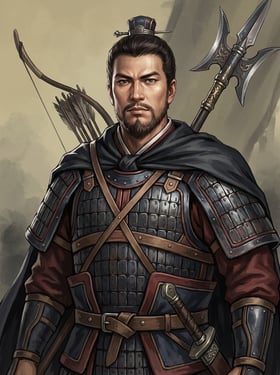
Zhang Liao's martial prowess surpassed others; he threw himself into battle with valor, stayed composed amid crisis, served his lord with loyalty and diligence, and understood the bond of ruler and minister. He once faced death without fear, stretching out his neck to await execution, and to Cao Cao's face cursed him as a 'traitor to the state.'

Life
In the novel: 31 chapters · In the Records: 15 volumes
Life169–222
194 CE (Xingping 1)
- Fire Attack at PuyangPuyangWarrior
198 CE (Jian'an 3)
15 more events
199 CE (Jian'an 4)
200 CE (Jian'an 5)
201 CE (Jian'an 6)
- Battle of CangtingCangtingWarrior
- Cao Cao Pacifies HebeiYeWarrior
207 CE (Jian'an 12)
208 CE (Jian'an 13)
209 CE (Jian'an 14)
- Battle of TianzhushanMount TianzhuCommander
214 CE (Jian'an 19)
- Battle of WanWanWitness
215 CE (Jian'an 20)
216 CE (Jian'an 21)
- Battle of Ruxu (217)RuxukouWarrior
224 CE (Huangchu 5)
- Cao Pi's Guangling CampaignGuanglingKilled in action
- Lü Bu's faction
- Cao Wei
- Dong Zhuo's Faction· Undated
- Hatched: dated by chapter
- Life event
- Death
List all 12 stops
- Mayi169Birthplace
- Puyang194Fire Attack at Puyang
- Xuchang198Mi Heng Beats the Drum and Reviles Cao Cao
- Xiapi198–200Battle of Xiapi+3 more
- Xuchang200Guan Yu Hangs Up His Seal and Returns the Gold
- Ye201Cao Cao Pacifies Hebei
- Cangting201Battle of Cangting
- White Wolf Mountain207Cao Cao's Campaign Against the Wuhuan+1 more
- Jing Province208Cao Cao's Southern Campaign Against Jing Province
- Mount Tianzhu209–214Battle of Tianzhushan+1 more
- Xiaoyao Ford215Battle of Xiaoyao Ford+1 more
- Guangling224Cao Pi's Guangling Campaign
On the boards
Compare with someone →Where this person ranks on each board.
Who they were
Character profile
- Character
- Zhang Liao's martial prowess surpassed others; he threw himself into battle with valor, stayed composed amid crisis, served his lord with loyalty and diligence, and understood the bond of ruler and minister. He once faced death without fear, stretching out his neck to await execution, and to Cao Cao's face cursed him as a 'traitor to the state.'
- Manner of speech
- Zhang Liao spoke plainly and to the point, addressing his lord as 'my lord' or 'my enlightened lord,' and in discussing warfare often closed with decisive phrases such as 'the crux of victory or defeat lies in this one battle.'
- Life
- Zhang Liao was a native of Mayi in Yanmen, originally a descendant of Nie Yi who changed his surname to escape a feud, and in his youth a commandery clerk. He served in turn under Ding Yuan, He Jin, Dong Zhuo, and Lü Bu, then submitted to Cao Cao, who appointed him Gentleman of the Household and granted him the rank of Marquis Within the Passes. He repeatedly garrisoned Hefei, crushed Sun Quan, and beheaded the Chanyu Tadun, dying at last of illness at Jiangdu.
- Weapons
- Zhang Liao chiefly used the halberd, and also the bow and the saber.
- Anecdotes
- Chen Shou ranked Zhang Liao 'foremost of the Five Elite Generals,' and together with Zhang He and Xu Huang praised him as 'thoroughly accomplished.' Lord Guan knew he had a spirit of loyalty and duty, and once drew him into the tale through the memory of their old battle at Puyang.
Historical Record
Zhang Liao, courtesy name Wenyuan, was from Mayi in Yanmen. His original surname was Nie, but he changed it to Zhang to avoid a feud. In his youth, he served as a local administrative clerk and was successively summoned by Ding Yuan and He Jin; he then served under Dong Zhuo and Lü Bu. After Lü Bu was defeated at Xiapi, Zhang Liao led his men to join Cao Cao. He was appointed General of the Household and enfeoffed as a Lord of the Passes; thereafter, he repeatedly held general’s posts and became a leading military commander under Cao Cao. At the Battle of Boma, he and Guan Yu served as vanguard commanders and defeated Yan Liang’s army. He was also appointed vanguard during the campaign against the Wuhuan, and at White Wolf Mountain he routed the enemy and killed Tadun. During the siege of Chang Xi, Zhang Liao observed that the enemy commander was wavering, took the initiative to invite him to talk, and used Cao Cao’s authority to persuade him to surrender. He even climbed the mountain alone and entered the man’s home. Cao Cao said this conduct was unbecoming of a senior general, but Zhang Liao explained that he had judged the man would not dare harm him.
Zhang Liao excelled at making decisions in battle and could also steady his troops in a crisis. When panic and a fire broke out at the camp in Changshe one night, he judged that the whole camp was not in revolt. He ordered those who had not rebelled to sit still, then formed ranks with several dozen personal guards and captured and killed the ringleaders. During the campaign against Chen Lan and Mei Cheng, he led his army to Mount Tianzhu. Despite concerns about the treacherous paths and his small force, he decided to attack and ultimately killed both men. His most famous military achievement came at the Battle of Hefei. Cao Cao had left secret instructions. After Sun Quan arrived with a large army and besieged the city, Zhang Liao urged an attack before the enemy could complete its encirclement. He recruited eight hundred men that night, then donned armor and wielded a halberd as he led the charge the next day, pressing into the ranks beneath Sun Quan’s command before turning back to break through and rescue his surrounded troops. The Wu army’s morale was shaken, and after more than ten days it lifted the siege and withdrew. Cao Cao thereupon appointed Zhang Liao General Who Conquers the East.
Zhang Liao continued to take part in campaigns against Wu. He was once summoned to relieve Fancheng, and on another occasion went with Cao Xiu to Hailing, where they reached the river. After Emperor Wen ascended the throne, Zhang Liao was enfeoffed as Marquis of Jinyang. At Jian Shi Hall, Emperor Wen asked him about the defeat of Wu and praised him as “Zhao Hu of ancient times.” When Zhang Liao fell gravely ill, Emperor Wen sent imperial physicians to visit him and went to see him in person. Zhang Liao eventually died of illness in Jiangdu and was posthumously titled Marquis Gang. Remembering his achievements at Hefei, Emperor Wen said that Zhang Liao and Li Dian had defeated one hundred thousand enemy troops with eight hundred foot soldiers, and that the Wu army had been robbed of its courage ever since. After his death, he was enshrined alongside the other generals of Cao Wei in the temple of the Grand Ancestor.
In the Novel
The Romance of the Three Kingdoms portrays Zhang Liao as a brave, loyal, and perceptive commander among Lü Bu’s former subordinates. During the fighting at Puyang, he is shown serving under Lü Bu as one of his doughty generals, alongside Zang Ba and others. When Cao Cao is ambushed, the novel also has Zhang Liao and Zang Ba attack from both sides out of the city, reinforcing his image as a fierce warrior in Lü Bu’s camp. The Records of the Three Kingdoms does not record these specific ambushes inside Puyang. After Lü Bu’s defeat and death, the novel has Zhang Liao captured. He faces Cao Cao without fear and denounces him as a “traitor to the state”; after Liu Bei and Guan Yu plead on his behalf, he is released and surrenders. The Records of the Three Kingdoms merely says that Zhang Liao led his men to join Cao Cao after Lü Bu’s defeat; it does not include the dramatic scene of his face-to-face denunciation and release following an appeal.
The novel particularly emphasizes Zhang Liao’s old friendship with Guan Yu and his skill with words. At Xiapi, he rides alone up a mound to persuade Guan Yu. Rather than tempting him with wealth and rank, he argues from their Peach Garden oath, the trust placed in him to protect Liu Bei’s family, and the need to preserve a useful life; he then persuades Guan Yu to surrender temporarily by setting out “three advantages.” He subsequently conveys Guan Yu’s “three conditions” on his behalf, prompting Cao Cao to agree. This is the novel’s literary elaboration of Zhang Liao as a persuasive man who valued affection and kept faith. The historical accounts say that he and Guan Yu both served as vanguard commanders at Boma, and that Guan Yu left after receiving generous treatment from Cao Cao, but they do not tell of Zhang Liao persuading him to surrender at the mound at Xiapi.
Key Relationships
- Cao Cao: Zhang Liao first served Lü Bu, then led his men to join Cao Cao. He repeatedly distinguished himself in the Cao Wei army and was especially esteemed for his defense of Hefei. Cao Cao personally praised his achievements, and Emperor Wen also hailed him as “Zhao Hu of ancient times.”
- Guan Yu: The two once served together as vanguard commanders at the Battle of Boma. The historical account says that after Guan Yu killed Yan Liang, he left Cao Cao to return to Liu Bei, and Cao Cao ordered Zhang Liao to ask about his intentions. The novel goes further, portraying Zhang Liao as persuading Guan Yu to surrender temporarily at Xiapi and treating him with the consideration due an old friend; this episode is unique to the novel.
- Li Dian and Yue Jin: Zhang Liao defended Hefei alongside the two men. Although Li Dian had long been at odds with Zhang Liao, he put the state’s interests first and joined the sortie; Yue Jin, meanwhile, followed the secret instructions and guarded the army.
- Sun Quan: Zhang Liao’s attack at Hefei dealt a blow to Sun Quan’s army. Later, when Sun Quan attacked Hefei again and withdrew, Zhang Liao led his troops in an assault on his force; Sun Quan personally escaped danger.
Signature Episodes
- Leading the charge at Boma: Cao Cao adopted a diversionary strategy and made a rapid assault on Baima. Zhang Liao and Guan Yu led the charge, defeated Yan Liang’s army, and relieved the siege. This battle established Zhang Liao’s reputation for military achievement in Cao Cao’s army.
- Receiving the command pennant at White Wolf Mountain: The expedition against the Wuhuan unexpectedly encountered the enemy. After inspecting their formation, Cao Cao appointed Zhang Liao as vanguard. Zhang Liao fought fiercely and routed the enemy, and Tadun was killed. Pei Songzhi’s annotations further say that Cao Cao handed Zhang Liao the command pennant he was carrying, showing the confidence he placed in Zhang Liao’s performance in battle.
- The charge of eight hundred at Hefei: Facing one hundred thousand Wu troops, Zhang Liao argued that they should strike the enemy’s vanguard before its forces could complete their encirclement. He led eight hundred men into battle, charged into the Wu ranks, then broke through and turned back to rescue his troops. Sun Quan was forced to lift the siege, making this Zhang Liao’s most renowned feat.
- Persuading Guan Yu at the mound (unique to the novel): In the novel, Zhang Liao rides alone up the mound and uses appeals to “righteousness,” rather than force, to persuade Guan Yu to surrender temporarily. He also conveys the conditions Guan Yu proposes, presenting him as eloquent and mindful of old ties. The Records of the Three Kingdoms does not record this episode.
Quotes
54 lines in the books · 3 featured
「當初劉使君與兄結義之時,誓同生死;今使君方敗,而兄即戰死,倘使君復出,欲求兄相助,而不可復得,豈不負當年之盟誓乎?其罪一也。劉使君以家眷付託於兄,兄今戰死,二夫人無所倚賴,負卻使君依託之重。其罪二也。兄武藝超群,兼通經史,不思共使君匡扶漢室,徒欲赴湯蹈火,以成匹夫之勇,安得為義?其罪三也。兄有此三罪,弟不得不告。」
This speech persuading Guan Yu to surrender reflects Zhang Liao's blend of wisdom and courage, a classic passage in Romance of the Three Kingdoms.
「主公遠征在外,吳兵以為破我必矣。今可發兵出迎,奮力與戰,折其鋒銳,以安眾心,然後可守也。」
This speech displays Zhang Liao's boldness and strategic vision at the Battle of Hefei, cementing his standing as a renowned general.
「公遠征在外,比救至,彼破我必矣。是以教指及其未合逆擊之,折其盛勢,以安衆心,然後可守也。成敗之機,在此一戰,諸君何疑?」
This is recorded as historical fact: Zhang Liao rallied the troops' morale before the Battle of Hefei, reflecting his military talent.
- Family
- Lord & vassal
- Friends
- Enemies
- Teacher & student
- Other
History vs. novel
7 points · 3 novel-only
| History | Novel |
|---|---|
| The Eight Valiant Generals Go into BattleNovel embellishes | |
The Records of the Three Kingdoms says that Zhang Liao served Ding Yuan and Dong Zhuo in his early years, and later joined Lü Bu. It does not record him taking the field alongside Zang Ba as one of the “Eight Valiant Generals.” vol. 17 | The novel lists Zhang Liao as one of the eight valiant generals under Lü Bu and has him intercept Xiahou Dun in battle, forcing Cao Cao’s army to retreat. ch. 11 |
| The Puyang Pincer AttackNovel only | |
| — | The novel says that Cao Cao entered Puyang and fell into a trap, where Zhang Liao burst out from the eastern lane and joined Zang Ba in attacking him, forcing him to fight his way out. ch. 12 |
| Surrender at XiapiNovel embellishes | |
After Lü Bu was defeated and killed at Xiapi, Zhang Liao led his men in surrendering to Cao Cao and was appointed Gentleman of the Household and granted the title of Lord of the Passes. The Records of the Three Kingdoms does not record him berating Cao Cao to his face. vol. 17 | The novel says that when Zhang Liao was brought before Cao Cao, he angrily denounced him as a “traitor to the state” and stretched out his neck, ready to die. After Liu Bei and Guan Yu pleaded for him, Cao Cao released and employed him. ch. 20 |
| Persuading Guan Yu to SurrenderNovel only | |
| — | The novel says Zhang Liao urged Guan Yu to surrender, warning that otherwise he would commit “three offenses.” Guan Yu, in turn, set three conditions: he would surrender to the Han, his two sisters-in-law must be treated well, and he would leave as soon as he learned Liu Bei’s whereabouts. Cao Cao agreed. ch. 25 |
| Killing Tadun at White Wolf MountainNovel embellishes | |
The historical account says that when the army encountered the enemy at Liucheng, Zhang Liao strongly urged Cao Cao to attack. Cao Cao entrusted him with the command pennant, and the Wei army routed the enemy and killed Tadun. vol. 17 | The novel places the battle at White Wolf Mountain and says Zhang Liao led the charge and personally killed Modun. In the historical account, the man killed was Tadun. ch. 33 |
| Rescuing Cao Cao at Changban BridgeNovel only | |
| — | The novel says that when Zhang Fei’s shout sent Cao Cao fleeing, Zhang Liao and Xu Chu caught up and steadied his horse’s reins, reassured him, and advised him to rally the army and fight again. ch. 42 |
| The Surprise Attack at HefeiNovel embellishes | |
The historical account says Zhang Liao led eight hundred men in a surprise attack on Sun Quan’s army of one hundred thousand, charging as far as Sun Quan’s position before breaking out and rescuing the rest of his men. The Wu army was shaken, and Sun Quan withdrew after besieging the city for more than ten days. vol. 17 | The novel also says Zhang Liao urged an attack before the Wu army could join forces, but focuses on how he and Li Dian put aside their differences, laid an ambush at Xiaoyao Ford, and cut the bridge. ch. 67 |
- The Eight Valiant Generals Go into BattleNovel embellishes
- History
The Records of the Three Kingdoms says that Zhang Liao served Ding Yuan and Dong Zhuo in his early years, and later joined Lü Bu. It does not record him taking the field alongside Zang Ba as one of the “Eight Valiant Generals.”
vol. 17
- Novel
The novel lists Zhang Liao as one of the eight valiant generals under Lü Bu and has him intercept Xiahou Dun in battle, forcing Cao Cao’s army to retreat.
ch. 11
- The Puyang Pincer AttackNovel only
- Novel
The novel says that Cao Cao entered Puyang and fell into a trap, where Zhang Liao burst out from the eastern lane and joined Zang Ba in attacking him, forcing him to fight his way out.
ch. 12
- Surrender at XiapiNovel embellishes
- History
After Lü Bu was defeated and killed at Xiapi, Zhang Liao led his men in surrendering to Cao Cao and was appointed Gentleman of the Household and granted the title of Lord of the Passes. The Records of the Three Kingdoms does not record him berating Cao Cao to his face.
vol. 17
- Novel
The novel says that when Zhang Liao was brought before Cao Cao, he angrily denounced him as a “traitor to the state” and stretched out his neck, ready to die. After Liu Bei and Guan Yu pleaded for him, Cao Cao released and employed him.
ch. 20
- Persuading Guan Yu to SurrenderNovel only
- Novel
The novel says Zhang Liao urged Guan Yu to surrender, warning that otherwise he would commit “three offenses.” Guan Yu, in turn, set three conditions: he would surrender to the Han, his two sisters-in-law must be treated well, and he would leave as soon as he learned Liu Bei’s whereabouts. Cao Cao agreed.
ch. 25
- Killing Tadun at White Wolf MountainNovel embellishes
- History
The historical account says that when the army encountered the enemy at Liucheng, Zhang Liao strongly urged Cao Cao to attack. Cao Cao entrusted him with the command pennant, and the Wei army routed the enemy and killed Tadun.
vol. 17
- Novel
The novel places the battle at White Wolf Mountain and says Zhang Liao led the charge and personally killed Modun. In the historical account, the man killed was Tadun.
ch. 33
- Rescuing Cao Cao at Changban BridgeNovel only
- Novel
The novel says that when Zhang Fei’s shout sent Cao Cao fleeing, Zhang Liao and Xu Chu caught up and steadied his horse’s reins, reassured him, and advised him to rally the army and fight again.
ch. 42
- The Surprise Attack at HefeiNovel embellishes
- History
The historical account says Zhang Liao led eight hundred men in a surprise attack on Sun Quan’s army of one hundred thousand, charging as far as Sun Quan’s position before breaking out and rescuing the rest of his men. The Wu army was shaken, and Sun Quan withdrew after besieging the city for more than ten days.
vol. 17
- Novel
The novel also says Zhang Liao urged an attack before the Wu army could join forces, but focuses on how he and Li Dian put aside their differences, laid an ambush at Xiaoyao Ford, and cut the bridge.
ch. 67
Combat
On the field
Duels, kills and executions as the texts tell them, counted separately for the Records and the Romance.
Duel them- RecordsJuan 1Struck downTadunWon「斬蹋頓及名王已下」
- RomanceCh. 11DuelXiahou DunBroken off「呂布陣上,張遼截住廝殺」
- RomanceCh. 11DuelLu QianCao HongWon「操使呂虔、曹洪戰之,不利」
- RomanceCh. 30DuelZhang HeDraw40 bouts「二將鬥了四五十合,不分勝負」
- RomanceCh. 30Struck downJiang QiWon「奇措手不及,被張遼斬於馬下」
- RomanceCh. 32DuelYuan ShangWon「不三合,架隔遮攔不住,大敗而走」
All encounters (14)
Loading…
Battles in command
Battles this person commanded in, with the outcome as each text tells it.
- Records
- 2W 0L 0D 0 undecided
- Romance
- 1W 0L 0D 0 undecided
- Records207Battle of White Wolf MountainWonvs the enemyJuan 1「虜衆大崩,斬蹋頓及名王已下」
- Records215Battle of Xiaoyao FordWonvs Wu forcesJuan 17「自旦戰至日中,吳人奪氣,還修守備」
- Romance215Battle of Xiaoyao FordWonvs Wu troopsCh. 67「李典又截住廝殺,吳兵折了大半」
Stratagems
Plans this person devised or saw through, as the texts tell them.
- Records
- 2 carried out · 2 worked · 0 turned down · 0 seen through
- Romance
- 2 carried out · 2 worked · 0 turned down · 1 seen through
- RecordsPersuade to SurrenderPersuasionWorkedJuan 17「遼欲挑與語,儻可誘也」
- RecordsTell Those Who Do Not Resist to Sit StillDeceptionWorkedagainst the rebelsJuan 17「乃令軍中,其不反者安坐」
- RomanceInternal Agent Assassinates LiaoOtherSaw throughCh. 53「豈有一城皆反者?此是造反之人,故驚軍士耳」
- RomanceTurn the Enemy's Stratagem against ThemLureWorkedagainst Wu troopsCh. 53「此是吳兵外應,可就計破之」
- RomanceAmbushAmbushWorkedagainst Wu troopsCh. 67「來日引一軍於逍遙津北埋伏;待吳兵殺過來,可先斷小師橋」
Events
Events (36)
Battles and events the texts place this person in, by date.
Battles
- 198Battle of XiapiWarrior
- 200Battle of Guandu
- 201Battle of CangtingWarrior
- 201Battle of Rangshan
- 207Battle of White Wolf MountainWarrior
- 208Huarong Road
- 208Cao Cao's Southern Campaign Against Jing ProvinceWarrior
- 208Battle of Jiangling
All 18
- 208Battle of Red CliffsWarrior
- 208Borrowing Arrows with Straw Boats
- 208Battle of Red Cliffs
- 208Battle of Changban
- 209Battle of TianzhushanCommander
- 213Battle of Ruxukou
- 214Battle of WanWitness
- 215Battle of Xiaoyao FordCommander
- 216Battle of Ruxu (217)Warrior
- 222Three-Pronged Campaign against Wu
Other events
- 194Lü Bu's Seizure of Yanzhou
- 194Fire Attack at PuyangWarrior
- 197Yuan Shu Proclaims Himself Emperor
- 198Lü Bu Raids Xiaopei
- 198Mi Heng Beats the Drum and Reviles Cao CaoWitness
- 198Zang Ba Submits to Cao Cao
- 199Trial at White Gate TowerWarrior
- 200Guan Yu Slays Yan Liang
All 18
- 200Guan Yu Passes Five Passes and Slays Six Generals
- 200Guan Yu Surrenders to Cao CaoAdvisor
- 200Guan Yu's Three Conditions at TushanAdvisor
- 200Guan Yu Hangs Up His Seal and Returns the GoldWitness
- 200Guan Yu Takes the Robe at Ba Bridge
- 201Cao Cao Pacifies HebeiWarrior
- 207Cao Cao's Campaign Against the WuhuanWarrior
- 215Ambush North of Xiaoyao FordCommander
- 219Flooding of the Seven Armies
- 224Cao Pi's Guangling CampaignKilled in action
Places
- Native of
- MayiRecords
Continue
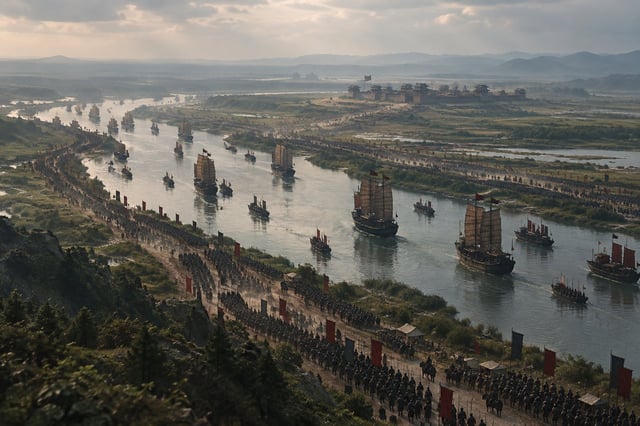
The Battle of Xiaoyao Ford in 3D
Replay the Battle of Xiaoyao Ford phase by phase on real terrain: troop strengths, movements and turning points at a glance, each marked as coming from the Records of the Three Kingdoms or the Romance.
Relationship timeline27 entries ▸
History · vol. 12
- He Kui§40
Fights
joined He Kui in attacking the bandits Hou Ping, Cong Qian, and others
History · vol. 17
- Chang Xi§3
Enemy
besieged him at Donghai; challenged him to talk, then went alone up San Gong Mountain, entered Xi’s home, paid respects to his wife and children, and persuaded him to surrender
- Tadun§3
Enemy
Liucheng then attacked and killed the chanyu Tadun
- Yue Jin§3
Friend
joined Yue Jin in capturing Yin'an and relocating its people to Henan; together defended Hefei
- Chen Lan§4
Enemy
led Zhang He, Niu Gai, and others to attack him; attacked Mount Tianzhu and killed Lan
- Zhang He§4
Commands
Commanded Zhang He, Niu Gai, and others to attack Chen Lan
Enemy
attacked at Mount Tianzhu and beheaded him
- Sun Quan§5
Enemy
At Hefei, he recruited eight hundred volunteers willing to die; they were the first to scale the walls and break into the enemy formation, charging to Sun Quan's standard; Sun Quan climbed a high tomb and defended himself with a long halberd; Liao shouted at Sun Quan to come down and fight; Sun Quan dared not move
- Zhang Hu§6
Child
father and son; succeeded to the title
- Lü Fan§6
Enemy
defeated Lü Fan with the generals
Sibling
brothers; enfeoffed his older brother Fan as a marquis
All 27
Loading…
Inner monologues · AI-generated3 monologues ▸
- I have reached Jiangdu, and my illness grows worse by the day. The river wind blows against my clothes, yet it still bri
- I have often thought that, when facing the enemy, the hardest thing is not wielding a halberd, but discerning the hearts
- I am Zhang Liao, courtesy name Wenyuan, from Mayi in Yanmen. I recall that in my youth, my family was descended from Nie