Language
← Girdle Edict

Guan Yu Passes Five Passes and Slays Six Generals

200 CE (Jian'an 5)

According to chapters 27 and 28 of the Romance of the San Guo, in the fifth year of Jian'an (200), after winning repeated distinction at Baima and Yanjin during the early phase of the Guandu campaign, Guan Yu learned of Liu Bei's whereabouts in Yuan Shao's camp. He thereupon sealed his official seal and returned the gold gifts he had received, left a letter of farewell to Cao Cao, and set out northward with the carriages of Lady Gan and Lady Mi to rejoin his sworn brother. Along the way he cut down six commanders who refused to let him pass: Kong Xiu at Dongling Pass, the Grand Administrator of Luoyang Han Fu, Bian Xi at Sishuiguan, the Grand Administrator of Xingyang Wang Zhi, Hu Ban — a subordinate of Wang Zhi who in the Romance defected to Guan Yu after spying on him — and Qin Qi at the Yellow River crossing. En route he also won the surrender of Liao Hua and some hundred-odd of his followers, avoided an assassination attempt thanks to a recommendation from Hu Hua, and finally received word from Sun Qian that Liu Bei had already moved on to Runan. After routing the pursuing troops of Xiahou Dun, he was reunited with Zhang Fei at the Ancient City, and Zhang Liao conveyed Cao Cao's order that no one was to give chase. The Romance uses this chain of heroic passages through the checkpoints to construct the image of Guan Yu as the embodiment of loyalty and righteousness combined (Guayinfengjin).

Part of the Girdle Edict campaign▶ Watch the whole campaign's routes on the map
Guan Yu Passes Five Passes and Slays Six Generals

Scene

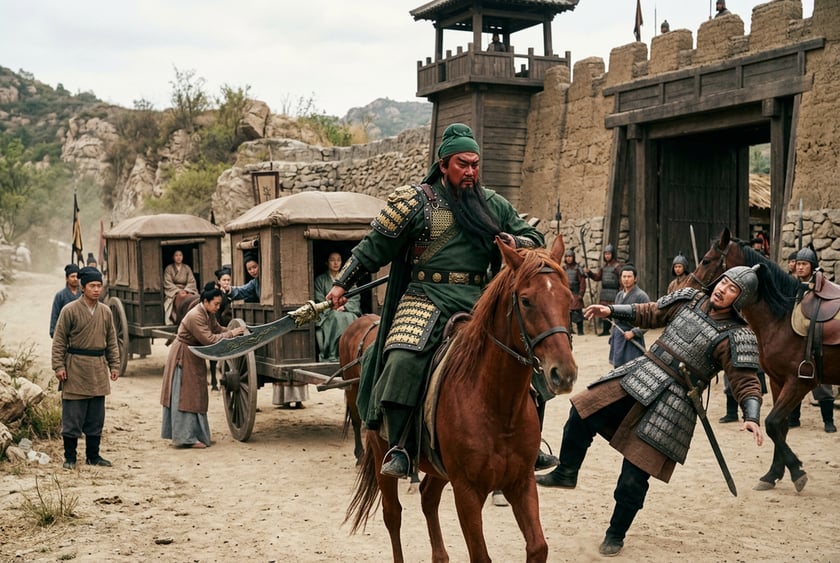
Riding the Red Hare and wielding his Green Dragon Crescent Blade, Guan Yu kills Kong Xiu with a single stroke before Dongling Pass. Behind him is the carriage train of the two ladies, Gan and Mi.

Featured people: Guan Yu

Imagine this scene →
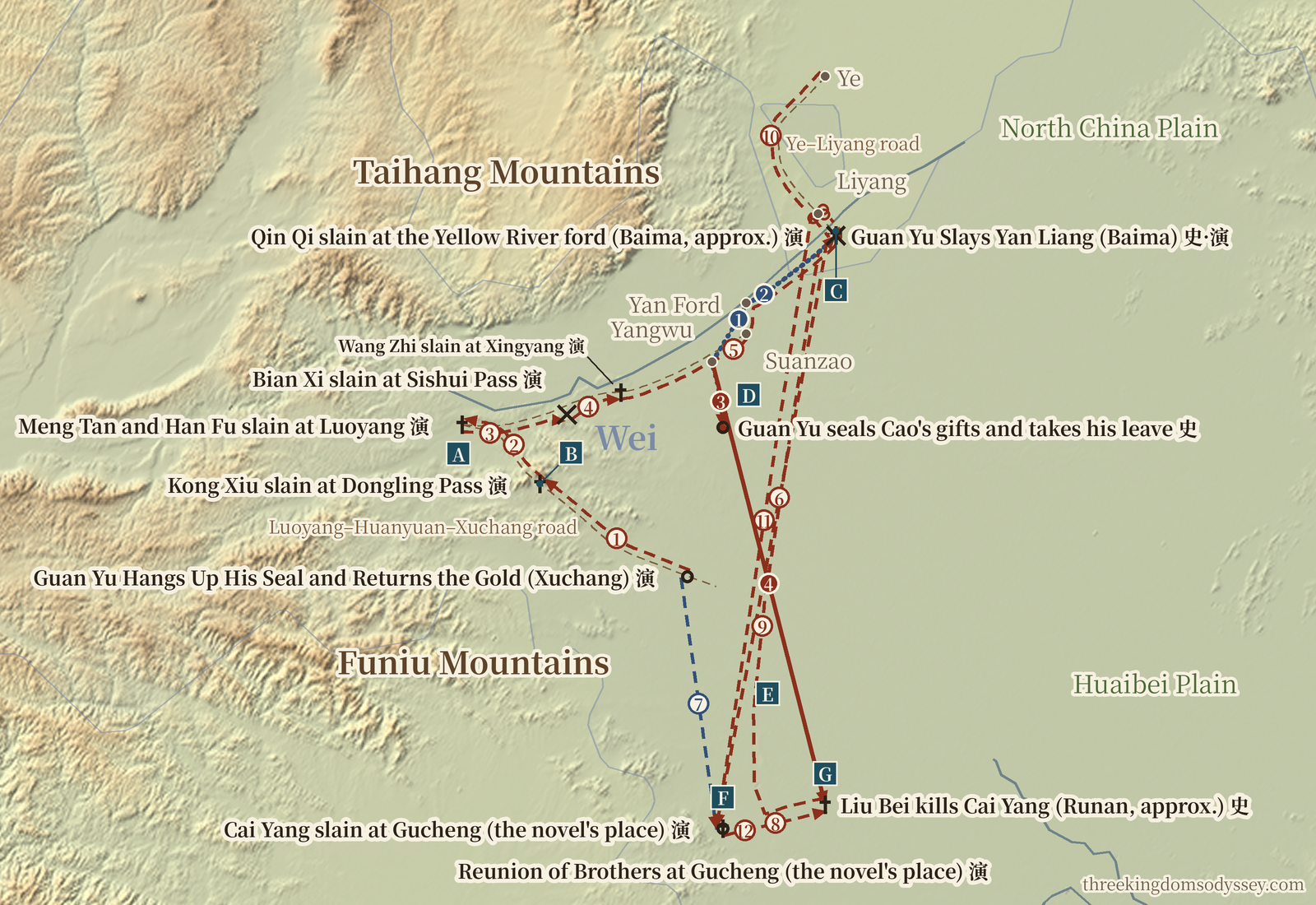
Map of the Guan Yu Passes Five Passes and Slays Six Generals, 200

Swipe to see the whole map

Map of the Guan Yu Passes Five Passes and Slays Six Generals, 200See the routes on the live map →

In the Records

  1. 1Cao Cao and Zhang Liao and Guan Yu marches on BaimaRecords of the Three Kingdoms, juan 1Records of the Three Kingdoms, juan 36
  2. 2Cao Cao falls back to GuanduRecords of the Three Kingdoms, juan 1
  3. 3Guan Yu marches on the Yangwu areaRecords of the Three Kingdoms, juan 36Records of the Three Kingdoms, juan 1
  4. 4Liu Bei, sent by Yuan Shao, marches on RunanRecords of the Three Kingdoms, juan 32Records of the Three Kingdoms, juan 1

In the Romance

  1. 1Guan Yu marches on Dongling Passsome twenty riders with the carriagesNovelRomance of the Three Kingdoms, ch. 26Romance of the Three Kingdoms, ch. 27
  2. 2Guan Yu marches on LuoyangRomance of the Three Kingdoms, ch. 27
  3. 3Guan Yu marches on Sishui PassRomance of the Three Kingdoms, ch. 27
  4. 4Guan Yu marches on XingyangRomance of the Three Kingdoms, ch. 27
  5. 5Guan Yu marches on the Liyang areaRomance of the Three Kingdoms, ch. 27
  6. 6Guan Yu and Sun Qian marches on GuchengRomance of the Three Kingdoms, ch. 27Romance of the Three Kingdoms, ch. 28
  7. 7Cai Yang, sent by Cao Cao, marches on GuchengRomance of the Three Kingdoms, ch. 28
  8. 8Guan Yu and Sun Qian marches on RunanRomance of the Three Kingdoms, ch. 28
  9. 9Guan Yu and Sun Qian marches on the Liyang areasome twenty horsemenNovelRomance of the Three Kingdoms, ch. 28
  10. 10Liu Bei and Jian Yong falls back to the Liyang areaRomance of the Three Kingdoms, ch. 28
  11. 11Liu Bei and Guan Yu and Guan Ping and Zhao Yun marches on GuchengRomance of the Three Kingdoms, ch. 28
  12. 12Liu Bei and Guan Yu and Zhang Fei and Zhao Yun marches on Runanfour or five thousand horse and footNovelRomance of the Three Kingdoms, ch. 28

In the Sanguozhi's main text Guan Yu, after killing Yan Liang, seals Cao Cao's gifts, writes his farewell and goes to Liu Bei in Yuan Shao's army; the five passes, the six generals and the meeting at Gucheng are the novel's.

The books mostly say only where an army set out and arrived: a Records line is solid between the places they name and dotted where it follows a reconstructed road between them; an open ring marks an end the books don't give.

Why these routes

  • AThe novel's road leaves Xu north-west, some 400 li out of the way to Luoyang, then doubles back east; for Hebei the direct way was north to Yan Ford or Baima.Schol.过五关斩六将(维基百科)Romance of the Three Kingdoms, ch. 27
  • BDongling Pass is an invented name; the novel only puts it on the road to Luoyang, so the map sets it on the Xu–Luoyang road over Huanyuan as a guess.Schol.过五关斩六将(维基百科)Romance of the Three Kingdoms, ch. 27
  • CThe novel's Huazhou is a later name for Han Baima; the Eastern Han Yellow River ran north of today's, and across Baima Ford lay Liyang, Yuan Shao's ground.Schol.过五关斩六将(维基百科)元和郡县图志 卷九(维基文库)Battle of Boma (Wikipedia)
  • DThe Sanguozhi has no passes to force: Guan Yu leaves Cao's camp for Yuan Shao's army, and Liu Bei's biography has Liu Bei raiding the lands round Xu with Liu Pi at the time.Hist.Records of the Three Kingdoms, juan 36Records of the Three Kingdoms, juan 1Records of the Three Kingdoms, juan 32
  • ESome writers read this to mean Liu Bei was in Runan, south of Xu, and that Guan Yu simply rode south a few hundred li to him.Schol.演义虚构三国单挑之:过五关斩六将,正史里全是虚构(网易号 黄昏看三国)Records of the Three Kingdoms, juan 32
  • FGucheng is not in the Sanguozhi; Zhumadian tradition puts it at Queshan's old town (today's Gucheng subdistrict), with a brothers' temple site and a 'Cai Yang grave'.Schol.古代兵革地 今朝耕作田(驻马店网,2022)
  • GCai Yang's death: in the Sanguozhi Cao Cao sends him against Liu Bei in Runan and Liu Bei kills him; the novel has Guan Yu behead him at Gucheng before one roll of the drums ends.BothRecords of the Three Kingdoms, juan 32Romance of the Three Kingdoms, ch. 28

Base map: Natural Earth; terrain: AWS Terrain Tiles (SRTM and others). Roads and marches reconstructed from the sources listed; positions approximate.


What happened next

Guan Yu

Continue

Guan Yu

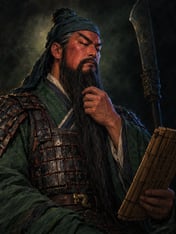
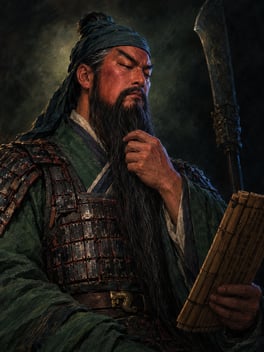
Guan Yu stood nine chi tall, his beard two chi long, his face like a ripe date, his lips as if rouged, with phoenix eyes and silkworm brows, a dignified appearance and awe-inspiring bearing. He would often stroke his beard with his left hand, reading a book by lamplight leaning on a low table; ruddy-faced and long-bearded, he once undid his beard-pouch to show his long beard to Pei Yuanshao, majestic and awe-inspiring.

Go to Guan Yu →

Related events

In depth

AI analysis

Background

From the perspective of modern historical narratology, "Passing Five Passes and Slaying Six Generals" is one of the most important "image-building long takes" in Romance of the San Guo. The episode does not appear in Guan Yu's own biography in San Guozhi; the historical record of Guan Yu's departure from Xudou to rejoin Liu Bei is dispatched in a single sentence: "Guan Yu sealed up all that had been bestowed upon him, submitted a letter of farewell, and hastened to join his lord at Yuan Shao's camp." The novel expands this into five passes, six generals, and a dozen or more confrontations — in essence a form of "narrative reprocessing," transforming a simple event of leaving a military encampment into a heroic marathon of "loyalty above all else". What must be recognized is that this reprocessing was not an isolated literary invention: it built on folk "Guan Gong drama" that had been continuously refined from the Yuan dynasty onward and was given its definitive form only when Luo Guanzhong set it down.

Course of Events

The overall structure of the narrative is remarkably regular: each pass follows the fixed rhythm of "blockade → negotiation → the opponent plots treachery or openly refuses → Guan Yu kills the general → passage through." At the Eastern Ridge Pass, Kong Xiu blocked the way on the grounds that "without a travel document you may not pass" and was slain by Guan Yu; at Luoyang, the prefect Han Fu and his deputy Meng Tan set up deer-antler barricades and fired arrows from ambush in an attempt to capture Guan Yu, who turned the tables after being struck by an arrow and killed both men; at Sishuiguan, Bian Xi — a former Yellow Turban bandit — had axe-wielding soldiers lying in wait in a temple to ambush Guan Yu, but a monk from the same hometown warned Guan Yu, who then killed Bian Xi; at Xingyang, the prefect Wang Zhi was related by marriage to Han Fu and attempted to burn Guan Yu to death in the official guesthouse, but his own officer Hu Ban — moved by a letter his father Hu Hua had written — warned Guan Yu instead, and Guan Yu fled and killed Wang Zhi; at the Yellow River ford, Qin Qi refused to ferry Guan Yu across and was killed so that the crossing could proceed. Two pivotal subsidiary episodes are the mid-journey enlistment of Liao Hua's contingent and the lodging at Hu Hua's manor, which established the letter-of-introduction connection with Hu Ban — two side plots that provide intelligence and personal networks for the subsequent "passage through," exemplifying the narrative's structural tidiness.

Outcome

Guan Yu ultimately left the zone of Caowei control after Zhang Liao relayed Cao Cao's message that pursuit was unnecessary; near Runan he met Sun Qian, learned that Liu Bei had already moved on, and proceeded to Gucheng for his reunion with Zhang Fei. Viewed through the internal logic of the novel's narrative, the outcome of "Passing Five Passes and Slaying Six Generals" is twofold. First, Guan Yu completed the ethical loop of "loyal to Liu Bei while not failing Cao Cao" — he did not slip away in secret but openly executed Guayinfengjin: hanging up his seal, returning all gifts in full, leaving behind a formal letter of farewell, and departing with only the two ladies-in-waiting and essential escort. Second, by pitting himself as a single fighter against the entire Caowei border-pass system, he elevated "personal martial valor + the bond of brotherhood" to a level that could virtually challenge the machinery of state violence.

Influence

The cultural influence this narrative episode exerted on later generations far exceeds its actual weight in the historical record of the Three Kingdoms period. First, it is the core component of the "Guan Gong loyalty and righteousness" narrative — without "Passing Five Passes and Slaying Six Generals," Guan Yu would simply have been a warrior who "first surrendered, then returned," a figure of fickle allegiance. It is this heroic marathon that makes the three-stage personality coherent: "the original surrender was forced upon me; the service rendered was repayment of a debt; the return to Liu Bei was finally coming home to my true self." The deification of Guan Yu as God of War and deity of loyalty that crystallized in the Ming and Qing dynasties has its narrative foundation precisely here. Second, from the perspective of institutional history, the episode itself reveals the existence of a "travel-document checkpoint" system in the late Han — Kong Xiu and Han Fu both initially blocked Guan Yu on the grounds that "without a travel document you may not pass", which was in fact a genuine practice of military checkpoints in the Han-Wei period. The novel converts it into a test of Guan Yu's moral resolve, but the underlying structure is historically real. Third, after killing Wang Zhi, Guan Yu lamented to himself: "I have no wish to kill people along the way, but circumstances leave me no choice. When Cao Cao learns of this, he will surely regard me as an ingrate". This soliloquy demonstrates the novel's nuanced handling of Guan Yu's inner conflict: he must complete his mission of departure and yet recognizes that killing Cao Cao's officials will brand him with the stigma of "ingratitude." This "ethical dilemma" construction elevates Guan Yu beyond the flat image of the typical novel warrior and makes him a hero with an inner life. From the perspective of novelistic engineering, this section is one of Luo Guanzhong's most successful chapters for layering "personal martial valor" with "ethical choice," and it furnished a replicable template for character construction in later classical fiction.

Done reading?
Walk through Five Passes yourself

Ride as Guan Yu through five passes, six generals

Start game →