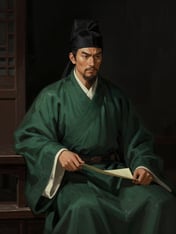
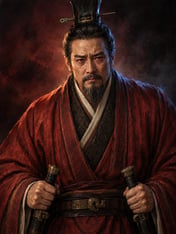
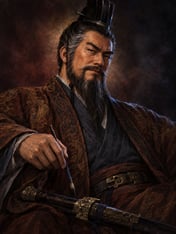
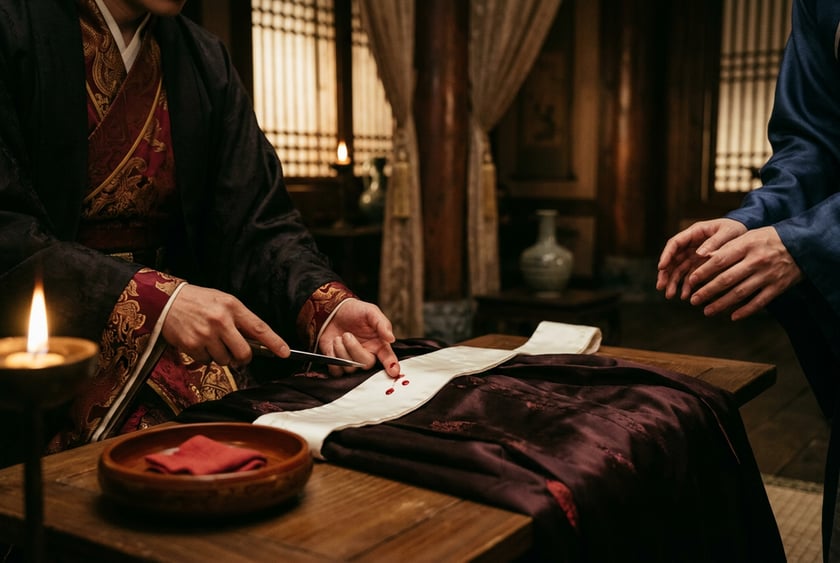
Between the fourth and fifth years of Jian'an (199–200), Dong Cheng — General of Chariots and Cavalry and maternal uncle of Emperor Xian of Han — claimed to have received a secret edict concealed in the emperor's silken robe-sash, authorizing him to kill Cao Cao. He drew into the conspiracy Zhong Ji, Colonel of the Changshui Cavalry, General Wu Zilan, Wang Zifu, and others, and attempted to recruit Liu Bei, Left General, who was then residing as a guest in Xudou. In the first month of the fifth year of Jian'an the plot was exposed, and Dong Cheng and his co-conspirators were all put to death; Cao Cao immediately launched an eastern campaign against Liu Bei, routed his forces in Xuzhou, whereupon Liu Bei fled to Yuan Shao while Guan Yu, defeated at Xiapi, surrendered. This abortive coup was the first direct confrontation between Emperor Xian and the consort clan group on one side and the Liu Bei camp on the other against Cao Cao, and it marked the definitive purge of the pro-Han restoration forces within the imperial court. Chapters 20 through 24 of the Romance of the Three Kingdoms dramatize this history into a fully elaborated "Yidaizhao" story — the Edict of the Silk Robe-Sash: Emperor Xian bites his finger for blood to write the edict himself, which Empress Fu has sewn into a jade-belted robe to present to Dong Cheng; Dong Cheng then leads seven men — Zhong Ji, Wu Shuo, Wang Zifu, Wu Zilan, Ma Teng, and Liu Bei — in a blood-sealed oath of alliance; the affair is eventually betrayed by a household slave, Qin Qingtong. From this episode branch the famous vignettes of cooking plum wine under spring skies, Guanyujiangcao (Guan Yu's surrender to Cao Cao), and Guan Yu's passage of the five passes slaying the six generals, all of which together serve as the pivotal turning point at which the Liu Bei camp breaks free of Cao Cao's orbit and moves toward independence.
The Records of the Three Kingdoms records Dong Cheng as having “received the emperor’s secret edict in his belt,” but Pei Songzhi’s annotation, quoting the Daily Records of Emperor Xian, more often records specific planning conversations between Dong Cheng, Wang Zifu, and others; it does not explicitly confirm whether the text of the secret edict truly came from Emperor Xian himself. The official history’s portrayal is closer to “imperial relatives by marriage plotting rebellion by invoking the Son of Heaven’s name and joining with outside allies.”
Romance
The novel moves the motivation for the entire episode earlier, adding a series of dramatic events: Empress Fu proposes the plan, Emperor Xian personally writes the edict in blood, and Empress Fu sews it into the lining of a jade belt. The secret edict becomes a concrete symbol of the Han house's “remaining legitimate resistance.” Cao Cao forcibly demands to see the belt and robe but fails to discover the edict, making the entire episode even more suspenseful.
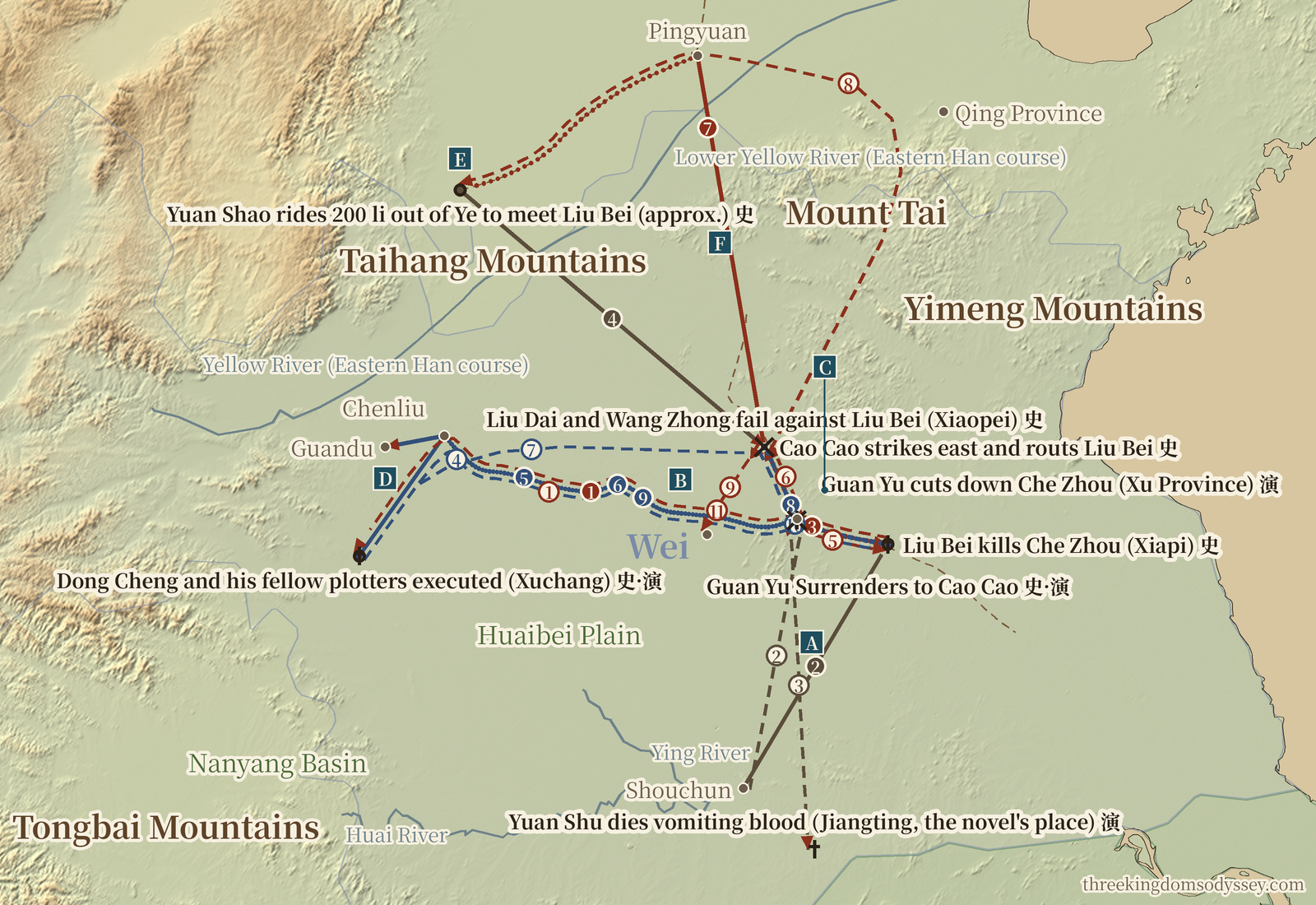
1Liu Bei and Zhu Ling meets the enemy at XiapiRecords of the Three Kingdoms, juan 32Records of the Three Kingdoms, juan 1
2Yuan Shu marches on the Xiapi areaRecords of the Three Kingdoms, juan 32Records of the Three Kingdoms, juan 1Records of the Three Kingdoms, juan 6
3Liu Bei marches on XiaopeiRecords of the Three Kingdoms, juan 32Records of the Three Kingdoms, juan 36Records of the Three Kingdoms, juan 1
4Yuan Shao's force reinforces XiaopeiRecords of the Three Kingdoms, juan 6
5Wang Zhong, sent by Cao Cao, marches on XiaopeiRecords of the Three Kingdoms, juan 1Records of the Three Kingdoms, juan 32
6Cao Cao marches on XiaopeiRecords of the Three Kingdoms, juan 1Records of the Three Kingdoms, juan 32
7Liu Bei falls back to the Ye areaRecords of the Three Kingdoms, juan 32Records of the Three Kingdoms, juan 36
8Cao Cao besieges XiapiRecords of the Three Kingdoms, juan 1Records of the Three Kingdoms, juan 32
9Cao Cao falls back to GuanduRecords of the Three Kingdoms, juan 1Records of the Three Kingdoms, juan 32Records of the Three Kingdoms, juan 36
In the Romance
1Liu Bei and Guan Yu and Zhang Fei and Zhu Ling meets the enemy at Xu Province50,000 menNovelRomance of the Three Kingdoms, ch. 21
2Yuan Shu and Ji Ling marches on the Xu Province areaRomance of the Three Kingdoms, ch. 21
3Yuan Shu falls back to JiangtingRomance of the Three Kingdoms, ch. 21
4Liu Dai and Wang Zhong, sent by Cao Cao, marches on the Xu Province area50,000NovelRomance of the Three Kingdoms, ch. 22
5Guan Yu holds XiapiRomance of the Three Kingdoms, ch. 22
6Liu Bei and Zhang Fei holds XiaopeiRomance of the Three Kingdoms, ch. 22
7Cao Cao marches on Xiaopei200,000 troopsNovelRomance of the Three Kingdoms, ch. 24
8Liu Bei falls back to YeRomance of the Three Kingdoms, ch. 24
9Zhang Fei falls back to Mount MangdangRomance of the Three Kingdoms, ch. 24
10Cao Cao and Zhang Liao besieges XiapiRomance of the Three Kingdoms, ch. 24Romance of the Three Kingdoms, ch. 25
11Guan Yu marches on XuchangRomance of the Three Kingdoms, ch. 25
In the Sanguozhi's main text Liu Bei kills Che Zhou at Xiapi and Cao Cao marches east from Guandu; in the novel Guan Yu kills Che Zhou at the city of Xuzhou and Cao Cao sets out from Xu.
The books mostly say only where an army set out and arrived: a Records line is solid between the places they name and dotted where it follows a reconstructed road between them; an open ring marks an end the books don't give.
Why these routes
AYuan Shu meant to go north to Yuan Tan in Qingzhou by way of Xiapi; Cao Cao sent Liu Bei to intercept him, and so Liu Bei left Xu.Hist.Records of the Three Kingdoms, juan 1Records of the Three Kingdoms, juan 6
BThe Sanguozhi names no road from Xu or Guandu to Xiapi; the map follows the Bian and Huo rivers to Pengcheng, then the Si, as the Shuijing zhu describes them.Schol.《水经注》卷二十三(汳水、获水),维基文库《水经注》卷二十五(泗水、沂水),维基文库
CThe Sanguozhi has Liu Bei leave Guan Yu at Xiapi and go back to Xiaopei himself; the novel makes it Sun Qian's plan of two mutually supporting strongholds.BothRecords of the Three Kingdoms, juan 32Romance of the Three Kingdoms, ch. 22
DCao Cao left Guandu for the east because he judged Yuan Shao too slow to move; he was back at Guandu after beating Liu Bei, and Yuan Shao never came out.Hist.Records of the Three Kingdoms, juan 1
ETian Feng urged Yuan Shao to strike Cao Cao from behind while he was away in the east; Yuan Shao refused, pleading his son's illness.Hist.Records of the Three Kingdoms, juan 6
FLiu Bei fled north into Qingzhou, whose inspector Yuan Tan, a man he had once recommended, came out with troops to meet him; Pingyuan was itself part of Qingzhou.Hist.Records of the Three Kingdoms, juan 32平原郡,维基百科
Base map: Natural Earth; terrain: AWS Terrain Tiles (SRTM and others). Roads and marches reconstructed from the sources listed; positions approximate.
The Girdle Edict incident took place in the third year after the political order of “holding the Son of Heaven hostage to command the regional lords” under Cao Cao had taken shape. In 196, the first year of Jian’an, Cao Cao brought Emperor Xian of Han to Xu Chang and moved the capital there. From then on, real power at court belonged to the Office of the Excellency of Works, and Emperor Xian became a political symbol. Yet the palace still contained a group of “old Han loyalists” and members of the imperial in-law clans—including Empress Fu, Fu Wan, Dong Cheng, and Zhong Ji—who remained genuinely concerned about the Han dynasty’s fate. From the perspective of institutional history, this two-tier structure of “puppet sovereign plus surviving imperial in-laws” was inherently unstable: once the in-laws realized that Cao Cao intended to pursue a “Han-to-Wei transition,” they were bound to make a final stand in the name of “serving the king”. The fourth year of Jian’an was a pivotal moment. By then, Cao Cao had subdued Lü Bu and brought Zhang Xiu to heel, leaving Yuan Shao as the main external threat. He also began accelerating his purge of Xu’s inner circles; actions such as executing Zhao Yan, a Gentleman of the Palace, and forcing Grand Commandant Yang Biao to retire left the officials “terrified”. It was amid this urgent sense that “the window of opportunity was closing” that Dong Cheng and the others began plotting.
Key Figures
At the center of the incident was General of Chariots and Cavalry Dong Cheng, a nephew of Empress Dowager Dong, the mother of Emperor Ling of Han, and an “uncle” of Emperor Xian (in fact, his father-in-law). He was one of the highest-ranking figures at court and one of the few with blood ties to the imperial house. He had also earned merit rescuing the emperor in the western capital and held genuine political loyalty to the Han. Liu Bei was then residing in Xu, in an awkward position: he was both the “Governor of Yu Province,” treated with courtesy by Cao Cao, and the “imperial uncle” recognized by the public, and he understood well the limits of how far he could rise within Cao Cao’s system. In Cao Cao and Liu Bei Discuss Heroes over Plum Wine, Cao Cao’s remark, “The heroes of the realm today are only you, my lord, and me”, made Liu Bei “drop his chopsticks”—at that moment, he realized he could no longer stay in Xu much longer. Among the other participants, Zhong Ji, Wu Shuo, Wang Zifu, and Wu Zilan were “accomplices in the know.” Though they carried less political weight, they supplied the manpower the plot required. Ma Teng represented outside support from Liangzhou and, in theory, could threaten Cao Cao’s rear from the west. Fu Wan, Empress Fu’s father, is portrayed in the Romance as the one who proposed the entire Girdle Edict plot, making him the planner within the palace.
Central Issues
The question posed by this abortive coup was a very specific one: once Cao Cao had secured control of the central government and military, but had not openly usurped the throne, did the opposition still have any legitimate and effective means of resistance? Dong Cheng and the others chose to “launch a coup in the form of a secret edict from the Son of Heaven,” essentially seeking to use “the legitimacy of the Han house” to counter “a military strongman dominating the court.” This approach had two fundamental weaknesses. First, outsiders could not verify whether the secret edict was genuine. Once Cao Cao controlled the flow of information from the palace, the edict could only be recognized after a successful coup. Second, the participants were nowhere near strong enough to face Cao Cao’s elite troops in Xu directly—the “household servants of five families” Dong Cheng could mobilize numbered only a little over a thousand in total. The plan could only be launched when Cao Cao was away on campaign and Xu’s defenses were weakened; but Cao Cao kept his forces under strict discipline, and Xu was never truly left “unguarded.” From a political-science perspective, this was a classic attempt to “pit resources of legitimacy against resources of power”—and when the opposing side also controlled the very symbol of legitimacy, the emperor, failure was all but certain.
Political Consequences
The purge after the plot was exposed was thorough. In the first month of the fifth year of Jian’an, Dong Cheng and the others were all executed, along with their clansmen and families. Cao Cao immediately “set out east to attack Liu Bei,” despite Yuan Shao’s ongoing troop mobilization in the north. The generals feared Yuan Shao might strike from behind, but Cao Cao replied, “Liu Bei is a man of outstanding talent. If we do not attack him now, he will surely become a future threat”. Those words set the course of Liu Bei’s fate for the next twenty years: Cao Cao henceforth regarded him as “a man of outstanding talent who had to be dealt with,” and Liu Bei could no longer survive within Cao Cao’s system. Liu Bei was defeated and fled to Yuan Shao, while Guan Yu was defeated at Xiapi and surrendered—this was the true starting point of the side story Guan Yu Surrenders to Cao Cao. On a broader historical scale, the failure of the Girdle Edict marked the crushing of the Han court’s last organized effort to restore the dynasty. From then on, Cao Cao could advance without fear of internal opposition through the three stages of “becoming Duke of Wei, advancing to King of Wei, and replacing Han.” In the twentieth year of Jian’an, Empress Fu again tried to enlist outside support through her father, Fu Wan; the result was once again “the plot was exposed, Fu Wan was executed, and Empress Fu was deposed.” This episode closely mirrored the Girdle Edict in structure, but had even less chance of success, because Cao Cao’s control over the palace had become more complete.
Counterfactual Scenarios
Two counterfactuals are especially worth exploring. First: what if Dong Cheng and the others had chosen a “low-profile, long-game strategy”—avoiding a coup and instead gradually infiltrating Xu’s imperial guards and local garrisons, waiting to coordinate with Yuan Shao when he marched south? In theory, this was a more prudent path, but it would have been extremely difficult to carry out. Dong Cheng and his associates lacked military command experience, and Xu’s imperial guards were a solid bloc in Cao Cao’s hands, leaving almost no opening for long-term infiltration. Even so, moving slowly would have been better than acting too soon. Their real mistake was exposing the plot before outside support had arrived. The betrayal by their servant Qin Qingtong was merely the surface cause; the deeper problem was that there were too many participants and they could not keep the secret. Second: if Liu Bei had not accepted Dong Cheng’s pact so early and had maintained the stance of a purely “guest commander under Cao Cao,” could he have survived within Cao Cao’s system? Judging from the conversation over plum wine, Cao Cao had already named Liu Bei “the only man who could stand beside him as a hero”. This meant that Cao Cao’s reckoning with Liu Bei was only a matter of time and had nothing to do with the Girdle Edict. At most, the edict brought that reckoning forward; it did not create it. Liu Bei’s request to lead an expedition to intercept Yuan Shu and escape was therefore “the better choice between two evils”: his chances of being killed if he stayed were far greater than if he took the opportunity to leave. Only by understanding this can we see why, from the Records of the Three Kingdoms to Romance of the Three Kingdoms, every narrator treats the Girdle Edict as the true beginning of Liu Bei’s “independent enterprise.” Before it, he was a senior guest commander within Cao Cao’s system; afterward, he was widely recognized throughout the realm as “the last scion of the Han house,” with no way back.