Background
The political landscape of the fourth year of Jian'an (199) was defined by the institutional advantage Cao Cao had gained by escorting Emperor Xian to Xudou — the ability to "uphold the Son of Heaven and command the disobedient." Liu Xie, the Emperor Xian, had by then already survived Dong Zhuo's deposition and reinstatement, the turbulence of Li Jue and Guo Si, and the harrowing eastward flight, before being installed by Cao Cao inside Xudou — nominally the Son of Heaven, but in practice a ceremonial head of state subordinated to a regent. Liu Bei had previously lost Xuzhou to Lv Bu's raid, wandered as a fugitive, and only then attached himself to Cao Cao and returned north to Xudou. For a warlord in exile who had lost even his base, the most critical political resource was no longer territory or troops but a symbol of legitimacy — and the political function of the title "Imperial Uncle" filled precisely that void.
Key Figures
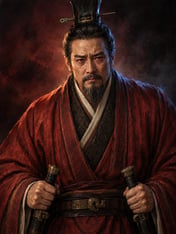
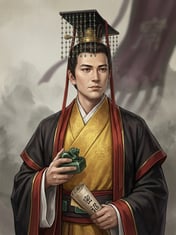
Liu Bei's formal status at this time was General of the Left and Governor of Yuzhou, attached to Cao Cao and residing temporarily in Xudou. His political record — suppressing the Yellow Turbans, aiding Tao Qian, holding Xuzhou — had always centered on the appeal of "Han imperial kinsman" and "man of benevolence and righteousness"; obtaining the Emperor's personal verbal confirmation of his generational relationship with the Han house was equivalent to elevating a claim that had circulated only in popular oral tradition into an officially recognized, court-sanctioned status. Emperor Xian, Liu Xie, had by this point been marginalized, yet still held the ceremonial power to confer legitimacy. He was content to cultivate a "fellow clan member" as a potential counterweight, quietly and in an angle Cao Cao could not easily oppose — a chess piece for possible future resistance. Cao Cao's reaction to the episode is portrayed in the novel as watchful inaction: he could not publicly block it, for he needed Liu Bei's prestige — yet he could not allow that prestige to grow too independent.
Core Issue
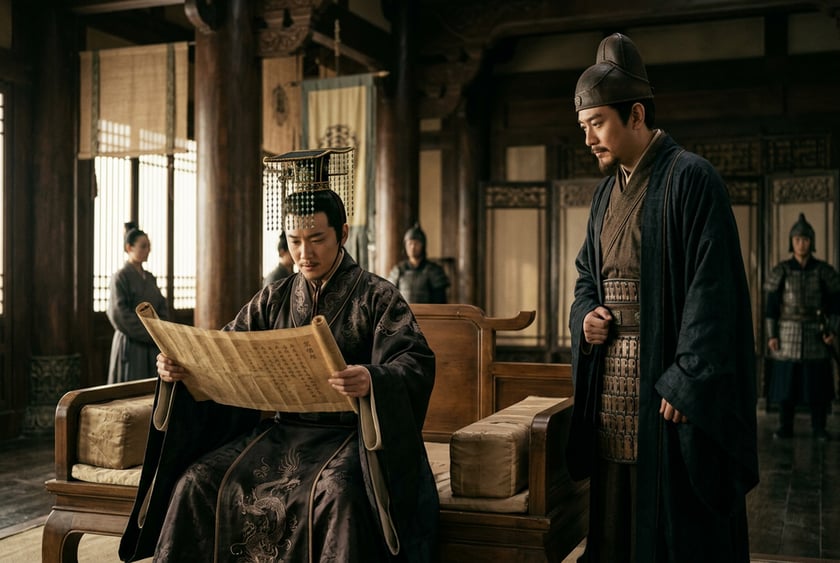
The heart of the matter was: within a political structure where "the Emperor is in Cao Cao's hands," who possessed the authority to interpret the meaning of "Han imperial kinsman"? The novel dramatizes the answer as the Emperor personally consulting the genealogy and conferring the title in open court. This act carried three layers of political meaning. First, it upgraded Liu Bei from the popular narrative of "self-claimed descendant of Prince Jing of Zhongshan" to the official narrative of "recognized by the Son of Heaven in person" — any future action by Liu Bei in opposition to Cao Cao could thenceforth be draped in the garb of "Han legitimate succession." Second, the Emperor thereby silently declared his position: his acquiescence to Cao Cao was not wholehearted, and he was still looking for a counterbalancing force. Third, the event itself bound Liu Bei to the "protect-the-Han" circle around the Emperor, making him politically obliged to provide mutual support with Dong Cheng, Wang Zifu, and their associates.
Political Consequences
The most immediate consequence of the Imperial Uncle status was the formation of the Yidaizhao conspiracy. Dong Cheng and his confederates needed an outsider who combined prestige, military power, and blood ties to the Emperor — Liu Bei happened to possess all three simultaneously. Once the Imperial Uncle status was widely disseminated, Liu Bei became — in the eyes of both court insiders and the world at large — a potential anti-Cao nucleus, and Cao Cao could no longer allow him to remain in Xudou long-term. Liu Bei subsequently used the pretext of intercepting Yuan Shu to break free of Cao Cao's control, and quickly raised troops again in Xuzhou and Runan, transforming himself from "a fugitive general attached to Cao Cao" into "an independent warlord flying the banner of restoring the Han." For all of Liu Bei's political narrative over the following twenty-plus years — from "ally with Wu, resist Cao" to entering Yizhou and claiming the title King of Hanzhong, and on to founding the Shuhan regime — the Imperial Uncle status served as foundational capital of legitimacy.
Counterfactual Analysis
Had the Emperor not publicly recognized Liu Bei as Imperial Uncle, Liu Bei could have continued claiming descent from Prince Jing of Zhongshan — but the rhetorical force of that claim would have been vastly diminished. Without official endorsement, Dong Cheng and his circle would not necessarily have viewed him as a core confederate in the Yidaizhao conspiracy, and Liu Bei would not necessarily have felt such urgency to escape Xudou. Even had he escaped, his efforts to recruit support in Jingzhou and Yizhou would have been far harder — Liu Biao and Liu Zhang, themselves Han imperial kinsmen, would not necessarily have regarded a fugitive warlord who could only claim kinship by his own account as a natural ally. In short, the Imperial Uncle status was the decisive narrative lever that pushed Liu Bei from "one warlord among many" onto the position of "representative of the Han house"; without this link in the chain, the political legitimacy narrative of Shuhan would have had to be rebuilt from scratch, and its historical trajectory might well have diverged fundamentally from reality. This is precisely why the novel treats this chapter as the turning point of Liu Bei's political career and renders it in such full detail.