Overview
Puyang was a county in Dong Commandery, Yanzhou, during the Eastern Han; its old city stood in the area of present-day Puyang County, southwest of Puyang City in Henan Province. In the first year of Xingping (194), Zhang Miao and Chen Gong welcomed Lü Bu as governor of Yanzhou, and he held Puyang. Cao Cao returned with his army and faced Lü Bu in a standoff there for over a hundred days. It was a key battlefield in their struggle for Yanzhou.
History
In the second year of Chuping (191), the Black Mountain bandit Bai Rao and others, numbering more than a hundred thousand, plundered Dong Commandery. Cao Cao led troops to Puyang and defeated Bai Rao, after which Yuan Shao recommended him for the post of Administrator of Dong Commandery.
In the first year of Xingping (194), Cao Cao again campaigned against Tao Qian, leaving Xiahou Dun, Administrator of Dong Commandery, to defend Puyang. Zhang Miao, Chen Gong, and others seized the opportunity to rebel and welcome Lü Bu; the commandery’s counties and districts responded one after another, while only Juancheng, Dong’e, and Fan held firm for Cao Cao. Xiahou Dun hurried to Juancheng with a light carriage. On the way, he fought Lü Bu; after Lü Bu withdrew into Puyang, he seized the baggage of Xiahou Dun’s army.
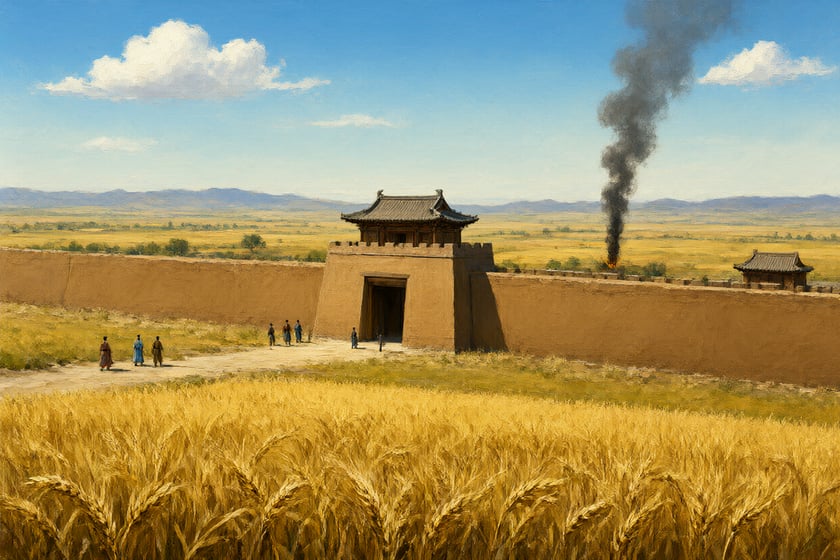
Cao Cao returned with his army and attacked Puyang. Lü Bu first sent cavalry to strike the Qing Province troops, who broke and fled. Cao Cao’s formation fell into disarray; as he rode out through the flames, he fell from his horse and burned his left palm. He escaped only after Sima Louyi helped him back onto his horse. Pei Songzhi’s commentary, citing the Annals of Emperor Xian, says that the powerful Tian clan of Puyang acted as double agents, enabling Cao Cao to enter the city; he then burned the eastern gate to show that he would not retreat. After Cao Cao’s defeat, Lü Bu’s cavalry captured him but did not recognize him. Cao Cao pointed to a man riding a yellow horse and said that was Cao Cao, and so he was released. Lü Bu also had a camp forty or fifty li west of Puyang. Cao Cao attacked and defeated it by night, but at dawn Lü Bu’s reinforcements engaged him on three sides. Cao Cao called for volunteers to break through enemy lines; Dian Wei was the first to answer, leading several dozen men in a desperate fight. Only then did Lü Bu’s troops withdraw. The two sides remained deadlocked for over a hundred days. A severe drought and locusts struck, and people resorted to cannibalism. When Lü Bu ran out of grain, he moved east and encamped at Shanyang. In the second year of Xingping (195), Cao Cao gradually recovered the cities of Yanzhou and defeated Lü Bu at Juye.
In the seventh year of Huangchu (226), Cao Gun was enfeoffed as Prince of Puyang. He took up his fief in the second year of Taihe (228), and in the sixth year of Taihe (232) his title was changed to Prince of Zhongshan.
Notable Figures
- Yuan Shao: In his early twenties, he served as Chief of Puyang and was known for his integrity.
- Xiahou Dun: After Lü Bu entered the city, he sent a general to feign surrender and seize Xiahou Dun, demanding valuables for his release. Xiahou Dun’s subordinate Han Hao brought up troops and killed the captors, freeing Xiahou Dun. From then on, Cao Cao established the rule that anyone who took hostages was to be attacked without regard for the hostages’ safety.
- Dian Wei: At the Battle of Puyang, he charged at the head of the formation wielding more than ten halberds. After the battle, he was appointed Commandant and put in charge of the personal troops guarding Cao Cao’s main tent.
- Cao Gun: Cao Cao’s son, he was fond of learning and skilled in literary composition. Admiring Qu Yuan, a minister of the state of Wei during the Spring and Autumn period who was buried at Puyang, he ordered before his death that his tomb be built near Qu Yuan’s.
Differences Between the Historical Record and the Novel
Chapter 12 of Romance of the Three Kingdoms presents the Tian clan’s deception as a stratagem devised by Chen Gong: Chen Gong had the Tian clan falsely claim that Lü Bu had gone to Liyang, then invite Cao Cao into the city, before setting fires at all four gates. Liu Ye advised Cao Cao to divide his troops into three units in case it was a trap. The Records of the Three Kingdoms does not mention Chen Gong devising this plan. The novel also says that after Cao Cao had regained Yanzhou, he advanced on Puyang; the Tian clan raised the drawbridge to prevent Lü Bu from entering the city, and Lü Bu fled to Dingtao. Cao Cao then took Puyang and left Liu Ye and others to guard it. The Records of the Three Kingdoms does not say how Puyang was recovered; it only states that in the second year of Xingping (195), Cao Cao recovered all the cities of Yanzhou and defeated Lü Bu at Juye. The Tian clan shutting the gates against Lü Bu and Liu Ye guarding Puyang are both episodes from the novel.