Yuan Shao's Faction · General of Chariots and Cavalry; General-in-Chief; Governor of Jizhou
Yuan Shao
courtesy name 本初 · –202
Not to be confused with Yuan Shao (爰邵) — Yuan Shao was known for using the I Ching to interpret Deng Ai's dream of invading Shu, predicting victory but fearing he would not return.
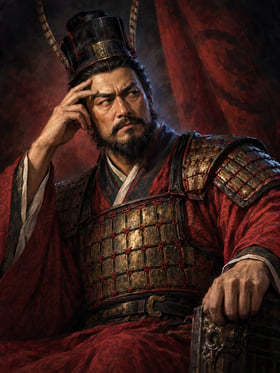
In golden helmet and golden armor, brocade robe and jade belt, he sat his horse before the ranks.

Life
In the novel: 34 chapters · In the Records: 26 volumes
Life?–202
189 CE (Zhongping 6)
- Assassination of He JinLuoyangAdvisor
- Dong Zhuo's CoupLuoyangAdvisor
190 CE (Chuping 1)
- Campaign against Dong ZhuoSuanzaoCommander
12 more events
190 CE (Chuping 1)
191 CE (Chuping 2)
192 CE (Chuping 3)
- Battle of JieqiaoJieqiaoCommander
195 CE (Xingping 2)
196 CE (Jian'an 1)
- Guo Jia Leaves Yuan Shao and Joins Cao CaoYeParticipant
197 CE (Jian'an 2)
199 CE (Jian'an 4)
- Zhang Xiu Surrenders to Cao CaoXuchangWitness
- Battle of YijingYijingCommander
200 CE (Jian'an 5)
- Battle of GuanduGuanduCommander
- Battle of BomaBaimaCommander
201 CE (Jian'an 6)
- Battle of CangtingCangtingCommander
202 CE (Jian'an 7)
- Dong Zhuo's Faction
- Yuan Shao's Faction
- Hatched: dated by chapter
- Life event
- Death
List all 12 stops
- RunanBirthplace
- Luoyang189–190Assassination of He Jin+2 more
- Suanzao190Campaign against Dong Zhuo
- You Province191Gongsun Zan's Control of Youzhou
- Jieqiao192Battle of Jieqiao
- Dongwuyang195Yuan Shao Besieges and Kills Zang Hong
- Ye196Guo Jia Leaves Yuan Shao and Joins Cao Cao
- Xuchang197–199The Ten Victories and Ten Defeats Theory+1 more
- Yijing199Battle of Yijing
- Guandu200Battle of Guandu
- Cangting201Battle of Cangting
- Ye202Death of Yuan Shao and the Succession Struggle among the Yuan Clan
On the boards
Compare with someone →Where this person ranks on each board.
- Master Strategists: #2Records
- Most Battles Lost: #4Romance
- Most Battles Won: #5Records
- Saw Through the Most: #6Records
- Most Advisors: #8Records
- Most Betrayed: #8Romance
- Best Connected: #8Romance
- Most Executions Ordered: #8Records
- Most Battles: #9Both
- Plans That Worked: #12Records
- Stratagem Success Rate: #13Records
- Most Talkative: #13Romance
Who they were
Character profile
- Appearance
- In golden helmet and golden armor, brocade robe and jade belt, he sat his horse before the ranks.
- Character
- Yuan Shao had great ambition but little wisdom, a fierce appearance but faint courage; he was jealous and lacked authority, had many troops but unclear organization, and proud generals under inconsistent orders. Outwardly generous and refined, with a measured bearing, he betrayed neither worry nor joy on his face, yet inwardly he was full of jealousy and malice. He yielded with propriety, but in council he showed hesitation, holding his troops in check, greedy for power and suspicious, both distrustful and yet credulous.
- Manner of speech
- Impassioned and dignified, he often invoked canonical statutes and grand principles.
- Life
- Yuan Shao, a native of Ruyang in Runan, was styled Benchu. His great-great-grandfather An served as Minister over the Masses of Han, and from An onward the family held the Three Ducal Offices for four generations. He once marshaled troops and slaughtered all the eunuchs; later, when Dong Zhuo proposed deposing the emperor, he drew his blade, made a long bow, and departed, fleeing to Jizhou. Raising troops at Bohai to attack Zhuo, he styled himself General of Chariots and Cavalry and headed the alliance. He coerced Han Fu into ceding Jizhou and thereupon took the post of Governor of Jizhou; later he defeated Gongsun Zan at Yijing and absorbed his forces, but was crushingly defeated by the Grand Progenitor at the Battle of Guandu, and in the seventh year of Jian'an fell ill and died of grief.
- Anecdotes
- Yuan Shao was a son by a concubine of the Minister over the Masses Yuan Feng, an elder half-brother of Yuan Shu, and was later given out for adoption. He was once chief of the Guandong coalition, later held the four provinces north of the Yellow River, and died in defeat at Guandu.
Historical Record
Yuan Shao, courtesy name Benchu, was from Ruyang, Runan, and belonged to the illustrious Yuan clan of Runan. His great-grandfather Yuan An once served as Grand Minister over the Masses, and for four generations after Yuan An, members of the family held the rank of Three Excellencies. Yuan Shao had an imposing appearance and was willing to humble himself and show respect to scholars, who flocked to join him. Cao Cao also associated with him when they were young. Yuan Shao held posts including Attendant Censor and Colonel of the Central Army, and later became Colonel Director of Retainers. His biography also records that he was the illegitimate son of Yuan Feng and was adopted as heir by his elder uncle Yuan Cheng. However, sources cited in Pei Songzhi’s annotations differ on his birth and mourning history, so these accounts cannot be treated as a settled conclusion.
After the death of Emperor Ling, Yuan Shao conspired with General-in-Chief He Jin to eliminate the eunuchs, repeatedly urging He Jin to act decisively without delay. He Jin hesitated and was ultimately killed by the eunuchs. Yuan Shao then led troops in capturing and killing the eunuchs; more than two thousand died. When Dong Zhuo entered the capital and proposed deposing the young emperor and installing the Prince of Chenliu, Yuan Shao opposed him and left the capital for Jizhou. Acting on the advice of Zhou Bi and others, Dong Zhuo appointed him Administrator of Bohai and enfeoffed him as Marquis of Kangxiang.
Yuan Shao raised troops at Bohai to campaign against Dong Zhuo, and the lords of the east appointed him their leader. He and Han Fu once plotted to install Liu Yu as emperor, but Liu Yu dared not accept. Later, taking advantage of Gongsun Zan’s advance against Han Fu, Yuan Shao induced Han Fu to hand over Jizhou and then took up the post of Governor of Jizhou. On Ju Shou’s advice, he also sought to seize Qingzhou, Bingzhou, and other territories; he later defeated Gongsun Zan and annexed four provinces. He once joined forces with Cao Cao to defeat an offensive by Yuan Shu’s side, but the two later became rivals competing for supremacy.
Before the Battle of Guandu, Yuan Shao led a large army south. Cao Cao’s biography describes him as ambitious but lacking in judgment, with arrogant generals and inconsistent orders. During the drawn-out conflict, Yuan Shao rejected Xu You’s proposal to attack Xu, whereupon Xu You defected to Cao Cao. Cao Cao launched a night raid on Wuchao and burned the grain stores, routing Yuan Shao’s army. Yuan Shao and Yuan Tan abandoned their troops and fled across the river. Yuan Shao subsequently rallied the remnants of his defeated forces and continued fighting Cao Cao’s army. In the seventh year of Jian’an, after a military defeat, he fell ill, vomited blood, and died. Yuan Shang succeeded him, and Yuan Tan and Yuan Shang soon became embroiled in conflict.
In the Novel
Romance of the Three Kingdoms portrays Yuan Shao as an aristocratic leader who bears the prestige of four generations of Three Excellencies and dares to stand up in open defiance. The novel depicts him stepping forward during He Jin’s deliberations to request troops to enter the palace and help install the young emperor, while advocating that the eunuchs be exterminated while the opportunity lasted. When He Jin would not listen, Yuan Shao proposed summoning troops from the various regions to the capital. After He Jin was killed, Yuan Shao led his men in forcing their way through the gates of the palace and hunting down the eunuchs; the novel depicts this action as fierce and swift. Historical accounts do record Yuan Shao’s participation in plotting to eliminate the eunuchs and his massacre of them after He Jin’s death, but the specific scenes and dialogue in the novel are literary embellishments.
When Dong Zhuo proposed deposing and installing emperors, the novel has Yuan Shao draw his sword and confront him, then hang up his tally at the eastern gate and flee to Jizhou. Historical accounts also record that he rejected Dong Zhuo’s plan and fled to Jizhou, but dramatic details such as “drawing his sword to face the enemy” should not be taken directly as historical fact. The novel later depicts Yuan Shao leading troops to join the coalition against Dong Zhuo. The lords appoint him their leader, and he ascends the altar, swears an oath over blood, and issues military orders. Compared with the concise historical record that “the lords appointed Shao their leader,” the novel emphasizes his prestige, the ceremonial atmosphere, and his bearing as one who commands the lords.
Key Relationships
Yuan Shao and He Jin were political partners in plotting to eliminate the eunuchs: Yuan Shao advocated acting swiftly, while He Jin repeatedly hesitated and was ultimately killed. Yuan Shao then used military force to purge the eunuchs. He broke with Dong Zhuo over the proposed deposition and installation of emperors; after fleeing Luoyang, Yuan Shao turned to organizing the forces of the eastern provinces against Dong Zhuo. In the novel, this break is dramatized as a sword-point confrontation at a banquet, a detail unique to the Romance.
Yuan Shao’s relationship with Han Fu shifted from alliance to a transfer of power: exploiting the pressure created by Gongsun Zan’s southward advance, Yuan Shao induced Han Fu to surrender Jizhou and took over as its governor. He and Cao Cao knew each other in their youth and stood together in the eastern coalition during the campaign against Dong Zhuo. Later, competition over the emperor, territory, and military strength brought them into rivalry, culminating in battle at Guandu. Yuan Shao was also the father of Yuan Tan and Yuan Shang. Yuan Shang succeeded him after his death, and the conflict between his two sons prolonged the turmoil in Hebei.
Signature Scenes
In the historical record, the scene that best conveys Yuan Shao’s political stature is the uprising of the eastern lords against Dong Zhuo and their appointment of him as their leader. Another turning point was his acquisition of Jizhou, followed by his expansion across the four provinces of Hebei, which gave him enough strength to contend with Cao Cao.
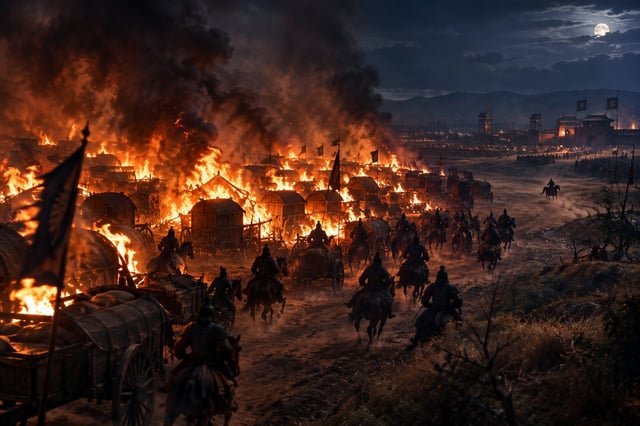
The Battle of Guandu reveals the missteps behind his strength: Yuan Shao’s encampments stretched for dozens of li, while Cao Cao’s forces were short of food and exhausted. After Xu You defected to him, Cao Cao attacked Wuchao. Yuan Shao could not restore his army’s morale and was ultimately routed. He continued to gather scattered troops after the defeat, but died of illness not long afterward, and the power he had built during his lifetime fractured amid the succession dispute.
The novel’s scene of the coalition leader ascending the altar is Yuan Shao’s signature stage: the various lords repeatedly defer to one another before he finally accepts the position. He reads the oath of alliance, swears the pact over blood, and assigns Yuan Shu to oversee provisions and Sun Jian to serve as the vanguard. This scene reinforces the literary image of Yuan Shao as first among the warlords; the details of the ceremony, the wording of the oath, and the specific military orders are unique to the novel.
Quotes
82 lines in the books · 3 featured
「可召四方英雄人士,勒兵來京,盡誅閹豎。此時事急,不容太后不從。」
This scheme brought Dong Zhuo into the capital, indirectly plunging the realm into chaos, and marked a turning point in Yuan Shao's political career.
「可惜吾上將顏良、文醜未至!得一人在此,何懼華雄?」
This line reveals Yuan Shao's arrogance and his high regard for Yan Liang and Wen Chou, and also sets the stage for Guan Yu slaying Hua Xiong while the wine was still warm.
「濫行匹夫!尚有面目於吾前獻計耶!汝與曹操有舊,想今亦受他財賄,為他作奸細,啜賺吾軍耳!本當斬首,今權且寄頭在項!可速退出,今後不許相見!」
A typical display of Yuan Shao's stubborn self-conceit and refusal to heed loyal counsel, which directly led to his defeat at the Battle of Guandu.
- Family
- Lord & vassal
- Friends
- Enemies
- Other
History vs. novel
8 points · 3 novel-only
| History | Novel |
|---|---|
| Execution of the eunuchsNovel embellishes | |
After He Jin’s death, Yuan Shao led troops in hunting down and killing the eunuchs, sparing neither young nor old. They mistakenly killed men without beards, and more than two thousand people died. vol. 6 | Yuan Shao ordered his soldiers to execute the eunuchs’ family members, sparing neither young nor old. The novel also describes scenes in which He Miao is killed and the palace catches fire. ch. 3 |
| Dong Zhuo’s deposition and appointmentNovel embellishes | |
Dong Zhuo wanted to depose the young emperor and install the Prince of Chenliu. Yuan Shao gave no direct reply; after raising his blade and bowing, he left. vol. 6 | At a banquet, Yuan Shao drew his sword and confronted Dong Zhuo, denouncing his act of deposing and appointing rulers. He then took his credentials and left the city, fleeing to Jizhou. ch. 4 |
| The alliance leader and the coalitionNovel embellishes | |
In the first year of Chuping, warlords from across the realm rose up at the same time and elected Yuan Shao as their leader. The historical record lists the various commanders and the troops each brought. vol. 1 | After receiving Cao Cao’s proclamation, Yuan Shao left Bohai with thirty thousand men under his command to join the coalition. The novel focuses on scenes of the warlords confronting Dong Zhuo on the battlefield. ch. 5 |
| Sun Jian and the Imperial SealNovel only | |
| — | Yuan Shao suspected Sun Jian of secretly keeping the Imperial Seal and confronted him, drawing his sword to threaten him. Sun Jian swore that he was innocent, then led his troops away. ch. 6 |
| His youngest son’s illness costs him an opportunityNovel only | |
| — | When Cao Cao campaigned east against Liu Bei and Xu was left undefended, Yuan Shao refused to send troops because his most beloved youngest son was ill, missing a prime opportunity to attack. ch. 24 |
| Tian Feng urges a protracted warNovel embellishes | |
Tian Feng advised wearing Cao Cao down through a protracted war and harassment. Yuan Shao ignored him and had him detained for allegedly undermining troop morale; after his defeat, Yuan Shao had him executed. vol. 6 | Before Yuan Shao set out to war, Tian Feng repeatedly tried to dissuade him. Yuan Shao flew into a rage and wanted to kill him, but later imprisoned him after Liu Bei intervened. ch. 25 |
| Blaming Liu Bei for Yan Liang’s deathNovel only | |
| — | After Guan Yu killed Yan Liang, Yuan Shao listened to suspicions and concluded that Liu Bei had conspired with Guan Yu. He ordered Liu Bei to be taken out and executed, but Liu Bei later talked him out of it. ch. 25 |
| Wuchao and the flight after GuanduNovel embellishes | |
After Xu You defected to him, Cao Cao launched a night raid on Wuchao, defeating its defenders and setting fire to the provisions. Yuan Shao and Yuan Tan abandoned their troops, crossed the river, and fled. vol. 1 | The novel says that Yuan Shao rejected Xu You’s plan, trusted Guo Tu’s advice too readily, and drove Zhang He and Gao Lan away. After Wuchao fell, he fled to Liyang with only a little over eight hundred cavalry. ch. 30 |
- Execution of the eunuchsNovel embellishes
- History
After He Jin’s death, Yuan Shao led troops in hunting down and killing the eunuchs, sparing neither young nor old. They mistakenly killed men without beards, and more than two thousand people died.
vol. 6
- Novel
Yuan Shao ordered his soldiers to execute the eunuchs’ family members, sparing neither young nor old. The novel also describes scenes in which He Miao is killed and the palace catches fire.
ch. 3
- Dong Zhuo’s deposition and appointmentNovel embellishes
- History
Dong Zhuo wanted to depose the young emperor and install the Prince of Chenliu. Yuan Shao gave no direct reply; after raising his blade and bowing, he left.
vol. 6
- Novel
At a banquet, Yuan Shao drew his sword and confronted Dong Zhuo, denouncing his act of deposing and appointing rulers. He then took his credentials and left the city, fleeing to Jizhou.
ch. 4
- The alliance leader and the coalitionNovel embellishes
- History
In the first year of Chuping, warlords from across the realm rose up at the same time and elected Yuan Shao as their leader. The historical record lists the various commanders and the troops each brought.
vol. 1
- Novel
After receiving Cao Cao’s proclamation, Yuan Shao left Bohai with thirty thousand men under his command to join the coalition. The novel focuses on scenes of the warlords confronting Dong Zhuo on the battlefield.
ch. 5
- Sun Jian and the Imperial SealNovel only
- Novel
Yuan Shao suspected Sun Jian of secretly keeping the Imperial Seal and confronted him, drawing his sword to threaten him. Sun Jian swore that he was innocent, then led his troops away.
ch. 6
- His youngest son’s illness costs him an opportunityNovel only
- Novel
When Cao Cao campaigned east against Liu Bei and Xu was left undefended, Yuan Shao refused to send troops because his most beloved youngest son was ill, missing a prime opportunity to attack.
ch. 24
- Tian Feng urges a protracted warNovel embellishes
- History
Tian Feng advised wearing Cao Cao down through a protracted war and harassment. Yuan Shao ignored him and had him detained for allegedly undermining troop morale; after his defeat, Yuan Shao had him executed.
vol. 6
- Novel
Before Yuan Shao set out to war, Tian Feng repeatedly tried to dissuade him. Yuan Shao flew into a rage and wanted to kill him, but later imprisoned him after Liu Bei intervened.
ch. 25
- Blaming Liu Bei for Yan Liang’s deathNovel only
- Novel
After Guan Yu killed Yan Liang, Yuan Shao listened to suspicions and concluded that Liu Bei had conspired with Guan Yu. He ordered Liu Bei to be taken out and executed, but Liu Bei later talked him out of it.
ch. 25
- Wuchao and the flight after GuanduNovel embellishes
- History
After Xu You defected to him, Cao Cao launched a night raid on Wuchao, defeating its defenders and setting fire to the provisions. Yuan Shao and Yuan Tan abandoned their troops, crossed the river, and fled.
vol. 1
- Novel
The novel says that Yuan Shao rejected Xu You’s plan, trusted Guo Tu’s advice too readily, and drove Zhang He and Gao Lan away. After Wuchao fell, he fled to Liyang with only a little over eight hundred cavalry.
ch. 30
Combat
On the field
Duels, kills and executions as the texts tell them, counted separately for the Records and the Romance.
- RecordsJuan 6ExecutionTian FengWon「果爲所笑。」遂殺之」
- RecordsJuan 7ExecutionZang HongWon「知終不為己用,乃殺之」
- RecordsJuan 7ExecutionChen RongWon「復見殺」
- RomanceCh. 30ExecutionChunyu QiongWon「紹怒,立斬之」
- RomanceCh. 31ExecutionTian FengWon「乃自刎於獄中」
Battles in command
Battles this person commanded in, with the outcome as each text tells it.
- Records
- 2W 2L 0D 1 undecided
- Romance
- 2W 3L 0D 1 undecided
- Records190Campaign against Dong ZhuoUndecidedvs Dong ZhuoJuan 1「諸軍兵十餘萬,日置酒高會,不圖進取」
- Romance190Campaign against Dong ZhuoUndecidedvs Dong ZhuoCh. 6「袁紹見眾人各自分散,就領兵拔寨,離洛陽,投關東去了」
- Romance190Battle of SishuiguanWonvs Hua Xiong's armyCh. 5「雲長提華雄之頭,擲於地上」
- Records192Battle of JieqiaoWonvs Gongsun Zan's armyJuan 8「紹軍廣川,令將麴義先登與瓚戰,生禽綱。瓚軍敗走勃海」
- Romance192Battle of JieqiaoLostvs Gongsun Zan's armyCh. 7「卻說袁紹輸了一陣,堅守不出」
- Records199Battle of YijingWonvs Gongsun Zan's armyJuan 8「紹設伏擊,大破之,復還守」
All battles (11)
Loading…
Stratagems
Plans this person devised or saw through, as the texts tell them.
- Records
- 11 carried out · 4 worked · 0 turned down · 1 seen through
- Romance
- 1 carried out · 1 worked · 0 turned down · 1 seen through
- RecordsAttack the Main CampOtherFailedJuan 1「就彼攻瓊等,吾攻拔其營,彼固無所歸矣」
- RecordsSummon Outside Troops to Coerce the Empress DowagerOtherFailedagainst the eunuch officialsJuan 6「進乃召卓使將兵詣京師」
- RecordsFalsely Promise to Let Them EscapeDeceptionWorkedJuan 6「紹偽許之,曰:「此大事,出當與太傅議。」」
- RecordsPersuade Han Fu to Yield JizhouPersuasionWorkedJuan 6「因馥惶遽,使陳留高幹、頴川荀諶等說馥曰」
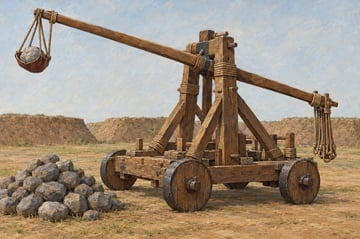
- RecordsHigh Siege Tower on an Earthen MoundSiegeSeen throughagainst The campJuan 6「太祖乃爲發石車,擊紹樓,皆破」
- RecordsUnderground TunnelSiegeSeen throughJuan 6「紹爲地道,欲襲太祖營。太祖輙於內爲長塹以拒之」
All stratagems (14)
Loading…
Events
Events (21)
Battles and events the texts place this person in, by date.
Battles
- 190Campaign against Dong ZhuoCommander
- 190Battle of SishuiguanCommander
- 192Battle of JieqiaoCommander
- 199Battle of YijingCommander
- 200Battle of GuanduCommander
- 200Battle of BomaCommander
- 201Battle of CangtingCommander
- 203Battle of Liyang
All 9
Other events
- 189Assassination of He JinAdvisor
- 189Dong Zhuo's CoupAdvisor
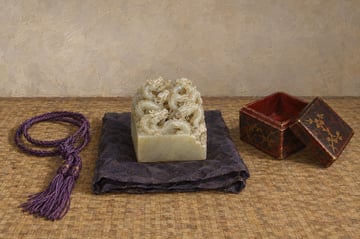
- 190Sun Jian Obtains the Heirloom Seal of the Realm
- 191Gongsun Zan's Control of YouzhouCommander
- 191Yuan Shao Takes Ji ProvinceInstigator
- 194Lü Bu's Seizure of Yanzhou
- 195Yuan Shao Besieges and Kills Zang HongInstigator
- 196Guo Jia Leaves Yuan Shao and Joins Cao Cao
All 12
- 197The Ten Victories and Ten Defeats TheoryCommander
- 199Zhang Xiu Surrenders to Cao CaoWitness
- 200Guan Yu Slays Yan Liang
- 202Death of Yuan Shao and the Succession Struggle among the Yuan ClanKilled in action
Famous objects

Places
- Native of
- RunanRecords
- Governed
- Ji ProvinceRecords
- Sili ProvinceRecords
- YeRecords
- PuyangRecords
- DongwuyangRecords
- Moved to
- Ji ProvinceRecords
Continue
The Battle of Guandu in 3D
Replay the Battle of Guandu phase by phase on real terrain: troop strengths, movements and turning points at a glance, each marked as coming from the Records of the Three Kingdoms or the Romance.
Relationship timeline29 entries ▸
History · vol. 1
- Liu Yu§11
Rival
Plotted with Han Fu to install Yu, the Governor of You Province, as emperor
- Gongsun Zan§43
Enemy
had already annexed Gongsun Zan and held land in four provinces
- Yuan Tan§51
Child
father and son; abandoned the army with Tan and fled across the river
History · vol. 6
- He Jin§26
Advises
When He Jin plotted to execute the eunuchs, Shao urged him to act decisively, but Jin refused
- Dong Zhuo§27
Enemy
When Zhuo proposed deposing the emperor, Shao pretended to agree, held his sword, bowed deeply, and left; Zhuo later exterminated Shao’s entire clan, including Grand Tutor Kui and others
History · vol. 11
- Yuan Tan§36
Child
father and son (Tan was Shao's eldest son)
- Yuan Shang§36
Child
father and son (Shang was Shao’s youngest son)
History · vol. 12
- Cui Yan§4
Commands
heard of his reputation and appointed him, making him Cavalry Commandant
All 29
Loading…
Inner monologues · AI-generated3 monologues ▸
- After my defeat at Guandu and my later setback at Cangting, I knew that the tide could not be turned in a day. In the pa
- I am Yuan Shao, courtesy name Benchu. Now I command troops and arms, with the forces of four provinces gathered around m
- I am Yuan Shao, courtesy name Benchu. I remember that when Emperor Ling died, both the inner palace and the court were i