Liu Biao's faction · Inspector/Governor of Jing Province; General Who Guards the South
Liu Biao
courtesy name 景升 · 142–208
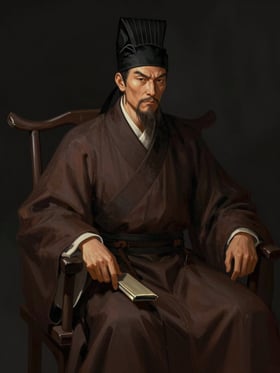
Liu Biao, Jing Province's governor, is known for pacifying it and Liu Cong's Surrender to Cao Cao; the novel depicts him as suspicious.

Life
In the novel: 29 chapters · In the Records: 31 volumes
Life?–208
191 CE (Chuping 2)
198 CE (Jian'an 3)
1 more event
201 CE (Jian'an 6)
206 CE (Jian'an 11)
208 CE (Jian'an 13)
Allegiance
- Liu Biao's faction
- Life event
- Death
List all 4 stops
On the boards
Compare with someone →Where this person ranks on each board.
Historical Record
Liu Biao, courtesy name Jingsheng, was from Gaoping, Shanyang. He was renowned from a young age and was known as one of the “Eight Worthies.” Tall and distinguished in appearance, he succeeded Wang Rui as Inspector of Jing Province after the death of Emperor Ling. When he first arrived in Jing Province, powerful clan bandits were rampant, while Yuan Shu occupied Nanyang. Following Kuai Yue’s plan, Liu Biao lured the bandit leaders to a gathering and executed them, then incorporated their forces. He also brought Zhang Hu and Chen Sheng of Jiangxia to surrender, gradually pacifying the lands south of the Yangtze. Yuan Shu once ordered Sun Jian to attack Liu Biao, but Sun Jian was struck by a stray arrow and died, and Yuan Shu failed to prevail. Li Jue and Guo Si subsequently appointed Liu Biao General Who Pacifies the South and Governor of Jing Province, and enfeoffed him as Marquis of Chengwu. Liu Biao accepted the troops under Zhang Ji and brought them into his allegiance. After Zhang Xian rebelled and died of illness, Liu Biao attacked and defeated his son Zhang Yi, extended his control south to Lingling and Guiyang, and held the Han River region in the north. His territory was vast, and he commanded more than a hundred thousand armed troops.
Liu Biao cultivated ties with Yuan Shao, but during the Battle of Guandu, though he promised aid, he sent no troops and did not support Cao Cao either, intending to hold the Jiang-Han region and observe how events unfolded. Han Song, Liu Xian, and Kuai Yue urged him to submit to Cao Cao, but he remained hesitant and sent Han Song to Xu to investigate. After returning to Jing Province, Han Song praised Cao Cao and urged Liu Biao to send his son to court. Liu Biao was enraged for a time and nearly had him killed, but after discovering that Han Song had no divided loyalties, he let the matter drop. A detail in the Pei commentary, quoting the Fuzi, adds that after Han Song received an appointment from the Son of Heaven, Liu Biao once took up his tally of authority intending to execute him, but in the end imprisoned him rather than killing him after Cai’s wife intervened. This account can be read alongside the biography’s version.
When Zhang Xiu was stationed at Wan, he allied with Liu Biao. Liu Bei came to seek refuge, and Liu Biao treated him generously but failed to put him to use. In the thirteenth year of Jian’an, Cao Cao campaigned south, and Liu Biao died of illness. His son Liu Cong succeeded him, and when Cao Cao reached Xinye, Liu Cong surrendered the entire province. Cao Cao took over Jing Province and appointed Wen Ping, a leading general formerly under Liu Biao, along with well-known men of Jing Province. Cao Cao later fared poorly in battle against Liu Bei at Chibi and withdrew after an epidemic struck. Liu Bei then took control of Jing Province and the commanderies south of the Yangtze.
In the Novel
The Romance of the Three Kingdoms portrays Liu Biao as a kinsman of the Han imperial house, Inspector of Jing Province and later its ruler, retaining his courtesy name Jingsheng, his birthplace of Gaoping in Shanyang, and his reputation as one of the “Eight Worthies.” The novel also depicts him as associating with seven renowned scholars and being assisted by Kuai Liang, Kuai Yue, and Cai Mao. This accords with the historical accounts of his early renown, his “Eight Worthies” appellation, and his reliance on the Kuai clan and Cai Mao. The novel’s character labels and specific account of these associations, however, are literary elaborations.
The novel emphasizes Liu Biao’s caution, suspicion, and indecisiveness, while also depicting him as showing benevolence and righteousness at certain moments. When Sun Jian attacked Jing Province, Liu Biao believed a letter from Yuan Shao and sent troops to intercept him, sowing enmity between them. The novel further depicts Kuai Liang laying an ambush and Sun Jian dying after being struck by an arrow—details not found in the historical accounts. After Sun Jian’s death, Liu Biao refused to take the opportunity to attack Jiangdong and instead exchanged Huang Zu for Sun Jian’s remains. He rejected Kuai Liang’s advice on the grounds that he could not bear to abandon an old friendship. This episode highlights his loyalty to personal ties and is part of the novel’s characterization.
The novel also follows the historical framework of “Zhang Xiu and Liu Biao joining forces,” depicting the two as working together to intercept Cao Cao. It presents the Battle of Anzhong as a case in which Liu Biao and Zhang Xiu fell for Cao Cao’s ambush, and has Liu Biao strongly urge Zhang Xiu to attack during their pursuit of Cao Cao’s army. After their first battle ended in defeat, Liu Biao’s misgivings kept him from pursuing again. These specific dialogues and scenes are novelistic inventions; the historical accounts record only that the two allies held strategic positions and that Cao Cao broke through them with a surprise force at night. When Cao Cao discussed heroes, Liu Bei praised Liu Biao as commanding the respect of the Nine Provinces, while Cao Cao dismissed him as “famed in name but lacking substance.” In this way, the novel reinforces his image as a cautious preserver of the status quo, lacking grand ambition.
Key Relationships
- Kuai Liang, Kuai Yue, and Cai Mao: The historical accounts record that when Liu Biao first arrived in Jing Province, he consulted with Kuai Liang, Kuai Yue, and Cai Mao on suppressing the unrest, and adopted Kuai Yue’s strategic plan. The novel has Kuai Liang offer advice on several occasions, while Kuai Yue and Cai Mao take part in the campaigns against Sun Jian, giving shape to a group portrait of his advisers.
- Zhang Xiu: After Zhang Ji’s death, Zhang Xiu took command of his troops and was stationed at Wan, where he allied with Liu Biao. When Cao Cao campaigned against Zhang Xiu, Liu Biao sent troops to support him. The novel further depicts the two as close allies, dependent on one another and joining forces to intercept Cao Cao. This more specific, dramatized alliance is unique to the novel.
- Liu Bei: Liu Bei sought refuge in Jing Province. Liu Biao treated him generously but failed to put him to use; when Cao Cao campaigned south, Liu Bei fled instead to Xiakou. The novel also has Liu Bei invoke their shared descent to persuade Yuan Shao to contact Liu Biao; this is unique to the novel.
- Han Song and Cao Cao: Han Song urged Liu Biao to submit to Cao Cao and, after being sent to Xu to assess him, praised Cao Cao’s authority and virtue. Liu Biao suspected him of divided loyalties, reflecting his suspicious and wavering approach to decision-making.
Notable Scenes
- Entering Yicheng alone and pacifying Jing Province: When Liu Biao first arrived in Jing Province, he entered Yicheng on horseback and made plans with Kuai Liang, Kuai Yue, and Cai Mao. Kuai Yue advised exploiting divisions among the clan bandits and luring their leaders to a gathering. Liu Biao executed the leaders, took their followers into his service, and then pacified the lands south of the Yangtze. This is a key scene in the historical account of how he established his rule in Jing Province.
- Accepting Zhang Ji’s remaining troops: Zhang Ji died while attacking Rangcheng. When officials in Jing Province congratulated Liu Biao, he said that he would accept condolences but not congratulations, and took Zhang Ji’s troops into his service, bringing them over to his side. This shows his skill in attracting strength through magnanimity.
- The transfer of Jing Province around the time of Chibi: After Liu Biao died, Liu Cong succeeded him and surrendered to Cao Cao. Cao Cao took over Jing Province but was defeated at Chibi and withdrew, whereupon Liu Bei seized the southern part of the province. Liu Biao did not live to witness the Battle of Chibi, but the succession crisis after his death formed the backdrop to Jing Province changing hands.
- The exchange for Sun Jian’s remains (unique to the novel): The novel depicts Liu Biao refusing to exploit Sun Jian’s recent death to advance into Jiangdong. Instead, he returns Sun Jian’s remains and receives Huang Zu in exchange, bringing the conflict to a close in the spirit of their old friendship. The Records of the Three Kingdoms only records that Yuan Shu sent Sun Jian to attack Liu Biao and that Sun Jian died in battle; it does not mention this exchange.
Quotes
40 lines in the books · 3 featured
「禰衡數辱曹操,操不殺者,恐失人望;故令作使於我,欲借我手殺之,使我受害賢之名也。吾今遣去見黃祖,使曹操知我有識。」
It displays Liu Biao's political cunning—judging men and killing with a borrowed knife—one of his classic portrayals.
「吾坐據荊州足矣,豈可別圖?」
A typical portrait of Liu Biao as unambitious and content to hold a quiet corner, shaping his character.
「我病已入膏肓,不久便死矣;特託孤於賢弟。我子無才,恐不能承父業。我死之後,賢弟可自領荊州。」
Entrusting his sons on his deathbed reflects his trust in Liu Bei and his worry over the future of Jing Province.
- Family
- Lord & vassal
- Friends
- Enemies
- Other
History vs. novel
7 points · 1 novel-only
| History | Novel |
|---|---|
| The Title of the Eight JunSources disagree | |
Historical records state that Liu Biao was renowned in his youth and was known as one of the “Eight Jun,” while also recording different accounts of the title. vol. 6 | The novel says that Liu Biao befriended seven other men of letters and was called one of the “Eight Jun of Jiangxia,” listing the names of the seven. ch. 6 |
| Conflict with Sun JianNovel embellishes | |
Yuan Shu and Sun Jian conspired to seize Jing Province and sent Sun Jian to attack Liu Biao. Sun Jian was killed by a stray arrow, and his army was defeated. vol. 6 | The novel depicts the conflict as Liu Biao intercepting Sun Jian on Yuan Shao’s orders. The two sides quarrel over the Imperial Seal, and Sun Jian eventually breaks through. ch. 6 |
| Zhang Xiu Pursues Cao CaoNovel embellishes | |
Zhang Xiu and Liu Biao were stationed together at Rangcheng. Jia Xu advised Zhang Xiu not to pursue Cao Cao at first; later, Zhang Xiu pursued him and won. The account does not mention Liu Biao taking part in the pursuit. vol. 10 | The novel depicts Liu Biao as initially urging Zhang Xiu to pursue Cao Cao, then refusing to join Zhang Xiu in another pursuit after their first battle ended in defeat. Zhang Xiu pursues Cao Cao alone and wins. ch. 18 |
| Liu Bei Enters Jing ProvinceNovel embellishes | |
Liu Bei sent Mi Zhu and Sun Qian to make contact with Liu Biao. Liu Biao personally welcomed him in the suburbs, treated him with the honors due a guest, and reinforced his troops. vol. 32 | The novel depicts Liu Biao rebuking Cai Mao and rejecting his plan to present Sun Qian, then personally going thirty li out of the city to welcome Liu Bei and arranging for him to live in Jing Province. ch. 31 |
| Liu Bei’s Raid on Xu ChangNovel embellishes | |
During Cao Cao's Northern Campaign against the Wuhuan, Liu Bei urged Liu Biao to seize Xu Chang, but Liu Biao did not take his advice. After Cao Cao returned, Liu Biao admitted that he had missed an opportunity. vol. 32 | The novel also depicts Liu Bei urging an attack on Xu Chang and Liu Biao declining to follow his advice. It goes on to describe Liu Biao later inviting Liu Bei to a feast and lamenting that he had not listened to him. ch. 34 |
| Sighing over His ThighsNovel only | |
| — | The novel depicts Liu Bei lamenting over a drink with Liu Biao that, having gone so long without riding, he had grown fat on the thighs. Liu Biao asks why, underscoring Liu Bei’s sorrow at having achieved nothing. ch. 34 |
| Entrusting Jing Province on His DeathbedSources disagree | |
Pei Songzhi cites the Book of Wei as saying that Liu Biao entrusted the state to Liu Bei when he was gravely ill. Pei Songzhi, however, argues that Liu Biao favored Liu Cong and had no reason to hand Jing Province to Liu Bei on his deathbed, and judges the account unreliable. vol. 32 | The novel depicts Liu Biao explicitly proposing, while gravely ill, that Liu Bei succeed him in Jing Province after his death. Liu Bei declines. After Liu Biao dies, Lady Cai and Cai Mao forge a will naming Liu Cong as his successor. ch. 39 |
- The Title of the Eight JunSources disagree
- History
Historical records state that Liu Biao was renowned in his youth and was known as one of the “Eight Jun,” while also recording different accounts of the title.
vol. 6
- Novel
The novel says that Liu Biao befriended seven other men of letters and was called one of the “Eight Jun of Jiangxia,” listing the names of the seven.
ch. 6
- Conflict with Sun JianNovel embellishes
- History
Yuan Shu and Sun Jian conspired to seize Jing Province and sent Sun Jian to attack Liu Biao. Sun Jian was killed by a stray arrow, and his army was defeated.
vol. 6
- Novel
The novel depicts the conflict as Liu Biao intercepting Sun Jian on Yuan Shao’s orders. The two sides quarrel over the Imperial Seal, and Sun Jian eventually breaks through.
ch. 6
- Zhang Xiu Pursues Cao CaoNovel embellishes
- History
Zhang Xiu and Liu Biao were stationed together at Rangcheng. Jia Xu advised Zhang Xiu not to pursue Cao Cao at first; later, Zhang Xiu pursued him and won. The account does not mention Liu Biao taking part in the pursuit.
vol. 10
- Novel
The novel depicts Liu Biao as initially urging Zhang Xiu to pursue Cao Cao, then refusing to join Zhang Xiu in another pursuit after their first battle ended in defeat. Zhang Xiu pursues Cao Cao alone and wins.
ch. 18
- Liu Bei Enters Jing ProvinceNovel embellishes
- History
Liu Bei sent Mi Zhu and Sun Qian to make contact with Liu Biao. Liu Biao personally welcomed him in the suburbs, treated him with the honors due a guest, and reinforced his troops.
vol. 32
- Novel
The novel depicts Liu Biao rebuking Cai Mao and rejecting his plan to present Sun Qian, then personally going thirty li out of the city to welcome Liu Bei and arranging for him to live in Jing Province.
ch. 31
- Liu Bei’s Raid on Xu ChangNovel embellishes
- History
During Cao Cao's Northern Campaign against the Wuhuan, Liu Bei urged Liu Biao to seize Xu Chang, but Liu Biao did not take his advice. After Cao Cao returned, Liu Biao admitted that he had missed an opportunity.
vol. 32
- Novel
The novel also depicts Liu Bei urging an attack on Xu Chang and Liu Biao declining to follow his advice. It goes on to describe Liu Biao later inviting Liu Bei to a feast and lamenting that he had not listened to him.
ch. 34
- Sighing over His ThighsNovel only
- Novel
The novel depicts Liu Bei lamenting over a drink with Liu Biao that, having gone so long without riding, he had grown fat on the thighs. Liu Biao asks why, underscoring Liu Bei’s sorrow at having achieved nothing.
ch. 34
- Entrusting Jing Province on His DeathbedSources disagree
- History
Pei Songzhi cites the Book of Wei as saying that Liu Biao entrusted the state to Liu Bei when he was gravely ill. Pei Songzhi, however, argues that Liu Biao favored Liu Cong and had no reason to hand Jing Province to Liu Bei on his deathbed, and judges the account unreliable.
vol. 32
- Novel
The novel depicts Liu Biao explicitly proposing, while gravely ill, that Liu Bei succeed him in Jing Province after his death. Liu Bei declines. After Liu Biao dies, Lady Cai and Cai Mao forge a will naming Liu Cong as his successor.
ch. 39
Combat
On the field
Duels, kills and executions as the texts tell them, counted separately for the Records and the Romance.
Stratagems
Plans this person devised or saw through, as the texts tell them.
- Records
- 1 carried out · 1 worked · 0 turned down · 0 seen through
- Romance
- 0 carried out · 0 worked · 0 turned down · 2 seen through
- RecordsAccept Zhang Ji and His FollowersPersuasionWorkedagainst Ji ZhongJuan 6「使人納其衆;衆聞之喜,遂服從」
- RomanceLure the EnemyLureUnresolvedagainst Sun JianCh. 6「兩山後伏兵齊起」
- RomanceKill with a Borrowed KnifeOtherSaw throughCh. 23「禰衡辱吾太甚,故借劉表手殺之,何必再問?」
- RomanceSowing DiscordSowing discordSaw throughagainst Liu BeiCh. 34「此必外人離間之計也」
Events
Events (10)
Battles and events the texts place this person in, by date.
Battles
Other events
- 191Sun Jian's Campaign Against Liu BiaoCommander
- 191Sun Jian Falls at XianshanCommander
- 198Huang Zu's Execution of Mi HengWitness
- 201Liu Bei Takes Refuge in Jing ProvinceInstigator
- 206The Succession Dispute of Liu BiaoCommander
- 208Liu Cong's Surrender to Cao CaoWitness
Famous objects
Places
- Governed
- Jing ProvinceRecords
- XiangyangRecords
Continue
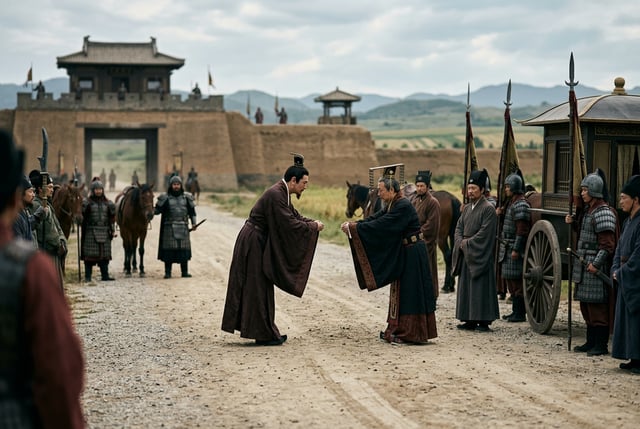
Liu Bei Takes Refuge in Jing Province
Relationship timeline17 entries ▸
History · vol. 6
- Yuan Shao§54
Friend
Formed an alliance with Yuan Shao in the north
- Zhang Xian§54
Enemy
Zhang Xian rebelled and sent a memorial; was attacked year after year; Xian died of illness
- Liu Bei§56
Friend
Bei fled to Biao; Biao treated him generously but could not employ him
History · vol. 32
- Liu Cong§12
Child
father and son (after Liu Biao died, his son Cong succeeded him)
History · vol. 35
- Liu Cong§5
Child
father and son (Cong was Biao’s youngest son; Biao loved him at his second wife’s urging)
Novel · ch. 6
Novel · ch. 18
Friend
agreed with Zhang Xiu to join forces and cut off Cao Cao’s route of retreat
- Cao Cao§5
Enemy
guarded a strategic pass to cut off Cao Cao's return route; later was soundly defeated in battle at Anzhong
All 17
Loading…
Inner monologues · AI-generated3 monologues ▸
- I am Liu Biao, courtesy name Jingsheng. When I reflect on what I upheld through half a lifetime, it was no more than the
- I am Liu Biao, courtesy name Jingsheng. Appointed to govern Jing Province, I faced more than the fate of a single city o
- I am Liu Biao, courtesy name Jingsheng, from Gaoping in Shanyang. Even as a youth, I was already renowned and associated