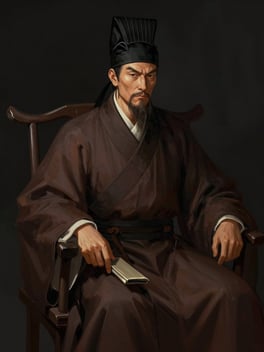
Circumstances of His Death
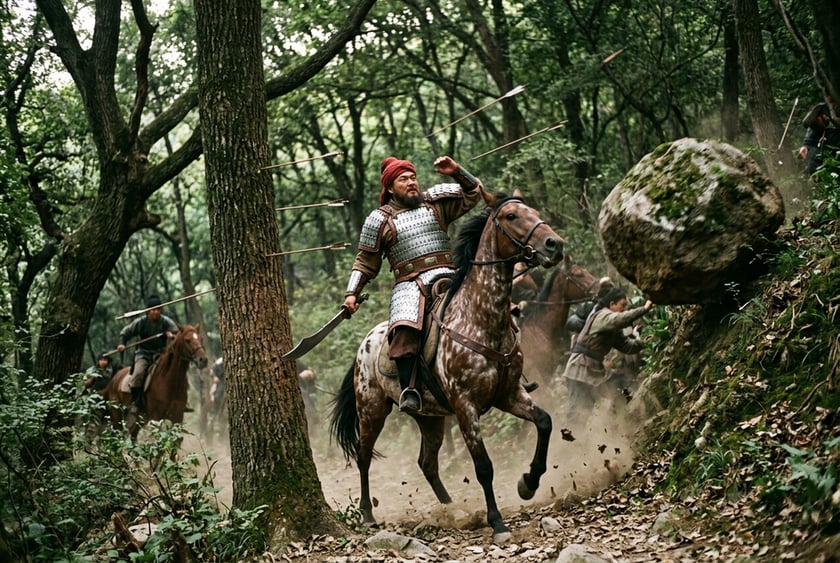
Sun Jian died at the height of his military success. In 191 (the second year of Chuping, according to Pei Songzhi’s textual research), he had just defeated Huang Zu between Fan and Deng, crossed the Han River, and besieged Liu Biao inside Xiangyang. According to the main text of the Records of the Three Kingdoms, he was riding alone through the Xianshan hills when Huang Zu’s soldiers shot and killed him. Xianshan lies south of Xiangyang; its dense woods made it the kind of terrain especially dangerous for cavalry.
The works cited in Pei’s annotations give different accounts of the final moments. The Dianlüe describes a night battle: acting on Liu Biao’s orders, Huang Zu went out at night to muster troops. On his return, Sun Jian intercepted him, and Huang Zu was routed into Xianshan. Pursuing him at night in the wake of victory, Sun Jian was struck by a hidden arrow among the bamboo and trees. The Heroes’ Record, by contrast, describes a mountain ambush: Liu Biao’s officer Lü Gong came along the mountain, and Sun Jian personally led light cavalry up in pursuit. Stones dropped by Lü Gong’s troops struck him on the head. The two accounts agree that Sun Jian, as commander, pursued the enemy with light cavalry deep into the woods and was ambushed without adequate protection. Whether he died from an arrow or a stone, Pei Songzhi records the differing accounts without choosing between them. The date of his death is also disputed: the main text gives the third year of Chuping, while the Heroes’ Record gives the seventh day of the first month of the fourth year. In his annotation to Sun Ce’s biography, Pei Songzhi drew on Sun Ce’s memorial and Zhang Fan’s History of the Han and Wu Record to conclude that it must have been the second year of Chuping, and that the biography was in error.
The Romance of the Three Kingdoms weaves these accounts into a complete story: first comes the ill omen of the commander’s banner being blown down by the wind; then Kuai Liang observes the stars and predicts that a general’s star is about to fall. Lü Gong is then allowed to break out toward Xianshan, where stones are prepared on the mountain and crossbowmen lie in ambush in the woods. Hearing the shouts, Sun Jian has no time to summon his officers and rides out with only thirty-odd cavalrymen. Because his horse is fast, he charges ahead alone and is killed by rolling stones and a hail of arrows. The novel combines the hidden arrows of the Dianlüe with Lü Gong and the falling stones of the Heroes’ Record, making Sun Jian’s death the result of both an omen from Heaven and a human plan.
Last Words or Final Instructions
The Records of the Three Kingdoms records no last words from Sun Jian, and the novel gives him none either. His death came so suddenly that he had no time to make any arrangements for what would follow. That very suddenness determined the course of the Sun family’s forces: there was no designated heir and no instructions about who should command the troops, so his closest relative had to take charge on a temporary basis.
The Records of the Three Kingdoms says that his nephew Sun Ben took over and led the soldiers to join Yuan Shu, who immediately recommended Sun Ben as Inspector of Yu Province. According to the memorial Sun Ce later submitted himself, as cited in Pei’s annotation from the Wu Record, the eldest son was seventeen at the time; Pei Songzhi’s calculation based on the biography puts him at eighteen. In any case, he was not yet able to command his father’s former troops. The army Sun Jian had built up thus returned to Yuan Shu’s hands. Sun Ce later had to ask Yuan Shu to return some of his father’s old troops before he could cross the river and establish himself.
The novel instead has Sun Ce witness his father’s death in the army and learn the terrible news by the Han River, where he weeps aloud. Huang Gai captures Huang Zu alive amid the fighting, Cheng Pu stabs Lü Gong to death, and Sun Ce insists that his father’s body must not remain in enemy hands. This portrayal makes Sun Ce assume the responsibilities of an eldest son from the very beginning, laying the groundwork for his later succession to his father’s cause.
Aftermath
Sun Jian’s body fell into Liu Biao’s hands. The Biography of Huan Jie in the Records of the Three Kingdoms recounts that Huan Jie, a former officer of Sun Jian, risked going to meet Liu Biao and asked him to return Sun Jian’s body. Moved by Huan Jie’s loyalty, Liu Biao handed it over. The novel renames the character Huan Kai and adds an exchange in which Huang Zu, who had been captured, is traded for Sun Jian’s body: Liu Biao’s adviser Kuai Liang argues that the envoy should be executed and that they should attack Jiangdong while Sun Jian’s death is still fresh, but Liu Biao, mindful of his friendship with Huang Zu, insists on the exchange. The exchange of Huang Zu for the body is not recorded in the Records of the Three Kingdoms.
Sun Ce escorted his father’s coffin east and buried him at Qu'e; afterward, he moved to Jiangdu and recruited worthy men. This broadly accords with the account in the Biography of Sun Ce in the Records of the Three Kingdoms. After Sun Quan Proclaims Himself Emperor in 229, Sun Jian was posthumously honored as Emperor Wulie.
Sun Jian’s death also forged an enduring enmity between the Sun family and Huang Zu. Sun Ce and Sun Quan attacked Huang Zu repeatedly thereafter, until Sun Quan captured Jiangxia and killed Huang Zu in 208, bringing the feud to an end.
Historical Assessment
In his appraisal, Chen Shou sums up Sun Jian’s life: brave and resolute, he rose from humble beginnings. He once urged Zhang Wen to execute Dong Zhuo; during the campaign against Dong Zhuo, he advanced on Luoyang and repaired the Han imperial tombs Dong Zhuo had dug up and destroyed, displaying a spirit of loyalty and heroic valor. Judging by his military record, he was also one of the few eastern coalition generals who actually engaged Dong Zhuo’s forces head-on and defeated them. That, however, is a later observation, not part of Chen Shou’s original appraisal.
Yet Sun Jian’s death also exposed another side of his character: as a commander, he repeatedly risked himself under fire and pursued the enemy with light cavalry. During the earlier campaign against the Yellow Turbans, he had already been wounded and thrown from his horse after advancing too far, and nearly died. At Xianshan, this same daring finally cost him his life. It is striking that his eldest son, Sun Ce, was later assassinated after riding out to hunt with too few guards. Both father and son died after, as commanders, exposing themselves recklessly to danger; their deaths caused two major breaks in the early development of the Sun regime.
On the broader stage, Sun Jian was thirty-seven when he died, just as the contest among the warlords was beginning. His early death deprived the Sun family of the chance to compete in the Central Plains, but it also indirectly prompted Sun Ce to turn toward Jiangdong and Sun Quan to hold the Yangtze, laying the groundwork for the emergence of Eastern Wu in the Three Kingdoms.