Strategic Background
After the coalition against Dong Zhuo disbanded, the warlords east of the passes soon split into two major camps. According to the Records of the Three Kingdoms: Biography of Yuan Shu, Yuan Shu was at odds with his elder cousin Yuan Shao and on bad terms with Liu Biao, so he allied himself to the north with Gongsun Zan; Yuan Shao, in turn, allied himself to the south with Liu Biao. Sun Jian had won great renown in the campaign against Dong Zhuo and was now serving under Yuan Shu, the sharpest weapon in Yuan Shu’s arsenal. Yuan Shu held Nanyang, facing off against Yuan Shao and Cao Cao to the north, while to the south lay Jing Province, controlled by Liu Biao. The most direct way to break out of this position was to expand southward and annex Jing Province. In 191 (the second year of Chuping, according to Pei Songzhi’s examination; the main text of the Biography of Sun the Suppressor of Rebels gives the third year of Chuping), Yuan Shu sent Sun Jian to campaign against Liu Biao.
The Records of the Three Kingdoms: Biography of Sun the Suppressor of Rebels recounts this expedition in only a few words, saying merely that Yuan Shu dispatched him; the Records of the Three Kingdoms does not mention any personal grievances. The Romance of the Three Kingdoms, by contrast, lays out two motives for the war. First, after Sun Jian obtained the Imperial Seal, he headed east, and Liu Biao, acting on Yuan Shao’s behalf, sent troops to intercept him, setting the two at odds. Second, after Liu Biao refused Yuan Shu’s request for grain, Yuan Shu wrote to Sun Jian, urging him to take revenge. The Records of the Three Kingdoms does not mention Liu Biao intercepting Sun Jian; this connection was added by the novel to heighten the dramatic conflict.
Deployments
According to the Records of the Three Kingdoms, Liu Biao sent Huang Zu to engage Sun Jian between Fancheng and Deng County. Fancheng lay on the north bank of the Han River, facing Xiangyang across the river, while Deng County was to its northwest. This indicates that Sun Jian advanced south from Nanyang, and that Huang Zu chose the open ground north of the Han River to meet him, hoping to keep the fighting away from Xiangyang.
The novel’s geography is different. Sun Jian gathered warships in Jiangdong, loaded them with horses, and sailed up the river straight toward Fancheng. On Liu Biao’s side, Kuai Liang proposed a plan: Huang Zu would lead the Jiangxia troops as the vanguard, while Liu Biao personally led the main force from Jing and Xiang as reinforcements. Sun Jian’s younger brother Sun Jing once urged him not to raise an army over a personal grudge, but Sun Jian ignored him and brought his eldest son, Sun Ce, along. In the novel, Cheng Pu, Huang Gai, and Han Dang—veteran generals who would later become elder statesmen of Eastern Wu—all take on major assault roles.
Key Decisions
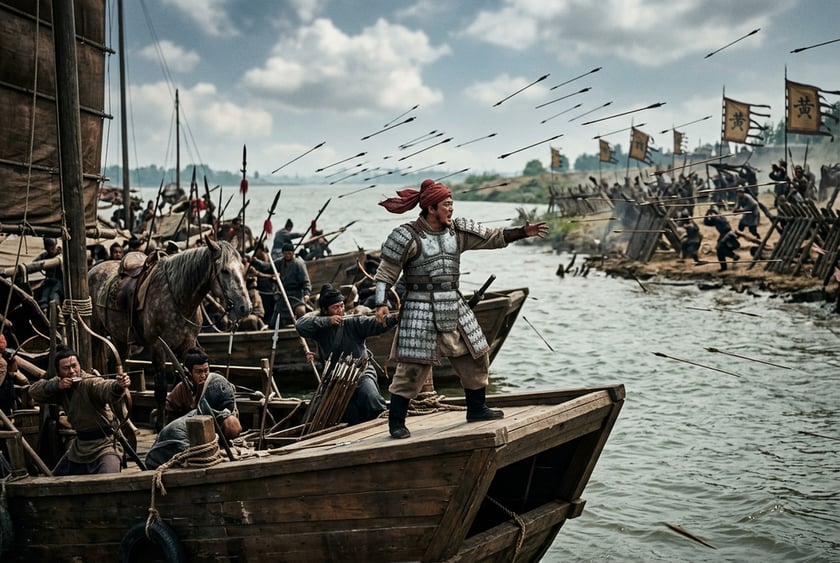
The first key decision rested with Huang Zu. He chose to meet Sun Jian in the field between Fan and Deng rather than hold the line along the Han River, and was defeated. Had the Jing forces withdrawn to the south bank of the Han River from the outset, Sun Jian would have had to fight his way across, at far greater cost. The novel depicts this episode as an exchange of arrows from the riverbank: Sun Jian repeatedly brought his ships close to shore to lure the enemy into firing. Once Huang Zu had exhausted his arrows, Sun Jian shot back with the wind at his back, forcing Huang Zu to retreat. After landing, Cheng Pu and Huang Gai attacked from separate routes. Huang Zu abandoned Fancheng and withdrew to Dengcheng; when he met Sun Jian again, he was defeated once more. Sun Ce shot Chen Sheng dead in the battle, and Han Dang killed Zhang Hu.
The second key decision rested with Sun Jian. After defeating Huang Zu, he did not pause but crossed the Han River and went straight on to besiege Xiangyang. It was a bold choice: Xiangyang was Liu Biao’s seat of government, and taking it would secure northern Jing Province at a stroke. But advancing deep into enemy territory with an isolated force and the Han River at his back meant that a setback could make retreat difficult. The novel vividly conveys this recklessness with an episode in which the wind breaks the pole of Sun Jian’s command banner, and Han Dang urges him to withdraw for the time being, but Sun Jian insists on pressing the attack.
The third key decision also rested with Sun Jian: he rode alone through Xianshan and was shot dead by one of Huang Zu’s men. Pei Songzhi’s commentary cites the Dianlüe, which says he was ambushed while pursuing Huang Zu through the night in the wake of his victory. The accounts differ on the cause and timing of his death; see the sub-event “Sun Jian’s Death at Xianshan” for details.
Results and Aftermath
Sun Jian’s death immediately brought the southern expedition to an end. His nephew Sun Ben rallied the troops and went over to Yuan Shu, who submitted a memorial appointing Sun Ben Inspector of Yu Province. The Sun family had lost its head, and its troops were absorbed into Yuan Shu’s forces. Sun Ce could only start over under Yuan Shu, until several years later, when he borrowed troops, crossed the river, and laid the foundations of the Sun family’s power in Jiangdong.
For Liu Biao, the battle secured Jing Province. For more than a decade afterward, Jing Province remained a relatively stable refuge, attracting large numbers of northern scholars who came south to seek his protection. For Yuan Shu, losing Sun Jian meant the failure of his plans for southward expansion. In 193, Cao Cao defeated him in the north, forcing him to retreat to Huainan.
The battle also sowed lasting enmity between the Sun family and Huang Zu. Sun Ce and his brother Sun Quan later campaigned against Huang Zu repeatedly; only in 208, when Sun Quan captured Jiangxia and killed Huang Zu, was the old score finally settled. Sun Jian’s vow before setting out, as portrayed in the novel, to repay any grudge became, in a sense, a footnote to the Sun family’s policy toward Jing Province across two generations.
Counterfactual
What might have happened if Sun Jian had not risked riding alone deep into the mountains, but instead had methodically tightened his siege of Xiangyang? Liu Biao had only recently arrived in Jing Province and had relied on local great clans such as Cai Mao and Kuai Yue to establish his position; his territory was not united as one. A prolonged siege might have caused some of the local Jing forces to waver. But Sun Jian’s supplies had to be transported from Nanyang along the north bank of the Han River, and Yuan Shu himself was beset on all sides. Whether he could sustain a long siege was just as uncertain.
If Sun Jian had actually taken Xiangyang, Yuan Shu would have held Nanyang and northern Jing Province, making his power far greater than Cao Cao’s at the time. As the actual conqueror, Sun Jian might well have established an independent regime in Jing Province. The political landscape of the late Eastern Han would then have gained a powerful state centered on Jing Province ahead of schedule. The Sun family might never have crossed the river to build its power in Jiangdong, and the stage for the Battle of Chibi would have been transformed entirely.