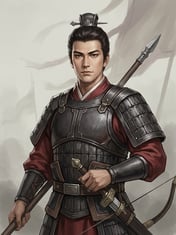
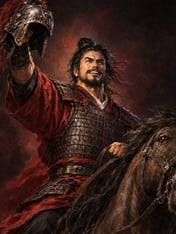
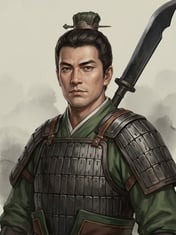
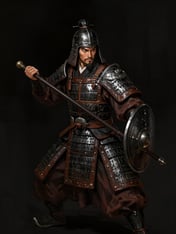
In the second year of Xingping (195), Sun Ce crossed the Yangtze and pacified Jiangdong, confronting Yangzhou Inspector Liu Yao in the area around Qu'e. Taishi Ci, who served under Liu Yao and came from the same commandery as Sun Ce, had originally been ordered only to scout the enemy’s forces. Since Liu Yao did not think highly of him and gave him no troops to command, he rode out ahead alone with a single cavalryman. In the area around Shenting Ridge, near Qu'e, Taishi Ci unexpectedly encountered Sun Ce and his party; Sun Ce was then accompanied by only thirteen horsemen, including Han Dang, Song Qian, and Huang Gai. The two fought one-on-one for dozens of bouts without a clear victor. In the ensuing melee, Sun Ce stabbed Taishi Ci’s mount and seized the hand-spear worn at the back of his neck, while Taishi Ci snatched Sun Ce’s helmet. Only when reinforcements from both sides arrived at the same time did the two part. The fifteenth chapter of *Romance of the Three Kingdoms* dramatizes the encounter: after dreaming at night that Emperor Guangwu had summoned him, Sun Ce went to burn incense at the Han Guangwu Temple on Shenting Ridge. On his way back, Taishi Ci caught up with him, and the two fought fifty bouts without a clear victor. The next day, Sun Ce displayed the hand-spear he had seized by raising it before the ranks, while Taishi Ci raised Sun Ce’s helmet in return. Though the battle ended without a victor, it laid the emotional and character groundwork for Sun Ce’s later defeat of Liu Yao and winning over of Taishi Ci.
The Wu section of the Records of the Three Kingdoms records that, because Liu Yao did not think highly of Taishi Ci, he was merely ordered to scout the enemy's strength. While riding ahead alone with one companion, Taishi Ci ran into Sun Ce and thirteen horsemen. In their duel, Sun Ce stabbed Taishi Ci's horse and seized his hand halberd, while Taishi Ci took Sun Ce's helmet. Reinforcements arrived just then, and the two separated. The episode is presented throughout as an incidental battle, without any supernatural coloring.
Romance
Chapter 15 of the novel first builds up the omens of Sun Ce dreaming that Emperor Guangwu summoned him and insisting on entering a temple to burn incense. It then invents a legendary episode in which Sun Ce enters dangerous territory with only thirteen horsemen and duels Taishi Ci for fifty bouts at Shenting Ridge. It also adds the dramatic scene the next day in which each side displays before the battle line the objects its soldiers had taken from the other. A commonplace encounter is elevated into a heroic prelude to Sun Ce’s domination of Jiangdong.
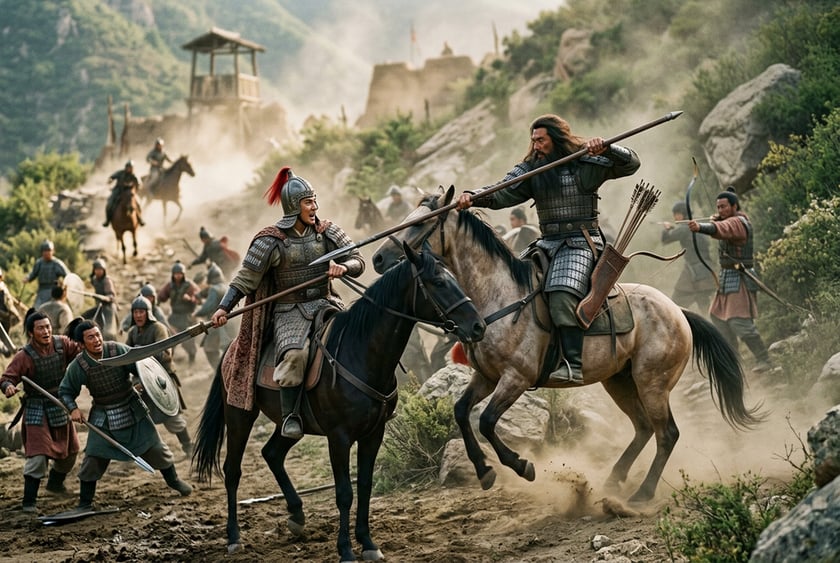
On the rugged mountain path at Shenting Ridge, Sun Ce and Taishi Ci ride horses and clash fiercely with weapons in hand, their mounts leaping amid billowing dust.
The Duel at Shenting took place in 195, during the second year of Xingping, as Sun Ce crossed the Yangtze and advanced south to pacify Jiangdong. At the time, the political landscape in the lower Yangtze region had a two-tier structure: a nominal central authority alongside de facto local powers. Liu Yao, the Inspector of Yangzhou, represented the remnants of the Eastern Han’s legitimate administrative system. Based in Qu'e, he held nominal authority over the region. Sun Ce, meanwhile, led an elite force made up of his father Sun Jian’s former troops, soldiers lent by his maternal uncle Wu Jing, and men he had gained when he parted ways with Yuan Shu. He crossed the river from Liyang with the aim of “seizing Jiangdong,” representing an emerging local military power. Conflict between these two forces was inevitable; the only question was which battle would prove the turning point.
Geographically, Shenting Ridge—near present-day Shenting Village in Xuebu Town, Jintan, Changzhou—lies southwest of Qu'e, between Danyang and Yanling. It was an unavoidable route both for Sun Ce’s scouts reconnoitering Liu Yao’s positions and for Liu Yao’s scouts tracking Sun Ce’s movements. An encounter arising purely from reconnaissance was therefore both accidental and inevitable.
As for the men involved, Taishi Ci and Sun Ce came from the same commandery. Taishi Ci should have been a potential recruit for Sun Ce, but at this time he held a nominal post under Liu Yao, who did not think highly of him. Liu Yao even refused to grant him the authority of a senior general, asking, “If I employ Ziyi, would Xu Zijiang not laugh at me?” This kind of “self-censorship based on the judgments of famous scholars” typifies how the literati culture of the late Eastern Han distorted practical decisions about appointing talent.
The Encounter
At the heart of the event was a chance one-on-one encounter lasting about twenty minutes. Taishi Ci was ordered to scout and rode ahead alone with one companion. Sun Ce rode out from camp to patrol with Han Dang, Song Qian, Huang Gai, and ten other horsemen. When the two scouting parties met on Shenting Ridge, the rational choice for both sides would have been to withdraw immediately and report back. Taishi Ci instead chose to issue a direct challenge. The only explanation for this choice is that he wanted to prove himself in a fight: already marginalized within Liu Yao’s camp, he had no opportunity to distinguish himself through ordinary channels.
Sun Ce’s response had the characteristic boldness of the “Little Conqueror.” Rather than send one of his formidable companions to fight first, he faced Taishi Ci himself. They fought until Sun Ce stabbed Taishi Ci’s mount and seized the short halberd behind his neck, while Taishi Ci snatched Sun Ce’s helmet. In the Romance, these two objects later became props that “proved the courage of both men”; in the historical account, however, they were simply items seized in the confusion of battle. Most importantly, reinforcements from both sides arrived at the same moment, forcing the duel to end. The Romance extends the opening phase of the duel into “fifty bouts without a victor,” adds a melee after the reinforcements arrive, and stages a scene the next day in which the two armies display the captured halberd and helmet before their ranks. In this way, a fight that may in reality have lasted only a few minutes becomes a heroic tale heralding Sun Ce’s rise to dominance in Jiangdong.
Outcome
In tactical terms, the Duel at Shenting was an inconclusive chance encounter, and neither side achieved a clear victory. Politically, however, both sides recognized its significance. Sun Ce was just beginning to establish his authority in Jiangdong and badly needed a heroic story that could spread widely. Fighting a formidable general from Liu Yao’s camp to a “draw” was both honorable and safe: victory would have been welcome, but a draw also demonstrated his opponent’s ability and made Sun Ce’s own record seem all the more impressive by comparison.
For Taishi Ci, the fight was his only chance to prove his ability to the world. His position in Liu Yao’s army did not improve noticeably afterward, but Sun Ce’s side remembered him, laying the groundwork for his later allegiance to Wu. After Liu Yao’s defeat, Sun Ce caught up with Taishi Ci and took him prisoner. Sun Ce personally untied him and asked whether he would “be willing to join him.” Taishi Ci promised to return after summoning the remaining followers of Liu Yao, and Sun Ce trusted him without hesitation. The foundation for that trust was laid in the Duel at Shenting, where the two had seen and respected each other on the battlefield.
Impact
The Duel at Shenting had three lasting effects. The first was tactical: it showed the generals of Jiangdong that a commander could personally fight a duel, establishing a model of leadership repeatedly reenacted in the eras of Sun Ce and Sun Quan—for example, Taishi Ci’s fierce fight with Sun Ce and Zhang Liao’s pursuit of Sun Quan at Ruxu Dock. This fostered the traditional image of Wu commanders as personally brave, in marked contrast to Cao Wei’s image of commanders directing operations from behind the scenes.
The second effect was in personnel: the encounter directly set in motion Taishi Ci’s transfer to Wu, a crucial acquisition of talent. After losing Taishi Ci, Liu Yao’s camp rapidly collapsed in the Battle of Qu'e. Sun Ce, meanwhile, gained a formidable general who could act independently in campaigns to take Nan Commandery and pacify the various commanderies of Jiangdong. More broadly, the event marked how the newly established Jiangdong regime integrated talent by “recognizing men on the battlefield.”
The third effect was literary. The Romance made the Duel at Shenting the defining scene for Sun Ce’s image as the “Little Conqueror” and Taishi Ci’s image as a “formidable general of loyalty and honor.” As a result, both men occupy a far greater place in the minds of later readers than their actual weight in the historical records would warrant. This is especially true of Taishi Ci: as the same-commandery acquaintance of Sun Ce recorded in greatest detail in the Wu section of the Records of the Three Kingdoms, his character, courage, and loyalty were shaped by this fight and his subsequent surrender. From this perspective, the Duel at Shenting was not merely a fight without a victor, but a pivotal event in shaping the early cultural character of the Jiangdong regime.