Romance
Sun Ce's army won
- Commanders
- Sun Ce's armySun Ce
- Zhang Ying's armyZhang Ying
Ch. 15「孫策引軍前來,乘勢掩殺。張英棄了牛渚」
195 CE (Xingping 2) · Niuzhu
According to chapter 15 of Romance of the Three Kingdoms, in the second year of Xingping (195), Sun Ce crossed the Yangtze and campaigned eastward to seize Yangzhou, first attacking Niuzhu, which was held by Zhang Ying, a subordinate of Liu Yao. Zhang Ying had stockpiled one hundred thousand units of grain in the Niuzhu depot and was defending behind the natural barrier of the Yangtze. Sun Ce brought his army to Niuzhu Ford; Zhang Ying advanced from his position to give battle, and Huang Gai crossed swords with Zhang Ying before the opposing lines without either side gaining the upper hand. At that moment, Jiang Qin and Zhou Tai, leading more than three hundred men they had gathered on the Yangzi River, voluntarily came to submit to Sun Ce; they set fire to Zhang Ying's camp from the rear. Zhang Ying's troops fell into chaos and rushed back to save the camp, whereupon Sun Ce seized the moment to press his attack. Zhang Ying was routed and fled, and Sun Ce accepted the surrender of more than four thousand soldiers, capturing a vast quantity of grain and military equipment. Liu Yao subsequently joined forces with Ze Rong to contest Niuzhu, but Sun Ce personally led his army in a counterattack. In the midst of battle he killed Fan Neng with a thunderous shout and captured and crushed Yu Mi before the lines, thereby earning the epithet "Little Conqueror". This engagement laid the military foundations for Sun Ce's control of the Jiangdong region and marked the starting point of Jiang Qin and Zhou Tai's service in the Wu army.
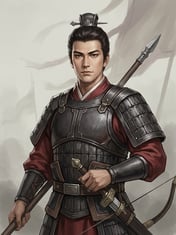 Sun CeCommanderTalk to me
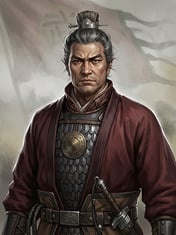 Huang GaiWarriorTalk to me
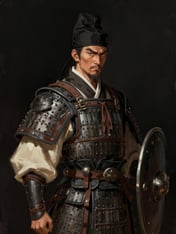 Zhang YingCommanderTalk to me
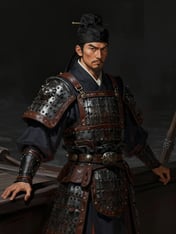 Jiang QinWarriorTalk to me
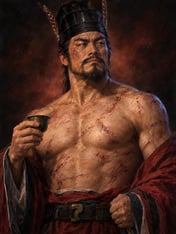 Zhou TaiWarriorTalk to me
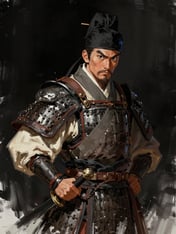 Yu MiKilled in actionTalk to me
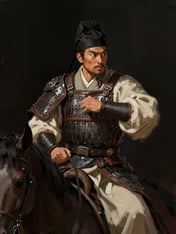 Fan NengKilled in actionTalk to me
Who won, as each book tells it; commanders as the text names them.
Romance
Sun Ce's army won
Ch. 15「孫策引軍前來,乘勢掩殺。張英棄了牛渚」
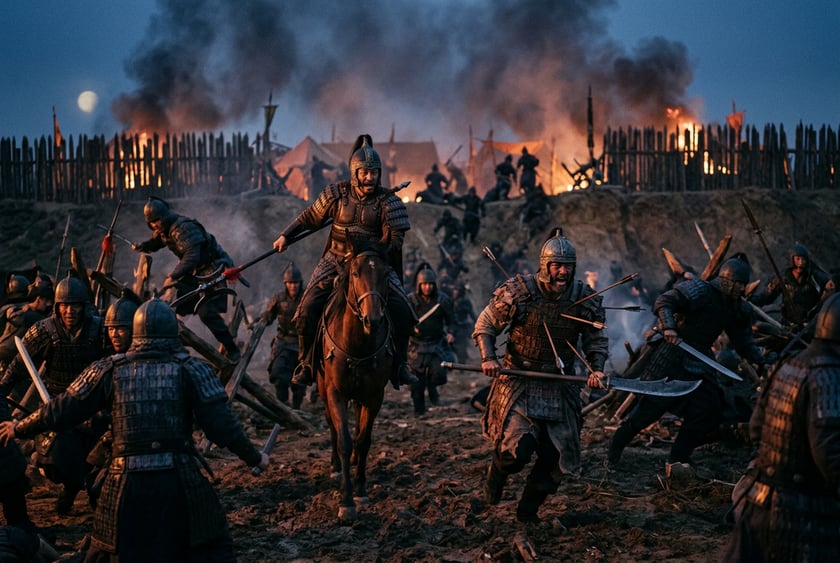
Scene
Under cover of night, flames blaze behind the Niuzhu camp as Jiang Qin and Zhou Tai lead their soldiers in an attack from the flank. Zhang Ying's camp is thrown into chaos.
Continue
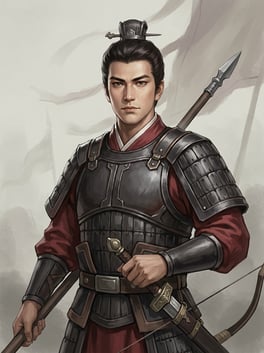
Sun Ce was of handsome countenance; when the surrendered troops heard 'Master Sun is here!' they all took fright and threw down their weapons.
1952 people in common
1912 people in common
1912 people in common
2152 people in common
1951 person in common
1961 person in common
1961 person in common
1961 person in common
The Battle of Niuzhu in the Romance of the Three Kingdoms takes place in the second year of the Xingping reign (195) — the opening act of Sun Ce's series of campaigns to cross the Yangtze and conquer the east. The backdrop: after his father Sun Jian was killed in battle, Sun Ce had sought refuge with Yuan Shu; when Yuan Shu broke his promise to give him the Yuzhou governorship, Sun Ce used a "borrowed troops" arrangement to obtain his own forces, determined to strike out on his own and cross the Yangtze to seize Yangzhou. Yangzhou Governor Liu Yao at the time controlled the territories of Danyang, Wu, Huiji, and others east of the Yangtze — the greatest obstacle to Sun Ce's entry into Jiangdong. Liu Yao's defensive deployment was multi-point occupation: he sent Zhang Ying to guard the Niuzhu granary depot (an important grain storage point on the Yangtze's south bank) and Ze Rong and Xue Li to guard Moling. Niuzhu was Sun Ce's first objective after crossing the river; it held "one hundred thousand in grain," and whoever seized Niuzhu had opened the door to Jiangdong.
On Sun Ce's side, the core battle commanders at this point included Cheng Pu, Huang Gai, Han Dang (veterans of Sun Jian), Zhu Zhi, and others. Numbers were modest — the Romance describes Sun Ce as having "his own forces" plus the contingent Yuan Shu had provided, totaling roughly ten thousand. But Sun Ce himself was of extraordinary valor and morale was extremely high. On Zhang Ying's side, as one of Liu Yao's commanders his task was to hold the Niuzhu granary depot — a position hastily built for riverfront defense. Zhang Ying was not without fighting skill, matching Huang Gai in front-line single combat "for several rounds without a decisive outcome", but he lacked depth and relief forces. The critical variable was two figures: Jiang Qin and Zhou Tai — "river brigands." Jiang Qin from Shouchun in Jiujiang and Zhou Tai from Xiaxai in Jiujiang had originally been "gathering men in the Yangtze River, living by plunder," and hearing that Sun Ce was "a Jiangdong hero capable of recruiting men of talent," they deliberately brought three hundred or so followers to seek him out. Both men later became core Sunwu commanders, but at the time of Niuzhu they were still a civilian armed force.
The key decision point of this battle was "coordinated interior-exterior action" — on the surface, Zhang Ying riding out to single-combat Huang Gai while Sun Ce pushed frontally, but the decisive blow was actually delivered by Jiang Qin and Zhou Tai setting fire to Zhang Ying's camp from the rear. The precondition for this tactical success was that Jiang Qin and Zhou Tai had already decided to join Sun Ce before the battle, and chose "a gift of entry to earn the chance of acceptance." From their perspective, Sun Ce attacking Niuzhu was a perfect moment to join — they could strike Zhang Ying from the rear, both creating a decisive advantage for Sun Ce and demonstrating their combat effectiveness to their new lord. Sun Ce's side had not pre-coordinated with Jiang Qin and Zhou Tai (in the Romance's narrative they learned of it only afterward), but Sun Ce seized the opportunity: fire broke out in the camp, Zhang Ying's troops turned in panic to fight the blaze, and Sun Ce immediately "brought his forces forward, pressing in to slaughter them." This capacity for rapid response to unexpected battlefield developments is the core distinction between a great commander and an ordinary one. In the second phase of the battle, Liu Yao and Ze Rong united their forces for a counterattack at Niuzhu; Sun Ce personally led his main force to meet them. The key decision in this phase was Sun Ce's personal display of valor. In the battle array he captured Yu Mi alive (a subordinate commander who charged out with a spear and was seized by Sun Ce within three exchanges); seeing Fan Neng galloping in to attack from the rear, Sun Ce "turned his head and let out a great shout, a voice like a great clap of thunder" — Fan Neng "was so shocked he tumbled backward off his horse, crashing headfirst, and died"; then Sun Ce carried Yu Mi wedged under his arm back to his own formation, and Yu Mi was already dead from the crushing. This performance of "crushing one general to death, shouting another to death," had all the commanders of Jiangdong calling Sun Ce "Little Conqueror" from that day forward.
The results of the battle had three layers. The first layer was material: Sun Ce seized the grain, military equipment, and over four thousand surrendered troops from the Niuzhu granary depot. This haul elevated Sun Ce from the dependent status of "troops borrowed from Yuan Shu" to a warlord capable of independent operations. The second layer was personnel: Jiang Qin and Zhou Tai officially joined Sun Ce's army, both appointed "Forward Cavalry Commanders." Both men later became core Sunwu commanders — Jiang Qin rose to Supervisor of Ruxu, and Zhou Tai was renowned for "bearing dozens of wounds" while shielding Sun Quan in the midst of battle, becoming one of the mainstays of Eastern Wu's warrior corps. The third layer was prestige: the establishment of the "Little Conqueror" epithet. This sobriquet invoked the image of Xiang Yu — "the Conqueror" — casting Sun Ce as the youthful hero of Jiangdong. In a time of chaos, such prestige was a tangible strategic resource — it could cause other Jiangdong strongmen to seek him out voluntarily, and cause opponents to flee at the mere mention of his name. Sun Ce's ability to pacify Jiangdong within just a few years was driven in no small part by the "Little Conqueror" charisma — this was one of its core engines.
What if Jiang Qin and Zhou Tai had not happened to come forward to join at this very moment? Sun Ce's attack at Niuzhu might have gone on considerably longer. Zhang Ying, though not Sun Ce's equal in fighting skill, could hold the granary depot to buy time, giving Liu Yao the opportunity to concentrate his main force for a counter-offensive. Sun Ce would still have won eventually, but at much greater cost. In this sense the victory at Niuzhu had a substantial element of luck — a case of "righteous volunteers appearing at just the right moment." If in the second phase Sun Ce had not displayed "Little Conqueror"-style personal valor in his encounter with Liu Yao and Ze Rong's counter-offensive, the tactical victory might still have been achievable (Sun Ce's forces by then were already augmented by the Niuzhu surrendered troops), but the "Little Conqueror" reputation would not have been established so early. The entire pace of the Jiangdong conquest might have slowed by half a year to a year — and that half-year to year carried enormous political significance for a newly risen warlord, because during the same period Yuan Shu was also attempting to infiltrate Jiangdong; Sun Ce had to establish legitimacy faster than Yuan Shu. If Sun Ce had been checked at Niuzhu and Zhang Ying had held him off, the first step of Sun Ce's cross-river strategy would have been frustrated, and he might have had to retreat north of the river, again placed under Yuan Shu's control. All of Jiangdong might have been unified by Liu Yao rather than the Sun family; the San Guo configuration would have been rewritten — without the Sunwu regime, there would have been no north-south separation after the Battle of Chibi to speak of. In this sense, though Niuzhu was a small-scale engagement, its strategic significance was deep enough — it was one of Sunwu's founding myths.