

Background
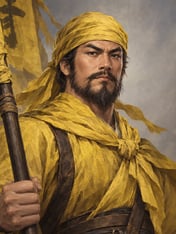
The narrative background to the Relief of the Siege of Beihai is one in which local authorities faced external military pressure and the collapse of internal security at the same time. According to Volume 11 of Romance of the Three Kingdoms, Kong Rong was considering whether to send troops to aid Xu Province, which was under attack by Cao Cao, when Guan Hai, a remnant of the Yellow Turbans, led his followers against Beihai. He demanded ten thousand shi of grain in exchange for withdrawing and threatened to slaughter the city’s inhabitants. Kong Rong refused to supply him with grain and then marched out to meet him in battle. His subordinate Zong Bao was soon killed by Guan Hai, the government forces were routed, and Beihai was besieged. This conflict is not merely a clash between two armed forces; it also depicts the urgent choices facing a local regime as it weighs food supplies, city defenses, and the duty to provide relief.
The event is generally dated to around the first year of Xingping (194), but the cited passages provide no explicit date. This date is therefore better treated as a rough placement of the event than as a precise date independently verified by those passages. The material itself comes from Romance of the Three Kingdoms, a literary narrative rather than a military report that can be equated directly with a contemporary record. The analysis below can therefore examine the political logic the story constructs, while distinguishing its plot details from verifiable historical facts. The name “Relief of the Siege of Beihai” in particular can encourage readers to treat the narrative’s ending as undisputed historical fact, but the available material supports only an account of how the novel tells the story of this crisis.
Main Figures
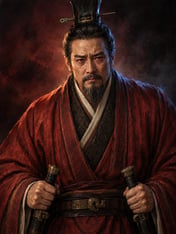
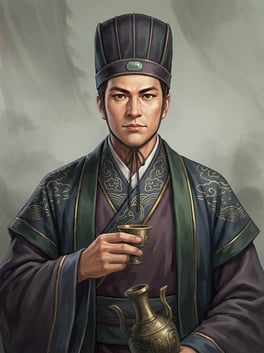
In the story, Kong Rong is both the defender of the city and the representative of local political order. By refusing Guan Hai’s demand for grain, he frames resistance as a duty to defend the Han realm. At the same time, he was initially concerned not only with Beihai but also with whether to aid Xu Province, showing how a local governor faced competing demands on his resources: assistance beyond his region and defense at home. Zong Bao’s death serves as an immediate sign of the weakness of the defensive system: although Kong Rong had official authority and a walled city, he lacked the strength to quickly overwhelm the besiegers.
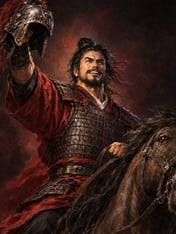
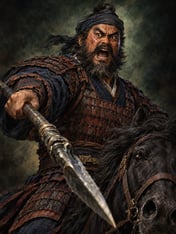
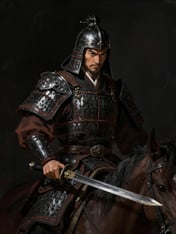
Taishi Ci is the key figure linking Beihai to outside reinforcements during the crisis. The novel presents his motive as repayment for Kong Rong’s kindness to his mother: he first breaks into the city alone on horseback, then is ordered to carry a letter seeking aid and explain Beihai’s peril to Liu Bei. His loyalty is not founded on kinship or ties to his native community; instead, it is portrayed as a bond that transcends private relationships and uses moral duty to bring about military cooperation. Liu Bei’s rhetorical question, “Did Kong Beihai know that there was a Liu Bei in this world?” expresses his awareness of the prestige implied by the invitation. He then sets out with Guan Yu and Zhang Fei. Guan Yu kills Guan Hai in battle, while Zhang Fei and Taishi Ci subsequently join the charge.
The participants’ roles are not entirely symmetrical: Kong Rong bears political responsibility for defending the city and seeking help; Taishi Ci takes the risks of communication and breaking through the encirclement; Liu Bei provides outside aid; and Guan Yu and Zhang Fei take part in the direct fighting. Zong Bao and Guan Hai, meanwhile, are respectively depicted as the defender and attacker who die in battle. It is worth noting that the passage from Volume 15 describes Taishi Ci shooting a defender atop the city wall during Sun Ce’s attack on Wu. It is not a continuation of the Relief of the Siege of Beihai and cannot be used to corroborate the outcome of this campaign. At most, it shows that the novel continues to portray Taishi Ci as a brave warrior in another conflict.
Key Issues
The first issue is whether local authorities can use compromise to secure short-term safety when confronted with armed extortion. Guan Hai offers to withdraw in exchange for grain and threatens to spare neither young nor old if he breaches the city. Kong Rong refuses, and the narrative thus links the defense of the city with the preservation of the Han dynasty’s authority. But this choice comes at a cost: the defenders are immediately defeated, the city is surrounded, and both the people and the government face greater danger. The novel does not discuss the size of the city’s grain reserves, the people’s views, or other possible negotiating strategies, so Kong Rong’s decision cannot simply be treated as the only viable policy.
The second issue is how “benevolence and righteousness” can be turned into political resources. Kong Rong had earlier given grain and silk to Taishi Ci’s mother, prompting Taishi Ci to risk his life to help him. Liu Bei, in turn, sends troops because Taishi Ci appeals for aid in the name of benevolence and righteousness. The story constructs a chain of generosity, gratitude, the delivery of a message, and military assistance, depicting personal virtue as an informal network connecting local regimes. It also suggests that crisis management depends not only on established bureaucratic structures but on personal prestige, private trust, and the rapid transmission of requests for help.
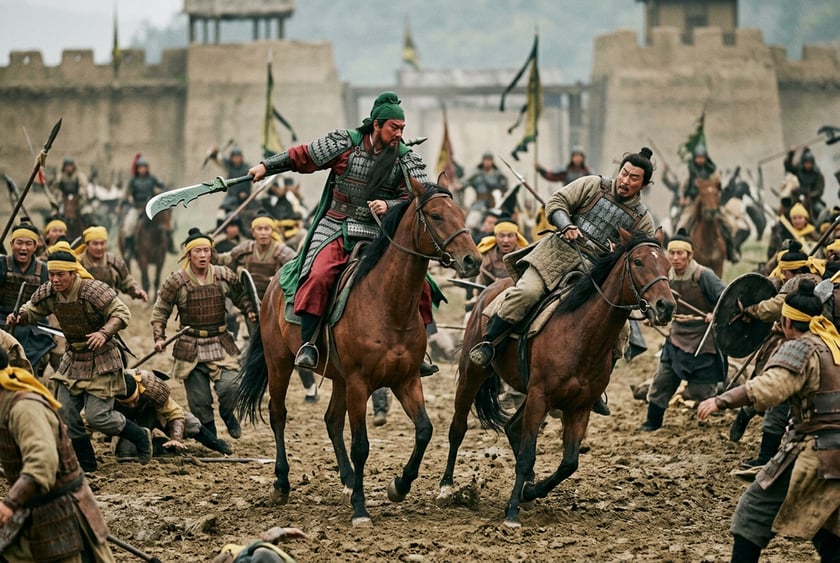
The third issue is the mutual reinforcement of military prestige and battlefield narrative. In the novel, Guan Hai dismisses the forces led by Liu Bei. Guan Yu’s killing of the enemy commander, Taishi Ci and Zhang Fei’s charge, and Kong Rong’s sortie in support of them then quickly turn the tide. This arrangement concentrates credit for the victory in the personal bravery of famous generals, while still recognizing the importance of cooperation from the defenders. For the study of political history, this portrayal shows how the novel explains authority and victory; it is not a military record sufficient to independently establish the size of the opposing forces, the course of the tactics, or the scale of casualties.
Political Consequences
At the level of the novel’s immediate narrative, once the reinforcements arrive, Guan Hai is killed by Guan Yu, the besiegers are attacked from both sides and defeated, many surrender, and the rest scatter. Thus, according to the ending given in Romance of the Three Kingdoms, the siege of Beihai is lifted. At the same time, the event outcome provided in the prompt is marked “unknown,” and the two should be considered together: the novel gives a clear ending, but if the question concerns independent historical verification, the cited passages provide no evidence beyond the novel confirming the details or historical outcome of the campaign.
This rescue also advances Liu Bei’s political activities toward Xu Province. Volume 11 goes on to recount that after leaving Beihai, Liu Bei borrows troops from Gongsun Zan to aid Xu Province and emphasizes that he is unwilling to break his word after having made a promise. In the structure of the story, then, the Relief of the Siege of Beihai not only brings a local crisis to a close but also serves as an intermediate episode in Liu Bei’s cultivation of a reputation for keeping faith and valuing righteousness. This narrative continuity, however, does not by itself prove that the Beihai campaign produced the same alliance effects or shifts in power in real-world politics.
More broadly, the story portrays local security as the result of cooperation among several parties: Kong Rong uses the city and government offices as a base; Taishi Ci opens a channel for requesting aid; Liu Bei provides mobile forces; Guan Yu and Zhang Fei take on the fighting; and the defenders seize the opportunity to sortie. The political implication is that a single local governor could not easily cope with mobile armed groups on his own. Prestige and military ties across regions could compensate for the limitations of local defenses, but the provision of aid could also draw the rescuers into new political commitments. The novel depicts this interdependence but does not explain Beihai’s postwar administrative recovery, grain losses, or the resettlement of those who surrendered, so such consequences should not be asserted without evidence.
Counterfactual Analysis
If Kong Rong had accepted the offer of grain in exchange for the besiegers’ withdrawal, he might have avoided an immediate battle, but the material does not say whether Guan Hai would have kept his word or made further demands after withdrawing. Concession might also have reduced the defenders’ available food and weakened the government’s ability to resist coercion. Conversely, although refusing preserved Kong Rong’s political stance, it led to Zong Bao’s death, the rout of the army, and the city’s encirclement. Since the novel provides no information about room for negotiation, the city’s grain reserves, or the people’s capacity to endure, the fact that reinforcements later won the battle is not enough to conclude that Kong Rong’s initial decision was necessarily the best one at the time.
If Taishi Ci had failed to break through the encirclement, Kong Rong would have had difficulty getting his request for help to Liu Bei in time; and if Liu Bei had not sent troops, the novel presents no plan by which the defenders of Beihai could have lifted the siege themselves. This counterfactual highlights the event’s dependence on individual action: Taishi Ci’s bravery, joined to Kong Rong’s earlier generosity, becomes a fragile but effective channel for rescue. However, alternative messengers, intervention by nearby powers, or changes within the besieging force in the real political circumstances are not addressed in the available material, so other possibilities cannot be ruled out on that basis.
Finally, if we consider only the battlefield outcome described in the novel, Beihai was relieved through outside aid. If “unknown outcome” is understood as a qualification about the historical evidence, the more cautious conclusion is that the literary text clearly states who won, while the available excerpts from historical sources are insufficient to verify that outcome and its political consequences independently. These two statements are not contradictory: they answer different questions—“What does the novel say?” and “What can the available material confirm?” For modern political-historical analysis, distinguishing between a narrative ending, a judgment about historical fact, and counterfactual reasoning is essential to avoiding the mistake of treating a literary story of loyalty and righteousness as a complete account of a war.