







Background
The so-called “Tao Qian's Three Cessions of Xuzhou” should first be understood as Romance of the Three Kingdoms’ literary rendering of a local power-transfer crisis, rather than as a record of a meeting that can be taken as verbatim historical fact. The available passages present a sequence of events in which Xu Province comes under military pressure from Cao Cao, Liu Bei arrives to provide aid, and Tao Qian attempts to arrange a successor. The political background is a convergence of external military threats and the local ruler’s advanced age and ill health, making “who can hold Xu Province” a more urgent question than the nominal title itself.
In the novel, Tao Qian proposes yielding the province for reasons beyond mere personal goodwill: he stresses that he is old and unable to manage affairs of state, and says that Liu Bei is a kinsman of the Han imperial house, suited to “strive to uphold the state.” But Liu Bei sees accepting the office as a moral risk, fearing that the world would regard him as taking Xu Province in its moment of peril. The story thus brings military relief, the legitimacy conferred by Han lineage, and political authority together: Xu Province is not merely a seal of office, but a domain whose rule must be assumed in the name of the public and accompanied by responsibility for its protection.
Main Figures
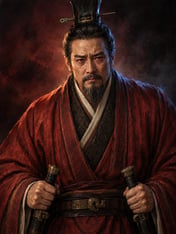
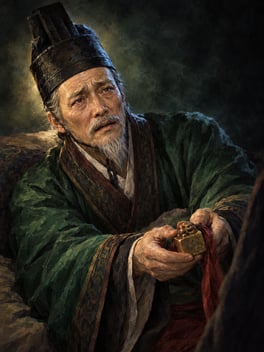
Tao Qian initiates the transfer of power. He first offers to yield his position while pressure from Cao Cao’s army has not yet abated. After Liu Bei refuses, Mi Zhu advises dealing with the enemy first. Once Cao’s forces withdraw, Tao Qian raises the matter again before everyone at a banquet, explaining his choice by citing his advanced age and his two sons’ unsuitability for office. This arrangement shows that Tao Qian is not merely expressing a personal wish; by raising the matter publicly and having local notables urge Liu Bei to accept, he also seeks to create visible political support for his successor.
Liu Bei’s refusal reflects the tension between his identity as the recipient of aid and his possible role as successor. He explains that he came to help “out of righteousness,” and fears that if he takes possession of Xu Province as soon as the crisis is over, his relief effort will be recast as an act of expansion. Even when Kong Rong, Mi Zhu, Chen Deng, and others urge him to accept, he suggests that Yuan Shu could also be considered, thereby making clear that he does not wish to equate “someone offering to yield” directly with “his own duty to accept.” Guan Yu and Zhang Fei offer different views, emphasizing respectively the practicality of temporarily taking charge of the province and the fact that accepting a transfer is not the same as seizing it by force; Zhao Yun, meanwhile, accompanies the relief force. These differences make Liu Bei’s hesitation the focus of the narrative.
Kong Rong and Tian Kai are both members of the outside relief force and witnesses, as well as political guarantors in the discussions over the transfer. Kong Rong counters Liu Bei’s refusal with the argument that “if Heaven offers it and you do not take it,” while Mi Zhu and Chen Deng appeal to the realities of governance, emphasizing respectively Xu Province’s strategic value at that moment and Tao Qian’s inability to attend to affairs. Mi Zhu later points out in particular that Cao’s forces withdrew because Lü Bu attacked Yanzhou, and that they might return the following year. This shows that the call for Liu Bei to accept was not only about personal standing, but also reflected concern for the continuity of the province’s defenses. These dialogues, however, represent the positions assigned to the characters by the novel and should not, without careful qualification, be treated as original records of each person’s actual political views.
Core Issues
The first issue is how legitimacy is created. Tao Qian has the authority of a ruler in office, but lacks the ability to continue governing. Liu Bei has the status of a kinsman of the Han imperial house and the prestige of having come to the province’s aid, but has not yet shown that he has received formal authorization from the people of Xu Province. The novel therefore has Tao Qian make repeated offers, Liu Bei refuse repeatedly, and the assembled officials take turns urging him to accept. This makes the transfer of power appear not to be a seizure, but a gradual process accomplished through cession, witness, and public urging. Repeatedly declining and renewing the offer expresses the ethic of modest deference, while also building public recognition for a potential new ruler.
The second issue is the conflict between moral reputation and strategic interest. Xu Province is “wealthy and prosperous” and has a large population, so it clearly holds practical political value. Yet if Liu Bei accepts too quickly, he may damage the credibility of his commitment to “righteousness.” Conversely, if he continues to refuse, a region without a strong succession plan may be left in a power vacuum when external enemies return. The novel compresses this dilemma into the compromise of “temporarily stationing in Xiaopei”: Liu Bei does not immediately take over the province, but leaves troops to protect it. This eases the dispute over legitimacy while preserving room for him to intervene in local affairs in practice.
The third issue is the extent to which the transfer is institutionalized. The passages mention taking possession of Xu Province’s official seal, Tao Qian personally drafting a memorial to submit to the imperial court, and publicly explaining the matter to everyone at a banquet. But they show neither a clear succession procedure nor a mechanism for authorization by local officials or specific arrangements for transferring military command. “Yielding Xu Province” thus looks more like a political negotiation, driven jointly by the incumbent ruler, the relief force’s commanders, and local literati amid the loosening order of the late Han, than a routine succession secured by stable institutions. The more elaborate the symbolic ceremony, the more it underscores the anxiety over legitimacy created by the lack of formal institutional safeguards.
Political Consequences
In the text provided, the first offer to yield the province does not immediately change Xu Province’s nominal ruler: Liu Bei refuses to accept the seal, Tao Qian remains in Xu Province, and Liu Bei agrees to the arrangement of stationing in Xiaopei. This compromise avoids an open break while keeping Liu Bei in the vicinity of Xu Province and assigning him responsibility for its defense. The juxtaposition of “nominal refusal” and “actual troop deployment” shows that political power does not always change hands in a single ceremony; the stationing of troops, protection of the local area, and cultivation of prestige can also alter the parties’ practical influence.
The withdrawal of Cao’s forces does not eliminate the pressure over succession. Mi Zhu tells Tao Qian that Cao’s troops left because Lü Bu attacked Yanzhou and because of a poor harvest, and predicts that they may return the following spring. Later, as Tao Qian’s illness worsens, he summons Mi Zhu and Chen Deng again to discuss the matter and prepares to offer the province in person while gravely ill. The so-called “Three Cessions” are therefore not three isolated acts of ceremony, but a process in which external threats, the ruler’s declining health, and uncertainty over succession repeatedly compound one another. It is important to note that the available passages end with the matter being discussed again, so they do not allow us to conclude how the final transfer was completed. “Liu Bei Takes Control of Xu Province,” as named in the prompt, is a related sub-event, but the material available here is insufficient to reconstruct its full course.
From the perspective of political history, this narrative’s effect lies in shaping an interpretive framework in which power is “gained through righteousness”: Liu Bei’s position is presented as the result of a transfer rather than a seizure, while the local elite’s appeals turn an individual succession into a public choice. Yet this framework also obscures the hard conditions involved in a transfer of power—military control, local administration, and external defense. The novel’s language of deference serves to legitimize the transfer, while the troops stationed in Xiaopei and the threat from Cao’s forces remind readers that moral legitimacy cannot become stable rule without security and governing capacity to support it.
Counterfactual Analysis
Had Liu Bei accepted Xu Province immediately, before Cao’s forces withdrew, this might in the short term have produced a unified military command more quickly and reduced ambiguity over responsibilities between Tao Qian and the relief force. But it would also have strengthened the accusation that he had used the relief effort to seize territory, damaging the moral prestige on which he relied. Tao Qian’s proposal that Liu Bei succeed him did provide a nominal basis for doing so, but it might not automatically have dispelled other local powers’ doubts about the new ruler. Counterfactual analysis can point out the advantages and disadvantages of this choice, but the novel’s material cannot establish that any particular outcome would necessarily have followed.
If Liu Bei had continued to refuse and left Xu Province, the combination of Tao Qian’s serious illness, doubts about the heir’s ability, and continuing external military pressure might have made local defense and the transfer of power more precarious. If Liu Bei only stationed himself in Xiaopei, he could retain his role as a source of aid, but the unresolved arrangement of power within the province would remain a risk. By having everyone choose to “remain in Xiaopei,” the novel temporarily balances these two risks rather than resolving them outright. The point of the counterfactual is not to speculate about which figure would ultimately prevail, but to recognize that Xu Province’s stability depended on whether legitimacy, military protection, and local governance could be brought together.