Tao Qian's Faction · Governor of Xu Province
Tao Qian
courtesy name 恭祖 · 132–194
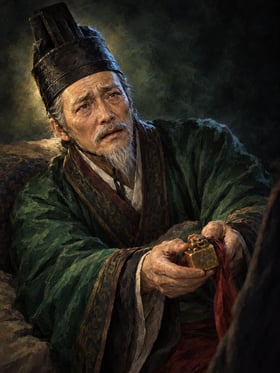
Tao Qian was upright and firm by nature, a man of high principle, but in his later years he turned from the right path and indulged his whims. He was warm, sincere, and honest; when misfortune struck he wept bitterly toward heaven, crying, 'I have offended Heaven'. He declared himself old and incapable and his two sons unworthy, wishing to yield Xu Province to a kinsman of the Han imperial house.

Life
In the novel: 6 chapters · In the Records: 13 volumes
Life?–194
193 CE (Chuping 4)
- Murder of Cao SongParticipant
- Cao Cao's Campaign Against Xu ProvinceXu ProvinceCommander
194 CE (Xingping 1)
- Tao Qian's Faction· Undated
- Life event
- Death
List all 2 stops
- DanyangBirthplace
- Xu Province193–194Cao Cao's Campaign Against Xu Province+2 more
On the boards
Compare with someone →Where this person ranks on each board.
Who they were
Character profile
- Character
- Tao Qian was upright and firm by nature, a man of high principle, but in his later years he turned from the right path and indulged his whims. He was warm, sincere, and honest; when misfortune struck he wept bitterly toward heaven, crying, 'I have offended Heaven'. He declared himself old and incapable and his two sons unworthy, wishing to yield Xu Province to a kinsman of the Han imperial house.
- Life
- Tao Qian was a man of Danyang. In his youth he was nominated as a flourishing talent, served as Prefect of Lu and Prefect of Shu, and took part in the campaign of the General of Chariots and Cavalry, Zhang Wen, against Han Sui. When the Yellow Turban uprising broke out in Xu Province, he was appointed Inspector of Xu Province and defeated the Yellow Turban Army. When Dong Zhuo threw the government into chaos, Tao Qian sent envoys with tribute and was promoted to General Who Pacifies the East, Governor of Xu Province, and enfeoffed as Marquis of Liyang. He came into feud with Cao Cao, who blamed him for the killing of his father, and Cao Cao's army therefore campaigned against him repeatedly. In the first year of the Xingping era Tao Qian died of illness at the age of sixty-three. Gravely ill, he told Mi Zhu, 'None but Liu Bei can bring peace to this province,' and after his death the people of the province welcomed Liu Bei.
- Anecdotes
- Tao Qian was styled Gongzu. He was Governor of Xu Province and was campaigned against by Cao Cao. He once nominated Zhang Zhao as a flourishing talent, but when Zhang Zhao declined, he had him detained.
Historical Record
Tao Qian, courtesy name Gongzu, was from Danyang. He was fond of learning from a young age. After being recommended as a Maocai, he successively held posts including magistrate of Lu and Inspector of You Province. He once took part in the campaign against Han Sui under the chariot-and-cavalry general Zhang Wen. During this period, he was forthright and unyielding. The Wu Shu, cited in Pei Songzhi’s commentary, records that he incurred the enmity of the commandery administrator Zhang Pan by refusing to submit to him, and that he once publicly humiliated Zhang Wen at a banquet. After the Yellow Turban uprising in Xu Province, Tao Qian was appointed Inspector of Xu Province and defeated the Yellow Turbans. During Dong Zhuo's Coup, he sent envoys by covert routes to present tribute to the court. He was later appointed General Who Pacifies the East and Governor of Xu Province, and enfeoffed as Marquis of Liyang.
Under Tao Qian’s administration, Xu Province prospered, with abundant grain, and many refugees came to settle there. But the Records of the Three Kingdoms also says that he “turned his back on the Way and indulged his own inclinations”: he distanced himself from the upright Guangling Administrator Zhao Yu and favored men such as Cao Hong, resulting in disorder in the administration of justice and harm to the worthy. Que Xuan of Xiapi proclaimed himself Son of Heaven. Tao Qian initially joined forces with him to plunder, but later killed Que Xuan and absorbed his followers. Tao Qian also once recommended Zhang Zhao as a Maocai. When Zhang Zhao declined, Tao Qian took this as an insult and had him detained; Zhang Zhao was released only after Zhao Yu intervened on his behalf.
Cao Cao’s father, Cao Song, was killed within Xu Province, and Cao Cao held Tao Qian responsible and led an army eastward. The accounts cited in Pei Songzhi’s commentary differ over who carried out the killing: one says Tao Qian sent troops to ambush and seize Cao Song’s family, while another says Tao Qian assigned the commandant Zhang Kai to escort them, and Zhang Kai killed Cao Song and took his belongings along the way. What the historical accounts confirm is that Cao Cao attacked Tao Qian in the name of avenging his father, capturing towns and advancing as far as Pengcheng, where Tao Qian’s army was defeated and retreated to hold its position. Cao Cao’s troops committed widespread slaughter wherever they passed, and many died in the Battle of Pengcheng. When Cao Cao launched another eastern campaign later, Tao Qian was afraid and considered returning to Danyang. He died of illness in the first year of Xingping, aged sixty-three. After his death, Liu Bei succeeded him in governing Xu Province.
In the Novel
Romance of the Three Kingdoms portrays Tao Qian as a gentle, sincere elder of Xu Province who wished to be on friendly terms with Cao Cao. The novel recounts how he welcomed Cao Song, hosted a banquet for him, and sent Zhang Kai with troops to escort him. Zhang Kai, however, killed Cao Song and his family, bringing Cao Cao’s vengeance upon Tao Qian. Faced with the invading army, Tao Qian blamed himself for the suffering of Xu Province’s people and even offered to bind himself and go to Cao Cao’s camp, submitting to whatever punishment Cao Cao chose in exchange for the people’s safety. Cao Cao refused to listen to his explanation, and the novel thus presents Tao Qian as a wronged man who grieves for his people. This differs from the historical accounts, which describe Tao Qian’s poor governance and his earlier alliance with Que Xuan for plunder.
The novel also portrays Tao Qian as the one who actively proposed that Liu Bei take control of Xu Province. When Cao Cao besieged Xu Province, Tao Qian followed Mi Zhu’s advice and sent for help. After Liu Bei arrived, Tao Qian offered him the province several times, but Liu Bei repeatedly declined. Tao Qian eventually asked Liu Bei to garrison Xiaopei. When gravely ill, he again urged Liu Bei to take over Xu Province, saying that his two sons were unfit to govern, and recommended Sun Qian to assist him. After Tao Qian’s death, Liu Bei provisionally took charge of the province at the request of the people of Xu Province. The historical accounts do record that, when gravely ill, Tao Qian entrusted Liu Bei with Xu Province, and that after his death the people of the province welcomed Liu Bei. But details such as Tao Qian repeatedly offering the province, the transfer of the seal and tally, and his deathbed recommendation of Sun Qian are elaborations added by the novel.
Key Relationships
- Cao Cao: The two became enemies over Cao Song’s death. The historical accounts say that Cao Cao blamed Tao Qian for his father’s death and launched an eastern campaign; the sources cited in Pei Songzhi’s commentary differ on whether the killers were Tao Qian’s soldiers or Zhang Kai. In Romance of the Three Kingdoms, Zhang Kai is explicitly shown rebelling and killing Cao Song after being ordered by Tao Qian to escort him, while Tao Qian declares, “This truly had nothing to do with Tao Qian.”
- Liu Bei: The historical account says that, when gravely ill, Tao Qian believed “none but Liu Bei could pacify this province.” After his death, Mi Zhu carried out his dying instructions and welcomed Liu Bei, whom the people of the province then acclaimed as their leader. The novel expands this into a story of Tao Qian offering Xu Province several times and Liu Bei repeatedly declining.
- Zhao Yu and Zhang Zhao: Tao Qian distanced himself from Zhao Yu for his uprightness. Zhao Yu later also rescued Zhang Zhao, whom Tao Qian had detained. Zhang Zhao had been recommended as a Maocai but declined, leading Tao Qian to believe that he looked down on him.
- Que Xuan: Tao Qian initially joined forces with Que Xuan, who had proclaimed himself Son of Heaven, to plunder; later he killed Que Xuan and absorbed his followers.
Defining Scenes
- Defeat at Pengcheng and Xu Province’s devastation: Cao Cao attacked in the name of avenging his father. Tao Qian’s army was defeated at Pengcheng, and the historical accounts record that many died. Cao Cao’s forces committed widespread slaughter wherever they passed, showing that this war was not merely a clash between warlords but also brought immense suffering to the people of Xu Province.
- Defending himself outside the city amid a sandstorm (exclusive to the novel): The novel has Tao Qian bow and explain himself before Cao Cao’s army, stressing that Cao Song’s death was not his intention. Cao Cao angrily rejects his words. Xiahou Dun rides out, Cao Bao engages him, and then a fierce wind drives sand through the air before both armies withdraw. This dramatic scene portrays Tao Qian as a besieged ruler unable to clear himself of blame.
- Entrusting the province on his deathbed: The historical accounts say that Liu Bei succeeded Tao Qian after his death and record that Tao Qian entrusted Xu Province to him while gravely ill. The novel elaborates this into three offers made from Tao Qian’s sickbed: Tao Qian points to his heart and dies, and Liu Bei finally accepts provisional authority over the province after repeated appeals from those around him.
Quotes
13 lines in the books · 3 featured
「今天下擾亂,王綱不振,公乃漢室宗親,正宜力扶社稷。老夫年邁無能,情願將徐州相讓。公勿推辭。謙當自寫表文,申奏朝廷。」
This line lays the foundation for Liu Bei's takeover of Xu Province and is an important turning point in the Romance of the Three Kingdoms.
「請玄德公來,不為別事:止因老夫病已危篤,朝夕難保;萬望明公可憐漢家城池為重,受取徐州牌印,老夫死亦瞑目矣!」
Entrusting his sons on his deathbed, he once again insists on yielding Xu Province to Liu Bei, shaping Tao Qian's image as loyal and generous.
「非劉備不能安此州也。」
Drawn from the official histories, this line succinctly sums up Tao Qian's endorsement of Liu Bei and carries historical significance.
- Family
- Lord & vassal
- Friends
- Enemies
- Other
Who is Tao Qian connected to?
Pick someone to see how many steps lie between them and Tao Qian.
History vs. novel
7 points · 3 novel-only
| History | Novel |
|---|---|
| Welcoming Cao SongNovel only | |
| — | To befriend Cao Cao, Tao Qian went beyond the provincial border to welcome Cao Song, hosted a banquet for him for two days, and sent Zhang Kai with troops to escort him. ch. 10 |
| Binding Himself to Seek PunishmentNovel only | |
| — | When Cao Cao attacked Xu Province, Tao Qian believed he had incurred Heaven’s wrath. He planned to bind himself and go to Cao’s camp, submitting to whatever punishment Cao chose in hopes of sparing the common people. ch. 10 |
| Yielding Xu ProvinceNovel only | |
| — | After Liu Bei came to Xu Province’s aid, Tao Qian offered to hand over the provincial seal. Liu Bei firmly declined, so Tao Qian asked him to garrison Xiaopei. ch. 11 |
| Entrusting the Province While Gravely IllNovel embellishes | |
When Tao Qian was gravely ill, he told Mi Zhu that only Liu Bei could pacify Xu Province. After Tao Qian died, Mi Zhu led the people of the province in welcoming Liu Bei to take charge. vol. 32 | On his deathbed, Tao Qian again asked Liu Bei to take over Xu Province. He said his two sons were unfit for the task and urged Liu Bei to instruct them and not let them take charge of the province. ch. 12 |
| Seeking Aid for Xu ProvinceNovel embellishes | |
When Cao Cao campaigned against Xu Province, Tao Qian sent an envoy to Tian Kai to report the emergency. Tian Kai and Liu Bei went together to provide aid. vol. 32 | The Romance recounts that Cao Cao attacked Xu Province because his father had been killed. Tao Qian marched out to meet him and explained that he had once sent Zhang Kai to escort Cao Song. ch. 10 |
| Battle Against the Yellow Turban ArmyHistory only | |
After the Yellow Turbans rose in Xu Province, Tao Qian was appointed Inspector of Xu Province and led troops to defeat and drive out the Yellow Turban Army. vol. 8 | — |
| Favoring Cao HongHistory only | |
In his later years, Tao Qian favored Cao Hong and other slanderous, wicked men. This led to discord in the administration of justice, and many upright people suffered as a result, while Xu Province gradually fell into disorder. vol. 8 | — |
- Welcoming Cao SongNovel only
- Novel
To befriend Cao Cao, Tao Qian went beyond the provincial border to welcome Cao Song, hosted a banquet for him for two days, and sent Zhang Kai with troops to escort him.
ch. 10
- Binding Himself to Seek PunishmentNovel only
- Novel
When Cao Cao attacked Xu Province, Tao Qian believed he had incurred Heaven’s wrath. He planned to bind himself and go to Cao’s camp, submitting to whatever punishment Cao chose in hopes of sparing the common people.
ch. 10
- Yielding Xu ProvinceNovel only
- Novel
After Liu Bei came to Xu Province’s aid, Tao Qian offered to hand over the provincial seal. Liu Bei firmly declined, so Tao Qian asked him to garrison Xiaopei.
ch. 11
- Entrusting the Province While Gravely IllNovel embellishes
- History
When Tao Qian was gravely ill, he told Mi Zhu that only Liu Bei could pacify Xu Province. After Tao Qian died, Mi Zhu led the people of the province in welcoming Liu Bei to take charge.
vol. 32
- Novel
On his deathbed, Tao Qian again asked Liu Bei to take over Xu Province. He said his two sons were unfit for the task and urged Liu Bei to instruct them and not let them take charge of the province.
ch. 12
- Seeking Aid for Xu ProvinceNovel embellishes
- History
When Cao Cao campaigned against Xu Province, Tao Qian sent an envoy to Tian Kai to report the emergency. Tian Kai and Liu Bei went together to provide aid.
vol. 32
- Novel
The Romance recounts that Cao Cao attacked Xu Province because his father had been killed. Tao Qian marched out to meet him and explained that he had once sent Zhang Kai to escort Cao Song.
ch. 10
- Battle Against the Yellow Turban ArmyHistory only
- History
After the Yellow Turbans rose in Xu Province, Tao Qian was appointed Inspector of Xu Province and led troops to defeat and drive out the Yellow Turban Army.
vol. 8
- Favoring Cao HongHistory only
- History
In his later years, Tao Qian favored Cao Hong and other slanderous, wicked men. This led to discord in the administration of justice, and many upright people suffered as a result, while Xu Province gradually fell into disorder.
vol. 8
Combat
On the field
Duels, kills and executions as the texts tell them, counted separately for the Records and the Romance.
- RecordsJuan 8AssassinationQue XuanWon「後遂殺宣,并其衆」
Events
Events (5)
Battles and events the texts place this person in, by date.
Battles
Other events
- 193Murder of Cao Song
- 193Cao Cao's Campaign Against Xu ProvinceCommander
- 194Liu Bei Takes Control of Xu ProvinceInstigator
- 194Tao Qian's Three Cessions of XuzhouInstigator
Places
- Native of
- DanyangRecords
- Governed
- You ProvinceRecords
- Xu ProvinceRecords
Continue
Cao Cao's Campaign Against Xu Province
Relationship timeline6 entries ▸
History · vol. 1
- Liu Bei§26
Student
Qian died, and Liu Bei succeeded him (administering Xu Province)
History · vol. 8
- Zhang Wen§22
Advised
Served on the staff of General of Chariots and Cavalry Zhang Wen and campaigned west against Han Sui
Novel · ch. 10
- Zhang Kai§11
Betrayer
Commandant; formerly a remnant of the Yellow Turbans who surrendered to Qian, now ordered to escort Cao Song, but turned on him and robbed him along the way
- Cao Cao§11
Enemy
had long wished to cultivate ties; sent Zhang Kai to escort him, but this brought a large army to avenge his father; he stated, “This truly had nothing to do with Tao Qian”
Novel · ch. 11
- Liu Bei§11
Friend
offered Xu Province three times, but Liu Bei firmly refused; Tao Qian then asked Liu Bei to station temporarily at Xiaopei
Novel · ch. 12
- Liu Bei§11
Student
thrice offered the seal and insignia of Xu Province; on his deathbed, pointed to his heart and died
Inner monologues · AI-generated3 monologues ▸
- I am Tao Qian, courtesy name Gongzu. During Dong Zhuo's Coup, the Son of Heaven was driven from place to place and moved
- I am Tao Qian, courtesy name Gongzu, from Danyang. I recall that when I was young, my father died early, and I was littl
- Looking back, I was Tao Qian, courtesy name Gongzu. I lived in the waning years of the Han, and saw the world grow incre