Background
The immediate trigger for Cao Cao's Campaign Against Xu Province was the murder of his father, Cao Song, and his family while they were traveling to Yanzhou. The surviving historical excerpts state that Cao Song had taken refuge in Langya to escape the turmoil and was later killed by Tao Qian. However, the two accounts cited in the Records of the Three Kingdoms do not agree: one says Tao Qian sent troops to seize and kill him, while the other says Tao Qian assigned Zhang Kai to escort the family, and Zhang Kai murdered them and robbed them between Hua and Fei. Cao Cao’s decision to make Tao Qian the target of his revenge therefore reflected both a desire to avenge his family and a political judgment about who bore responsibility. The Romance of the Three Kingdoms’ single, unequivocal attribution of blame should not be treated as identical to historical fact.
The events are generally dated to 193–194. The account cited in the Records of the Three Kingdoms says that Cao Cao returned from Xu Province in the spring of the first year of Xingping, then campaigned against Tao Qian again in the summer, capturing five cities and advancing as far as Donghai. The historical excerpts distinguish these two operations, indicating that the “campaign against Xu Province” was not necessarily a single battle with clearly defined boundaries and one conclusive outcome. By contrast, chapters 10 through 12 of the Romance of the Three Kingdoms weave together Cao Song’s murder, Cao Cao’s mobilization, the arrival of outside forces in Xu Province, and Tao Qian’s offer to yield his position into a continuous narrative—heightening the drama while shaping the moral judgments of its characters.
Key Figures
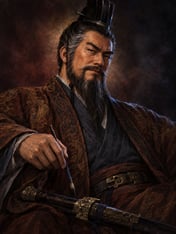
Cao Cao launched the military campaign and turned the private grief of losing a parent into a public punitive expedition. In the novel, he vows to “cleanse Xu Province” and orders the slaughter of civilians after cities are taken. He is thus not merely an avenger seeking the culprit, but a commander who imposes collective punishment on the population. The Records of the Three Kingdoms says that Cao Cao’s forces “left widespread devastation and slaughter in their wake,” echoing the novel’s depiction of violence. At the same time, the historical record preserves Sun Sheng’s criticism that Cao Cao went too far by punishing the guilty while harming those under their rule—a moral measure distinct from a narrative focused on victory and defeat.
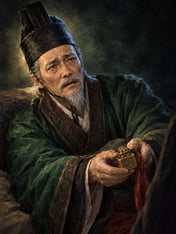
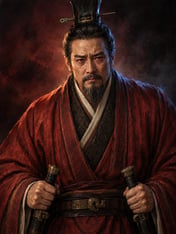
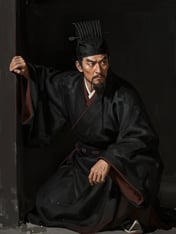
Tao Qian stands at the center of the dispute over responsibility. In the novel, he denies killing Cao Song and insists that Zhang Kai acted without his orders. The historical accounts cited, however, include both a version that attributes the killing to Tao Qian’s men and one that places direct responsibility on Zhang Kai. Cao Bao serves as Xu Province’s military defender, while Liu Bei, Kong Rong, and Tian Kai are presented as forces coming to its aid. Liu Bei urges Cao Cao to “put the court’s urgent needs before private vengeance,” seeking to recast the conflict as a question of the realm’s order rather than a personal feud. Chen Gong likewise argues that Zhang Kai is to blame, not the common people. Xun Yu and Cheng Yu remain behind to guard the rear, while in the novel Guo Jia advises Cao Cao to soothe Liu Bei with words and then resume the siege, reflecting different military and political considerations.
Central Issues
The foremost issue is whether responsibility can be transferred from the person who directly committed a crime to the political ruler. If Zhang Kai was indeed the direct killer of Cao Song, then whether Tao Qian was responsible for ordering or condoning the murder, or for failing to prevent it, must be argued separately. The surviving excerpts offer no uniform evidence sufficient to settle the dispute. Through Tao Qian’s defense and Chen Gong’s plea, the novel states plainly, “It was Zhang Kai’s crime, not Tao Qian’s.” Yet Cao Cao refuses to distinguish between the principal and his subordinates. In doing so, the novel exposes the danger of vengeance as politics: when a commander expands the targets of punishment from specific criminals to an entire province, revenge becomes collective punishment.
The second issue is the conflict between military objectives and the cost to civilians. The novel depicts Cao Cao’s forces killing people and plundering graves wherever they go, and places the order to slaughter the population directly in Cao Cao’s declaration of revenge. The historical record offers a more concise account, saying that his forces “left widespread devastation and slaughter in their wake.” The two texts differ in how they express it, but both portray the people of Xu Province as victims of the military campaign. Sun Sheng’s comment is especially important: even if the target of a punitive expedition is guilty, harming innocent people within that person’s jurisdiction crosses the bounds of legitimacy implied by “punishing the guilty and comforting the people.”
The third issue is how competing claims of political legitimacy shape the justification for action. Cao Cao invokes his father’s death as grounds for going to war, while Liu Bei turns attention to the remnants of the Yellow Turbans, the remaining adherents of Dong Zhuo, and the court’s crisis, arguing that public duty must come before private grievance. Chen Gong, for his part, seeks to restrain Cao Cao by invoking the lives of innocent civilians. Their dispute is not simply a matter of whether to seek revenge; it concerns whether the state’s order can restrain the powerful, and whether private grief can authorize violence without limit. The novel also contrasts Liu Bei’s fidelity and Kong Rong’s sense of justice with Cao Cao’s stubbornness, making moral judgment part of the political contest.
Political Consequences
The surviving material does not support reducing the entire course of events to a simple “victory” or “defeat.” The Records of the Three Kingdoms says that Cao Cao captured five cities and advanced to Donghai, then defeated Tao Qian’s subordinate Cao Bao and Liu Bei’s encamped troops on his return, and captured Xiangben. At the same time, it explicitly records the slaughter. The novel, by contrast, focuses on the situation after the arrival of reinforcements led by Kong Rong and Tian Kai, when Cao Cao divides his forces and can no longer devote his full strength to the siege. The different emphases caution readers to distinguish specific military results, stages of the campaign, and the novel’s narrative choices, rather than treating any one scene as the campaign’s final outcome.
Politically, the crisis in Xu Province turned a local conflict into a matter of alliances and outside intervention. Tao Qian sought help; Kong Rong and Tian Kai sent troops; and Liu Bei promised to follow with aid. Cao Cao, meanwhile, had to divide his forces among besieging cities, responding to reinforcements, and securing his rear. Through the arrival of outside forces, the novel presents Xu Province not as an isolated local battlefield, but as a political arena where different sides sought support in the name of “righteousness,” “fidelity,” and “vengeance.” Another consequence was that the safety of Xu Province’s people became closely bound up with the ruler’s legitimacy: if punishment ceased to distinguish criminals from civilians, military gains could come at the cost of moral authority and local allegiance.
Counterfactual Analysis
If Cao Cao had accepted Chen Gong’s distinction between the guilty and the innocent, or heeded Liu Bei’s counsel to “put the court’s urgent needs before private vengeance,” he might have limited his campaign to pursuing Zhang Kai, investigating the circumstances of Cao Song’s death, and demanding an accounting from Tao Qian. This would not necessarily have ended the conflict between Cao Cao and Tao Qian, but it might at least have reduced collective punishment of the people of the province and left Xu Province room to resolve the crisis through negotiation, surrendering Zhang Kai, or offering compensation. The price would have been that Cao Cao had to curb his posture of vengeance and risk being seen as weak by his rivals, or feel that his family had not been adequately avenged. These are only possibilities inferred from the proposals made by figures at the time, not outcomes recorded in the sources.
Conversely, if Tao Qian had earlier and more credibly clarified Zhang Kai’s identity, actions, and responsibility, and established a verifiable channel for negotiation with Cao Cao, the conflict might not have escalated so quickly into a military campaign against Xu Province. However, the surviving excerpts do not prove that such diplomatic measures would necessarily have succeeded. Cao Cao’s grief, mutual distrust between the two sides, and the politics of military power at the time might all have prevented evidence and negotiation from prevailing over calls for revenge. The more cautious conclusion is not to claim that any one counterfactual would certainly have changed the course of events, but to note the institutional failing exposed by the campaign: without credible investigations and mechanisms to restrain a commander’s use of violence, a private tragedy can readily become a collective burden imposed on an entire region.