Causes
The immediate background to Lü Bu's Seizure of Yanzhou was Cao Cao’s eastern campaign, the resulting gap in Yanzhou’s defenses, and Lü Bu’s circuitous search for support after the unrest in Guanzhong, which eventually brought him into Zhang Miao’s sphere of influence. According to the account in Romance of the Three Kingdoms, Lü Bu first sought refuge with Yuan Shu, Yuan Shao, and Zhang Yang in turn. After relations with each broke down, he turned to Zhang Miao; Zhang Miao’s younger brother, Zhang Chao, then introduced him to Chen Gong. Chen Gong saw Cao Cao’s departure as an opportunity to seize Yanzhou and urged Zhang Miao to use Lü Bu’s military prowess to build a hegemony. Zhang Miao consequently supported an attack on the commanderies and counties. This was not simply a border skirmish, but a realignment of power among local allies, mobile military groups, and Cao Cao’s base of operations.
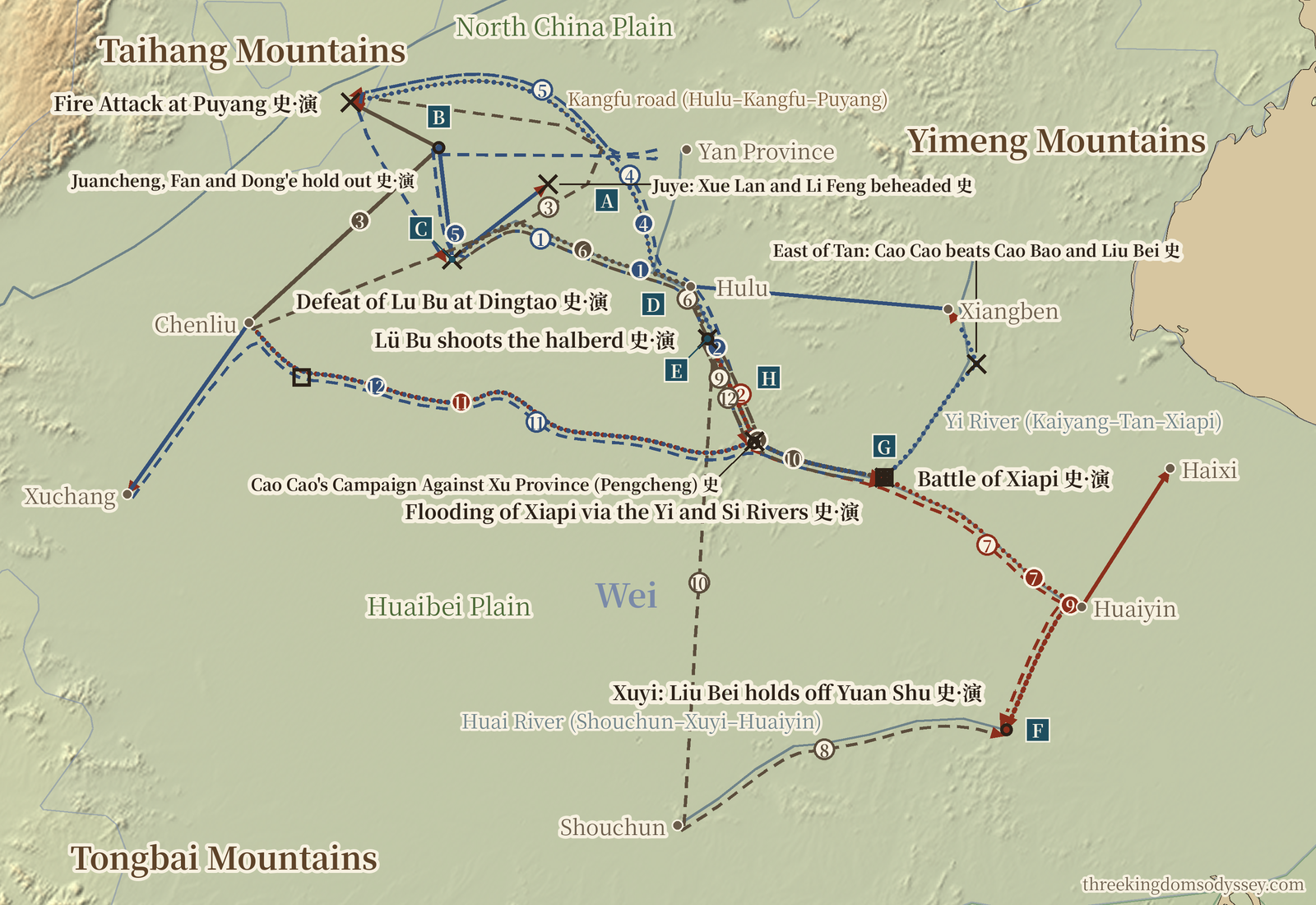
Strategically, Yanzhou was chosen because it was both the foundation of Cao Cao’s power and potentially vulnerable while his main force was away. Chen Gong’s plan centered on “seizing territory while it was undefended”: Lü Bu supplied military intimidation, while Zhang Miao provided local political support. This combination could expand rapidly in the short term, but did not automatically solve the problems of governing and consolidating the occupied territory. The novel says that Juancheng, Dong’a, and Fan County held out under Xun Yu and Cheng Yu, while many other places fell. This suggests that the crisis did not bring the entire region down at once; control was divided, and the Cao Cao faction still held key transport routes and defensive positions.
Factions Involved
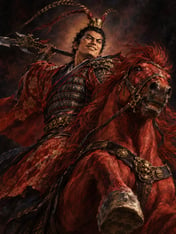
Lü Bu was the rebellion’s principal military commander. Zhang Miao played a role in launching the revolt and rallying local forces, while Zhang Chao serves in the narrative as the intermediary who introduces Chen Gong. Chen Gong was not merely an adviser: he also proposed a course of action that would make Yanzhou a political base. The alliance’s strengths lay in Lü Bu’s personal valor and ability to mobilize troops quickly. Its weaknesses were a fragile foundation of political trust and the lack of any guarantee that local strongholds, troops, and logistics could be brought under a stable, unified command. By placing Lü Bu alongside Zhang Miao and Chen Gong, the novel depicts a crisis involving both the military seizure of cities and political defection.
Cao Cao’s response relied on layered defenses and his key advisers. Xun Yu and Cheng Yu held Juancheng, Dong’a, and Fan County, preserving a foothold for Cao Cao’s return. Cao Ren provided support at the front and reported on the situation, while Xiahou Dun later took part in fighting in the Puyang area. Cao Cao himself had to manage the campaign elsewhere while preventing the loss of his power base. His faction’s survival depended not solely on the commander’s decisions in battle, but on a combination of city defense, reconnaissance, advice, and mobile operations. It is worth noting that the passages list Xiahou Dun among those involved but do not describe him as exercising independent command in every key action.
Key Turning Points
The first turning point came when Cao Cao learned that Yanzhou had fallen and immediately treated his return as a matter of survival. His remark that without Yanzhou he would be “homeless” shows that the region was more than territory: it was a base for supplying and recruiting troops and continuing the struggle for supremacy. Guo Jia advised him to set aside pressure on the outer front and focus on recovering Yanzhou. Cao Cao accepted the advice and withdrew. This reflected a shift in strategic priorities: when the heartland was threatened, continuing to pursue gains elsewhere could cost the regime its entire foundation.
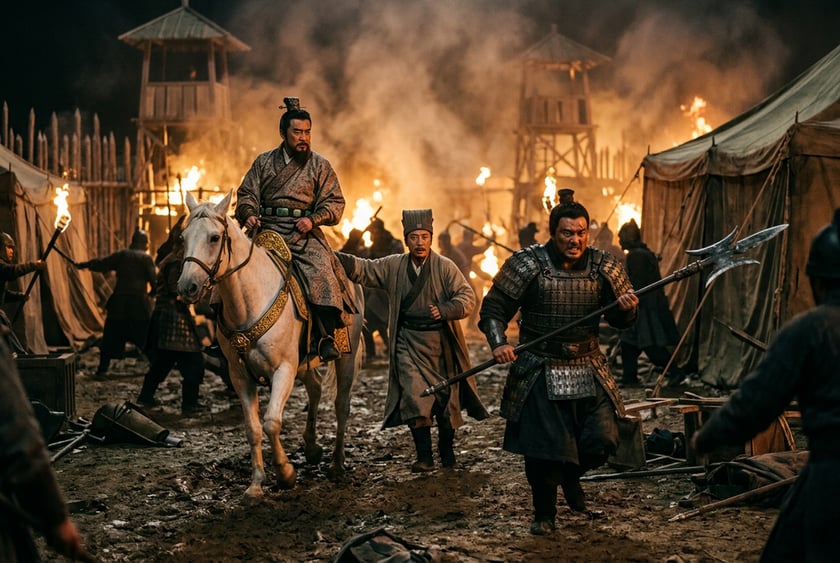
The second turning point was the coexistence of Lü Bu’s tactical advantage and Cao Cao’s resilience on the battlefield at Puyang. Lü Bu’s forces defeated Cao Cao’s troops at one point, putting Cao Cao in danger, and Dian Wei launched a charge to rescue him. Yet the outcome of the battle did not immediately decide the war. The novel also places locusts, soaring grain prices, and shortages of military provisions within the conflict; at one point, both sides temporarily ceased fighting because of the lack of food. The campaign’s progress was thus constrained by food supplies and the seasons, not just by the commanders’ courage. For Cao Cao, restoring supplies and keeping his army in action mattered more than the outcome of a single charge.
The third turning point arose from political changes within Puyang. When Cao Cao advanced again, Chen Gong urged Lü Bu to delay engaging the enemy, but Lü Bu refused. After Lü Bu was routed, Lady Tian at the city gate declared her intention to surrender to Cao Cao, leaving Lü Bu no choice but to retreat to Dingtao. This episode links divisions in the alliance’s decision-making with wavering support inside the city and defeat on the battlefield: once the defenders could no longer trust their commander to protect the city, local defections could quickly magnify a military setback. Cao Cao later pursued Lü Bu to Dingtao, where Zhang Miao, Zhang Chao, and others were still with him. This shows that the loss of Puyang did not immediately end the rebellion.
Suppression and Outcome
According to the cited episodes in the novel, Cao Cao held the key counties, returned to regain the initiative, and later recaptured Puyang. Cao Cao’s forces also defeated the troops of Xue Lan and Li Feng, and pursued Xue Lan after he fled. The method of suppression shown here was to secure strongholds and the route back first, then gradually strike at local armed forces—not to wipe out the enemy everywhere in a single decisive battle. The narrative uses the division of duties among Cao Cao’s generals, reconnaissance and intelligence, and the exploitation of enemy forces’ absence while they went out to forage to show how the conditions for a counteroffensive took shape.
However, “recapturing Puyang” must be distinguished from “completely suppressing the rebellion.” The cited material also describes Cao Cao continuing his pursuit at Dingtao, while Lü Bu’s forces remained active. A later account says that after learning Yuan Shao had sent troops to aid Cao Cao, Lü Bu discussed with Chen Gong the possibility of defecting to Xu Province. Thus, caution is warranted when considering the final outcome of the rebellion in Yanzhou: the existing summary labels it “unclear.” These passages support the conclusion that Cao Cao’s faction temporarily restored control of Yanzhou, but they are insufficient on their own to reconstruct the entire outcome of the fighting, and the novel’s episodes cannot be equated directly with facts established through historical research.
Historical Legacy
The most important lesson of the conflict is the tension between securing a power base and expanding beyond it. Cao Cao’s absence on campaign left Yanzhou exposed, enabling the rebels to occupy many places quickly. Yet the counties that held out, and the counteroffensive after his return, allowed Cao Cao to regroup. This shows that the resilience of a local regime depends not only on the strength of its field army, but also on the security of key cities, the administrative network, food supplies, and the loyalty of its allies. In the novel, Xun Yu’s warning that Cao Cao must not abandon Yanzhou to take Xu Province explicitly contrasts “the foundation” with “expansion.”
From the perspective of modern military history, the rebellion in Yanzhou also demonstrates the inherent fragility of coalition warfare. Zhang Miao’s political maneuvering, Chen Gong’s planning, and Lü Bu’s military capabilities could bring about a rapid breakthrough, but did not necessarily ensure lasting control. Though Cao Cao suffered a severe setback, he sustained the war through his defensive system, restored command, and adjusted logistics. At the same time, the sources on which this account is based all come from relevant chapters of Romance of the Three Kingdoms. They are suitable for analyzing the strategic logic and characterization in the novel, but should not be treated uncritically as a complete record of historical fact. Any firm judgment about the events still requires comparison with other historical sources.