Background
The Death of Sun Ce occurred in the late Eastern Han, when regional warlords were competing and the regime in Jiangdong had yet to become fully secure. In the fourth year of Jian’an, Sun Ce seized Lujiang and induced Hua Xin, the Administrator of Yuzhang, to surrender, expanding his power. He also sought the post of Grand Marshal but failed to obtain Cao Cao’s approval, and the Romance of the Three Kingdoms portrays him as constantly harboring ambitions to seize Xu. This background shows that Sun Ce was building local power in Jiangdong while also being seen as a military force capable of altering the balance of power in the north. His personal safety was therefore closely tied to the regional political order.
Historical records and the novel differ markedly in the level of detail they provide about his death. The Records of the Three Kingdoms merely records that, after learning Cao Cao and Yuan Shao were locked in a standoff, Sun Ce planned to attack Xu but was “killed by assassins” before he could set out. It gives no information about the assassins’ identities, the circumstances of the attack, or the course of his injuries. Thus, what can be established historically is that Sun Ce was killed in an assassination while planning a strategic campaign. Reconstructing the attack as a specific scene depends on later narratives and should not be equated with the brief historical account.
Main Figures
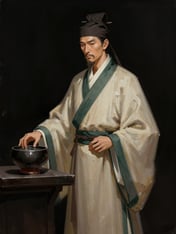
Sun Ce is the central figure in the episode and a key figure in Jiangdong’s military expansion and political consolidation. The Romance of the Three Kingdoms depicts him as decisive and hot-tempered: after receiving a secret letter from Xu Gong, he killed Xu Gong and was later attacked by Xu Gong’s retainers. Wounded, he was urged by his physician to rest, but became enraged upon hearing that Guo Jia had belittled him and even declared his intention to send troops against Xu Chang. This portrayal links personal character, military risk, and the response to his injuries, but it is first and foremost a work of fiction and cannot by itself establish Sun Ce’s actual state of mind or a single cause of his death.
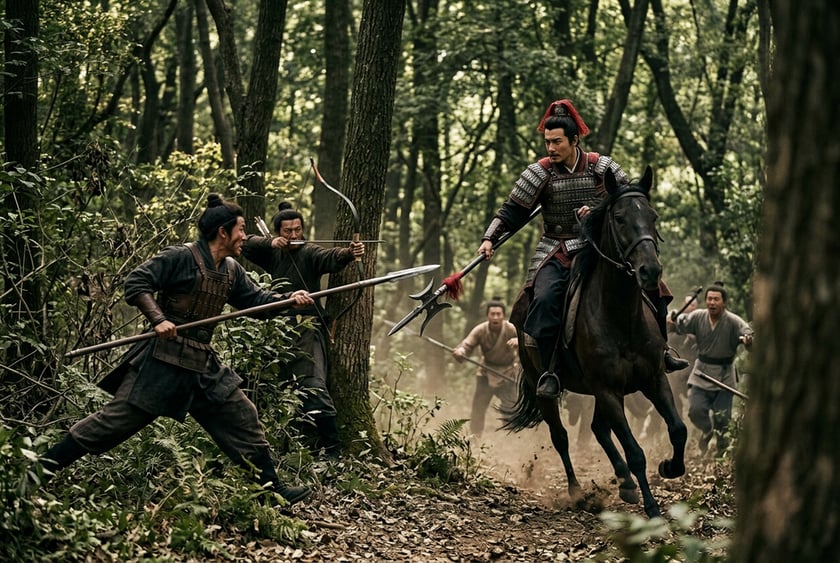
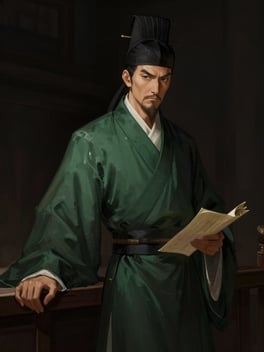
In the novel, Xu Gong sets the chain of attacks in motion. He tried to inform Cao Cao of the threat Sun Ce posed; after his secret letter was intercepted, Sun Ce had him executed, and Xu Gong’s retainers then attacked Sun Ce in the name of revenge. Cheng Pu and Han Dang are named as witnesses to the incident. The attackers falsely claimed to be soldiers under Han Dang, exploiting Sun Ce’s familiarity with and trust in the identities of those serving in his army. The assassination is thus presented as a security breach within Jiangdong, rather than a straightforward clash on the battlefield. The cited historical account does not confirm these relationships, so the distinction between the sources must be maintained.
Gan Ji plays a different role in the novel from Xu Gong’s retainers. He is not an organizer of the assassination, but is placed in the narrative around the time Sun Ce is wounded, becoming a symbol of the intersection between popular belief, sovereign authority, and psychological pressure. Sun Ce’s killing of Gan Ji, his refusal to heed his mother’s advice to perform rites to ward off misfortune, and the depiction of Gan Ji appearing to him form the novel’s supernatural thread. These elements reveal how the work explains Sun Ce’s agitation and crisis, but they are not historical evidence that spirits caused his death.
Key Issues
The first issue is the tension between expanding power and personal security. Sun Ce’s growing influence and his plans to attack Xu made him a rival capable of affecting Cao Cao’s strategic calculations. At the same time, the retaliatory assassination depicted in the Xu Gong episode shows that even a regional ruler with an army might not be able to identify threats close at hand. In the brief account in the Records of the Three Kingdoms, the assassins and the circumstances of Sun Ce’s death remain unknown; the novel, by contrast, gives the danger a specific source in Xu Gong’s old grievance. Read together, the two accounts raise questions about the vulnerability of security, but they do not prove that all the details added by the novel are factual.
The second issue is whether personal character can explain a political outcome. The Romance of the Three Kingdoms has Sun Ce disregard medical advice and grow angry over Guo Jia’s assessment of him, reinforcing the characterization that he was reckless, unguarded, hot-tempered, and lacking in foresight. It also weaves Guo Jia’s prediction into a pattern of apparent fulfillment. The historical record, however, only says that Sun Ce planned to attack Xu but had not yet set out when he was killed by assassins. It does not attribute his death to impulsiveness, insufficient rest, or the Gan Ji episode. A more cautious interpretation is that the novel’s characterization shapes the reader’s understanding of risk, but cannot replace analysis of the conditions surrounding the assassination, the organization of the regime, and gaps in the historical sources.
Political Consequences
The foremost political consequence of Sun Ce’s sudden death was that Jiangdong had to reconsider how to balance continued military action with the stability of the regime. The framing of the episode lists Sun Quan Succeeds to Power as a related event. From the perspective of political history, this means that Sun Ce’s personal prestige and command authority could not automatically be equated with a stable institutional order. The arrangements for succession, cooperation among generals, and recognition by local forces all became crucial to the regime’s continuity. The existing account in the Records of the Three Kingdoms confirms that Sun Ce was assassinated but does not describe in detail how Sun Quan took over, so the specifics of the succession should not be asserted on the basis of this passage alone.
The assassination also halted Sun Ce’s planned campaign northward. The historical account’s phrase “had not yet set out” indicates that his military plans against Cao Cao had not been put into action. His death therefore should not be presented as a turning point in a battle that had already begun; nevertheless, it did prevent him from pursuing his existing strategic options himself. For Jiangdong, the political focus shifted from its leader’s personal expansion to the transfer of power and internal coordination. The long-term impact of this change cannot be measured solely by the circumstances of the assassination.
Counterfactual Analysis
If Sun Ce had not been assassinated, the most immediate counterfactual question is not whether he would certainly have captured Xu, but whether his plans to move north could have been put into action. The Records of the Three Kingdoms only says that he “planned to attack Xu, but had not yet set out”; it provides no information on troop deployments, logistical conditions, or Cao Cao’s defensive posture, so the likelihood of success cannot be reliably estimated. Even if Sun Ce had continued expanding, he would still have faced the need to balance the resources required for a distant campaign against those needed to govern Jiangdong. This analysis should remain at the level of possibility rather than treating the novel’s bold words as a definite strategic plan.
If Sun Ce had survived the assassination attempt, he might have had an opportunity to strengthen his guard, settle old grievances, and clarify the order of succession, but the available sources are insufficient to show that such measures would necessarily have succeeded. The episode instead reminds us that a leader’s military ability does not automatically amount to a robust succession system. The analytical significance of Sun Quan Succeeds to Power lies precisely in how it shifts the question from “Could Sun Ce continue his campaigns?” to “Could the Sun regime endure without its founder?” This is a well-founded political question, but also a counterfactual boundary to which the limited historical sources cannot provide a definitive answer.