Overview
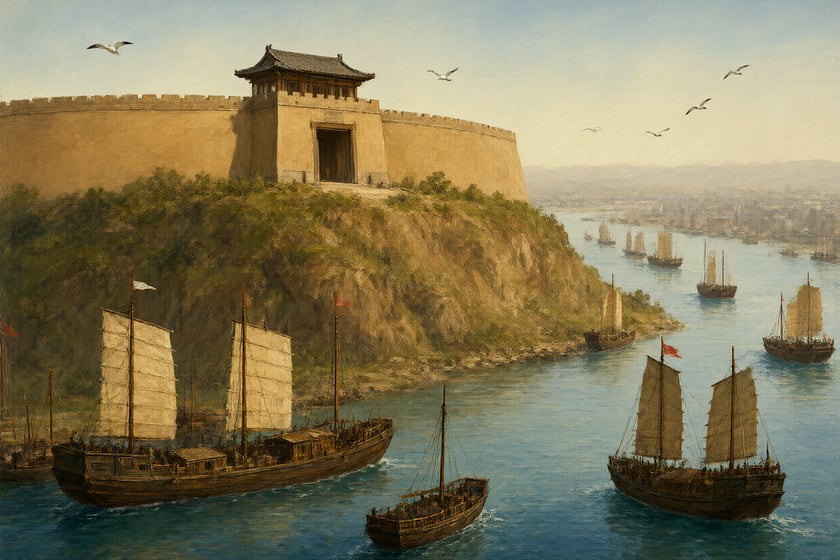
Jingkou was a city in Dantu County, Wu Commandery, during the Eastern Han dynasty. The Records of the Three Kingdoms called it “Jing” or “Jingcheng.” Its site was in the area of Beigu Mountain in present-day Jingkou District, Zhenjiang, Jiangsu Province, on the southern bank of the Yangtze River. After Sun Quan became a general, he once made Jing his seat of government. After Liu Bei became governor of Jing Province, he made a special trip to Jing to meet Sun Quan. Eastern Wu later established the Jingxia Commandery post to guard the area, making Jingkou an important river-defense stronghold downstream from Jianye. In Romance of the Three Kingdoms, the place is called “Nanxu”.
History
In the second year of Xingping (195), Sun Ce crossed the Yangtze eastward and defeated Liu Yao’s generals Fan Neng and Zhang Ying. Liu Yao, governor of Yang Province, fled to Dantu, then sailed west upstream and withdrew to Yuzhang. In the fifth year of Jian’an (200), Sun Ce planned to attack Chen Deng, the Administrator of Guangling. His army reached Dantu and waited for grain supplies. While hunting there, he was shot in the face by retainers of Xu Gong, the late Administrator of Wu Commandery.
Sun He served as a general and was stationed in Jingcheng. After Sun He was killed, his nephew Sun Shao, then only seventeen, gathered the remaining troops, repaired Jingcheng, and built watchtowers to guard against the enemy. When Sun Quan returned after quelling the disorder, he made a night attack on the city. The defenders immediately took to the walls and prepared to resist. Sun Quan greatly valued Sun Shao and appointed him Colonel Who Carries On the Legacy, granting him Qu’e and Dantu counties as his fief. After Sun Quan became a general, he made Jing his seat of government and recalled Hu Zong to take charge of documents.
After Liu Bei became governor of Jing Province, Sun Quan married his younger sister to him, and Liu Bei later went to Jing to meet Sun Quan. At the time, Lü Fan secretly urged Sun Quan to detain Liu Bei. Zhou Yu also submitted a memorial proposing that Liu Bei be moved to Wu and kept under house arrest amid palaces and beautiful women. With Cao Cao in the north, Sun Quan did not accept the proposal. In the fifteenth year of Jian’an (210), Zhou Yu went to Jing again to meet Sun Quan and requested permission to join Sun Yu in a westward campaign to seize Yi Province. Sun Quan agreed, but Zhou Yu died on the way while returning to Jiangling to prepare. According to the Spring and Autumn Annals of Emperor Xian, cited in Pei Songzhi’s commentary, while in Jing Liu Bei once asked Sun Quan whether he intended to station troops in Jingcheng. Sun Quan replied that the waters at Moling could accommodate large ships and that he planned to move his base there. Zhang Hong also recommended moving the capital to Moling, and Sun Quan accepted.
In the third year of Jiahe (234), Sun Quan issued an edict renaming Dantu County Wujin County. Eastern Wu established the Jingxia Commandery post to command the troops stationed at Jingkou. After the Battle of Quebei in the fourth year of Chiwu (241), Gu Cheng took up this post. Sun Shao’s sons Sun Yue and Sun Kai also served in succession as Jingxia Commandery commander. In the eighth month of the first year of Tianxi (276), Sun Kai, the Jingxia Commandery commander, surrendered to the Western Jin.
Figures
- Sun He and Sun Shao: Sun He’s original surname was Yu; Sun Ce bestowed on him the surname Sun. His nephew Sun Shao began his career by defending Jingcheng and later became Administrator of Guangling. He served as a frontier general for decades, was skilled at cultivating his troops, and rarely suffered defeat.
- Gu Cheng: A grandson of Chancellor Gu Yong, he once helped Zhuge Ke pacify the Shanyue. Later, he and his elder brother Gu Tan, among others, were exiled to Jiaozhou. He died at the age of thirty-seven.
- Sun Kai: Son of Sun Shao, he succeeded his younger brother Sun Yue as Jingxia Commandery commander. Sun Hao suspected him of wavering between sides because of the Yongan Shi Dan rebellion. Fearing for his life, Sun Kai took his wife and several hundred personal guards with him when he was summoned and defected to the Jin dynasty.
- Hua He: A native of Wujin in Wu Commandery—the county’s name after Dantu was changed—he once served as Assistant Director of the Secretariat. At the time of the Conquest of Shu by Wei, he submitted a memorial expressing grief and distress.
Differences in the Historical Novel
Romance of the Three Kingdoms uses the later name “Nanxu” and sets the story of Liu Bei's Marriage into Eastern Wu there: Zhou Yu devises a plan to marry Sun Quan’s younger sister to Liu Bei, hoping to lure him to Nanxu and detain him. In the winter of the fourteenth year of Jian’an (209), Liu Bei travels to Nanxu with Zhao Yun and Sun Qian. Wu Guotai and Qiao Guolao meet Liu Bei at Ganlu Temple. Sun Quan and Liu Bei stand together in front of the temple, and Liu Bei exclaims, “This is truly the finest landscape under Heaven”. Following Zhuge Liang’s instructions in the brocade pouch, Zhao Yun escorts Liu Bei and Lady Sun away from Nanxu in the first month of the fifteenth year of Jian’an (210). In the histories, Sun Quan married off his sister first, and Liu Bei went to Jing to meet him afterward. Zhou Yu and Lü Fan did indeed ask that Liu Bei be detained, but the meeting at Ganlu Temple and the brocade-pouch stratagem are not recorded in the Records of the Three Kingdoms.
The novel also says that after Taishi Ci died, he was buried at the foot of Beigu Mountain in Nanxu. The Records of the Three Kingdoms does not state where Taishi Ci died. In the novel, when Cao Pi attacks Wu, he plans to cross the river and strike directly at Nanxu. Xu Sheng has reeds bundled into human figures overnight and mock city walls built along the river, frightening the Wei army into retreat. The commentary by Pei Songzhi on the Biography of the Lord of Wu in the Records of the Three Kingdoms, citing Gan Bao’s Chronicles of Jin and the Biography of Xu Sheng, also records that the people of Wu built decoy cities along the river and that Cao Pi withdrew after seeing them. However, the decoy cities stretched from Shitou to Jiangcheng and were not said to reach Nanxu.
Today
The site of ancient Jingkou is in present-day Jingkou District, Zhenjiang, Jiangsu Province. Ganlu Temple on Beigu Mountain is famous because of its story in Romance of the Three Kingdoms, and the mountain still has several sites associated with Three Kingdoms legends.