Gan Ji
–200
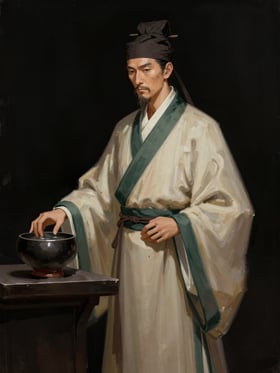
Romance of the Three Kingdoms depicts Gan Ji healing with talisman water; Sun Ce killed him, but the Records of the Three Kingdoms omits him.
Life
In the novel: 1 chapter · In the Records: 1 volume
Life?–200
200 CE (Jian'an 5)
- Death of Sun CeJingkouWitness
Appearances
- Life event
- Death
List all 2 stops
- LangyaBirthplace
- Jingkou200Death of Sun Ce
On the boards
Compare with someone →Where this person ranks on each board.
Historical Record
The Records of the Three Kingdoms does not record Gan Ji; he appears only in novels such as Romance of the Three Kingdoms. His life, affiliations, or fate therefore cannot be supplemented on the basis of the historical biographies in this collection. Accounts of his activities in Wu, his use of talisman water to heal people, and his conflict with Sun Ce are all inventions of the novel, not historical facts that can be stated here.
In the Novel
Romance of the Three Kingdoms portrays Gan Ji as a Taoist priest from Langye who traveled between Wu and Kuaiji and was revered by the common people. The novel says that he claimed to have entered the mountains to gather herbs during the reign of Emperor Shun, where he found the Taiping Qingling Dao above the spring at Quyang. The book mostly contained techniques for treating illness. He healed people with talisman water and took no payment, saying that he merely acted on Heaven’s behalf to spread its teachings and save the people. The common people consequently regarded him as an immortal, but Sun Ce suspected that he was using occult arts to stir up the people. He denounced him as a sorcerer and likened him to figures such as Zhang Jue.
Gan Ji’s literary image combines the roles of savior of the people and persecuted victim. Imprisoned on Sun Ce’s orders, he was pleaded for by the officials. Lü Fan then cited the drought and asked Sun Ce to let him pray for rain to atone for his supposed crimes. Gan Ji bathed, changed his clothes, and bound himself beneath the blazing sun. He said he sought three feet of sweet rain to save the people, while predicting that he would probably still be unable to escape death. The novel then describes thunder and lightning breaking out and sweet rain falling; officials and commoners bowed in thanks. Sun Ce, however, decided that the rain was merely a sorcerer’s chance encounter with the weather, and ultimately ordered Gan Ji’s execution. This episode links miracle, political suspicion, and tragic ending, making Gan Ji a character who practices his art out of compassion but cannot change his own fate. These events and supernatural descriptions are all part of the novel; the Records of the Three Kingdoms does not record them.
After his death, Gan Ji repeatedly appeared as a ghostly figure. The novel says that his corpse vanished during the night, and that Sun Ce saw him again and again in the hall, in lamplight, and in a mirror. Lady Wu attributed her son’s illness to the unjust killing of an immortal and urged him to perform rites to avert disaster. Though Sun Ce reluctantly went to the Yuqing Temple, he still refused to thank Gan Ji. Gan Ji’s image then appeared above a canopy formed by the incense smoke. Sun Ce hurled his sword at it, striking a young soldier who had taken part in the execution, and then ordered the temple destroyed and set on fire. Thus Gan Ji, once a Taoist priest who prayed for rain to save the people, became a ghost who haunted Sun Ce’s thoughts, while also driving the novel’s plot as Sun Ce’s suspicion and anger deepened.
Key Relationships
- Sun Ce: The two form the central conflict in the novel. Sun Ce first flew into a rage at the people burning incense and bowing to Gan Ji, and ordered his arrest. Later, persuaded by the officials, he let Gan Ji pray for rain, but grew angry again when the rain fell and the officials and commoners bowed in reverence, ultimately ordering his execution. Sun Ce regarded Gan Ji as a threat who misled the people, while Gan Ji answered the accusations by saving them and practicing his art. This relationship and its conflict are unique to the novel.
- Zhang Zhao, Lü Fan, and the officials: Zhang Zhao and others opposed killing Gan Ji, and several dozen officials jointly petitioned Sun Ce to spare him. Lü Fan proposed that he atone by praying for rain. The officials’ remonstrance contrasts with Sun Ce’s severity and highlights Gan Ji’s isolation. These relationships are all depicted in the novel.
- Lady Wu: She regarded Sun Ce’s illness as calamity brought on by the unjust killing of Gan Ji and urged him to do good and perform rites to avert disaster. When Sun Ce refused to believe her, she made arrangements in secret. The mother and son’s differing attitudes toward ghosts and spirits continue the plot in which Gan Ji affects Sun Ce even after death; this is unique to the novel.
Signature Scenes
- Revered in the street and arrested by Sun Ce (unique to the novel): Gan Ji walks along the road wearing a crane-feather cloak and holding a staff of mugwort, as the people burn incense and prostrate themselves before him. Seeing this, Sun Ce angrily denounces him as a sorcerer and orders him seized. The stark contrast between the people’s reverence and Sun Ce’s hostility establishes his distinctive place in the novel.
- Praying for rain beneath the blazing sun and foretelling his execution (unique to the novel): Gan Ji binds himself beneath the blazing sun and prays for rain to save the people, saying that he fears he cannot escape his fate. After heavy rain falls from the heavens, he is not pardoned but instead executed by Sun Ce. The success of his effort to save the people set against his own death makes this the character’s most concentrated tragic scene.
- Appearing after death and Sun Ce’s sword at the Yuqing Temple (unique to the novel): After the corpse vanishes, Gan Ji appears repeatedly. At the Yuqing Temple, Sun Ce sees incense smoke gather into a canopy and hurls his sword at the figure he sees, mistakenly killing a young soldier who had taken part in the execution. The novel heightens the scene by having those around Sun Ce say that they saw nothing, leaving fear and obstinacy intertwined.
In the sources
Where the books name Gan Ji
Novel · ch. 29Romance of the Three Kingdoms
策訪知大怒,痛責獄吏,仍將于吉械繫下獄。張昭等數十人,連名作狀,拜求孫策,乞保于神仙。…
Read the whole paragraph
策訪知大怒,痛責獄吏,仍將于吉械繫下獄。張昭等數十人,連名作狀,拜求孫策,乞保于神仙。策曰:「公等皆讀書人,何不達理?昔交州刺史張津,聽信邪教,鼓瑟焚香,常以紅帕裹頭,自稱可助出軍之威,後竟為敵軍所殺。此等事甚無益,諸君自未悟耳。吾欲殺于吉,正思禁邪覺迷也。」呂範曰:「某素知于道人能祈風禱雨。方今天旱,何不令其祈雨以贖罪?」策曰:「吾且看此妖人若何。」遂命於獄中取出于吉,開其枷鎖,令登壇求雨。
Novel · ch. 29Romance of the Three Kingdoms
於是眾官及百姓,共將于吉扶下柴堆,解去繩索,再拜稱謝。孫策見官民俱羅拜於水中,不顧衣服,乃勃然大怒,叱曰:「晴雨乃天地之定數,妖人偶乘其便,你等何得如此惑亂!」…
Read the whole paragraph
於是眾官及百姓,共將于吉扶下柴堆,解去繩索,再拜稱謝。孫策見官民俱羅拜於水中,不顧衣服,乃勃然大怒,叱曰:「晴雨乃天地之定數,妖人偶乘其便,你等何得如此惑亂!」掣寶劍令左右速斬于吉。眾官力諫。策怒曰:「爾等皆欲從于吉造反耶!」眾官乃不敢復言。策叱武士將于吉一刀斬頭落地。只見一道青氣,投東北去了。策命將其屍號令於市,以正妖妄之罪。
Novel · ch. 29Romance of the Three Kingdoms
是夜風雨交作,及曉不見了于吉屍首。守屍軍士報知孫策。策怒,欲殺守屍軍士。…
Read the whole paragraph
是夜風雨交作,及曉不見了于吉屍首。守屍軍士報知孫策。策怒,欲殺守屍軍士。忽見一人,從堂前徐步而來,視之,卻是于吉。策大怒,正欲拔劍砍之,忽然昏倒於地。左右急救入臥內,半晌方甦。吳太夫人來視疾,謂策曰:「吾兒屈殺神仙,故招此禍。」策笑曰:「兒自幼隨父出征,殺人如麻,何曾有為禍之理?今殺妖人,正絕大禍,安得反為我禍?」夫人曰:「因汝不信,以致如此;今可作好事以禳之。」策曰:「吾命在天,妖人決不能為禍,何必禳耶?」夫人料勸不信,乃自令左右暗修善事禳解。
Quotes
3 lines in the books · 2 featured
「貧道乃瑯琊宮道士。順帝時曾入山採藥,得神書於曲陽泉水上,號曰《太平青領道》,凡百餘卷,皆治人疾病方術。貧道得之,惟務代天宣化,普救萬人。未曾取人毫釐之物,安得煽惑人心?」
This line reveals Gan Ji's identity as a Daoist and mentions the 'Taiping Qingling Dao,' a core episode of his story.
「吾求三尺甘霖,以救萬民,然我終不免一死。」
This line foreshadows the tragic ending in which Gan Ji, pleading on behalf of the people, is nonetheless put to death—laden with a sense of fate.
Family, lords and rivals
1 relationships
Who is Gan Ji connected to?
Pick someone to see how many steps lie between them and Gan Ji.
Combat
On the field
Duels, kills and executions as the texts tell them, counted separately for the Records and the Romance.
- RomanceCh. 29ExecutionSun CeLost「策叱武士將于吉一刀斬頭落地」
Events
Events (1)
Battles and events the texts place this person in, by date.
Other events
- 200Death of Sun CeWitness
Places
- Native of
- LangyaRecords
Continue
Death of Sun Ce
Inner monologues · AI-generated1 monologue ▸
- As I was brought upstairs under guard, I heard Sun Ce accuse me of stirring up the people. Facing his anger, I simply ex