Records
Wu forces won
- Commanders
- Cao forcesCao Ren
Vol. 54「仁由是遂退」
208 CE (Jian'an 13) · Jiangling
From the winter of 208 to 209, after the Battle of Chibi, Zhou Yu and Cheng Pu led Eastern Wu forces in an attack on Nan Commandery, where they faced off against Cao Ren’s troops. Gan Ning first secured Yiling, but after coming under siege, he was rescued by an army led by Zhou Yu. Even after being wounded, Zhou Yu continued to organize the troops and direct the fighting. Cao Ren eventually withdrew, allowing Eastern Wu to consolidate its positions in Nan Commandery and around Jiangling. This campaign expanded Eastern Wu’s foothold in Jing Province and helped reshape the balance of power there after the Battle of Chibi, influencing the strategic plans of both Sun and Liu.
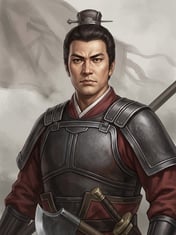 Xu HuangWarriorTalk to me
 Zhou YuCommanderTalk to me
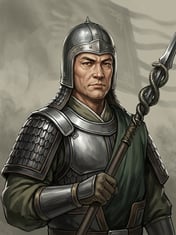 Cheng PuCommanderTalk to me
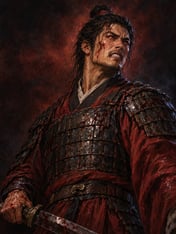 Ling TongWarriorTalk to me
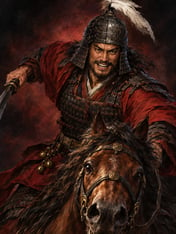 Gan NingWarriorTalk to me
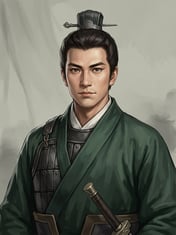 Lü MengAdvisorTalk to me
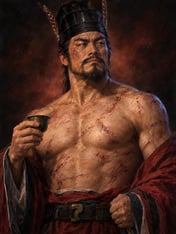 Zhou TaiWarriorTalk to me
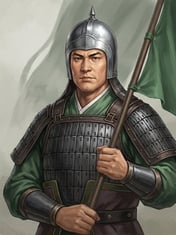 Xu ShengWarriorTalk to me
10 more: Ding FengHan DangCao RenCao HongYue JinCao ChunNiu JinGuan YuLiu BeiLiu Qi
Who won, as each book tells it; commanders as the text names them.
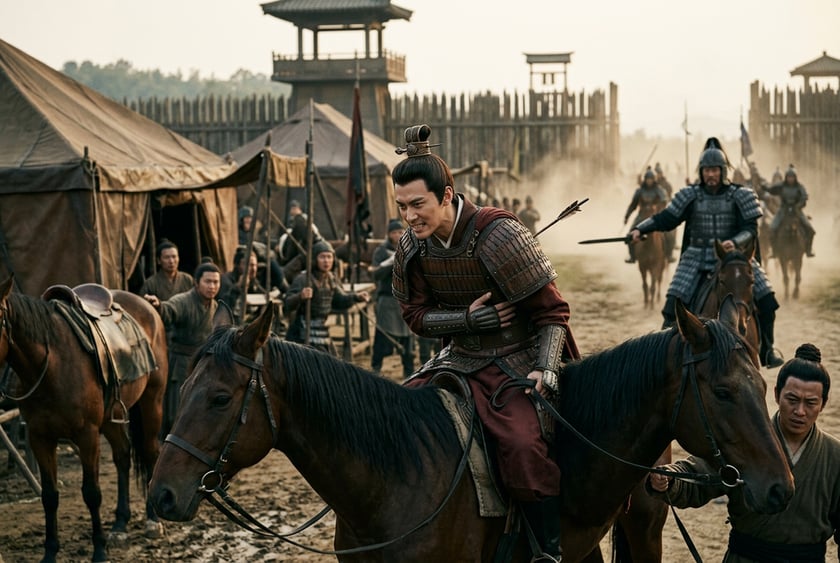
Scene
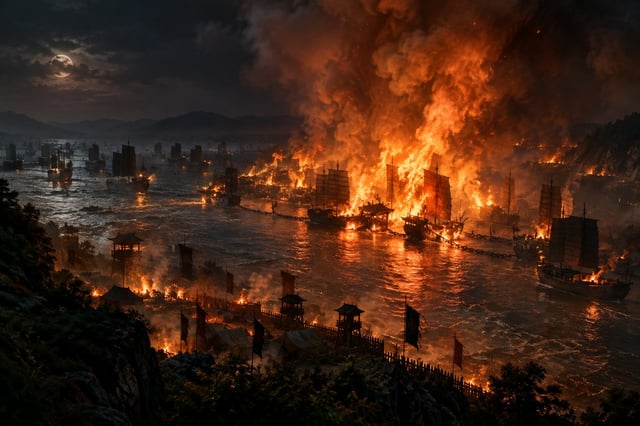
Zhou Yu rides out to direct the battle but is struck in the right side by a stray arrow and withdraws to his tent, enduring the pain. On learning that Zhou Yu is injured and confined to bed, Cao Ren leads his troops into battle. Zhou Yu then gets up again, inspects the camp, and rallies morale.
The history portrays the Battle of Jiangling as a hard-fought siege lasting nearly a year, in which Zhou Yu personally braved arrows to capture Nan Commandery. The novel rewrites it as a comic battle of wits in which “Zhou Yu is wounded by an arrow and feigns death, while Zhuge Liang takes three cities in his absence.”
The Records of the Three Kingdoms presents the Battle of Nanjun as a hard-fought engagement led by Eastern Wu, in which Zhou Yu was personally wounded by a stray arrow. The novel casts Liu Bei and Zhuge Liang as the “oriole” watching for an opportunity to seize Nan Commandery, and adds many dramatic episodes in which Zhou Yu and Liu Bei compete for the spoils.
Continue
Replay the Battle of Red Cliffs phase by phase on real terrain: troop strengths, movements and turning points at a glance, each marked as coming from the Records of the Three Kingdoms or the Romance.
2156 people in common
2085 people in common
2165 people in common
2103 people in common
2194 people in common
2083 people in common
2083 people in common
2083 people in common
The Battle of Jiangling was a struggle over Nan Commandery, Jiangling, and Yiling in the aftermath of Chibi. Victory at Chibi did not automatically eliminate Cao forces’ strongholds in Jing Province: Cao Ren still held Jiangling, whose stores of provisions were ample, enabling him to hold the city and tie down Wu forces. For Eastern Wu, unless it could force the Cao army to withdraw or seize key positions, its advantage on the Yangtze would be difficult to turn into stable control on land. The Records of the Three Kingdoms records that Zhou Yu and Cheng Pu advanced to Nan Commandery and faced Cao Ren across the river, showing how the conflict shifted from the outcome of a naval battle to a contest involving siege, relief, and control of lines of communication.
The heart of this campaign was not simply a comparison of troop numbers, but a struggle to seize the initiative. Wu forces had to defend their camps and flanks while attacking the city, while the Cao army could use its fortified city, provisions, and mobile forces to wear down its opponents. Yiling lay on the outskirts of Jiangling. After Gan Ning advanced to hold it, Cao Ren sent a detachment to besiege him, showing that an outlying position could threaten Cao forces but could also become a weak point where Wu forces might be isolated. Liu Bei’s side was also concerned with who would control Nan Commandery. The Romance of the Three Kingdoms portrays the competition between Wu and Liu over the fruits of victory as an overt theme. According to an account in the Wu lu cited by historical sources, Liu Bei also once suggested using a flanking maneuver to intercept Cao Ren, but this passage should be considered separately from the main text of the Records of the Three Kingdoms and from the novel’s narrative.
Wu forces were led by Zhou Yu and Cheng Pu, with Zhou Yu in command at the front. Gan Ning was sent to Yiling to establish an outpost. When Gan Ning was besieged, Zhou Yu took Lü Meng’s advice, leaving Ling Tong to guard the rear while he and Lü Meng led troops to relieve the siege. This arrangement shows that Wu did not simply commit all its forces to the relief operation; the troops left behind were meant to prevent Cao Ren from striking the rear while the main force was away from camp. After Gan Ning broke out, Wu forces moved to the north bank and took up position, setting a date for battle in an attempt to turn a successful relief operation into control over the pace of the fighting.
On the Cao side, the key deployments confirmed by historical sources are that Cao Ren held Jiangling and sent a detachment of cavalry and infantry to besiege Gan Ning. This both put pressure on the Wu outpost and forced Zhou Yu to choose between attacking the city and going to its relief. The novel adds further detail, describing sorties by Cao Hong, Cao Chun, and Niu Jin, as well as the participation of Wu commanders such as Han Dang, Zhou Tai, Xu Sheng, and Ding Feng. These details help explain how the Romance of the Three Kingdoms depicts the fighting, but should not be accepted uncritically as historical fact. Guan Yu, Liu Bei, Liu Qi, and other figures also appear in the broader narrative context of shifting power in Jing Province, but the cited historical sources do not record their specific deployments in this campaign in comparable detail.
The first key decision came when Gan Ning was besieged. If Zhou Yu had not gone to his aid, the position at Yiling might have fallen, Wu’s forward force might have been destroyed, and trust among the troops might have weakened. But an immediate relief operation would leave a gap in the defenses facing Jiangling. Lü Meng proposed that Ling Tong guard the rear, that he lead the vanguard, and that Zhou Yu bring up the rear. In effect, this divided the risk between the relief column and the camp’s defenders. Historical sources record that the relief succeeded, but also show that Zhou Yu was struck by an arrow in the right flank during a subsequent engagement and seriously wounded. Thus, although this decision preserved the outpost, it came at the cost of an injury to the command center.
The second decision was how to exploit the psychological impact of the commander’s injury. The historical account says only that Cao Ren heard Zhou Yu was bedridden and had not risen, and then assembled his troops and advanced. Zhou Yu responded by getting up and inspecting the camp to encourage his men, after which Cao Ren withdrew. This episode shows that information on the battlefield was itself a military resource: if Wu forces were judged to have lost their commander’s effectiveness, Cao forces might press their advantage. Zhou Yu’s public appearance prevented that assessment. The Romance of the Three Kingdoms takes a different approach: it turns the arrow wound into a plot in which Cao Ren mistakenly believes Zhou Yu is dead and Wu forces ambush and counterattack, adding dramatic episodes involving a feigned death and a raid on the camp. This heightens the contest of wits, but cannot replace the briefer account in the historical sources.
The third decision concerned how to turn battlefield gains into control. The novel relates that after Zhou Yu was wounded and Cao forces fell for a ruse, Zhuge Liang seized Nan Commandery and made further arrangements for Jing Province and other territories. This recasts the campaign from a confrontation between Wu and Cao into a contest between Wu and Liu over the fruits of victory in Jing Province. Readers often incorporate episodes such as Zhao Yun Seizes Nanjun into accounts of the campaign, but the cited materials provide no independent historical evidence for Zhao Yun’s actions. Accordingly, discussion of the campaign’s decisions should assess separately the relief operation, engagements, and withdrawal recorded for Wu forces, and the chain of stratagems the novel constructs around the transfer of Nan Commandery.
As far as the cited account in the Records of the Three Kingdoms is concerned, what can be confirmed is that Gan Ning’s siege was lifted, Wu forces took up position on the north bank and prepared for battle, Zhou Yu was struck by an arrow and wounded, and Cao Ren withdrew after Zhou Yu reappeared and encouraged his troops. The passage does not say who ultimately held Jiangling over the long term, nor does it provide a complete conclusion that would settle the outcome of the campaign as a whole. The result should therefore be treated as “unclear”; the later transfer of Nan Commandery in the novel cannot be taken directly as a definitive historical account.
In terms of military effectiveness, Wu forces gained the local initiative: they rescued Gan Ning, maintained a forward presence, and prevented Cao Ren from immediately overwhelming them while Zhou Yu was wounded. This does not mean, however, that the defenders of Jiangling had been eliminated or that firm control over Nan Commandery had been established. The novel links Zhou Yu’s injury, the feigned death that lures the enemy, and Liu Bei’s faction seizing a city in the ensuing opening into a series of turning points, leading to an escalation of tensions between Wu and Liu. This reflects later narratives’ emphasis on conflicts of interest in Jing Province, rather than a campaign outcome confirmed by the cited historical sources.
The longer-term repercussions lie in the fact that the alliance after Chibi was not free of competition. The military pressure created by Cao Ren’s defense of the city coexisted with Liu Bei’s side’s interest in the opportunity to take Nan Commandery. Even while jointly opposing Cao forces, Wu and Liu had to confront the question of who would control the transportation hubs, cities, and strategic depth after the war. The available materials are sufficient to show that this tension had entered the narratives of the campaign at the time, but not to reconstruct all the negotiations or the actual process of occupation.
If Zhou Yu had chosen not to relieve Gan Ning, Wu forces might have been able to keep more troops on the front facing Jiangling, avoiding both the commander’s exposure to danger and his injury. But if Cao forces had captured Yiling, Cao Ren might have gained a safer foothold on the outskirts, while Wu forces would have lost a position from which to threaten Jiangling. Conversely, if Ling Tong had not been left to guard the rear during the relief operation, Cao Ren might have seized the opportunity to attack the camp while Wu’s main force was away, bringing the success of the relief operation into conflict with the safety of the main position. The historical sources do not prove that any alternative would have failed, but they do show that Zhou Yu consciously divided his forces between relieving the outpost and defending the rear.
If Cao Ren had treated Zhou Yu’s injury as a brief opportunity to exploit and maintained the pressure, Wu forces might have found it harder to restore their formation. Yet the historical account says Cao Ren advanced after learning that Zhou Yu was bedridden, then withdrew once Zhou Yu appeared and inspected the camp. This shows that deterrence and judgments about morale affected the course of action. Conversely, although Zhou Yu steadied his men by appearing in person, he also risked worsening his injuries. The novel magnifies this risk into a counterplot involving a “feigned death,” offering a dramatic alternative possibility, but this does not warrant inferring that such a plan was actually used to lure the enemy on the historical battlefield.
If Wu and Liu had reached a clear division of responsibilities for taking Nan Commandery and defending it afterward, they might have reduced the risk that gains would turn into internal competition before they were consolidated. But the cited historical sources are insufficient to determine whether such an arrangement was feasible, or to establish the full process by which Nan Commandery was actually transferred. The more cautious counterfactual conclusion is that the key to the campaign at Jiangling lay not only in an engagement outside the city, but in whether the relief of the outpost, the commander’s injury, the resilience of the city’s defenders, and the alliance’s competing interests could all be managed at once. A change in any one of these factors could have affected what followed, but these fragments alone cannot establish the final outcome.