Sun Quan's Faction · Deputy General
Gan Ning
courtesy name 兴霸 · c. 170–c. 220
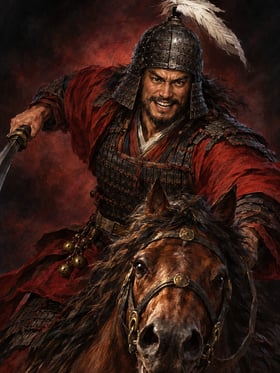
Gan Ning was coarse and fierce, fond of killing, yet open and full of stratagem, holding wealth lightly and honoring men of worth, able to keep and generously provide for stout warriors. He was clear-cut in his loyalties and grudges, lucid in reasoning through affairs, magnanimous and decisive, and was called a 'Tiger General.'

Life
In the novel: 16 chapters · In the Records: 5 volumes
Life170–220
208 CE (Jian'an 13)
5 more events
209 CE (Jian'an 14)
- Gan Ning Holds YilingYilingCommander
213 CE (Jian'an 18)
- Battle of RuxukouRuxukouWarrior
214 CE (Jian'an 19)
- Battle of WanWanWarrior
215 CE (Jian'an 20)
216 CE (Jian'an 21)
Allegiance
- Sun Quan's Faction
- Liu Biao's faction
- Eastern Wu
- Hatched: dated by chapter
- Life event
List all 8 stops
On the boards
Compare with someone →Where this person ranks on each board.
Who they were
Character profile
- Character
- Gan Ning was coarse and fierce, fond of killing, yet open and full of stratagem, holding wealth lightly and honoring men of worth, able to keep and generously provide for stout warriors. He was clear-cut in his loyalties and grudges, lucid in reasoning through affairs, magnanimous and decisive, and was called a 'Tiger General.'
- Manner of speech
- Gan Ning avowed himself a subject in the line of loyal servants, pledging to give his utmost strength and his life to repay the one he served. When laying out for Sun Quan his plan to attack Huang Zu, he analyzed the sharp points and the dull with clarity, his manner one of drawing his sword to bark a curt rebuke, or feigning delight to lure the foe.
- Life
- Gan Ning was a native of Linjiang in Ba Commandery. In his youth he was a wandering bravo, then attached himself to Liu Biao and Huang Zu, and finally submitted to Eastern Wu. He had once been a 'Brocade-Sail Bandit,' but later repented of his former faults, mended his ways, and turned to good, going over to Liu Biao, after which he was detained by Huang Zu at Xiakou.
- Weapons
- Gan Ning used the crossbow and the bow and arrow, and once swore his troops to battle with wine poured from a silver bowl.
- Anecdotes
- Sun Quan once said, 'Mengde has Zhang Liao, and I have Xingba—well enough matched are they,' and remarked that 'though the man is rough and bold and does not always act as one would wish, on the whole he is a great fellow.' Gan Ning once went on campaign while ill; after his death the King of Wu grieved bitterly, buried him lavishly, and set up a shrine to him.
Historical Record
Gan Ning, courtesy name Xingba, was from Linjiang in Ba Commandery. The Book of Wu adds that he was originally from Nanyang and that his ancestors had settled in Ba Commandery. He once served as an official, was recommended as a jiju yuan, and was appointed assistant administrator of Shu Commandery, but later abandoned his office and returned home. In his youth, he admired chivalrous wanderers and gathered a band of reckless young men. They carried bows and crossbows and wore bells when they traveled; when people heard the bells, they knew it was him. In his early years he acted with force, sometimes seizing property and harming people under the jurisdiction of local officials. Later he curbed his raids and also read the works of the various masters. He successively attached himself to Liu Biao and Huang Zu, but neither made much use of him. With Su Fei’s help, he eventually broke away from Huang Zu and joined Sun Quan. Zhou Yu and Lü Meng jointly recommended him, and Sun Quan treated him as one of his established officials.
Gan Ning was both resourceful and courageous in battle. After joining Wu, he advised Sun Quan that Liu Biao was weak and Huang Zu was in decline, and urged him to take Huang Zu first, then expand westward into Jing Province. Sun Quan accepted his advice and defeated Huang Zu. Later, Gan Ning joined Zhou Yu and others in routing Cao Cao’s forces at Wulin. During the campaign against Nan Commandery, he proposed taking Yiling first. After entering the city, he held out against a siege by five or six thousand of Cao Ren’s troops with fewer than a thousand men, defending it until help arrived. Lü Meng offered a plan, and Zhou Yu led troops to lift the siege. Gan Ning also joined Lu Su at Yiyang to resist Guan Yu. With only a small force, he made a nighttime advance, and Guan Yu halted his attempt to cross the river upon hearing of it. During the assault on Wan, Gan Ning was appointed siege commander. Holding a climbing rope in his hands, he scaled the walls and led the charge. After the battle, he was appointed General Who Breaks the Enemy.
During the Battle of Ruxu, Gan Ning served as commander of the vanguard and led his men in a nighttime raid on a Wei encampment, startling the enemy into retreat. Sun Quan praised him as a match for Cao Cao’s subordinate Zhang Liao. In the twentieth year of Jian’an, as Sun Quan’s forces withdrew from Hefei, Zhang Liao launched a surprise attack on Sun Quan. Gan Ning took up his bow to meet the enemy and fought fiercely alongside Ling Tong and others to protect their lord. Chen Shou summed him up as “fierce and fond of killing,” but also described him as openhearted and resourceful, generous with wealth and respectful toward worthy men. He treated his able soldiers well, and they were glad to serve him.
In the Novel
Romance of the Three Kingdoms portrays Gan Ning as a legendary figure who transformed from a “brocade-sailed bandit” into a valiant general of Eastern Wu. The novel retains his history of serving Liu Biao and Huang Zu before joining Wu, while emphasizing his reform, choice of a worthy lord, and gratitude for past kindness. After Sun Quan accepted him, Gan Ning proposed defeating Huang Zu first and then expanding into Jing Province and Ba-Shu, showing that he could do more than fight bravely: he could also assess the situation and offer strategic advice.
The novel depicts Gan Ning as especially formidable on the battlefield. When blocked at Miankou, he led small boats in a daring advance and cut the mooring lines of the mengchong warships. When Huang Zu fled after his defeat, Gan Ning lay in ambush and intercepted him, personally shooting him dead. This episode links an earlier humiliation to revenge, and has Gan Ning plead for Su Fei, who had once helped him, portraying him as someone who clearly remembered both grudges and kindnesses. These details belong to the novel’s narrative and should not be treated as historical-biographical records.
In the Chibi story, Gan Ning first shoots Cai Xun dead at Sanjiangkou, then takes part in Zhou Yu’s feigned-surrender plan and the fire attack at Wulin. The novel goes further, depicting him penetrating Cao Cao’s camp and killing Cai Zhong, Ma Yan, and Zhang Yi. The Records of the Three Kingdoms records Gan Ning’s participation in the Battle of Wulin, but not these specific killings or the fire-attack episode; these are dramatic embellishments unique to the novel. The novel also has Gan Ning propose an attack on Yiling. After he is besieged, Zhou Yu, Zhou Tai, and others come to his rescue, highlighting both his boldness in taking the initiative and his role as a comrade whom others rush to aid.
Key Relationships
Sun Quan: After Gan Ning joined Wu, Sun Quan valued him. Gan Ning advised him to take Huang Zu and distinguished himself at Wan and Ruxu. Sun Quan likened himself to Cao Cao by saying, “I have Xingba,” demonstrating his confidence in Gan Ning’s courage and strategic ability.
Zhou Yu and Lü Meng: The two jointly recommended Gan Ning. When he was besieged at Yiling, Lü Meng proposed that Ling Tong remain behind to hold the rear while he and Zhou Yu went to his aid. During the assault on Wan, Lü Meng also recommended Gan Ning for the post of siege commander. Their plans and Gan Ning’s execution of them complemented one another.
Su Fei: Su Fei repeatedly spoke to Huang Zu on Gan Ning’s behalf and helped him escape. Even after joining Wu, Gan Ning remembered this kindness and asked Sun Quan to spare Su Fei. This episode appears in Pei Songzhi’s commentary on the Book of Wu and in Romance of the Three Kingdoms; the novel expands on it with a scene in which Gan Ning weeps and begs for Su Fei’s pardon.
Ling Tong: Historical accounts record that Ling Tong and Gan Ning fought together to protect Sun Quan at Jinbei. Pei Songzhi’s commentary additionally relates that Ling Tong resented Gan Ning for the death of his father, Ling Cao, and that Sun Quan ordered him not to seek revenge; Lü Meng also intervened to mediate between them. The novel moves this old enmity to a banquet, where the two clash with drawn swords, and has Sun Quan assign Gan Ning to garrison Xiakou to keep him away from Ling Tong—an episode found only in the novel.
Signature Scenes
Besieged at Yiling, yet calm and smiling: Gan Ning took up a defensive position at Yiling in advance. Though Cao Ren’s large army laid siege and the soldiers inside the city were afraid, he remained calm and talked and laughed. Zhou Yu followed Lü Meng’s plan and came to lift the siege. The core of the historical account is the risky position, the determined defense, and the combined efforts of the relieving force—not an easy victory by an isolated army.
The nighttime raid at Ruxu: Gan Ning first drank with his men, then rallied a hesitant commander. Afterward, they went out at night with their mouths muffled and attacked the enemy camp, sending the Wei army into a startled retreat. The shared wine in silver bowls and his face-to-face goading gave the raid both the daring of a commander and a strong sense of ceremony.
Scaling Wan with a climbing rope in hand: As siege commander, Gan Ning personally took hold of a climbing rope and scaled the walls, leading his soldiers in the assault. In the end, they captured Wan. This siege scene from the historical accounts most powerfully conveys his image as a leader who went first into battle.
The fire attack at Wulin and the killing of enemy generals: The novel has Gan Ning lead Cai Zhong deep into Cao Cao’s camp to set fires, then kill Ma Yan and Zhang Yi, intensifying the pursuit of the defeated army at every turn. This succession of personal battlefield heroics is unique to the novel; the historical accounts merely record that Gan Ning took part in routing Cao Cao at Wulin.
Quotes
27 lines in the books · 3 featured
「今漢祚日微,曹操彌憍,終爲篡盜。南荊之地。山陵形便,江川流通,誠是國之西勢也。寧已觀劉表,慮旣不遠,兒子又劣,非能承業傳基者也。至尊當早規之,不可後操圖之。圖之之計,宜先取黃祖。祖今年老,昏耄已甚,財穀並乏,左右欺弄,務於貨利,侵求吏士,吏士心怨,舟船戰具頓廢不脩,怠於耕農,軍無法伍。至尊今往,其破可必。一破祖軍,鼓行而西,西據楚關,大勢彌廣,即可漸規巴蜀。」
This is Gan Ning's strategic plan, presented to Sun Quan, for taking Jing Province and setting designs on Ba and Shu, displaying his outstanding military foresight.
「寧今夜只帶一百人馬去劫曹營;若折了一人一騎,也不算功。」
This line displays Gan Ning's bold spirit and confidence in his own ability, the heart of the tale of 'raiding the Wei camp with a hundred horsemen.'
「可復以五百人益吾,吾往對之,保羽聞吾欬唾,不敢涉水,涉水即是吾禽。」
This line reflects Gan Ning's valor and his contempt for Guan Yu, a vivid portrait of his character.
- Family
- Lord & vassal
- Friends
- Enemies
- Other
Who is Gan Ning connected to?
Pick someone to see how many steps lie between them and Gan Ning.
History vs. novel
7 points · 2 novel-only
| History | Novel |
|---|---|
| The Brocade-Sailed BanditNovel embellishes | |
Historical records say that in his early years, Gan Ning recruited wandering swordsmen. His followers carried bows, crossbows, and bells, and the people knew it was him when they heard the bells. The Book of Wu also records that he traveled in great luxury, but does not call him the “Brocade-Sailed Bandit.” vol. 55 | The novel says that Gan Ning once decorated his boat sails with brocade from Xichuan, earning him the name “Brocade-Sailed Bandit,” and emphasizes his image as a chivalrous hero who roamed the land. ch. 38 |
| Huang Zu’s DeathSources disagree | |
Historical records say that when Gan Ning pursued Huang Zu, the man he shot and killed was the commandant Ling Cao, allowing Huang Zu to escape. The sources do not record Gan Ning personally killing Huang Zu. vol. 55 | The novel depicts Gan Ning ambushing Huang Zu as he fled outside the east gate, shooting him and cutting off his head to present to Sun Quan. ch. 39 |
| Interceding for Su FeiNovel embellishes | |
Historical records say that after Sun Quan defeated Huang Zu, Gan Ning pleaded for Su Fei, who had once helped him, and Sun Quan eventually pardoned Su Fei. vol. 55 | The novel depicts the appeal for Su Fei as taking place after the victory celebrations: invoking their past kindness, Gan Ning begs Sun Quan to spare him, even offering his own head if Su Fei escapes. ch. 39 |
| Defending YilingNovel embellishes | |
During the attack on Nan Commandery, Gan Ning proposed taking Yiling first and defended the city with fewer than a thousand men. Though besieged by five or six thousand of Cao Ren’s troops, he remained composed and even joked, until Zhou Yu came to his relief. vol. 55 | The novel depicts Gan Ning volunteering to capture Yiling with three thousand elite troops. After defeating Cao Hong, he occupied the city and was then besieged by Cao’s army. ch. 51 |
| Night Raid at RuxuNovel embellishes | |
Historical records say that Gan Ning was ordered to raid the enemy camp at night. He first rallied his men and the commander with a speech, then set out in silence, startling the enemy and forcing them to retreat. vol. 55 | The novel depicts Gan Ning raiding the camp with just a hundred cavalrymen, wearing white goose feathers in his helmet as a marker. He charged through Cao’s camp and returned unharmed. ch. 68 |
| Bond with Ling TongNovel only | |
| — | The novel depicts Ling Tong falling from his horse and facing danger on the battlefield. Gan Ning saves him by shooting Yue Jin, and Ling Tong is so grateful that the two become sworn brothers, ready to live or die for each other. ch. 68 |
| Shot by ShamokeNovel only | |
| — | The novel depicts Gan Ning setting out on campaign despite suffering from dysentery. After encountering Shamoke, he is struck by an arrow and flees to Fuchi Mouth, where he dies beneath a tree as a flock of crows circles his body. ch. 83 |
- The Brocade-Sailed BanditNovel embellishes
- History
Historical records say that in his early years, Gan Ning recruited wandering swordsmen. His followers carried bows, crossbows, and bells, and the people knew it was him when they heard the bells. The Book of Wu also records that he traveled in great luxury, but does not call him the “Brocade-Sailed Bandit.”
vol. 55
- Novel
The novel says that Gan Ning once decorated his boat sails with brocade from Xichuan, earning him the name “Brocade-Sailed Bandit,” and emphasizes his image as a chivalrous hero who roamed the land.
ch. 38
- Huang Zu’s DeathSources disagree
- History
Historical records say that when Gan Ning pursued Huang Zu, the man he shot and killed was the commandant Ling Cao, allowing Huang Zu to escape. The sources do not record Gan Ning personally killing Huang Zu.
vol. 55
- Novel
The novel depicts Gan Ning ambushing Huang Zu as he fled outside the east gate, shooting him and cutting off his head to present to Sun Quan.
ch. 39
- Interceding for Su FeiNovel embellishes
- History
Historical records say that after Sun Quan defeated Huang Zu, Gan Ning pleaded for Su Fei, who had once helped him, and Sun Quan eventually pardoned Su Fei.
vol. 55
- Novel
The novel depicts the appeal for Su Fei as taking place after the victory celebrations: invoking their past kindness, Gan Ning begs Sun Quan to spare him, even offering his own head if Su Fei escapes.
ch. 39
- Defending YilingNovel embellishes
- History
During the attack on Nan Commandery, Gan Ning proposed taking Yiling first and defended the city with fewer than a thousand men. Though besieged by five or six thousand of Cao Ren’s troops, he remained composed and even joked, until Zhou Yu came to his relief.
vol. 55
- Novel
The novel depicts Gan Ning volunteering to capture Yiling with three thousand elite troops. After defeating Cao Hong, he occupied the city and was then besieged by Cao’s army.
ch. 51
- Night Raid at RuxuNovel embellishes
- History
Historical records say that Gan Ning was ordered to raid the enemy camp at night. He first rallied his men and the commander with a speech, then set out in silence, startling the enemy and forcing them to retreat.
vol. 55
- Novel
The novel depicts Gan Ning raiding the camp with just a hundred cavalrymen, wearing white goose feathers in his helmet as a marker. He charged through Cao’s camp and returned unharmed.
ch. 68
- Bond with Ling TongNovel only
- Novel
The novel depicts Ling Tong falling from his horse and facing danger on the battlefield. Gan Ning saves him by shooting Yue Jin, and Ling Tong is so grateful that the two become sworn brothers, ready to live or die for each other.
ch. 68
- Shot by ShamokeNovel only
- Novel
The novel depicts Gan Ning setting out on campaign despite suffering from dysentery. After encountering Shamoke, he is struck by an arrow and flees to Fuchi Mouth, where he dies beneath a tree as a flock of crows circles his body.
ch. 83
Combat
On the field
Duels, kills and executions as the texts tell them, counted separately for the Records and the Romance.
- RomanceCh. 38Struck downLing CaoWon「被黃祖部將甘寧一箭射死」
- RomanceCh. 38Struck downDeng LongWon「將鄧龍砍死」
- RomanceCh. 39Struck downHuang ZuWon「背射黃祖,祖中箭翻身落馬」
- RomanceCh. 45Struck downCai XunWon「甘寧拈弓搭箭,望蔡壎射來,應弦而倒」
- RomanceCh. 50Struck downCai ZhongWon「寧將蔡中一刀砍於馬下」
- RomanceCh. 50Struck downMa YanWon「馬延正欲交鋒,早被甘寧一刀斬於馬下」
All encounters (11)
Loading…
Battles in command
Battles this person commanded in, with the outcome as each text tells it.
- Romance
- 1W 0L 0D 0 undecided
- Romance214Battle of WanWonvs Defenders of WanCh. 67「亂刀砍死朱光。餘眾多降,得了皖城」
Stratagems
Plans this person devised or saw through, as the texts tell them.
- Romance
- 2 carried out · 2 worked · 0 turned down · 0 seen through
- RomanceAmbushAmbushWorkedagainst JiangxiaCh. 39「甘寧料得黃祖必走荊州,乃於東門外伏兵等候」
- RomanceRaid the CampOtherWorkedagainst Cao troopsCh. 68「寧今夜只帶一百人馬去劫曹營;若折了一人一騎,也不算功」
Events
Events (15)
Battles and events the texts place this person in, by date.
Battles
- 208Battle of JiangxiaWarrior
- 208Battle of JianglingWarrior
- 208Battle of Red Cliffs
- 208Battle of Red Cliffs
- 213Battle of RuxukouWarrior
- 214Battle of WanWarrior
- 215Battle of Xiaoyao FordWarrior
- 216Battle of Ruxu (217)Warrior
All 10
Other events
- 208Gan Ning's Counsel to Target Huang ZuAdvisor
- 209Gan Ning Holds YilingCommander
- 210Zhou Yu's Stratagem of Borrowed Road to Destroy Guo
- 215Ambush North of Xiaoyao FordWarrior
- 216Gan Ning's Hundred Horsemen Raid on the Wei CampCommander
Famous objects
Places
- Native of
- Ba CommanderyRecords
- NanyangRecords
- Was at
- YilingRecords
- YiyangRecords
- Shu CommanderyRecords
Continue
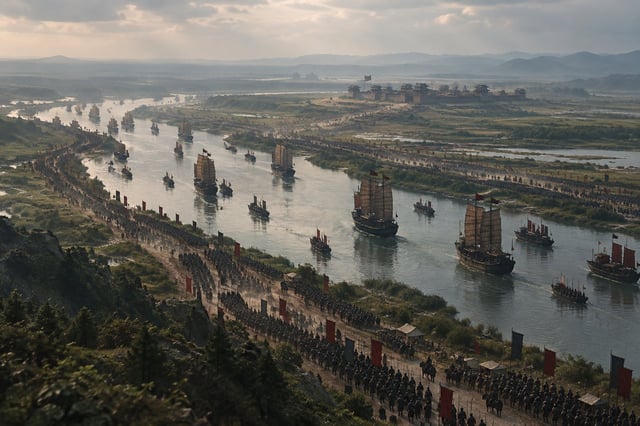
The Battle of Xiaoyao Ford in 3D
Replay the Battle of Xiaoyao Ford phase by phase on real terrain: troop strengths, movements and turning points at a glance, each marked as coming from the Records of the Three Kingdoms or the Romance.
Relationship timeline16 entries ▸
History · vol. 55
Novel · ch. 39
- Huang Zu§2
Enemy
Took up a bow, nocked an arrow, and shot Huang Zu in the back; Huang Zu fell from his horse, and his head was cut off
- Su Fei§3
Friend
Remembering his past kindness, was willing to surrender his official rank and title to atone for his crime
- Ling Cao§4
Enemy
Once shot and killed Ling Cao in Jiangxia (Ling Tong’s father)
Novel · ch. 49
Novel · ch. 50
All 16
Loading…
Inner monologues · AI-generated3 monologues ▸
- I am Gan Ning, courtesy name Xingba. Here I lie wounded by arrows, my strength ebbing away. The river wind sweeps past t
- I am Gan Ning, courtesy name Xingba. I recall that when I first joined Wu, Zhou Yu and Lü Meng both spoke on my behalf.
- I am Gan Ning, courtesy name Xingba, from Linjiang in Ba Commandery. In my youth, I was stronger than most, and I loved