Overview
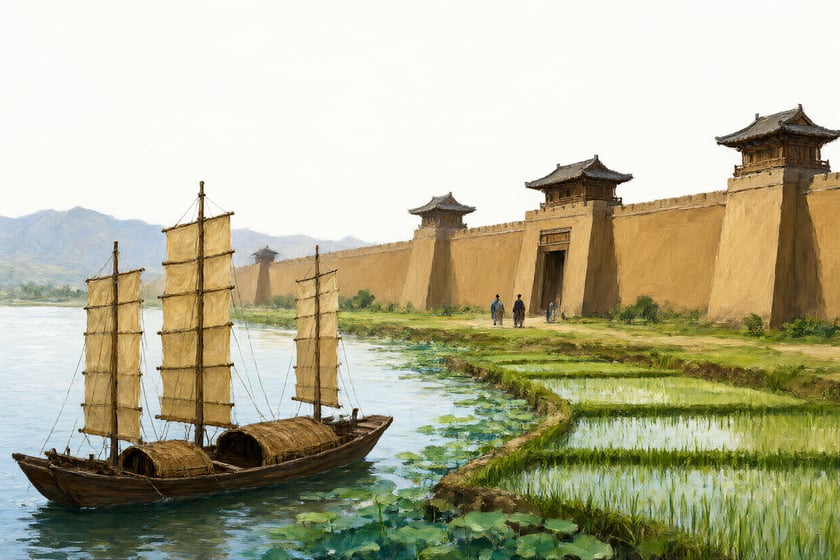
Jiangling was the seat of Nan Commandery in Jing Province during the Eastern Han. The city stood in present-day Jingzhou District, Jingzhou, Hubei Province, beside the Yangtze River, and the commandery governor of Nan Commandery was stationed there in the late Han period. When Liu Biao held Jing Province, much of its military supplies were gathered there. In the thirteenth year of Jian’an (208), Cao Cao feared that Liu Bei would seize Jiangling first, so he abandoned his baggage train and pursued him at speed with a lightly equipped force. Over the following seventy-odd years, Jiangling passed in turn to Cao Cao, Sun Quan, and Liu Bei, before remaining for a long period in Eastern Wu’s possession. It was a key city in the Three Kingdoms’ struggle for Jing Province.
History
In the ninth month of the thirteenth year of Jian’an (208), Liu Cong surrendered to Cao Cao. Cao Cao advanced on Jiangling, where he rewarded his men according to merit and sought to reassure Jing Province’s officials and people. Wang Lang, who accompanied the army, later recalled that Cao Cao had stayed in Liu Biao’s audience hall. That winter, Cao Cao set out from Jiangling to pursue Liu Bei. After his defeat at Chibi, he withdrew north, leaving Cao Ren and Xu Huang to defend Jiangling. Zhou Yu and Cheng Pu immediately attacked and faced Cao Ren across the river. While personally directing the fighting, Zhou Yu was struck in the right flank by a stray arrow. On hearing the news, Cao Ren led troops out, but Zhou Yu, despite his wound, rode around the camps to encourage his soldiers. Cao Ren eventually withdrew.
Sun Quan appointed Zhou Yu as a deputy general and governor of Nan Commandery, and stationed him at Jiangling. In the fifteenth year of Jian’an (210), Zhou Yu prepared to head west and seize Yi Province. He returned to Jiangling to put his baggage in order, but fell ill and died at Baqiu while on the way. Lu Su succeeded Zhou Yu in command of the troops, while Cheng Pu became governor of Nan Commandery. At Lu Su’s urging, Sun Quan lent Liu Bei the lands of Jing Province. Lu Su also moved his encampment down from Jiangling to Lukou. Jiangling passed to Liu Bei’s faction, and Guan Yu and Meng Da were stationed there in turn.
In the twenty-fourth year of Jian’an (219), Guan Yu attacked Cao Ren in the north. When the Han River flooded, he sent 30,000 captured infantry and cavalry, including Yu Jin, to be held at Jiangling. At the time, Mi Fang, governor of Nan Commandery, was defending Jiangling. Resentful and uneasy because Guan Yu looked down on him, he was secretly courted by Sun Quan. When Lü Meng’s forces reached Nan Commandery, Mi Fang opened the city gates and surrendered. Lü Meng took control of Jiangling, reassured the elderly and infirm, and released Yu Jin. Jiangling thereafter belonged to Wu; after Lü Meng’s death, Zhu Ran took over its defense.
In the third year of Huangchu (222), Emperor Wen of Wei, Cao Pi, launched the Three-Pronged Campaign against Wu, dispatching Cao Zhen, Xiahou Shang, and Zhang He to besiege Jiangling. In the first month of the following year, Cao Zhen sent another force to occupy the river islands outside the city. The Wei army built earthen mounds and dug tunnels, besieging the city for six months. Disease was widespread inside, and only 5,000 men were fit to fight. Yao Tai, the magistrate of Jiangling, secretly colluded with the Wei army and plotted to assist them from within. The plot was exposed, and Zhu Ran had him executed. In the end, with an epidemic spreading, Emperor Wen of Wei issued an order to lift the siege and withdraw.
In the eleventh year of Chiw u (248), Zhu Ran rebuilt Jiangling’s fortifications. In the second year of Jiaping of Wei (250), Wang Chang led an army against Jiangling. The Wu general Shi Ji pursued them out of the city, but was ambushed and routed. The Wei general Wang Ji once observed that the fertile fields around Jiangling, irrigated by the Ju and Zhang rivers, numbered in the thousands. He proposed establishing military farms there and stockpiling grain before making a fresh bid to conquer Wu. In the first year of Fenghuang (272), Bu Chan, the defender of Xiling, rebelled against Wu. Yang Hu of Jin led an army toward Jiangling, but Lu Kang judged that Jiangling’s defenses were strong and its garrison sufficient, and that Xiling should be relieved first. Earlier, he had ordered Zhang Xian, the commander of Jiangling, to build a great dike blocking the route across the flatlands. Yang Hu hoped to use the water held by the dike to transport grain, so Lu Kang ordered it breached. In the fourth year of Tianji (280), the Jin general Du Yu captured Jiangling and executed Wu Yan, Wu’s commander of Jiangling.
Notable Figures
- Cao Ren: Left at Jiangling as acting General Who Conquers the South to resist Zhou Yu. On one occasion, he rode with only several dozen cavalry into the Wu army’s encirclement to rescue his subordinate Niu Jin. His chief clerk, Chen Jiao, exclaimed, “The general is truly a heavenly being”.
- Zhou Yu: While stationed at Jiangling, he once submitted a memorial to Sun Quan proposing that Liu Bei be moved to Wu territory and placed under house arrest, with Guan Yu and Zhang Fei separated. Sun Quan did not accept the proposal.
- Mi Fang: Liu Bei’s governor of Nan Commandery. After he surrendered the city, the families of Guan Yu’s officers and soldiers all fell into Wu’s hands, and Guan Yu’s army consequently disintegrated.
- Zhu Ran: On his deathbed, Lü Meng recommended him as “more than courageous enough to hold a position.” Zhu Ran took over the defense of Jiangling; in the first year of Huangwu (222), he also joined Lu Xun in resisting Liu Bei and was appointed General Who Conquers the North. After holding Jiangling against the siege, he became famous in enemy territory.
- Wu Yan was also Eastern Wu’s last commander of Jiangling; he was killed when the city fell[c:990075317].
Differences Between History and Fiction
The Records of the Three Kingdoms says only that Zhou Yu was struck by a stray arrow while attacking Jiangling, and that he directed the battle despite his wound, forcing Cao Ren to withdraw. The Romance of the Three Kingdoms, by contrast, says that before Cao Cao withdrew north, he left Cao Ren a secret plan. The Wei army opened the city gates to lure Zhou Yu into the outer enclosure and ambush him, while Zhou Yu, though his arrow wound had not healed, still went into battle while ill. Zhou Yu then turned the plan against the enemy, pretending that his wound had flared up and that he was dying in order to lure Cao Ren into attacking his camp. While the two sides were fighting, Zhao Yun, acting on Zhuge Liang’s orders, seized the city of Nan Commandery ahead of them. The feigned death, ambush, and Zhao Yun’s capture of Nan Commandery are not recorded in the Records of the Three Kingdoms. The novel also says that Liu Bei left Mi Zhu and Liu Feng to defend Jiangling when he campaigned south against the four commanderies, and that he later stationed Zhao Yun at Jiangling when he entered Yi Province. The Records of the Three Kingdoms says that Liu Bei left Meng Da stationed at Jiangling when he entered Shu, while the “Biography of Zhao Yun” in the Records of the Three Kingdoms says only that Zhao Yun “remained in Jing Province.”
Today
The former site of Jiangling is in present-day Jingzhou District, Jingzhou, Hubei Province. Much of the surviving wall of the ancient city of Jingzhou was rebuilt during the Ming and Qing dynasties, and it is among the more completely preserved ancient city walls in China.