
Strategic Background
Around 250 (the second year of the Jia Ping era), the balance of power between Wei and Wu was undergoing a subtle shift. In Wei, Sima Yi had eliminated Cao Shuang’s faction in the previous year’s Incident at the Gaoping Tombs, and the Sima clan had taken control of the court. The new rulers needed to demonstrate their capabilities on the frontiers, but were unwilling to risk a large-scale crossing of the Yangtze. In Wu, meanwhile, Sun Quan’s later years were consumed by the succession struggle between Crown Prince Sun He and Prince of Lu Sun Ba. High-ranking court officials were either exiled or driven to their deaths, dealing a serious blow to the command structure defending the Yangtze.
Wang Chang seized this opportunity. His memorial linked Wu’s political crisis to the geography of western Jing Province: on the one hand, the “dispute between the legitimate and secondary heirs” meant that Wu would be slow to make decisions; on the other, the areas of Qian, Wu, Zigui, and Fangling on the north bank of the Yangtze between Baidi and Yiling bordered Wei’s newly established Xincheng Commandery. Their populations were a mix of Han Chinese and non-Han peoples, making them vulnerable points that could be nibbled away at from nearby. This was a limited plan to “take advantage of the enemy’s disorder and seize its outlying territory,” not an all-out southern campaign.
Deployments on Both Sides
The Wei army advanced on three fronts at once: Zhou Tai, Administrator of Xincheng, attacked the Wu, Zigui, and Fangling line on the westernmost front; Wang Ji, Inspector of Jing Province, advanced toward Yiling; and Wang Chang personally led the main force toward Jiangling. The advantage of advancing on three fronts was that the Wu garrison in Jing Province could not tell where the main attack would fall. Even if Zhou Tai’s western force took only a few county seats, it could still tie down Wu troops.
The Wu commander in the Jiangling sector was Shi Ji, son of Zhu Ran. Jiangling was Wu’s main stronghold on the middle reaches of the Yangtze, with formidable defenses and a connection to the southern bank across the river. The Wu response was to withdraw to the south bank, then cross the river in seven columns and counterattack, seeking to use the region’s waterways to drive the Wei army back to the north bank.
Key Decisions
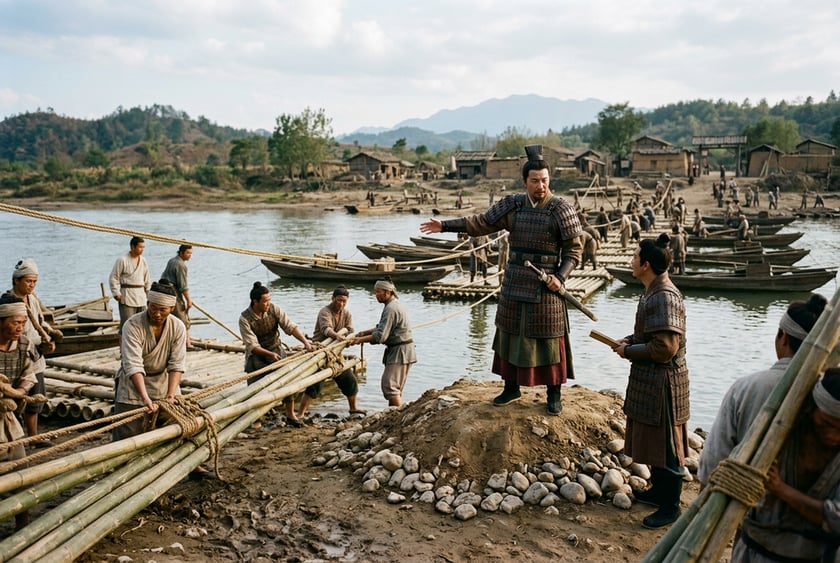
The first key decision came at the river crossing. Wang Chang laid a floating bridge between the two banks using bamboo cables, sending his infantry directly across the water. This use of engineering to make up for a disadvantage in naval forces reflected a typical northern approach to fighting in the southern waterways.
The second key decision came when the Wu army counterattacked in seven columns. Wang Chang concentrated his crossbows and fired them all at once, driving back the attackers with a dense shower of arrows. Shi Ji was forced to withdraw into Jiangling by night, while the Wei army pursued and killed hundreds.
The third—and clearest demonstration of Wang Chang’s command ability—was how to deal with a fortified city. A direct assault on Jiangling would have been extremely costly, while a siege risked being broken by Wu reinforcements. Wang Chang chose to “lure the enemy out of the city”: he first sent five units back along the main road, making the defenders think the Wei army was retreating; then he paraded captured armor, horses, and severed heads around the city to inflame the defenders’ anger; at the same time, he placed troops in ambush along the route of retreat. Shi Ji duly came out in pursuit and was routed in the ambush. His officers Zhongli Mao and Xu Min were killed, and after capturing a large quantity of weapons, equipment, banners, and drums, the Wei army regrouped and returned. This combination of “feigning weakness, provoking anger, and laying an ambush” embodied the principles of “provoke the enemy when it is angry” and “do not pursue an enemy feigning flight.” This time, however, it was the Wu army that made the mistake of pursuing a feigned retreat.
The Wu account provides the other side of the story. The biography of Zhu Ji appended to the “Biography of Zhu Ran” in the Records of the Three Kingdoms says that Wang Chang failed to take Jiangling and withdrew. Shi Ji judged that the Wei army, having come a long way, was exhausted, and arranged with General Who Displays Might Zhuge Rong to attack it from front and rear. He caught up with the Wei army at Jinan, thirty li from the city. Shi Ji initially gained the advantage, but Zhuge Rong held his troops back and did not advance; Shi Ji then suffered a defeat. This shows that the Wu pursuit was not simply reckless: it was the failure of coordination that squandered the opportunity.
Outcome and Repercussions
In terms of the results, this was a typical victory with limited objectives. The Wei army did not capture Jiangling or establish a foothold south of the Yangtze, but it badly damaged Wu’s field forces in Jing Province and demonstrated strategically that Wei could take the initiative in that theater. Wang Chang was consequently promoted to General Who Conquers the South, granted the same honors as the Three Excellencies, and elevated to Marquis of Jingling. Wang Ji and Zhou Tai were also commended for their service.
The more far-reaching impact was on personnel and the broader strategic balance. Wang Chang and Wang Ji both went on to become regional commanders relied upon by the Sima clan. When Guanqiu Jian and Wen Qin rebelled, Wang Chang led troops in the campaign to suppress them. When Zhuge Dan rebelled, Wang Chang held Jiaoshi and advanced on Jiangling, tying down Shi Ji and Quan Xi and preventing them from sending aid east to Huainan. In other words, the Jiangling campaign established a psychological advantage for Wei over Wu in Jing Province for the years that followed, and allowed the Sima clan to deal with the three Huainan rebellions without as much concern about threats to their western flank.
Counterfactual Analysis
If Shi Ji had not come out of the city in pursuit, but instead held firm at Jiangling, the Wei army would most likely have had to withdraw with only limited gains. The campaign would then have been regarded as an ordinary border raid, and Wang Chang’s reputation would not have risen so sharply.
If Wang Chang had chosen to assault Jiangling directly, Wei’s lack of a navy and the need to carry supplies across the Yangtze would likely have led to a repeat of the siege in the Huangchu era, when Cao Zhen and Xiahou Shang besieged Jiangling for half a year without taking it. That might instead have given Wu an opportunity to unite its people amid internal turmoil.
Another question worth considering is why Wei did not press its advantage and expand its gains. The answer may lie in the Sima clan’s priorities in the early years of its rule: securing internal stability and guarding against Huainan mattered far more than taking excessive risks in Jing Province. The campaign under Wang Chang was considered a success precisely because it struck a balance between “being able to win” and “knowing when to stop.”