





Background
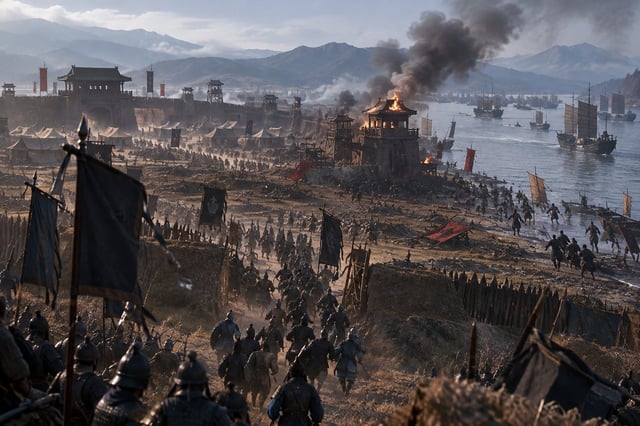
Lü Meng's River Crossing in White is usually understood against the backdrop of Guan Yu's Northern Campaign, the depletion of Jing Province’s defenses, and the breakdown of the Sun-Liu alliance. Based on the available material, the event was not simply a surprise river crossing, but a strategic turning point that combined military action with alliance politics and intelligence assessment. However, the cited passages come mainly from Romance of the Three Kingdoms and can directly support only an account of how the novel constructs this narrative; they cannot, on their own, serve as historical proof of the operation’s details, timing, or decision-making process.
Chapter 61 of the novel presents the Wu court’s observations of Liu Bei’s forces being divided and sent far afield. Gu Yong advises first cutting off the river approaches and blocking the enemy’s route of retreat, then concentrating forces to advance on Jing and Xiang; Sun Quan calls the plan “excellent.” This passage reveals the strategic logic within the story: take advantage of the enemy’s main force being far away, prioritize transport routes and lines of retreat, and seek to alter the battlefield situation before reinforcements can arrive. It provides the political and military backdrop to the operation, but does not describe how Lü Meng's River Crossing in White was carried out.
Main Figures
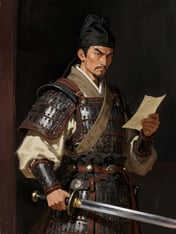
Lü Meng is a key military organizer in the narrative of the event, while Lu Xun is associated with Wu’s overall coordination and planning. As the highest decision-maker, Sun Quan bears responsibility for turning a local opportunity into a state action. The available citations do not present these roles evenly: Chapter 77 explicitly attributes the seizure of Jing Province to “Lü Meng of Eastern Wu,” but the cited passage does not explain Lu Xun’s or Sun Quan’s specific orders or division of responsibilities in Lü Meng's River Crossing in White. Their roles should therefore be analyzed in light of the event’s broader account, while respecting the limits of the evidence.
Shi Ren and Mi Fang were key figures in Jing Province’s defense system, while Guan Yu was the principal victim of the operation. From the perspective of political history, the first two should not be reduced to moral symbols of loyalty or betrayal. Their choices involved trust between local commanders and their superior, risk assessments under wartime pressure, and the effect of shifting alliance dynamics on the loyalty of a city’s defenders. But the cited passages provide no details of their specific actions, so their motives or degree of responsibility cannot be determined from this evidence.
Central Issues
The first issue is how the alliance turned into a rivalry. In Chapter 73, Sima Yi links the old grievances between Sun Quan and Liu Bei, the dispute over Jing Province, and Cao Cao’s strategic calculations. Cao Cao’s side hopes to use an attack by Sun Quan on Jing Province to force Liu Bei to send troops from the two river regions to its aid, thereby putting him under pressure on two fronts. This shows that the novel portrays the crisis over Jing Province as a contest involving multiple parties, not an isolated tactical clash between Eastern Wu and Guan Yu. However, this is a strategist’s proposal within the novel, not a record of an actual decision.
The second issue is the relationship between the operation’s success and its information advantage. Later accounts often summarize Lü Meng's River Crossing in White as a covert, disguised, and unexpected operation, but the citations provided here do not describe the white clothing, the river route, or specific tactics. What can be confirmed is that Chapter 61 emphasizes Wu’s observation that Liu Bei had divided his forces and sent them far afield, and its discussion of cutting off the route of retreat; Chapter 77, meanwhile, reports that “Lü Meng has already attacked Jing Province.” Together, these passages help analyze how the novel sets up the opportunity and the outcome, but they are insufficient to reconstruct the operational details.
Political Consequences
In the novel’s narrative, the fall of Jing Province and Guan Yu’s death constitute a major political shock. Chapter 77 has Xu Jing inform Zhuge Liang that “Lü Meng has already attacked Jing Province, and Lord Guan has been killed,” and depicts Liu Bei responding to the news with “We swore to live and die together,” expressing shock and grief. The consequences shown here are not merely the transfer of a military stronghold, but also the emotional blow to Shu Han’s leadership and a narrative signal that relations between Shu and Wu have further deteriorated.
From the perspective of modern political history, control of Jing Province meant influence over regional routes, troop movements, and bargaining power within the alliance. Its loss narrowed the strategic options available to Guan Yu and Liu Bei’s side and made it difficult to uphold the commitments of their earlier cooperation. However, the subsequent political course should not be attributed simplistically to a single surprise attack. The available material shows the strategic incentives behind the struggle for Jing Province and the transmission of news, but does not provide sufficient historical evidence to assess its long-term institutional impact or to determine the responsibility of each party on the basis of the novel alone.
Counterfactual Analysis
Had Eastern Wu failed to seize the opportunity created by Liu Bei’s division of forces, Gu Yong’s proposal to “first cut off the river approaches and block the route of retreat” might have lost its window of opportunity, and the fighting over Jing Province might more easily have turned into a contest to send in reinforcements. Conversely, even if the operation had succeeded, stronger communication, command coordination, and mutual trust between Jing Province’s defenders and Guan Yu might have raised the cost of taking the province for Eastern Wu. These possibilities show that an opening arises from the interaction between external deployments and internal defenses, rather than from the strategy of a single commander alone. But the available citations contain no battlefield information sufficient to verify these hypotheses.
Another counterfactual is that, had Sun Quan and Liu Bei been able to ease their dispute over Jing Province, Cao Cao’s plan to exploit the two sides’ old grievances to pin them down might have failed. Chapter 73 presents this fragile alliance through Sima Yi’s stratagem: exploiting existing resentments could put an opponent under pressure on two fronts more effectively than a direct attack. From this perspective, the deeper significance of Lü Meng's River Crossing in White lies in how it exposes the alliance’s lack of a stable mechanism for resolving disputes. This remains a political interpretation of the novel’s narrative, however, and cannot substitute for independent historical investigation.