Romance
Shu troops won
- Commanders
Ch. 72「曹兵大潰而逃,孔明連夜追趕」
219 CE (Jian'an 24) · Han River
According to chapters seventy through seventy-two of San Guo Yanyi, in the summer of the twenty-fourth year of Jian'an (219), the Battle of Hanzhong entered its final phase as the Shuhan army inflicted a series of defeats on Wei forces along the Hanshui. After Huang Zhong conducted a successful night raid on the three camps of Xiahou Shang and Han Hao and pressed his pursuit to the bank of the Hanshui, he was surrounded and trapped below Mount Beishan by Zhang He and Xu Huang. Zhao Yun then led three thousand cavalry in a daring charge to break through the encirclement and rescue Huang Zhong and Zhang Zhu, throwing the Wei troops into panic. That night Zhao Yun employed the "empty camp stratagem" to lure Wei troops into an ambush; the Wei soldiers trampled one another in the chaos, and many fell into the Hanshui and drowned. Liu Bei was so moved that he declared "Zilong is courageous in every inch of his body," and enfeoffed him as General of Mighty Might. Cao Cao then sent Xu Huang and Wang Ping to fight again; Xu Huang forced a crossing of the Hanshui and formed his battle line, but was routed when Huang Zhong and Zhao Yun attacked from both flanks. Wang Ping, censured for remonstrating against the plan, defected to the Shuhan side in the midst of battle. Zhuge Liang then defeated Cao Cao again with a feigned dispostion using troops posted with their backs to the water, and the Wei army retreated all along the line, ceding the entire Hanshui front to Liu Bei.
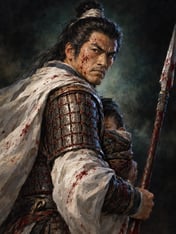 Zhao YunLivedWarriorTalk to me
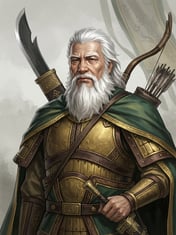 Huang ZhongWarriorTalk to me
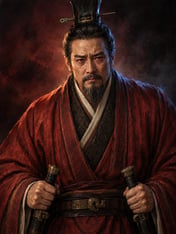 Liu BeiLivedCommanderTalk to me
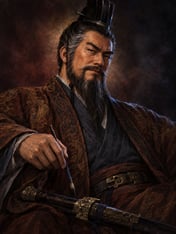 Cao CaoLivedCommanderTalk to me
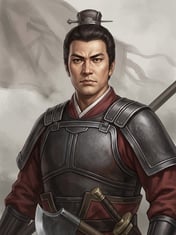 Xu HuangWarriorTalk to me
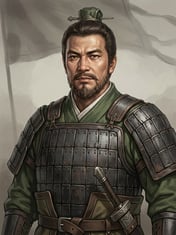 Wang PingWarriorTalk to me
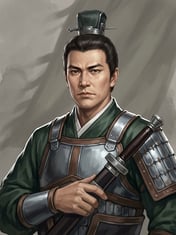 Zhang YiWarriorTalk to me
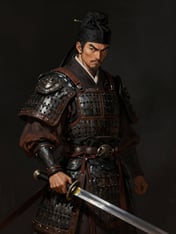 Zhang ZhuWarriorTalk to me
1 more: Zhang He
Who won, as each book tells it; commanders as the text names them.
Romance
Shu troops won
Ch. 72「曹兵大潰而逃,孔明連夜追趕」
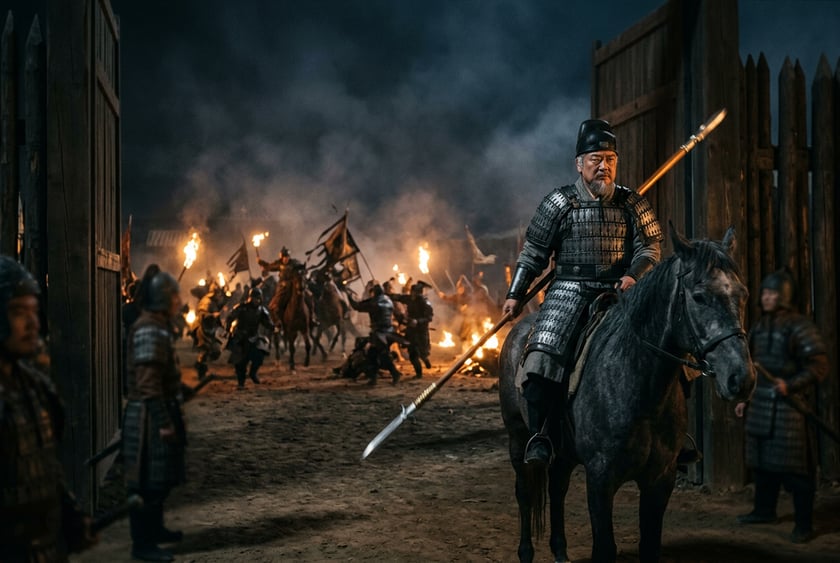
Scene
Under cover of night, Zhao Yun sits on horseback before an empty camp. In the distance, Cao Cao's soldiers rush chaotically toward the camp in the firelight, only to fall into a crush, trampling one another.
Featured people: Zhao Yun
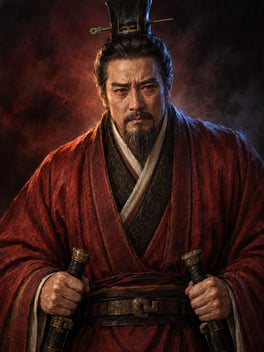
Continue
Seven chi five cun tall, with ears hanging to his shoulders and hands reaching past his knees; his eyes could look back upon his own ears, his face like capped jade, his lips as if rouged.
2014 people in common
2193 people in common
2193 people in common
2143 people in common
2133 people in common
2103 people in common
2283 people in common
2103 people in common
The Battle of Han River is the Romance of the Three Kingdoms’ concentrated depiction of the closing phase of the Hanzhong Campaign. As a set piece unique to the novel, its central purpose is not to supplement the historical record, but to give Zhao Yun—long relegated to a supporting narrative role—a full moment in the spotlight. In the novel’s narrative structure, the first half of the Hanzhong Campaign features the veteran Huang Zhong distinguishing himself by slaying Xiahou Yuan at Mount Dingjun. The second half must then bring another of the “Five Tiger Generals” to the fore: more than a decade has passed since Zhao Yun’s Zhao Yun Rescues His Lord on a Single Horse at Changban, with no comparable grand display, so the Battle of Han River serves as his “second moment of glory.” Geographically, the area around Micang Mountain on the north bank of the Han River was an important supply depot for Cao Cao. Huang Zhong’s night raid on Han Hao and Xiahou Shang, followed by his advance straight to the Han River, was essentially an attempt to sever the Cao army’s logistical lifeline in Hanzhong. In the novel’s overall arrangement of the Hanzhong Campaign, the successive victories along the Han River provide the final straw that prompts Cao Cao to retreat over the “chicken ribs” remark.
On the Shu Han side, Huang Zhong led the main forward force, Zhao Yun served as the reserve ready to provide support, and Zhang Zhu and Zhang Yi served respectively as deputy general and rear-camp guard. This two-pronged deployment of “forward advance plus supporting force” recurs at several stages of the Hanzhong Campaign, forming a stylized depiction of Shu Han’s way of war in the novel. On the Cao Wei side, Zhang He and Xu Huang initially encircled Huang Zhong. Later, Cao Cao personally directed operations, first using subordinate generals such as Murong Lie and Jiao Bing to block the way in successive lines, then replacing them with Xu Huang as the vanguard and Wang Ping as deputy vanguard for a forced crossing of the Han River and deployment on the far bank. Xu Huang cited Han Xin’s example of “deploying with one’s back to the water, putting oneself in a desperate position to survive” as his rationale. Wang Ping challenged him to his face, saying that “Zhao Yun and Huang Zhong may not act as Han Xin expected,” laying the groundwork for a tactical rift between them. This pairing of “a headstrong commander and a deputy who tries to dissuade him” is a recurring narrative device in the novel, foreshadowing defeat. It both makes Xu Huang’s subsequent rout seem plausible and prepares the ground for Wang Ping’s defection.
The first decision point is Zhao Yun’s “empty-camp stratagem.” When Zhang He and Xu Huang pursued him to his camp, Zhao Yun did not follow the usual course of shutting the gates and refusing battle. Instead, he sat astride his horse with a spear before the camp gate, while inside the camp the banners were lowered and all was silent, creating the impression that a large ambush must be waiting. When the Cao army turned to flee, it was met by a volley of arrows and crossbow bolts; its soldiers trampled one another and fell into the Han River. The essence of this tactic is “using stillness to control movement”: it took advantage of Zhang He and Xu Huang’s mental fatigue from the pursuit, making it one of the novel’s rare victories won without a numerical advantage. The second decision point is Xu Huang’s forced crossing of the Han River. Xu Huang invoked Han Xin’s story but overlooked the fact that Han Xin’s Zhao opponents, when he deployed with his back to the water, were already demoralized by prolonged attrition. Huang Zhong and Zhao Yun, by contrast, were riding high after a major victory. Xu Huang’s “back-to-the-water formation” was not “putting himself in a desperate position to survive,” but “trapping himself in a desperate position”. The third decision point is Wang Ping’s defection in the midst of battle. A native of Dangqu in Baxi, Wang Ping was already familiar with Hanzhong’s geography. Even before Xu Huang’s forced crossing, he foresaw defeat. After Xu Huang turned his anger on him, Wang Ping set fire to the camp that night, crossed the Han River, and went over to Zhao Yun. His defection not only gave Shu Han a key general familiar with Hanzhong’s terrain, but also symbolized the beginnings of a centrifugal tendency in the Cao Wei army, with men gravitating toward the nearest available lord. The fourth decision point is Zhuge Liang’s counter-stratagem of “feigning weakness with one’s back to the water.” He deliberately had the Shu army “make camp with the Han River at their backs” and “leave behind many horses and weapons,” creating suspicious openings to provoke Cao Cao’s doubts. Cao Cao took the bait; in his haste to retreat during battle, he was instead attacked from three directions by the Shu army. This stratagem echoes Zhao Yun’s empty-camp stratagem as its opposite in style—one yielding, the other forceful—and stands as a representative example of Zhuge Liang’s command in the novel.
Within the novel’s narrative, the Battle of Han River has three immediate results. First, Liu Bei appoints Zhao Yun “General of Tiger Might,” establishing his place among the Five Tiger Generals as the embodiment of “courage”. Second, Wang Ping joins Shu Han, laying important groundwork for the later Northern Expeditions and the Battle of Jieting: during the Battle of Jieting, he is one of the few deputy generals to keep his composure. Third, after his lament about “chicken ribs,” Cao Cao formally withdraws from the Hanzhong battlefield. The novel presents the successive setbacks at the Battle of Han River as the decisive factor in the outcome of the entire Hanzhong Campaign. In the broader arc of the novel, the Battle of Han River is the final piece in the narrative of the Five Tiger Generals taking the stage together: Guan Yu guards Jingxiang, Zhang Fei holds Baxi, Ma Chao attacks Xiabian, Huang Zhong takes Mount Dingjun, and Zhao Yun saves the Han River. Each has a stage of his own, together forming a portrait of Shu Han at the height of its military prowess. In its characterization, the novel draws heavily on themes such as “using stillness to control movement,” “overcoming the strong while weak,” and “a commander’s suspicions leading to defeat.” These highlight Shu Han’s generals as both wise and brave more effectively than straightforward depictions of head-on clashes, reflecting the novel’s characteristic preference for “wisdom triumphing over force.”
If we set aside the novel’s fictional elements and consider the historical context, the Han River front was indeed an important theater of the Hanzhong Campaign in the summer of the twenty-fourth year of Jian’an. The Cao army’s supply pressures and Liu Bei’s army’s advantage in the high ground were also real. But highly dramatic episodes such as Zhao Yun’s “empty-camp stratagem” and Wang Ping’s defection in the midst of battle have no corresponding record in the Records of the Three Kingdoms. Wang Ping was indeed a native of Dangqu in Baxi, and he did switch from Cao Wei to Shu Han during the Hanzhong Campaign. However, the Records of the Three Kingdoms gives no explicit account of the circumstances of his defection. The novel turns it into a complete chain of events—“Xu Huang’s forced crossing, Wang Ping’s remonstrance, and his setting fire to the camp in the midst of battle”—a typical example of fictionalizing events by using a character’s motives to drive the plot. Removing this episode from the novel would not alter the historical framework of the Hanzhong Campaign. But without it, Zhao Yun’s overall standing in the novel would be substantially diminished: he might remain merely “the last of the Five Tiger Generals” rather than become the very embodiment of courage and valor. Understanding this also explains why the novel makes the Battle of Han River so vivid: it is not rewriting history, but giving its characters firmer footing.