Cao Wei · Deputy Vanguard
Wang Ping
courtesy name 子均 · –248
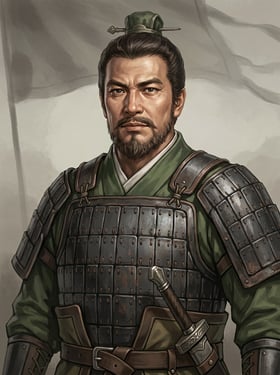
Wang Ping grew up amid the campaigns of the army; his hand could not write, and the characters he knew numbered no more than ten.

Life
In the novel: 20 chapters · In the Records: 4 volumes
Life?–248
219 CE (Jian'an 24)
- Battle of Han RiverHan RiverWarrior
225 CE (Huangchu 6)
228 CE (Taihe 2)
- Execution of Ma SuHanzhongWitness
5 more events
228 CE (Taihe 2)
229 CE (Taihe 3)
231 CE (Taihe 5)
234 CE (Qinglong 2)
- Rebellion of Wei YanNanzhengWarrior
244 CE (Zhengshi 5)
- Battle of XingshiMount XingshiCommander
Allegiance
- Cao Wei
- Shu Han
- Liu Bei's faction
- Hatched: dated by chapter
- Life event
List all 10 stops
- DangquBirthplace
- Han River219Battle of Han River
- Nanzhong225Seven Captures of Meng Huo
- Hanzhong228Execution of Ma Su
- Jieting228Battle of Jieting
- Mount Qi228First Northern Expedition+1 more
- Wudu229Zhuge Liang's Third Northern Expedition
- Mount Qi231Zhuge Liang's Fourth Northern Expedition
- Nanzheng234Rebellion of Wei Yan
- Mount Xingshi244Battle of Xingshi
On the boards
Compare with someone →Where this person ranks on each board.
9 more boards
- Most Foes Defeated: #29of 78Romance
- Plans That Worked: #31of 159Romance
- Most Duel Wins: #33of 54Romance
- Most Generals Slain: #33of 64Romance
- Master Strategists: #42of 220Romance
- Novel Embellished: #77of 2137Both
- Best Connected: #79of 1005Romance
- Most Talkative: #94of 607Romance
- Overlooked by the Novel: #597of 2137Both
Who they were
Character profile
- Appearance
- Wang Ping grew up amid the campaigns of the army; his hand could not write, and the characters he knew numbered no more than ten.
- Character
- Wang Ping observed the law and the rules, spoke no jest, and would sit erect the whole day through; yet he was narrow and suspicious in temper, and held himself in low esteem. Cautious and steady, he did not lose his composure in the face of the enemy, could keep himself whole in adversity, and dared to offer remonstrance. Loyal and valiant, ready to give his life, he was praised by Kongming with a sigh as 'a truly loyal minister.'
- Manner of speech
- Wang Ping weighed the situation when facing the enemy, once saying, 'Could it be that Sima Yi has learned of it and made preparations in advance?'
- Life
- Wang Ping was a man of Dangqu in Baxi. Originally reared in his maternal family, the He clan, he later resumed the surname Wang. Together with Du Huo and Pu Hu he went to Luoyang and was made acting Colonel; he followed Cao Cao on the campaign into Hanzhong, and afterward surrendered to the Former Sovereign Liu Bei, being appointed General of the Standard Gate and Lieutenant General. Wang Ping successively served as Front Army Supervisor and Grand General Who Guards the North, in command of Hanzhong, and once quelled the revolt of Wei Yan. In the seventh year of Yanxi he held Mount Xingshi against Cao Shuang's host of more than a hundred thousand, compelling the Wei army to withdraw.
- Anecdotes
- When Wang Ping dictated letters, they were all sound in sense and reason, and when he had the biographies of the Shiji and the Hanshu read to him, his discussions of them never missed their import. He was Grand General Who Guards the North and Marquis of Anhan of Shu Han.
Historical Record
Wang Ping, courtesy name Ziyun, was from Dangqu, Ba County. He was originally raised by his maternal relatives, the He family, and later resumed the Wang surname. He once accompanied Du Huo and Pu Hu to Luoyang, where he served as an acting colonel. After following Cao Cao in Cao Cao's Campaign Against Hanzhong, he surrendered to Liu Bei and was appointed a Gate Guard General and Assistant General. His career shows that he switched from the Wei side to Shu Han and later became an important commander on Shu Han’s northern frontier for many years.
In the sixth year of Jianxing, Wang Ping served under Ma Su and took part in the Battle of Jieting. Ma Su abandoned the water source and went up the mountain, leaving his deployment in disarray. Wang Ping repeatedly urged him to reconsider, but Ma Su did not listen, and the Shu army was defeated. When the troops scattered, Wang Ping led only a thousand men, beating drums and holding their ground. Zhang He suspected they had laid an ambush and did not dare approach. Wang Ping then rallied the scattered soldiers and led his force back. Zhuge Liang therefore commended Wang Ping in particular and promoted him. In the ninth year of Jianxing, when Zhuge Liang besieged Mount Qi, Wang Ping separately held the southern perimeter. Zhang He attacked, but Wang Ping stood firm, preventing him from winning.
After Zhuge Liang’s death, Wei Yan rebelled, and Wang Ping defeated him in a battle. Wang Ping thereafter held posts including General Who Pacifies Han and Administrator of Hanzhong, and was enfeoffed as Marquis Who Pacifies Han. In the sixth year of Yanxi, he became Supervising General of the Vanguard and General Who Guards the North, commanding Hanzhong. In the seventh year of Yanxi, Cao Shuang led more than a hundred thousand Wei troops in an attack on Hanzhong. The Shu garrison had fewer than thirty thousand men, and the other commanders were alarmed. Wang Ping opposed the proposal to defend only the two cities of Han and Le. He argued that Liu Min and Du Qi should first be sent to hold Mount Xingshi, while he brought up the rear, and that he should be ready to lead a thousand men against the enemy if they divided their forces and headed toward Huangjin. Liu Min agreed and led troops to hold Mount Xingshi. Fei Yi and the troops from Fu arrived in succession, and the Wei army withdrew, just as Wang Ping had initially predicted.
Wang Ping had grown up in the military and could not write by hand. He knew no more than a dozen characters, but his dictated documents were well organized. When others read him biographies from the Records and the Han histories, he could grasp their central meaning and offer incisive, well-targeted comments. He observed the law, spoke gravely, and often sat upright throughout the day. On the other hand, historical biographies also describe him as narrow-minded, suspicious, and self-effacing—traits regarded as his shortcomings. After his death, his son Wang Xun inherited his title.
In the Novel
The Romance of the Three Kingdoms portrays Wang Ping as a commander deeply familiar with terrain and cautious in recognizing danger. In chapters 71 and 72, he is still in Cao Cao’s camp and is ordered to assist Xu Huang in attacking the Han River. When Xu Huang prepares to draw up his troops with the river at their backs, Wang Ping urgently advises him against it, warning that their retreat would be perilous and that they should not rashly imitate Han Xin. Xu Huang ignores him and is routed after being attacked from both sides by Huang Zhong and Zhao Yun. He then blames Wang Ping for failing to come to his aid. That night, Wang Ping sets a fire and escapes from the Wei camp to join Zhao Yun. He explains the terrain around the Han River to Liu Bei and is appointed Assistant General and local guide. This specific account of his defection from Cao Wei to Liu Bei, along with the episode in which he escapes by setting a fire, is the novel’s invention. The Records of the Three Kingdoms merely says that he surrendered to Liu Bei after following Cao Cao in Cao Cao's Campaign Against Hanzhong; it does not record his nighttime flight across the Han River.
The novel later has Wang Ping take part in the campaign at Shangyong and serve as a deputy commander during Zhuge Liang's Southern Campaign. Together with Zhang Yi, he attacks E Huan from both sides and helps Wei Yan capture him alive. When Zhuge Liang divides his forces to meet the various Nanzhong armies, he also orders Wang Ping to engage the enemy on the left flank. In the story of Meng Huo’s capture, Wang Ping and Guan Suo first feign defeat to lure the enemy in, then turn back and attack from both sides once the enemy has advanced deep into their territory. Later, during a night raid, he leads troops out from one side to join Wei Yan and Zhao Yun in a three-pronged assault. The novel also has him accompany Zhuge Liang on the Northern Expeditions, serving as a Gate Guard General and Assistant General, and join Zhang Yi in attacking Jiang Wei’s grain-raiding force near Jicheng. These specific feats in the southern campaigns and the capture of Meng Huo belong to the novel and should not be conflated with the historical record.
Key Relationships
In his early years, Wang Ping served on campaign with Cao Cao, then surrendered to Liu Bei and became a Shu Han commander. Historical accounts explicitly record this transition but do not include the novel’s account of his defection across the Han River. At Jieting, he served under Ma Su. Ma Su ignored his advice, but after the defeat Wang Ping maintained order with a small force and rallied the scattered troops. This episode became emblematic of his caution and reliability in service. After Zhuge Liang’s death, Wang Ping, acting on Yang Yi’s orders, resisted Wei Yan at the front; the historical record says, “This was Wang Ping’s achievement.” The novel, by contrast, portrays him as taking part in multiple campaigns in the south and north.
Wang Ping and Liu Min shared the same view on the defense of Hanzhong and jointly held Mount Xingshi. Facing a great disparity in numbers, they made holding the strategic passes and waiting for reinforcements their priority. Wang Ping encountered Zhang He at Jieting and also faced him in the Battle of Mount Qi: in the former, he beat drums and held his ground, making Zhang He suspect an ambush; in the latter, he held the southern perimeter, preventing Zhang He from breaking through.
Signature Scenes
After the defeat at Jieting, Wang Ping led a thousand men in beating drums and holding their position. This steadied his own force and kept the Wei army from advancing rashly; he then rallied the scattered troops and withdrew. It was not a victory that turned the tide, but it showed that he could preserve his troops amid defeat and explains why Zhuge Liang valued him so highly.
In the Battle of Xingshi, Wang Ping rejected the other commanders’ proposal to hold the cities and wait for the enemy to withdraw. Instead, he proposed that they first occupy Mount Xingshi while he brought up the rear. More than a hundred thousand Wei troops attacked, while the Shu garrison numbered fewer than thirty thousand. Liu Min joined him in carrying out the plan, and the Wei army withdrew after reinforcements arrived. The historical record’s phrase “just as Wang Ping had planned” makes clear that the battle unfolded as he had anticipated.
The novel’s most dramatic parallel scene comes after Xu Huang ignores Wang Ping’s advice and is defeated at the Han River: Xu Huang tries to kill Wang Ping, who sets fire to the camp that night and defects to Shu. This expands his image from the steady, defensive commander of the historical record into a fictional character who can discern danger and decisively change sides. (Unique to the novel.)
Quotes
18 lines in the books · 3 featured
「參軍差矣:若屯兵當道,築起城垣,賊兵縱有十萬,不能偷過;今若棄此要路,屯兵於山上,倘魏兵驟至,四面圍定,將何策保之?」
These words embody Wang Ping's military foresight, forming a sharp contrast with Ma Su; it is the key dialogue of the Battle of Jieting.
「吾累隨丞相經陣,每到之處,丞相盡意指教。今觀此山,乃絕地也。若魏兵斷我汲水之道,軍士不戰自亂矣。」
Wang Ping's precise judgment of the terrain foreshadowed the inevitability of Jieting's fall, highlighting his military acumen.
「不然。漢中去涪垂千里。賊若得關,便為禍也。今宜先遣劉護軍、杜參軍據興勢,平為後拒。若賊分向黃金,平率千人下自臨之,比爾間,涪軍行至,此計之上也。」
Recorded in the official history, this displays Wang Ping's strategic vision and decisive resolve in the Battle of Xingshi.
- Family
- Enemies
- Other
Who is Wang Ping connected to?
Pick someone to see how many steps lie between them and Wang Ping.
History vs. novel
8 points · 3 novel-only
| History | Novel |
|---|---|
| Joining Liu BeiNovel embellishes | |
Wang Ping accompanied Du Huo and Pu Hu to Luoyang, where he was appointed a Commandant. He later served in Cao Cao's Campaign Against Hanzhong, then defected to Liu Bei and was appointed a Gate General and General of the Vehement Might. vol. 43 | The novel depicts Wang Ping serving as a Gate General in Cao Cao's army. When Xu Huang ignored his advice and was defeated, Wang Ping set fire to the camp at night and defected to Zhao Yun, then went over to Liu Bei. ch. 71 |
| Southern Campaign against Meng HuoNovel only | |
| — | The novel has Wang Ping accompany Zhuge Liang's Southern Campaign as a deputy general. He and Zhang Yi lead troops to a barbarian stockade, where they capture Lady Zhurong and her family alive. ch. 87 |
| Capturing Xiahou Mao aliveNovel only | |
| — | The novel depicts Wang Ping intercepting Xiahou Mao as he breaks out during the attack on Anding City, and capturing him alive after just one exchange. ch. 92 |
| Advising against Ma Su's plan at JietingNovel embellishes | |
During the Battle of Jieting, Ma Su abandoned the water source to take the high ground and deployed his troops in disarray. Wang Ping repeatedly advised him against it, but his counsel went unheeded, and the Shu army suffered a crushing defeat. vol. 43 | The novel gives a detailed account of Wang Ping urging Ma Su to camp at a strategic pass and warning him of the danger of being cut off from water. Ma Su refused, so Wang Ping led another five thousand men to set up camp ten li below the mountain and sent a messenger to report to Zhuge Liang. ch. 95 |
| After the defeat at JietingNovel embellishes | |
After the Shu army scattered, the thousand or so men under Wang Ping beat their drums and held their position, causing Zhang He to suspect an ambush and refrain from pressing his advance. Wang Ping then rallied the scattered troops and led them in retreat. vol. 43 | The novel depicts Wang Ping rescuing Wei Yan after the fighting at Jieting, and the two retreating to Lieliucheng. He later explains what happened to Zhuge Liang, stressing that he had tried to stop Ma Su. ch. 95 |
| Defending the southern perimeterHistory only | |
When Zhuge Liang besieged Mount Qi, Wang Ping separately defended the southern perimeter. Zhang He attacked, but Wang Ping held his ground, and Zhang He could not take the position. vol. 43 | — |
| Repelling Cao Shuang at Mount XingshiHistory only | |
Cao Shuang led more than a hundred thousand infantry and cavalry to attack Hanzhong. Wang Ping proposed occupying Mount Xingshi first and bringing up the rear himself, while guarding against an enemy force splitting off to attack Huangjin. After reinforcements arrived in succession, the Wei army withdrew, just as Wang Ping had predicted. vol. 43 | — |
| Ambushed at BeiyuanNovel only | |
| — | The novel depicts Wang Ping and Zhang Ni being ordered to the Wei camp. On the way, they learn that the positions at Beiyuan and near the pontoon bridge have fallen. As they retreat, the Wei army attacks them, inflicting heavy losses on the Shu forces. ch. 102 |
- Joining Liu BeiNovel embellishes
- History
Wang Ping accompanied Du Huo and Pu Hu to Luoyang, where he was appointed a Commandant. He later served in Cao Cao's Campaign Against Hanzhong, then defected to Liu Bei and was appointed a Gate General and General of the Vehement Might.
vol. 43
- Novel
The novel depicts Wang Ping serving as a Gate General in Cao Cao's army. When Xu Huang ignored his advice and was defeated, Wang Ping set fire to the camp at night and defected to Zhao Yun, then went over to Liu Bei.
ch. 71
- Southern Campaign against Meng HuoNovel only
- Novel
The novel has Wang Ping accompany Zhuge Liang's Southern Campaign as a deputy general. He and Zhang Yi lead troops to a barbarian stockade, where they capture Lady Zhurong and her family alive.
ch. 87
- Capturing Xiahou Mao aliveNovel only
- Novel
The novel depicts Wang Ping intercepting Xiahou Mao as he breaks out during the attack on Anding City, and capturing him alive after just one exchange.
ch. 92
- Advising against Ma Su's plan at JietingNovel embellishes
- History
During the Battle of Jieting, Ma Su abandoned the water source to take the high ground and deployed his troops in disarray. Wang Ping repeatedly advised him against it, but his counsel went unheeded, and the Shu army suffered a crushing defeat.
vol. 43
- Novel
The novel gives a detailed account of Wang Ping urging Ma Su to camp at a strategic pass and warning him of the danger of being cut off from water. Ma Su refused, so Wang Ping led another five thousand men to set up camp ten li below the mountain and sent a messenger to report to Zhuge Liang.
ch. 95
- After the defeat at JietingNovel embellishes
- History
After the Shu army scattered, the thousand or so men under Wang Ping beat their drums and held their position, causing Zhang He to suspect an ambush and refrain from pressing his advance. Wang Ping then rallied the scattered troops and led them in retreat.
vol. 43
- Novel
The novel depicts Wang Ping rescuing Wei Yan after the fighting at Jieting, and the two retreating to Lieliucheng. He later explains what happened to Zhuge Liang, stressing that he had tried to stop Ma Su.
ch. 95
- Defending the southern perimeterHistory only
- History
When Zhuge Liang besieged Mount Qi, Wang Ping separately defended the southern perimeter. Zhang He attacked, but Wang Ping held his ground, and Zhang He could not take the position.
vol. 43
- Repelling Cao Shuang at Mount XingshiHistory only
- History
Cao Shuang led more than a hundred thousand infantry and cavalry to attack Hanzhong. Wang Ping proposed occupying Mount Xingshi first and bringing up the rear himself, while guarding against an enemy force splitting off to attack Huangjin. After reinforcements arrived in succession, the Wei army withdrew, just as Wang Ping had predicted.
vol. 43
- Ambushed at BeiyuanNovel only
- Novel
The novel depicts Wang Ping and Zhang Ni being ordered to the Wei camp. On the way, they learn that the positions at Beiyuan and near the pontoon bridge have fallen. As they retreat, the Wei army attacks them, inflicting heavy losses on the Shu forces.
ch. 102
Combat
On the field
Duels, kills and executions as the texts tell them, counted separately for the Records and the Romance.
Duel them- RomanceCh. 87DuelMang YazhangBroken off「二將交鋒,戰不數合,王平便走」
- RomanceCh. 92DuelXiahou MaoWon1 bouts「交馬只一合,生擒夏侯楙於馬上」
- RomanceCh. 93DuelJiang WeiWon「維力窮抵敵不住,奪路歸城」
- RomanceCh. 95DuelZhang HeLost「戰有數十餘合,平力窮勢孤,只得退去」
- RomanceCh. 102Struck downCen WeiWon「岑威引敗兵抵敵,被王平一刀斬了」
- RomanceCh. 105DuelWei YanBroken off「戰不數合,平詐敗而走」
Battles in command
Battles this person commanded in, with the outcome as each text tells it.
- Records
- 0W 0L 0D 1 undecided
- Romance
- 0W 1L 0D 0 undecided
- Romance228Battle of JietingLostvs Wei troopsCh. 95「馬謖料守不住,只得驅殘兵殺下山西逃奔」
- Records244Battle of XingshiUndecidedvs Wei's armyJuan 33「魏大將軍曹爽、夏侯玄等向漢中,鎮北大將軍王平拒興勢圍,大將軍費禕督諸軍往赴救,魏軍退」
Stratagems
Plans this person devised or saw through, as the texts tell them.
- Records
- 1 carried out · 1 worked · 0 turned down · 0 seen through
- Romance
- 2 carried out · 2 worked · 0 turned down · 0 seen through
- RecordsFeigned TroopsFeintWorkedagainst WeiJuan 43「惟平所領千人鳴鼓自持,魏將張郃疑其伏兵,不往逼也」
- RomancePersuade the Rebels to DispersePersuasionWorkedagainst Wei Yan's armyCh. 105「汝等軍士,皆是西川之人,川中多有父母妻子,兄弟親朋」
- RomanceLure the EnemyLureWorkedagainst Wei Yan's armyCh. 105「平詐敗而走,延隨後趕來。眾軍弓弩齊發,延撥馬而回」
Events
Events (18)
Battles and events the texts place this person in, by date.
Battles
- 218Hanzhong Campaign
- 219Battle of Han RiverWarrior
- 228First Northern ExpeditionWarrior
- 228Battle of JietingWarrior
- 228Zhuge Liang's Northern ExpeditionsWarrior
- 229Zhuge Liang's Third Northern ExpeditionWarrior
- 230Cao Zhen's Invasion of Shu
- 231Zhuge Liang's Fourth Northern ExpeditionWarrior
All 10
- 234Battle of Wuzhang Plains
- 244Battle of XingshiCommander
Other events
Famous objects

Places
Continue
The Zhuge Liang's Northern Expeditions in 3D
Replay the Zhuge Liang's Northern Expeditions phase by phase on real terrain: troop strengths, movements and turning points at a glance, each marked as coming from the Records of the Three Kingdoms or the Romance.
Relationship timeline11 entries ▸
History · vol. 43
- Ma Su§28
Advised
was assigned as Ma Su’s vanguard while Ma Su served as army adviser; repeatedly remonstrated with Su, but his advice was not heeded, and they were badly defeated at Jieting
- Zhang He§28
Fights
After Jieting, gradually gathered the scattered remnants from the various camps; later, when Liang besieged Mount Qi, Zhang He attacked Wang Ping, and Wang Ping held firm without moving
- Wei Yan§29
Fights
Liang died at Wugong; Wei Yan rebelled and was defeated in a single battle, a credit to Ping.
- Cao Shuang§30
Fights
They were resisted at Mount Xingshi, and the Wei army withdrew
Novel · ch. 72
- Xu Huang§1
Enemy
Wang Ping earnestly admonished Xu Huang not to cross the Han River, but he was not heeded; Xu Huang blamed him for not coming to the rescue and wanted to kill him, so Ping instead fled
Novel · ch. 89
Commands
followed the secret plan and entered the ambush; later, served as advance scout and drank from the Dumb Spring
Novel · ch. 90
- Lady Zhurong§18
Fights
led troops into the barbarian stockade with Zhang Yi, capturing Lady Zhurong and all the old and young alive
Novel · ch. 92
- Xiahou Mao§18
Enemy
captured him alive on horseback after just one exchange
All 11
Loading…
Inner monologues · AI-generated3 monologues ▸
- I recall that I was originally from Dangqu in Baxi. My name was Ping, and my courtesy name was Zijun. The records here d
- After the Chancellor’s death, the army lost its center. I remembered how I had once followed the army in and out of Guan
- At Jieting, the gateway to Hanzhong was at stake. The Chancellor ordered me to go there with Ma Su, and I did not regard