Shu Han · (Hanzhong) Area Commander
Wei Yan
courtesy name 文长 · –234
Not to be confused with Wei Yan (卫演) — Wei Yan served Gongsun Yuan; the novel says Sima Yi rebuffed his surrender mission to Wei, but the Records of the Three Kingdoms omits him.
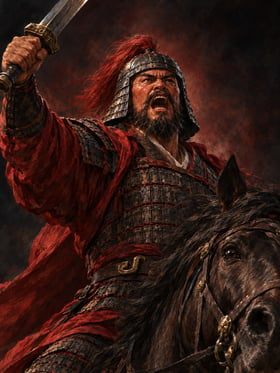
Eight chi tall, with a face like a dark date.

Life
In the novel: 36 chapters · In the Records: 8 volumes
Life?–234
209 CE (Jian'an 14)
19 more events
210 CE (Jian'an 15)
211 CE (Jian'an 16)
- Meeting at FuchengFuWarrior
212 CE (Jian'an 17)
213 CE (Jian'an 18)
214 CE (Jian'an 19)
218 CE (Jian'an 23)
- Hanzhong CampaignHanzhongWarrior
219 CE (Jian'an 24)
223 CE (Huangchu 4)
225 CE (Huangchu 6)
228 CE (Taihe 2)
231 CE (Taihe 5)
234 CE (Qinglong 2)
234 CE (Qinglong 2)
- Liu Bei's faction
- Shu Han
- Hatched: dated by chapter
- Life event
- Death
List all 12 stops
- Changsha209Guan Yu Fights Huang Zhong and Takes Changsha+1 more
- Jiangling210Zhou Yu's Stratagem of Borrowed Road to Destroy Guo
- Fu211Meeting at Fucheng
- Jiameng212Liu Bei's Takeover of Yi Province+1 more
- Yi Province213–214Liu Bei's Takeover of Yi Province+1 more
- Hanzhong218–219Hanzhong Campaign+1 more
- Chengdu223Zhuge Liang Repels the Five Armies
- Nanzhong225Seven Captures of Meng Huo
- Chencang228Zhuge Liang's Second Northern Expedition+1 more
- Mount Qi228–231Zhuge Liang's Northern Expeditions+1 more
- Shangfang Valley234Fire Attack at Shangfang Valley
- Nanzheng234Rebellion of Wei Yan
On the boards
Compare with someone →Where this person ranks on each board.
- Counsel Ignored: #2Romance
- Most Battles Won: #9Romance
- Most Battles: #9Both
- Best Duel Record: #10Romance
- Most Duel Wins: #11Romance
- Most Foes Defeated: #13Romance
- Most Betrayed: #14Romance
- Most Defections: #15Romance
- Stratagem Success Rate: #18Romance
- Novel Embellished: #18Both
- Most Generals Slain: #19Romance
- Master Strategists: #19Romance
Who they were
Character profile
- Appearance
- Eight chi tall, with a face like a dark date.
- Character
- Wei Yan was good at caring for his soldiers and fierce beyond compare, yet haughty by nature and often harboring resentment, proud of his valor and arrogant in vying for merit. Bold and possessed of an unbridled spirit, he was forever set on winning swift victories by surprise assault.
- Manner of speech
- To Kongming's face he sneered that his 'orders were not clear,' and he arrogantly brought up the old proposal of the Ziwu Valley. On the battlefield he shouted his challenge, 'Sima Yi, do not flee!', and boasted, 'Never mind calling out three times—even three thousand shouts, what difficulty would there be in that?'
- Life
- Wei Yan entered Shu with the Former Lord as a subordinate commander, achieved repeated military merits, and was promoted to General of the Standard Gate. He was singled out by Liu Bei to serve as Commander garrisoning Hanzhong, later advanced to General Who Guards the North, and further promoted to Front Army Adviser and Grand General Who Campaigns in the West, granted the staff of authority and enfeoffed as Marquis of Nanzheng. After Zhuge Liang died, he fell out with Yang Yi and was in the end pursued and beheaded by Ma Dai, with his three kindred branches exterminated.
- Weapons
- Wei Yan brandished a blade and spurred his horse, using bow and arrow and a great saber, and once wielded a long spear.
- Anecdotes
- He once dreamed of horns growing on his head, which Zhao Zhi deceitfully called the sign of a qilin, though in truth it was an ill omen. At his end he called out three times, 'Who dares kill me?', and was straightway beheaded; Sun Quan appraised him as 'full of valor but crooked of heart.'
Historical Record
Wei Yan, courtesy name Wenchang, was from Yiyang. In his early years, he entered Shu with Liu Bei as a retainer and, after repeatedly distinguishing himself in battle, was promoted to General of the Gate. When Liu Bei moved his seat of government to Chengdu and needed a senior general to defend Hanzhong, everyone thought Zhang Fei would be chosen. Liu Bei instead appointed Wei Yan to oversee Hanzhong, made him General Who Subdues the Distant, and additionally appointed him Administrator of Hanzhong. When Liu Bei asked how he would meet the responsibility, Wei Yan replied that if Cao Cao led the armies of the realm to attack, he would personally stand against the enemy on his lord’s behalf; if the force consisted merely of a deputy general leading a hundred thousand men, he asked to be allowed to defeat them. Liu Bei praised his answer, and those present considered his words bold and stirring.
After Liu Bei Proclaims Himself Emperor, Wei Yan was promoted to General Who Guards the North and enfeoffed as Marquis of Duting. In the fifth year of Jianxing, Zhuge Liang was stationed in Hanzhong and appointed Wei Yan to oversee the vanguard, serve as Secretariat Director of the Prime Minister’s Office, and act as Inspector of Liang Province. In the eighth year of Jianxing, Wei Yan advanced west into Qiang territory and defeated the Wei generals Fei Yao and Guo Huai at Yangxi. He was promoted to Senior General of the Van and General Who Conquers the West, granted authority to act with imperial credentials, and further enfeoffed as Marquis of Nanzheng. When Zhuge Liang campaigned at Mount Qi, Wei Yan, Gao Xiang, and Wu Ban were ordered to engage Sima Yi. The account cited in the historical tradition says that the Shu army routed the Wei forces; Pei’s commentary, however, also discusses doubts about the relevant accounts, so variant claims should not all be treated as established fact.
Wei Yan was exceptionally brave and skilled at caring for his troops, but he was also proud and conceited. He repeatedly asked to lead a separate force of ten thousand through the Ziwu Valley, taking a different route to rendezvous at Tong Pass in imitation of Han Xin. Zhuge Liang considered the plan dangerous and did not accept it. Wei Yan therefore often regarded Zhuge Liang as timid, and the two disagreed over military strategy. He was also long at odds with Yang Yi; Fei Yi once mediated when the two were arguing.
In the twelfth year of Jianxing, after Zhuge Liang died, Wei Yan refused to bring up the rear according to the withdrawal order arranged by Yang Yi. He declared that he was still there and advocated leading the army onward to attack Wei. He then returned south ahead of the others and burned the gallery road. Each man submitted a memorial accusing the other of rebellion. Wei Yan sent troops from the Southern Valley Pass to block Yang Yi’s army, but his own men refused to fight for him and scattered. Wei Yan fled to Hanzhong with his sons and others. Yang Yi sent Ma Dai in pursuit, and Ma Dai beheaded Wei Yan and exterminated his clan to the third degree. Wei Yan’s biography in the Records of the Three Kingdoms says that his real intention may have been to eliminate Yang Yi and the others, rather than surrender to Cao Wei; this is the biography’s assessment of his motives.
In the Novel
The Romance of the Three Kingdoms portrays Wei Yan as a valiant, battle-hardened general who repeatedly devises ingenious stratagems, and uses the “bone spur at the back of his head” to foreshadow his fate. The novel says that when Liu Bei entered Jing Province, Wei Yan bravely opened Xiangyang’s gates to save the people. He was unable to follow Liu Bei after fighting Wen Ping, and later entered the service of Han Xuan. The novel then has him rescue Huang Zhong, kill Han Xuan, and offer Changsha to Liu Bei. Because Wei Yan killed his former lord and surrendered the city, Zhuge Liang wants to execute him, but Liu Bei intercedes and saves his life. The opening of the gates, Han Xuan’s death, and the “bone spur” prophecy are all inventions of the novel; none of these episodes appears in the Records of the Three Kingdoms.
The novel also frequently depicts Wei Yan fighting in Liu Bei’s ranks. He competes with Huang Zhong for the honor of leading the assault on an enemy camp, then independently changes course to attack Leng Bao’s camp and suffers a setback. He later sets an ambush, captures Leng Bao, and redeems himself. During the defense of the Fu River, he and Huang Zhong take turns patrolling, and he captures Leng Bao when Leng Bao tries to divert the river. These episodes portray him as competitive and decisive, but also as someone whose rashness can land him in danger. The battles in question are not recorded in the supplied text of the Records of the Three Kingdoms.
Key Relationships
Liu Bei: According to the historical record, Liu Bei disregarded the consensus and entrusted Wei Yan with defending Hanzhong, demonstrating his confidence in Wei Yan’s military ability. Wei Yan responded with a bold declaration that he would stand against the enemy. The novel instead depicts his allegiance as beginning with opening Xiangyang’s gates, rescuing Huang Zhong at Changsha, and offering the city to Liu Bei; it also has Liu Bei intervene to stop Zhuge Liang from killing him. This development of their relationship belongs to the novel.
Zhuge Liang: According to the historical record, Wei Yan believed that his proposed campaign had not been adopted and once lamented that his talents were not being fully used. After Zhuge Liang’s death, Wei Yan also refused to accept the withdrawal arrangements under Yang Yi’s command. The novel dramatizes suspicion of Wei Yan through the “bone spur at the back of his head,” but this should not be confused with the historical account.
Yang Yi: The two men were at odds for a long time, and their struggle for power eventually escalated into each raising troops against the other. After Wei Yan was defeated and fled, he was pursued and beheaded. Huang Zhong: The Records of the Three Kingdoms does not record the two competing in the novel’s manner for the honor of leading an assault. The novel, however, depicts them both competing for that honor and Huang Zhong saving Wei Yan from danger, showing a relationship that combined rivalry with cooperation.
Signature Scenes
Appointment to defend Hanzhong: Liu Bei asked Wei Yan how he would shoulder the responsibility of defending the region. Wei Yan contrasted an army led by Cao Cao with a hundred thousand men led by a deputy general, saying that he could handle either defending against or defeating the enemy, depending on the size of the force. The historical account says Liu Bei praised this reply and those present were impressed. The exchange encapsulates Wei Yan’s confidence and the bearing of a military commander.
Victory at Yangxi: After being ordered to advance west into Qiang territory, Wei Yan defeated Fei Yao and Guo Huai at Yangxi. For this achievement, he was promoted to General Who Conquers the West and enfeoffed as Marquis of Nanzheng, marking a major military success in his historical career.
Defeat and death at the Southern Valley Pass: After Zhuge Liang’s death, Wei Yan returned south ahead of the others and faced off against Yang Yi’s army. He Ping rebuked him, whereupon Wei Yan’s troops promptly deserted. Wei Yan fled with his sons and others, but was eventually pursued and beheaded by Ma Dai. The account records the outcome of the conflict while also preserving the explanation that Wei Yan meant to eliminate Yang Yi rather than defect north.
The “bone spur” and surrender: In the novel, Wei Yan rescues Huang Zhong in Changsha, beheads Han Xuan, and then joins Liu Bei. Zhuge Liang declares, based on the “bone spur at the back of his head,” that Wei Yan will surely rebel in the future, while Liu Bei pleads for his life. This scene condenses the novel’s foreshadowing of Wei Yan’s character and fate into a single confrontation. The historical account contains no record of him rescuing Huang Zhong, killing Han Xuan, or being judged a future rebel by his appearance. (Unique to the novel)
Quotes
38 lines in the books · 3 featured
「夏侯楙乃膏粱子弟,懦弱無謀。延願得精兵五千,取路出褒中,循秦嶺以東,當子午谷而投北,不過十日,可到長安。夏侯楙若聞某驟至,必然棄城望邸閣橫門而走。某卻從東方而來,丞相可大驅士馬,自斜谷而進:如此行之,則咸陽以西,一舉可定也。」
The daring Ziwu Valley stratagem displays Wei Yan's military boldness; though never carried out, it became a controversy for the ages.
「誰敢殺我?」
His arrogant words before death throw his tragic end into relief and became a classic allusion.
「若曹操舉天下而來,請爲大王拒之;偏將十萬之眾至,請爲大王吞之。」
Recorded in the official histories, upon first meeting Liu Bei he displayed his ambition, establishing his image of valor and self-confidence.
- Lord & vassal
- Friends
- Enemies
- Other
History vs. novel
7 points · 2 novel-only
| History | Novel |
|---|---|
| Guarding HanzhongNovel embellishes | |
Liu Bei appointed Wei Yan to command the troops in Hanzhong and concurrently serve as its governor, and granted him the title General Who Guards the Distant Regions. Everyone was greatly surprised by this. vol. 40 | After Liu Bei Proclaims Himself King of Hanzhong, he enfeoffed Wei Yan as governor of Hanzhong. The novel does not include historical appointment details such as the title General Who Guards the Distant Regions. ch. 73 |
| Defeating Guo Huai at YangxiNovel embellishes | |
In the eighth year of Jianxing, Wei Yan defeated Guo Huai and others at Yangxi. For this achievement, he was promoted to Senior Military Adviser and General Who Conquers the West, and further enfeoffed as Marquis of Nanzheng. vol. 40 | The novel contains no specific account of the Battle of Yangxi; it only depicts Wei Yan repeatedly distinguishing himself in battle during the southern campaign. ch. 87 |
| Dividing the Forces at Tong PassNovel embellishes | |
Wei Yan often requested ten thousand troops to advance along a separate route from Zhuge Liang and rendezvous at Tong Pass. Zhuge Liang judged this impracticable and rejected the proposal. vol. 40 | The novel renders Wei Yan's proposal to divide the forces as a specific plan to lead five thousand elite troops through Ziwu Valley in a surprise attack on Chang'an, and has him reproach Zhuge Liang for rejecting it. ch. 100 |
| Prophecy of RebellionNovel only | |
| — | After Wei Yan submitted, Zhuge Liang claimed that he had a rebellious bone at the back of his head, predicting that he would inevitably rebel one day. He spared him for the time being after Liu Bei pleaded on his behalf. ch. 53 |
| Luring the Enemy into Panshe ValleyNovel only | |
| — | Zhuge Liang ordered Wei Yan to lose fifteen battles in a row and abandon seven camps, luring Meng Huo into Panshe Valley; Wei Yan then took part in the ambush that captured Meng Huo. ch. 90 |
| Struggle for Power after the Chancellor's DeathNovel embellishes | |
After Zhuge Liang's death, Wei Yan refused to submit to Yang Yi's control, led his troops south, and clashed with Yang Yi, ultimately suffering defeat and fleeing. vol. 40 | The novel depicts Yang Yi using Zhuge Liang's final instructions to test Wei Yan; Wei Yan rose in revolt because he refused to accept the arrangements, while Ma Dai pretended to assist him. ch. 104 |
| Defeat at the Southern Valley PassNovel embellishes | |
Wei Yan blocked Yang Yi's troops at the Southern Valley Pass, but his subordinates broke ranks, believing he was in the wrong. After he fled to Hanzhong, Ma Dai pursued and beheaded him. vol. 40 | The novel depicts He Ping rebuking Wei Yan, after which most of the Shu army deserted. Wei Yan and Ma Dai pursued He Ping; this passage in the novel does not yet depict Wei Yan's death. ch. 105 |
- Guarding HanzhongNovel embellishes
- History
Liu Bei appointed Wei Yan to command the troops in Hanzhong and concurrently serve as its governor, and granted him the title General Who Guards the Distant Regions. Everyone was greatly surprised by this.
vol. 40
- Novel
After Liu Bei Proclaims Himself King of Hanzhong, he enfeoffed Wei Yan as governor of Hanzhong. The novel does not include historical appointment details such as the title General Who Guards the Distant Regions.
ch. 73
- Defeating Guo Huai at YangxiNovel embellishes
- History
In the eighth year of Jianxing, Wei Yan defeated Guo Huai and others at Yangxi. For this achievement, he was promoted to Senior Military Adviser and General Who Conquers the West, and further enfeoffed as Marquis of Nanzheng.
vol. 40
- Novel
The novel contains no specific account of the Battle of Yangxi; it only depicts Wei Yan repeatedly distinguishing himself in battle during the southern campaign.
ch. 87
- Dividing the Forces at Tong PassNovel embellishes
- History
Wei Yan often requested ten thousand troops to advance along a separate route from Zhuge Liang and rendezvous at Tong Pass. Zhuge Liang judged this impracticable and rejected the proposal.
vol. 40
- Novel
The novel renders Wei Yan's proposal to divide the forces as a specific plan to lead five thousand elite troops through Ziwu Valley in a surprise attack on Chang'an, and has him reproach Zhuge Liang for rejecting it.
ch. 100
- Prophecy of RebellionNovel only
- Novel
After Wei Yan submitted, Zhuge Liang claimed that he had a rebellious bone at the back of his head, predicting that he would inevitably rebel one day. He spared him for the time being after Liu Bei pleaded on his behalf.
ch. 53
- Luring the Enemy into Panshe ValleyNovel only
- Novel
Zhuge Liang ordered Wei Yan to lose fifteen battles in a row and abandon seven camps, luring Meng Huo into Panshe Valley; Wei Yan then took part in the ambush that captured Meng Huo.
ch. 90
- Struggle for Power after the Chancellor's DeathNovel embellishes
- History
After Zhuge Liang's death, Wei Yan refused to submit to Yang Yi's control, led his troops south, and clashed with Yang Yi, ultimately suffering defeat and fleeing.
vol. 40
- Novel
The novel depicts Yang Yi using Zhuge Liang's final instructions to test Wei Yan; Wei Yan rose in revolt because he refused to accept the arrangements, while Ma Dai pretended to assist him.
ch. 104
- Defeat at the Southern Valley PassNovel embellishes
- History
Wei Yan blocked Yang Yi's troops at the Southern Valley Pass, but his subordinates broke ranks, believing he was in the wrong. After he fled to Hanzhong, Ma Dai pursued and beheaded him.
vol. 40
- Novel
The novel depicts He Ping rebuking Wei Yan, after which most of the Shu army deserted. Wei Yan and Ma Dai pursued He Ping; this passage in the novel does not yet depict Wei Yan's death.
ch. 105
Combat
On the field
Duels, kills and executions as the texts tell them, counted separately for the Records and the Romance.
Duel themRecords
- Duels
- 0W 0L 0D
DeathKilled by Yang YiStruck down · Juan 33
Romance
- Duels
- 3W 3L 0D
DeathKilled by Ma DaiAssassination · Ch. 105
- RecordsJuan 33Struck downYang YiLost「舉兵相攻,延敗走。斬延首」
- RomanceCh. 41DuelWen PingLost「魏延與文聘交戰,從巳至未」
- RomanceCh. 53AssassinationHan XuanWon「魏延直殺上城頭,一刀砍韓玄為兩段」
- RomanceCh. 62DuelLeng BaoBroken off30 bouts「二將交馬,戰到三十合」
- RomanceCh. 63DuelLeng BaoWon「交馬不數合,被魏延活捉去了」
- RomanceCh. 65DuelYang BaiWon「魏延與楊柏交戰,不十合,楊柏敗走」
All encounters (20)
Loading…
Battles in command
Battles this person commanded in, with the outcome as each text tells it.
- Romance
- 2W 0L 0D 0 undecided
- Romance223Five-Route Invasion of ShuWonvs Wei's five armiesCh. 86「曹真屯兵於斜谷道,不能取勝而回」
- Romance223Zhuge Liang Repels the Five ArmiesWonvs Wei's five armiesCh. 86「見了馬超,不戰自退;南蠻孟獲起兵攻四郡,皆被魏延用疑兵計殺退回洞去了」
Stratagems
Plans this person devised or saw through, as the texts tell them.
- Records
- 0 carried out · 0 worked · 1 turned down · 0 seen through
- Romance
- 5 carried out · 3 worked · 1 turned down · 0 seen through
- RecordsRendezvous at Tong Pass by Separate RoutesOtherTurned downagainst WeiJuan 40「延每隨亮出,輒欲請兵萬人,與亮異道會於潼關,如韓信故事,亮制而不許」
- RomanceRaid the CampOtherFailedagainst Sichuan troopsCh. 62「早有伏路小軍飛報入寨,冷苞已有準備了」
- RomanceAmbushAmbushWorkedagainst Sichuan troopsCh. 62「狹路伏兵忽起,搭鉤齊舉,把冷苞活捉了」
- RomanceLure the EnemyLureWorkedagainst Cao troopsCh. 72「魏延詐敗而走,操方麾軍回戰馬超」
- RomanceLure the EnemyLureWorkedagainst Gao Ding's armyCh. 87「戰不數合,延詐敗走,煥隨後趕來」
- RomanceSurprise Attack through the Ziwugu ValleyOtherTurned downagainst WeiCh. 92「遂不用魏延之計」
All stratagems (7)
Loading…
Events
Events (35)
Battles and events the texts place this person in, by date.
Battles
- 213Liu Bei's Takeover of Yi ProvinceWarrior
- 213Battle of Luocheng
- 218Hanzhong CampaignWarrior
- 222Battle of Xiaoting
- 223Zhuge Liang Repels the Five ArmiesCommander
- 228First Northern Expedition
- 228Zhuge Liang's Second Northern ExpeditionWarrior
- 228Battle of Jieting
All 13
Other events
- 208Liu Cong's Surrender to Cao Cao
- 209Guan Yu Fights Huang Zhong and Takes ChangshaInstigator
- 209Liu Bei's Escape from WuWitness
- 209Kongming's Three Sealed-Envelope Stratagems
- 209Wei Yan Kills Han Xuan and SurrendersInstigator
- 210Zhou Yu's Stratagem of Borrowed Road to Destroy GuoWarrior
- 211Cao Cao Cuts His Beard and Discards His Robe
- 211Meeting at FuchengWarrior
All 22
- 212Liu Bei's Takeover of Yi ProvinceWarrior
- 212Liu Bei Executes Yang Huai and Gao PeiWarrior
- 214Death of Pang Tong at LuofengpoWarrior
- 214Zhang Ren Captured at Golden Goose BridgeWarrior
- 219Liu Bei's Elevation to King of HanzhongWitness
- 219Wei Yan Appointed Administrator of HanzhongCommander
- 225Seven Captures of Meng HuoWarrior
- 227Former Memorial on Sending Out the Troops
- 228Tianshui RevoltsWarrior
- 228Battle for ChencangWarrior
- 231Wooden Ox and Flowing Horse
- 231Zhang He Shot Dead at MumendaoWarrior
- 234Fire Attack at Shangfang ValleyWarrior
- 234Rebellion of Wei YanCommander
Famous objects




Places
Continue
The Battle of Wuzhang Plains in 3D
Replay the Battle of Wuzhang Plains phase by phase on real terrain: troop strengths, movements and turning points at a glance, each marked as coming from the Records of the Three Kingdoms or the Romance.
Relationship timeline37 entries ▸
History · vol. 33
History · vol. 40
- Guo Huai§49
Fights
In Jianxing year 8, Yan went west into Qiang territory and fought Wei’s Rear General Fei Yao and Inspector of Yong Province Guo Huai at Yangxi; Yan decisively defeated them
- Yang Yi§50
Rival
Only Yang Yi did not defer to Yan; Yan was extremely resentful, and the two were like water and fire
- Zhuge Liang§50
Advises
Whenever he accompanied Liang on campaign, he would always ask for ten thousand troops to take a separate route and meet at Tong Pass, as in Han Xin's story; Liang restrained him and refused; Yan often called Liang timid
- Yang Yi§51
Enemy
After Liang died, Yan and Yi each memorialized the other as a rebel; Yan occupied the southern valley pass and attacked Yi, who sent Ma Dai in pursuit to kill him.
Novel · ch. 41
All 37
Loading…
Inner monologues · AI-generated3 monologues ▸
- I am Wei Yan, courtesy name Wenchang, from Yiyang. I remember following the late lord into Shu, where I repeatedly disti
- After the Chancellor died, the army suddenly found itself without support on the banks of the Wei River. I, Wei Yan, had
- I recall that in those days, when Jing and Xiang were still in turmoil, I was no more than a soldier. What I hoped for w