Records
Liu Bei's army won
Vol. 32「進圍成都數十日,璋出降」
213 CE (Jian'an 18) · Yi Province
According to chapters 61 through 65 of the San Guo Yanyi, between the seventeenth and nineteenth years of Jian'an (212–214), Liu Bei entered Yizhou under the pretext of "responding to Liu Zhang's invitation to resist Zhang Lu," and ultimately turned the tables on his host and absorbed the region. The meeting at Fuchenghuimian, where Pang Tong and Fa Zheng urged Liu Bei to kill Liu Zhang on the spot — advice he refused — served as the fuse that lit the war; the staged sword dance between Wei Yan and Zhang Ren at the banquet hall and the exposure of Zhang Song's secret correspondence then pushed both sides into open rupture. In the opening phase Liu Bei's advance along the Fuguan–Luocheng line went smoothly: Huang Zhong and Wei Yan successively defeated Leng Bao, Deng Xian, Wu Lan, and Lei Tong, capturing Leng Bao and Wu Yi alive; but Pang Tong was struck by a stray arrow and killed while besieging Luocheng, leaving the Yizhou campaign temporarily dependent on Zhuge Liang, Zhang Fei, and Zhao Yun, who had been dispatched up into Sichuan as a relief force by separate routes. After Zhang Fei released Yan Yan in a magnanimous gesture at Jiangzhou and pressed forward without pause, he linked up with Zhuge Liang; once Luocheng was finally taken, Zhuge Liang sent Fa Zheng to write a letter urging Liu Zhang to surrender. Liu Zhang denounced Fa Zheng as "a man who sells out his master for personal gain" and still wanted to hold Mianzhu, but Fei Guan and Li Yan ultimately opened the city gates and submitted; with Mianzhu lost, Chengdu had nothing left to defend. Ma Chao's rallying to Liu Bei following the fighting at Jiamengguan delivered the final blow of the Yizhou campaign, and Liu Zhang surrendered at Chengdu, bringing Yizhou under new rule.
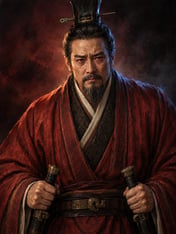 Liu BeiLivedCommanderTalk to me
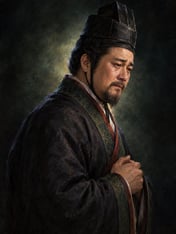 Liu ZhangVictimTalk to me
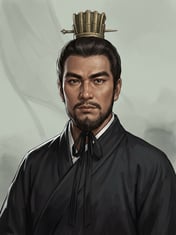 Pang TongKilled in actionTalk to me
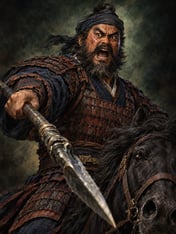 Zhang FeiWarriorTalk to me
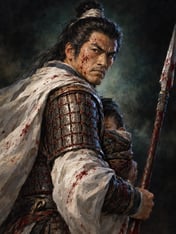 Zhao YunLivedWarriorTalk to me
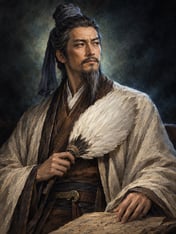 Zhuge LiangLivedCommanderTalk to me
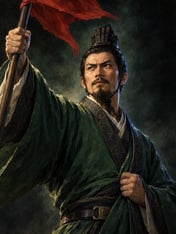 Fa ZhengInstigatorTalk to me
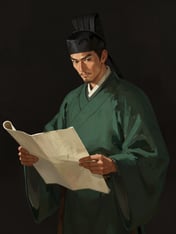 Zhang SongInstigatorTalk to me
Who won, as each book tells it; commanders as the text names them.
Records
Liu Bei's army won
Vol. 32「進圍成都數十日,璋出降」
Romance
Liu Bei's army won
Ch. 65「親齎印綬文籍,與簡雍同車出城投降」
Scene
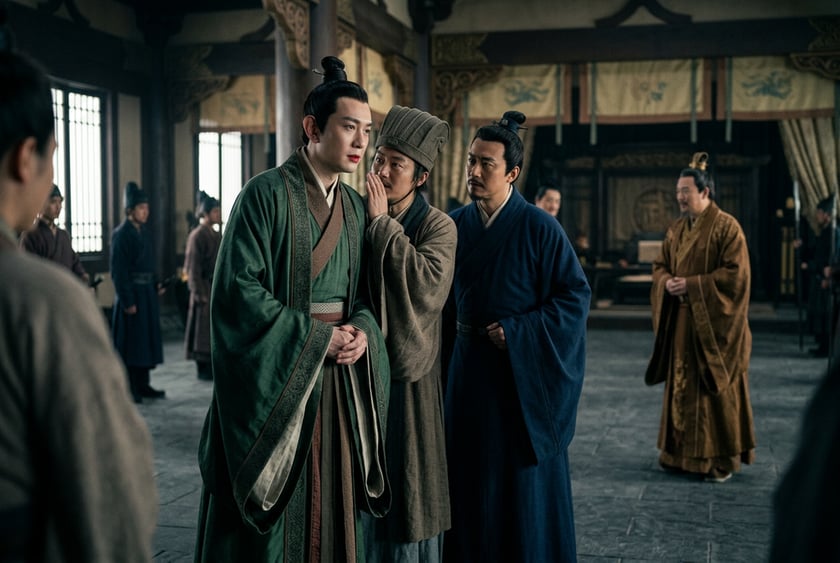
At the Meeting at Fucheng, Liu Bei and Liu Zhang meet, while Pang Tong and Fa Zheng stand behind Liu Bei and quietly urge him to seize the opportunity to kill Liu Zhang.
Swipe to see the whole map
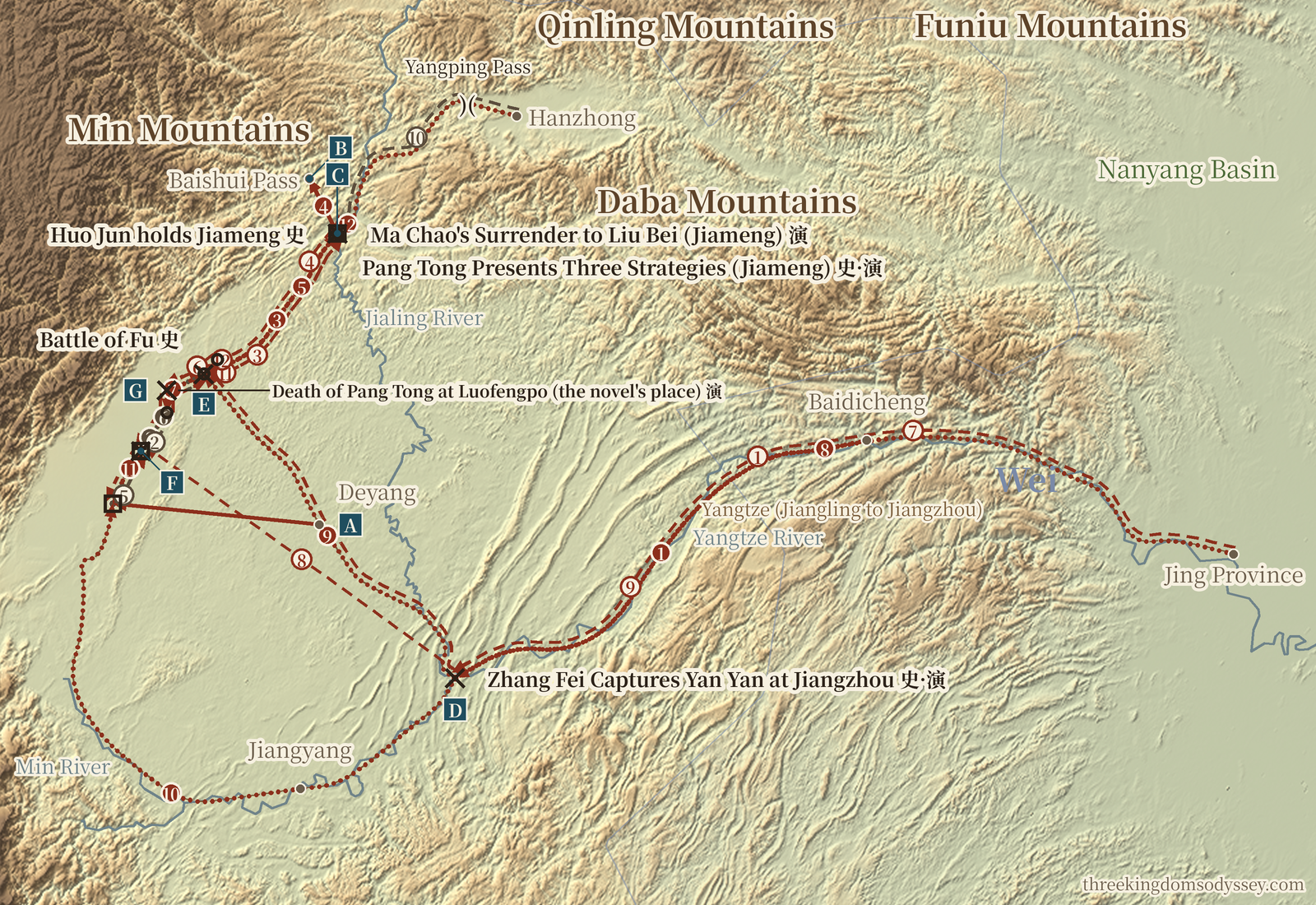
The Sanguozhi has Pang Tong killed by a stray arrow while storming Luo; the Fallen Phoenix Slope and Zhang Fei's duel with Ma Chao at Jiameng are the novel's.
The books mostly say only where an army set out and arrived: a Records line is solid between the places they name and dotted where it follows a reconstructed road between them; an open ring marks an end the books don't give.
Base map: Natural Earth; terrain: AWS Terrain Tiles (SRTM and others). Roads and marches reconstructed from the sources listed; positions approximate.
211
211
212
212
212
213
213
214
214
214
214
214
Continue
Fa Zheng could clearly discern success and failure and possessed extraordinary schemes and calculations; a single meal's kindness or a mere glare's grudge he never failed to requite, and he was not known for virtue and plainness. He advanced by cunning stratagems and judged matters without hesitation.
2197 people in common
2106 people in common
2095 people in common
2185 people in common
2085 people in common
2104 people in common
2094 people in common
2094 people in common
The Battle of Yizhou was not a single engagement but a strategic annexation spanning two years — more precisely, the critical undertaking by which Liu Bei's forces completed the upgrade from "guests lodged in Jing-Xiang" to "founding a state in one's own territory." In the sixteenth year of Jian'an (211), Liu Zhang, at the invitation engineered by Fa Zheng and Zhang Song's covert scheming, invited Liu Bei to advance north and counter Zhang Lu — itself a product of the loosening grip of governance within Yizhou. A regime in which "borrowing troops to defend against an outside threat" could become a routine procedural proposal had in reality already lost the capacity to sustain itself independently. On Liu Bei's side, two long-standing constraints weighed on Jingzhou: Sunwu's pressure for the return of Nanjun was growing increasingly insistent to the east, and Cao Cao had never truly withdrawn from the Xiang-Fan theater to the north after Chibi. From the standpoint of strategic economics, Jingzhou was "liquid capital" that had to be hedged with "landed capital" — and Yizhou was at the time the only available target that could be swallowed, held, and that possessed a complete production chain. Pang Tong's urgent advocacy after the Fuchenghuimian — that Liu Bei should kill Liu Zhang at the banquet and directly seize Shu — reflected precisely this judgment that "the window of opportunity was short". Yet Liu Bei ultimately chose the gradual approach — not from moral hesitation but because he clearly understood that "if the seizure of Shu cost him the hearts of the people, the cost of governing would be beyond bearing" — so he preferred a two-year delay in order to bring the Shu scholars and great families to his side.
Liu Bei's side deployed in a clearly "layered" structure. The first layer was political penetration: Zhang Song and Fa Zheng provided Liu Bei with a voice inside Chengdu and supplied geographical maps. The second layer was the forward expeditionary force: Pang Tong, Huang Zhong, Wei Yan, Liu Feng, and Guan Ping composed the vanguard entering Shu, advancing south along the Fu River and successively attacking the outer perimeter of Fuguan and Luocheng; the third layer had Zhuge Liang personally leading Zhang Fei and Zhao Yun via Jiangzhou and the outer waterway into Shu as a reserve, ensuring that if the front line faltered no strategic vacuum would form. Liu Zhang's side exhibited a "dispersed and mutually uncoordinated" character: Liu Gui, Zhang Ren, Leng Bao, Deng Xian, Wu Yi, and Lei Tong each held a separate section of the line with no unified battlefield command; Zheng Du's advice to Liu Zhang — "scorch the earth and hold firm in a war of attrition to exhaust Liu Bei's forces" — was personally overruled by Liu Zhang on the grounds that "uprooting the people to defend against the enemy" was not a preserving measure. This choice had moral justification, but strategically it meant voluntarily discarding the only card that might have worn down the invaders over time. The fundamental gap between the two forces lay not in numerical strength but in willingness and organizational capacity to sustain "long-duration warfare."
The entire annexation unfolded through six nodes that truly determined its course. The first was Liu Bei's refusal to kill Liu Zhang after the Fuchenghuimian — preserving Liu Zhang's political capital so that the Shu-interior scholarly clans would not turn against Liu Bei en masse during the later absorption period. The second was Leng Bao's plan to release floodwaters being seen through and turned against him: Wei Yan and Huang Zhong struck by night and captured Leng Bao alive. The third was Pang Tong falling to a stray arrow outside Luocheng — the most grievous loss of the entire Shu campaign, forcing Liu Bei to urgently summon Zhuge Liang into Shu. The fourth was Zhang Fei magnanimously releasing Yan Yan at Jiangzhou: treating the captured general with courtesy caused forty-five successive fortifications across the Ba-Xi and Ba-Dong corridor to surrender at the rumor of his approach, and Zhang Fei drove straight to Luocheng. The fifth was Fa Zheng's letter urging Liu Zhang to surrender being angrily rejected by Liu Zhang — this political pathway having been foreclosed, Liu Bei was forced to turn to the frontal assault on Mianzhu. The sixth was Li Yan leading three thousand troops out to fight and then defecting, leaving the Mianzhu gateway wide open: this act of betrayal was no accident but the final surfacing of "Liu Zhang's camp having already lost the hearts of the people". Ma Chao's submission was the decisive closing blow.
In immediate terms, Liu Bei in two years, and with relatively limited casualties, linked Jingzhou and Yizhou into a continuous integrated strategic territory — the material preconditions for founding Shuhan were thereby preliminarily established. Pang Tong's sacrifice was the heaviest price of this victory: he and Zhuge Liang had originally been the twin constellation of Liu Bei's inner circle, and his death left Shuhan's civil-military decision-making for the next twenty-plus years critically dependent on Zhuge Liang alone. This "single-pillar structure" would not reveal its fragility until Wuzhangyuan more than twenty years later. In terms of medium-term resonance, the manner in which Yizhou was absorbed shaped Shuhan's internal structure: Fa Zheng, Li Yan, Huang Quan, and other local-born members of the Yizhou scholarly class were brought into the upper echelon of the regime, running in parallel with the Jingzhou faction represented by Zhuge Liang — an internal tension that ran through the whole early period of Shuhan and was the distant cause of the post-Yiling-defeat Baidituogu arrangement of "Li Yan as Zhuge Liang's deputy." In terms of long-range resonance, the Battle of Yizhou fixed the San Guo configuration — Cao Cao, after Chibi, never managed to push south again; the dispute between Sun Quan and Liu Bei over the Xiang River was pushed to the following year; and the geographic foundation of the three-part division was complete by this point.
If Liu Bei had actually heeded Pang Tong and Fa Zheng at the Fuchenghuimian and killed Liu Zhang to seize Shu on the spot, what would have happened? The most likely chain of events: the Shu-interior scholarly clans would have used "Liu Bei murdering his host" as a pretext for a broad-based backlash, Zhang Lu and Sun Quan would have struck from north and south, and the entire annexation might have been reversed within six months, with Liu Bei potentially forced back to Jingzhou. A second counterfactual: if Liu Zhang had adopted Zheng Du's scorched-earth fortification strategy — relocating the people of Baxi and Zitong across the Fu River to the west, burning the wild grain stores, and digging in for a passive defense — Liu Bei's expeditionary army, with supply lines already thin, could at most have held out for one hundred days before being forced to withdraw; this path would not even have required a single decisive battle to reverse the situation. At the more macro level: if Pang Tong had not fallen to a stray arrow outside Luocheng, Shuhan's political architecture would have been a "triangular balance" of Zhuge Liang and Pang Tong standing shoulder to shoulder with Fa Zheng in support; the Battle of Yiling might not necessarily have been lost, and the path of the northern campaigns might not have been so one-dimensional — history, before that stray arrow at Luofengpo, was originally traveling along a far wider road.