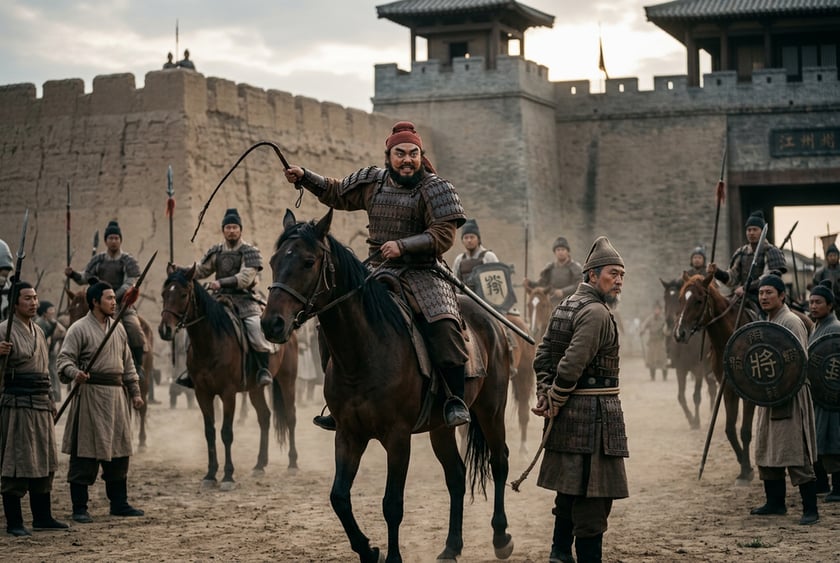
During Liu Bei's Takeover of Yi Province in 213, the eighteenth year of Jian’an, Liu Bei’s subordinates Zhang Fei and Zhuge Liang advanced upstream to Jiangzhou. They defeated Yan Yan, a subordinate of Liu Zhang and administrator of Ba Commandery, and captured him alive. Zhang Fei released Yan Yan and invited him to join his staff as a guest. The army then continued to pacify the commanderies and counties, eventually reuniting with Liu Bei at Chengdu. The Battle of Jiangzhou enabled Liu Bei’s forces to continue their advance in the campaign for Yi Province. After Yi Province was pacified, Zhang Fei was appointed Administrator of Baxi Commandery.
The biography of Zhang Fei in the Records of the Three Kingdoms only records that Zhang Fei went upriver to Jiangzhou, defeated and captured Yan Yan, the Ba Commandery governor, expressed respect for his integrity, and received him as a guest. Zhang Fei then continued to capture the passes along the way, with no mention of Yan Yan playing a role in this. Yan Yan himself does not appear again in later records.
Romance
The novel expands Yan Yan's change of heart into "surrendering out of gratitude and volunteering to serve as the vanguard," and has him call out along the way to induce others to surrender. The forty-five passes from Ba Commandery to Luocheng then submit at the delivery of a proclamation, directly attributing Zhang Fei's rapid advance into Shu to Yan Yan's guidance.
The Battle of Jiangzhou took place during the military campaign that followed Liu Bei’s entry into Yi Province and his conflict with Liu Zhang. The surviving historical sources summarize Zhang Fei’s actions as follows: he and Zhuge Liang and others advanced upstream along the river, pacifying commanderies and counties, and at Jiangzhou defeated Yan Yan, the Administrator of Ba Commandery, and captured him alive. This shows that the battle was not merely a siege and the capture of a general; it also occurred at a critical stage in Liu Bei’s army’s advance into the heart of Yi Province and its efforts to secure local control.
The Romance of the Three Kingdoms presents the siege as a more involved affair: Yan Yan held the city and resisted, Zhang Fei challenged him several times without success, then pretended to withdraw while searching for a route, luring Yan Yan out to intercept him before countering with an ambush and capturing him. These details reflect the novel’s shaping of strategy and dramatic conflict and should not be treated as equivalent to the brief account in the Records of the Three Kingdoms. The reliable historical core is that Zhang Fei took the city and captured Yan Yan alive; the specific ruse belongs to the novel’s narrative.
Main Figures
Zhang Fei’s role in this battle carries a dual significance: he was both a battlefield commander and a representative of the new regime. The Records of the Three Kingdoms says that after “capturing Yan alive,” Zhang Fei did not torture him into submission, but instead “admired him and released him, taking him in as a guest.” This shows Zhang Fei’s recognition of the enemy general’s integrity, and also that punishment was not the only option after capture: treating local commanders well could turn military victory into political cooperation.
Yan Yan was not a passive figure awaiting an offer of surrender. The reply refusing to yield recorded in the histories frames his resistance as a defense of his territory. The Romance of the Three Kingdoms goes further, portraying him as an old general who would rather die than submit and who surrendered only after being treated with respect. The novel then makes Yan Yan a vanguard commander who, drawing on his familiarity with local passes and people, persuades the garrisons along the route to submit. This portrayal highlights the political value of local knowledge and prestige, but its claim that “everywhere he went, all surrendered” cannot be taken directly as a historical conclusion.
Zhuge Liang and Zhao Yun must be treated differently. The Records of the Three Kingdoms explicitly includes Zhuge Liang among the commanders advancing upstream, but does not say that he directly participated in capturing or persuading Yan Yan to surrender. The materials provided also contain no record of Zhao Yun’s actions in this specific incident at Jiangzhou. The two should therefore not be presented as on-the-spot decision-makers in the battle merely because their names appear in the list of figures. The accounts focus directly on Zhang Fei and Yan Yan; the specific roles of the other commanders remain unclear.
Central Issues
The central question is not simply “who won,” but how a conqueror could turn military coercion into political acceptance. Yan Yan’s refusal to surrender represented the unwillingness of the existing local forces to readily accept an outside power. Zhang Fei’s decision to release and honor him after his victory recast their relationship from adversaries into host and guest. Such courtesy did not deny the reality of war; rather, by acknowledging his opponent’s courage, it gave him dignity and a way to change his allegiance.
The Romance of the Three Kingdoms condenses this transition into a highly symbolic ritual: Yan Yan refuses to kneel, Zhang Fei first becomes angry, then personally removes his bonds, clothes him, invites him to sit in the place of honor, and apologizes. The scene’s significance lies not merely in showing Zhang Fei “turning from anger to delight,” but in the public resetting of the power relationship: the captive is no longer simply someone to be disposed of, but a general treated with respect. Through this episode, the novel portrays Zhang Fei as both formidable and discerning, and depicts Yan Yan’s surrender as the result of moral persuasion.
Political history, however, requires distinguishing a narrative of personal virtue from institutional integration. Yan Yan’s being honored and submitting does not mean that the entire society of Ba Commandery immediately accepted Liu Bei’s rule. His surrender may have been shaped by security, practical interests, ties to his former subordinates, or his assessment of the likely victor. The novel attributes the successive submission of local garrisons to Yan Yan’s influence, while the more restrained historical record establishes only that Yan Yan was released and received as a guest. Both accounts point to the importance of winning people over, but they offer evidence of differing strength.
Political Consequences
Militarily, the capture of Jiangzhou enabled Liu Bei’s army to continue advancing into the heart of Yi Province. The histories say that Zhang Fei won battles along the way and later joined Liu Bei at Chengdu; after Yi Province was pacified, Zhang Fei received gifts and was appointed Administrator of Baxi. These records show that the victory at Jiangzhou formed part of a larger campaign and a postwar system of appointments, in which military achievements were incorporated into the new regime’s rewards and governance arrangements rather than standing as an isolated personal duel.
From the perspective of governance, releasing Yan Yan demonstrated at least one viable strategy for integration: preserving the status and dignity of local elites and seeking their cooperation could reduce the cost of continued resistance more effectively than indiscriminate killing. The novel’s portrayal of Yan Yan as a vanguard commander who persuaded people to surrender along the route vividly illustrates how local commanders could serve as intermediaries between old and new regimes. The historical sources, however, do not establish the actual scale of this chain reaction, nor do they justify the claim that Ba Commandery faced no resistance as a result.
Counterfactual Analysis
If Zhang Fei had executed Yan Yan after capturing him, this might have strengthened deterrence in the short term, showing the garrisons the cost of resistance. But it might also have turned Yan Yan into a symbol of martyrdom, encouraging the local people to keep resisting and narrowing Liu Bei’s room to win over officials and scholars in Yi Province. Conversely, if Yan Yan had been released but refused to cooperate, Zhang Fei would still have gained a prisoner, but might not have secured the local connections of someone familiar with the region’s passes. Neither possibility can be confirmed by the sources; they simply illustrate how the treatment of a captured general involved deterrence, prestige, and the costs of governance.
Even without the ruse described in the novel, the outcome of the fighting at Jiangzhou would not necessarily have changed, though the city’s strong defenses and the difficult roads would have increased the cost of advancing. Likewise, if Yan Yan had lacked local prestige, his submission might have had little effect on the garrisons along the route. The broader counterfactual is that even if Jiangzhou had fallen quickly, Liu Bei still would have needed sustained military action, cooperation from local officials, and postwar appointments to stabilize Yi Province. The capture of Yan Yan at Jiangzhou was therefore a turning point of symbolic importance, but it cannot by itself explain Yi Province’s eventual allegiance. Its historical significance lies in showing how military breakthroughs and political incorporation could work together during a campaign.