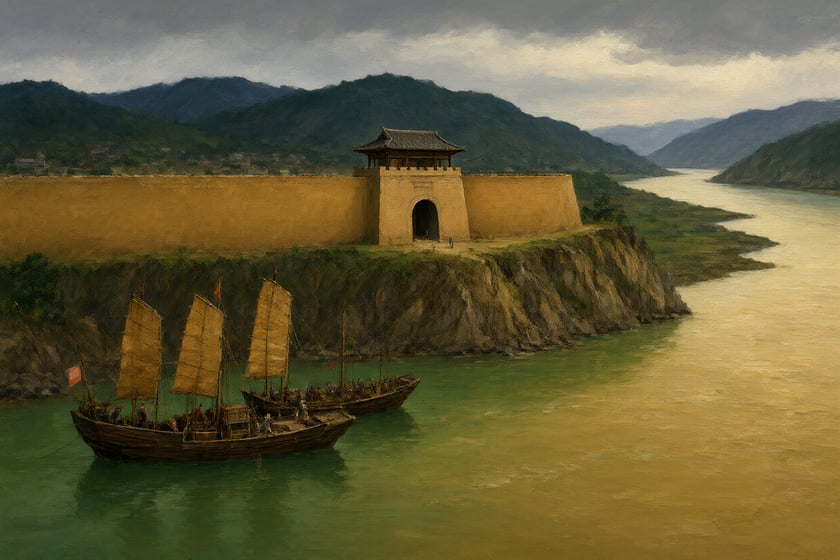
Overview
Jiangzhou was a county in Ba Commandery, Yi Province, during the Eastern Han. Yan Yan, Liu Zhang’s administrator of Ba Commandery, held out there against an attack. The site of the old county lies around present-day Yuzhong District, Chongqing, where the Jialing River flows into the Yangtze. It was a crucial stop on the route upriver from Jing Province into Shu: Liu Bei passed through Jiangzhou on his way into Shu, as did Zhuge Liang and Zhang Fei when they led troops westward. After Shu Han was founded, a military governor was stationed there for many years; together with Yongan, Jiangzhou guarded the eastern frontier.
History
After Liu Zhang inherited Yi Province, Zhao Wei, on whom he had relied, exploited popular resentment to launch a rebellion. In 200, the fifth year of the Jian’an era, Liu Zhang defeated the rebels and attacked Zhao Wei at Jiangzhou. Zhao Wei’s officers Pang Le and Li Yi switched sides and killed him.
In 211, the sixteenth year of the Jian’an era, Liu Zhang invited Liu Bei into Shu. Liu Bei reached a point north of Jiangzhou, then traveled north along the Dianjiang River to Fu. Later, after Liu Bei and Liu Zhang fell out, Liu Bei summoned Zhuge Liang into Shu. Between 213 and 214, the eighteenth and nineteenth years of the Jian’an era, Zhuge Liang led Zhang Fei, Zhao Yun, and others upriver to the west, subduing the commanderies and counties along the way. When Zhang Fei reached Jiangzhou, he defeated Liu Zhang’s administrator of Ba Commandery, Yan Yan, and captured him. Yan Yan would rather die than surrender. Respecting his integrity, Zhang Fei released him and treated him as a guest. Zhuge Liang divided his forces at Jiangzhou, sending Zhao Yun up the Outer River to Jiangyang; in the end, they all joined Zhuge Liang at Chengdu. In 215, the twentieth year of the Jian’an era, Sun Quan and Liu Bei’s forces redrew the boundaries of Jing Province, after which Liu Bei immediately led his troops back to Jiangzhou.
In 221, the first year of the Zhangwu era, Liu Bei launched Liu Bei's Eastern Campaign (Battle of Xiaoting) against Sun Quan, leaving Zhao Yun in command at Jiangzhou. After Liu Bei suffered a setback at Zigui, Zhao Yun advanced to Yongan, by which time the Wu forces had withdrawn. In the spring of 226, the fourth year of the Jianxing era, Zhuge Liang prepared to campaign north toward Hanzhong and put Li Yan in charge of the rear. Li Yan moved his garrison from Yongan to Jiangzhou and built a large walled city there, later known as the old city of Ba Commandery. While stationed at Jiangzhou, Li Yan once asked for five commanderies to be carved out to establish Ba Province, with himself as its governor. In 230, the eighth year of the Jianxing era, Li Yan led twenty thousand men to Hanzhong. Zhuge Liang submitted a memorial recommending Li Yan’s son Li Feng as military governor of Jiangzhou, entrusting him with the army and the defense of the rear. In the tenth month of 231, the ninth year of the Jianxing era, flocks of birds flew from south of the river to the north between Jiangyang and Jiangzhou; thousands plunged into the water and died. After Zhuge Liang’s death, Deng Zhi was promoted to General of the Front and soon put in command at Jiangzhou. He frequently exchanged letters with Sun Quan, who sent him generous gifts.
When discussing the fall of Shu Han, the Eastern Jin historian Sun Sheng argued that Liu Shan could have withdrawn eastward and held Jiangzhou, summoned troops from Nanzhong, and sought aid from Wu in hopes of mounting a later campaign; he need not have surrendered so hastily.
People
- Yan Yan: Liu Zhang’s administrator of Ba Commandery. He became famous for saying, “Our province has only generals who would rather have their heads cut off,” when Zhang Fei captured him.
- Zhao Yun: He passed through Jiangzhou while accompanying Zhuge Liang into Shu and was later appointed to command Jiangzhou during the Zhangwu era.
- Fei Guan: A relative of Liu Zhang, he surrendered to Liu Bei and later served as administrator of Ba Commandery and military governor of Jiangzhou.
- Li Yan and Li Feng: Li Yan was one of the ministers Liu Bei entrusted with Liu Shan’s care. He moved his garrison to Jiangzhou and built a large walled city there; his son Li Feng succeeded him in command at Jiangzhou. Li Yan’s subordinate, the Officer of the Commandant’s Gate Wang Chong, incurred his resentment and, fearing punishment, defected to Wei.
- Li Fu: A native of Fu in Zitong, he became administrator of Ba Xi in 221, the first year of the Jianxing era, and also served as military governor of Jiangzhou and General Who Displays Might. He later entered the court as Vice Director of the Department of State Affairs.
- Deng Zhi: He served as an envoy to Eastern Wu and helped restore friendly relations between Wu and Shu. Later, he commanded at Jiangzhou and maintained frequent contact with Sun Quan.
Differences Between the Historical Record and Fiction
The account of Yan Yan’s capture and defiance, and Zhang Fei’s decision to release and honor him, appears in the Zhang Fei Biography in the Records of the Three Kingdoms. The Romance of the Three Kingdoms changes the story: Zhang Fei personally unties Yan Yan, bows, and apologizes, after which Yan Yan, moved by gratitude, surrenders. It also depicts Yan Yan guiding Zhang Fei’s army, with the commanders guarding the passes surrendering as soon as they see the army approach, so that the force never has to fight along the way. In its account of the Battle of Xiaoting, the novel says that Zhao Yun, then at Jiangzhou, hears that Wu and Shu are at war and rushes to the battlefield. He kills Zhu Ran with a spear, rescues the trapped Liu Bei, and escorts him to Baidicheng. By contrast, the Yun Biezhuan, quoted in Pei Songzhi’s annotations to the Records of the Three Kingdoms, says only that after Liu Bei’s setback at Zigui, Zhao Yun advanced to Yongan, by which time the Wu forces had already withdrawn.
Today
The site of old Jiangzhou lies in present-day Yuzhong District, Chongqing, around the Yuzhong Peninsula where the Jialing River joins the Yangtze. It is part of Chongqing’s old urban center today.