



Strategic Background
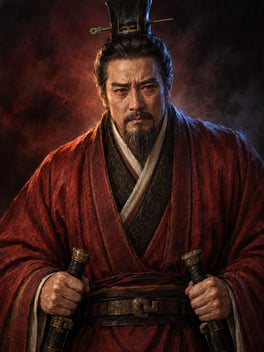
In the narrative of the novel, the battle at the Jin'yan Bridge represents a critical turning point in the middle phase of the Battle of Yizhou. By this point Liu Bei had been in Yizhou for more than two years: from welcoming Liu Zhang's invitation into Shu in the sixteenth year of Jian'an, to breaking with Liu Zhang and marching south from Jiamengguan in the seventeenth year, to capturing Fucheng and investing Luocheng in the eighteenth year — a steady advance, though at the cost of Pang Tong's death from a stray arrow in mid-campaign. Luocheng was the last shield of Liu Zhang's regime, and Zhang Ren was the most prestigious native commander in the Yizhou army. Liu Bei had been unable to take it, and was in a state of strategic deadlock — "Luocheng cannot fall, and there can be no decisive battle at Chengdu." Zhuge Liang's personal arrival at the front was itself a strategic escalation: in the narrative logic of the novel, this is the emblematic scene of Shuhan's lead strategist changing of the guard after "Pang Shiyuan falls".
Deployments
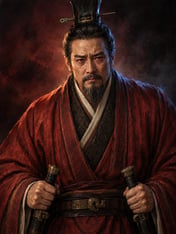
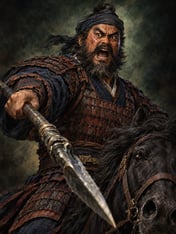
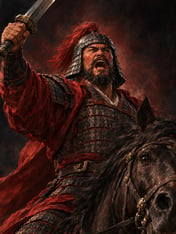
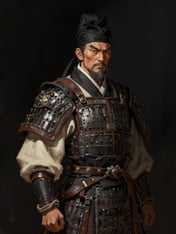
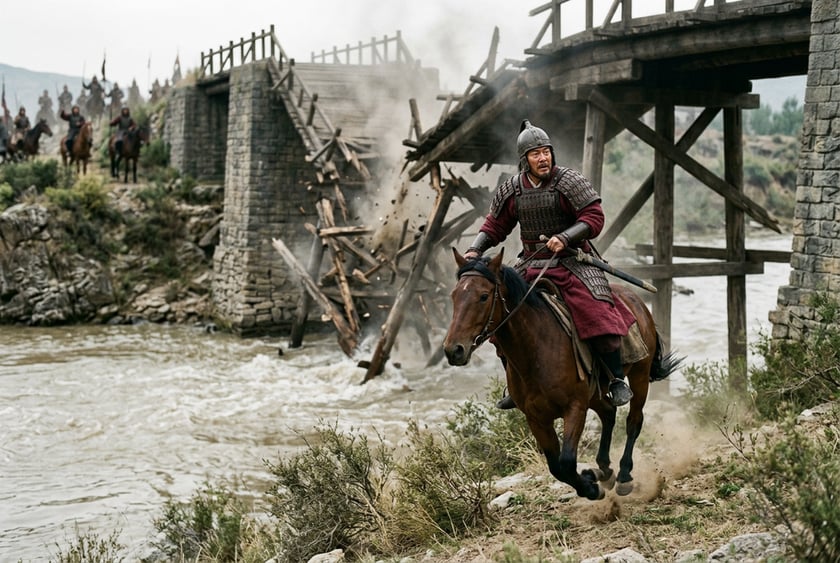
Zhang Ren's side: he left Zhang Yi and Liu Gui to hold Luocheng, while he and the newly arrived Zhuo Ying sallied from the city to repel the enemy, Zhang Ren as the forward detachment and Zhuo Ying as the rear — the intent being to beat back Zhuge Liang through open battle. This disposition was not unreasonable: field battle outside the walls could exploit the troop loyalty that Zhang Ren had accumulated through multiple previous victories, and avoid the attrition of a prolonged siege. Zhuge Liang's side was an elaborately designed "four-direction ambush" model: on both banks of the reed-and-rush marshes five or six li south of the Jin'yan Bridge, suitable for concealment, Wei Yan placed a thousand spearmen on the left bank specifically to target officers on horseback (to break Zhang Ren's personal cavalry escort), Huang Zhong placed a thousand swordsmen on the right bank specifically to cut down horses (to neutralize the cavalry charge), Zhang Fei placed a thousand soldiers along the small hill-paths to the east toward which the enemy might flee in defeat (to seal the southward escape route), and Zhao Yun lay hidden north of the Jin'yan Bridge waiting to destroy the bridge (to seal the northward escape route). Zhuge Liang himself led a deliberately "disordered and undressed" decoy force out south of the bridge to feign weakness and goad the enemy into action. Viewed through modern tactical analysis, this is a standard three-phase ambush of "lure the enemy — cut off retreat — encircle and annihilate."
Critical Decision Points
The success or failure of the entire plan hinged on two psychological assessments: first, Zhuge Liang's assessment that Zhang Ren, emboldened by his side's recent victories, would be arrogant, and that upon seeing Zhuge Liang's own force in disorder would certainly attack; second, Zhang Ren's assessment that this was Zhuge Liang's first battle, that the rumors of "Zhuge's godlike use of troops" might be more reputation than substance. These two assessments were, at the tactical level, symmetric — both sides were placing their bets on a reading of the other's inner state. The outcome proved Zhuge Liang's reading more accurate: Zhang Ren's cold laugh — "Zhuge uses troops like a god? It turns out his reputation exceeds reality" — immediately followed by an all-out advance, was a textbook display of the arrogance that results from underestimating an enemy. The moment Zhang Ren led his full force across the Jin'yan Bridge south in pursuit, Zhao Yun's destruction of the bridge became the decisive action — it not only cut off Zhang Ren's shortest path northward back into Luocheng but also allowed the encirclement of "flanking ambushes on left and right and Zhang Fei sealing the southern route" to snap immediately into place. Zhang Ren was forced to flee south along the river, ran straight into Zhang Fei, and was taken alive.
Outcome and Resonance
Zhang Ren was brought before the headquarters; Liu Bei urged his surrender repeatedly, but Zhang Ren refused with the words "Can a loyal minister serve two lords? Kill me today and I will still not surrender tomorrow — kill me at once!" Zhuge Liang, to honor his integrity, ordered his execution. In terms of tactical result, Zhang Ren's death pulled out the strongest pillar supporting Luocheng; the garrison commanders Liu Gui and Zhang Yi lost their anchor and the city soon fell; and Liu Zhang's Chengdu had no further hope of outside rescue — the Battle of Yizhou entered its closing phase. In terms of narrative function in the novel, this battle is the high point of "Zhuge Liang's first campaign on the western front": he not only captured and killed a renowned general through stratagems, but also showed respect for the concept of "integrity" in ordering Zhang Ren's execution — a stroke that set the moral tone for his later relationships with loyal Yizhou figures such as Huang Quan and Wang Lei. Meanwhile, Zhang Ren's image of "a loyal minister who would not serve two lords" became a benchmark by which later generations judged the Yizhou officialdom, and indirectly heightened the counterpoint supporting the narrative of Liu Bei "winning allegiance through virtue."
Counterfactual Analysis
If Zhang Ren had not fallen into Zhuge Liang's trap and had not rashly advanced south of the bridge, how would the Luocheng campaign have unfolded? The most probable outcome is that Zhang Ren would have defended the city and held out, harassing Liu Bei's supply lines with small cavalry raids and dragging the Shuhan offensive out for several additional months. Pang Tong was already dead, Guan Yu was holding Jingzhou and could not move, and Zhang Fei, Zhao Yun, and Zhuge Liang were all already committed to the western theater — had the Battle of Yizhou been prolonged by half a year more, a reaction window would have opened for Cao Cao's side (Cao Cao himself campaigned west against Zhang Lu in the twentieth year of Jian'an), and Liu Bei might have been forced to address pressure from the Hanzhong direction before he could take Chengdu. A second line of speculation: had Liu Bei successfully persuaded Zhang Ren to surrender, Shuhan would have gained a capable native-born general, potentially strengthening the lineup for the future Battle of Hanzhong and the early phases of the northern campaigns. But Zhang Ren's fierce character and his deep entanglement with the native Yizhou gentry might have made him a "difficult subordinate even after surrender" — Liu Bei's choice to execute rather than retain him may itself reflect a political calculation of this kind. The novel's line of Zhuge Liang's — "Execute him to preserve his name" — is a literary act of honoring a worthy foe, and equally a composed settling of accounts with a troublesome enemy.