Overview
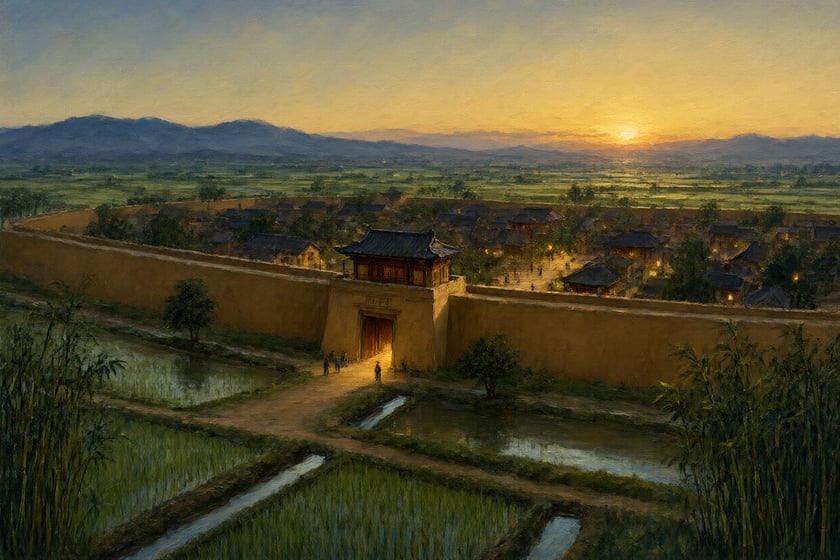
Luocheng was Luoxian County in Guanghan Commandery, Yi Province, during the Eastern Han dynasty. Its former site lies north of present-day Guanghan City, Deyang, Sichuan. Before 188, it was the seat of the Inspector of Yi Province. In 213–214, Liu Bei entered Shu and was held at bay here by Liu Xun, son of Liu Zhang, for nearly a year. Liu Bei’s military adviser Pang Tong was also killed by a stray arrow during the siege. The Battle of Luocheng thus became a pivotal engagement in Liu Bei’s conquest of Yi Province.
History
In 188, Ma Xiang, Zhao Zhi, and others proclaimed themselves Yellow Turbans at Mianzhu. Gathering more than ten thousand followers, they captured Luoxian County and killed Xi Jian, Inspector of Yi Province. After entering Shu, Liu Yan moved the provincial seat to Mianzhu.
After breaking with Liu Zhang, Liu Bei advanced and occupied Fucheng. Liu Zhang sent Liu Gui, Leng Bao, Zhang Ren, Deng Xian, and others to meet him at Fucheng, but they were defeated and retreated to Mianzhu, where Li Yan then led the troops stationed there in surrender. Liu Bei immediately advanced to besiege Luocheng, which Liu Xun defended for nearly a year. According to the Miscellaneous Records of Eminent Elders of Yi Province, cited in Pei Songzhi’s commentary, after their defeat Zhang Ren and Liu Gui retreated to Luocheng and joined Liu Xun in defending it. Zhang Ren led troops out to Yan Bridge for another battle, but was defeated and captured. He refused to surrender, and Liu Bei had him executed. During the siege, Pang Tong led troops in an assault on the city and was struck by a stray arrow and killed, at the age of only thirty-six. Fa Zheng also wrote to Liu Zhang at this time, saying that although Luocheng still had ten thousand soldiers, they were all defeated troops, and urging him to make plans without delay. In the summer of 214, Luocheng fell. Liu Bei then besieged Chengdu for several dozen days, until Liu Zhang surrendered. From then on, Luocheng belonged to Liu Bei. Hearing from afar in Jing Province that Luocheng had fallen, Ma Liang wrote to Zhuge Liang, calling it “Heaven’s blessing”. After Liu Bei entered Shu, Xi Zhen, who had accompanied him into the region, served successively as magistrate of Luoxian and Pi counties.
In 263, the Wei general Deng Ai entered Shu by the narrow route through Yinping, killed Zhuge Zhan at Mianzhu, and advanced to Luocheng. Liu Shan sent Zhang Shao and Deng Liang out of the city bearing the imperial seal and cords to request surrender. The two met Deng Ai in Luoxian, and Shu Han came to an end.
People
- Liu Xun: Son of Liu Zhang, he led the defense of Luocheng and held out against the siege for nearly a year.
- Zhang Ren: A native of Shu Commandery, he came from a humble family, was brave from a young age, and served as an assistant in the provincial administration. Defeated and captured, he would rather die than serve two lords; Liu Bei lamented his fate.
- Pang Tong: Liu Bei’s military adviser, he was struck by a stray arrow and killed while Luoxian was under siege. Liu Bei deeply mourned him, posthumously granting him the title of Marquis within the Passes and the posthumous name Marquis Jing.
- Xi Zhen: A native of Xiangyang, he accompanied Liu Bei into Shu and served successively as magistrate of Luoxian and Pi counties, and as Administrator of Guanghan. His reputation was second only to Pang Tong’s.
Differences in Historical and Fictional Accounts
The Records of the Three Kingdoms says only that Pang Tong was struck by a stray arrow and killed while leading troops in an assault on Luoxian. Chapter 63 of Romance of the Three Kingdoms, by contrast, has him take a different route and reach a mountain valley called the Valley of the Fallen Phoenix. Because his courtesy name was “Young Phoenix,” he senses ill fortune and is about to order a retreat when Zhang Ren’s ambush troops kill him with a volley of arrows.
Regarding Zhang Ren’s capture, Pei Songzhi’s commentary says only that he was defeated and captured after going out to fight at Yan Bridge. The novel has Zhuge Liang personally enter Shu, inspect Golden Wild Goose Bridge east of Luocheng, set an ambush and dismantle the bridge, then surround and capture Zhang Ren after luring him across it. Liu Bei also has him buried beside Golden Wild Goose Bridge. The novel further says that Zhang Yi killed Liu Gui atop the city wall and opened the gates to surrender the city, while Liu Xun escaped through the west gate back to Chengdu. These episodes do not appear in the Records of the Three Kingdoms; the Biography of Zhang Yi in that work records only that he became a secretary after Liu Bei had pacified Yi Province. In the novel, Wu Yi leads troops to Luocheng to help defend it, but is later captured by Zhao Yun and surrenders. By contrast, the Eulogies to the Assistants of Ji Han, preserved in the Biography of Yang Xi in the Records of the Three Kingdoms, records that Wu Yi surrendered while resisting Liu Bei at Fucheng.
Today
The former site of Luocheng is in present-day Guanghan City, Sichuan, whose urban area includes Luocheng Subdistrict. Remains of Luocheng’s Han-dynasty walls can still be seen in the city, including sections of rammed-earth wall. Han bricks inscribed with “Luocheng” have also been unearthed. Fanghu Park lies within the site area.