Background
Volume 61 of Romance of the Three Kingdoms places Cao Cao Elevated to Duke of Wei within a political climate in which his “power and authority grew day by day.” At Xu, Dong Zhao set forth Cao Cao’s achievements, arguing that he had campaigned for years, pacified rival warlords, rid the people of harm, and thereby enabled the Han dynasty to endure. He should therefore no longer be ranked alongside ordinary ministers. This speech did more than praise Cao Cao’s military successes: it portrayed his political standing as already exceeding the limits of a conventional ministerial position. The title of Duke of Wei and the Nine Bestowments thus became a proposed means of converting existing power into recognized status and ritual symbols.
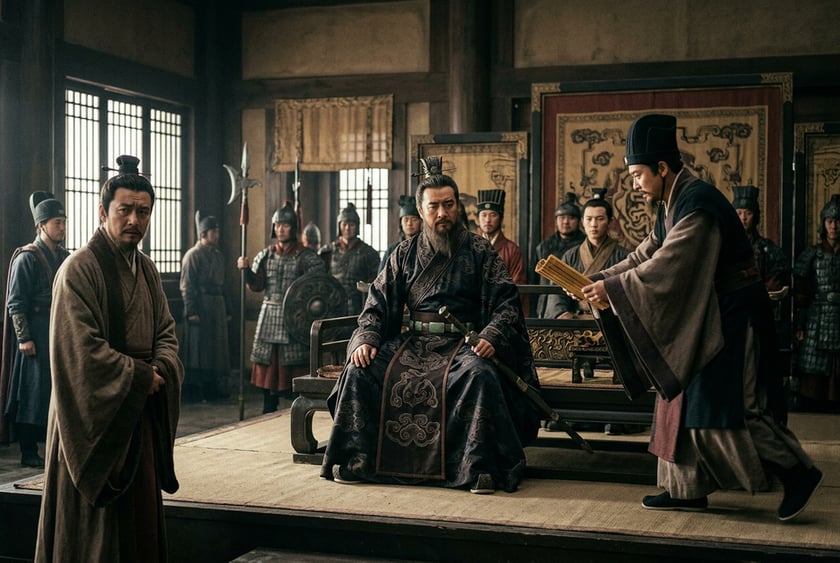
However, it is important to distinguish the proposal in the narrative from a grant of rank that had already been completed. Dong Zhao proposed that Cao Cao “should receive the position of Duke of Wei and be granted the Nine Bestowments,” then “submitted a memorial requesting that Cao be honored as Duke of Wei.” This shows that the text describes a petition for investiture; the passage does not say whether Emperor Xian of Han approved it or whether the grant was formally completed, nor does it present a corresponding imperial edict. The outcome must therefore remain unclear: the proposal and memorial alone do not establish that the process of elevation had concluded.
The scene also reveals the tension between the institutional framework of the Han court and the realities of power. The story places the proposal within the political space of the court at Xu and expresses it through a “memorial,” so Cao Cao’s rise in status still had to take a form that could be publicly articulated in the name of the Han house. In other words, the narrative does not depict the shift in power as a simple personal seizure; instead, it presents a political reordering framed through established titles, petition procedures, and the language of ritual.
Main Figures
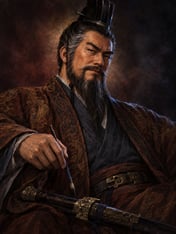
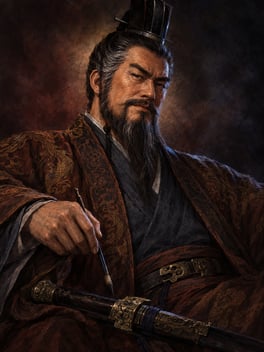
Cao Cao is the central figure and actual beneficiary of the arrangement. Dong Zhao invokes Cao Cao’s achievements to argue for his elevation and the Nine Bestowments, showing that, within the story’s structure, Cao Cao need not make the entire case himself: his supporters can translate his political advantage into an entitlement to higher rank. Yet when Cao Cao hears Xun Yu’s objection, he “changes color in anger.” This suggests that he is not emotionally indifferent to the arrangement of status and legitimacy; at the very least, the narrative presents him both as the beneficiary of growing power and as a figure directly implicated in the controversy.
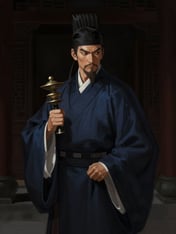
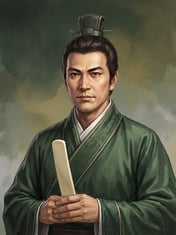
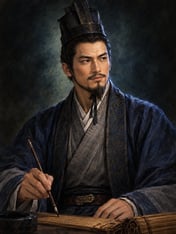
Dong Zhao acts as the strategist and advocate for advancement. His argument has three parts: a comparison of achievements, historical precedents, and political reward. He first elevates Cao Cao’s accomplishments above those of the Duke of Zhou and Lü Wang, then stresses his contributions to the realm and the Han house, and finally concludes that the title of Duke of Wei and the Nine Bestowments are commensurate with those achievements. Xun Yu, by contrast, draws on a different political ethic. He argues that Cao Cao originally raised an army in righteousness to uphold the Han house and should remain loyal and modest. Their conflict is therefore not simply a matter of pro-Cao and anti-Cao positions, but a disagreement over whether achievement can be converted into higher rank—and whether such a conversion would betray the original purpose.
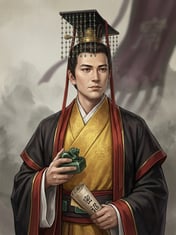
Liu Xie and Xi Lü are listed among the participants as witnesses, but the cited passage records no words, decisions, or specific actions by either of them. In Liu Xie’s case in particular, the text indicates a petitioning relationship only through the phrase “submitted a memorial requesting that Cao be honored”; it does not record his response. Nor does it assign Xi Lü a political stance that can be established from the passage. Analysis should distinguish the designation “present or witnessing” from roles with clearly recorded words or actions, and avoid inferring from the list an attitude not recorded in the Records of the Three Kingdoms.
Core Issues
The first issue is the boundary between achievement and recognized status. Dong Zhao presents the pacification of rival warlords, the protection of the people, and the preservation of the Han house as grounds for elevation. His reasoning is that great achievements merit institutional recognition above the rank of an ordinary minister. Xun Yu’s rebuttal suggests, however, that achievement does not necessarily authorize its beneficiary to overstep the norms of modesty. If the original justification for taking up arms was “to uphold the Han house,” then acquiring the title of Duke of Wei could alter the political commitment that had been made. By setting these two arguments against each other, the story shows that “great achievement” and “loyalty to Han” do not necessarily harmonize on their own.
The second issue is how ritual institutions can serve power. Here, the title of Duke of Wei and the Nine Bestowments are not isolated honors, but a package of political symbols Dong Zhao seeks on Cao Cao’s behalf. They make the elevation appear to be a reward for merit rather than a naked expansion of power. Xun Yu’s objection therefore has institutional significance: he is not disputing whether Cao Cao has won military victories, but whether achievement can be used to redefine the limits of a minister’s position. For modern political history, this narrative illustrates how ritual, rank, and political legitimacy reinforce one another, but it does not establish how any of the related institutional arrangements were actually carried out.
The third issue is whether the opinions of court officials can constrain power. Xun Yu states plainly, “It must not be done.” Dong Zhao immediately counters, “How can one man stand in the way of the hopes of the many?”—shifting the dispute from a judgment of principle to an appeal to majority sentiment. The story provides no details or evidence about who made up these “hopes of the many.” This turn is significant: when the dissenter is depicted as a lone individual, institutional debate can be recast as one person obstructing public expectations. Yet Cao Cao’s change of color and Xun Yu’s sigh also show that this appeal to collective will was not beyond dispute.
Political Consequences
At the level of the narrative, the most immediate consequence is an open dispute within the court over status and legitimacy: Dong Zhao puts forward elevation and the Nine Bestowments as a viable proposal, while Xun Yu objects on grounds of loyalty and modesty. The dispute exposes the political cost of an arrangement that could otherwise be presented as a reward for merit: it may change how people understand Cao Cao’s position and the authority of the Han house. What emerges is not merely a difference of policy opinion, but a disagreement over what kind of political order can still be called “upholding the Han house.”
For Cao Cao, Dong Zhao’s advocacy provides an institutional formulation of his power; for the Han court, the memorial preserves the appearance of a procedure in which recognition is granted in the name of the Han house. But because the cited text gives no decision by Liu Xie, no edict of investiture, and no subsequent institutional changes, these can only be treated as possible political functions of the proposal, not as outcomes that had already been realized. Distinguishing “proposing the title of Duke of Wei and the Nine Bestowments” from “formally completing the investiture” is essential to understanding the uncertainty surrounding this event.
As for Xun Yu, the text explicitly depicts only his immediate objection and sigh; these two passages do not explain what followed. We can establish that his opposition did not stop Dong Zhao from submitting the memorial, but we cannot infer that Xun Yu took further action at the time or that his opinion had no effect in the court. Through his apprehension, the narrative adds a moral warning to the political escalation: each step in the institutionalization of power may force former allies to reconsider where their loyalty lies and where their political limits are.
Counterfactual Analysis
If Xun Yu’s objection had been accepted, the most immediate change might have been a delay or impediment to the proposed elevation and the Nine Bestowments, at least until their relationship to the goal of “upholding the Han house” had been more fully explained. This would not necessarily have meant that Cao Cao lost his actual power, but it might have kept that power from being expressed, for a time, through equally explicit symbols of rank and ritual. This speculation follows from Xun Yu’s objections on moral and status-related grounds; it does not mean the text records any actual alternative plan.
If Dong Zhao’s argument about “the hopes of the many” had prevailed, the proposal for elevation might have gained a stronger appearance of collective support, making it harder for opponents to keep the dispute at the level of principle. But the text does not explain how the court officials formed or expressed this “public will,” so it cannot be asserted that it represented a general consensus. The counterfactual point is that the same elevation of power has weaker legitimacy when described as a personal desire, and is more readily absorbed into institutional language when presented as a reward granted by the many. This is a central function of Dong Zhao’s rhetorical strategy.
If Emperor Xian of Han had ultimately rejected or delayed the petition, the tension between the authority of the Han house and Cao Cao’s actual power might have become more pronounced. If he had approved it, the title of Duke of Wei might have provided a new public form for the power relationship. However, the surviving quotation does not record Liu Xie’s decision, so any judgment about approval, rejection, or subsequent developments must remain conditional. The safest conclusion is that this passage describes advocacy, opposition, and a petition, but provides no final decision. The event’s political significance can be analyzed, but its outcome must remain unclear.