Overview
The Nine Bestowments were nine kinds of ceremonial objects and attendants conferred by the emperor upon eminent ministers, also referred to as “conferring the Nine Bestowments.” The Records of the Three Kingdoms records that Emperor Xian of Han formally invested Cao Cao as Duke of Wei and granted him the Nine Bestowments. Later, Cao Pi granted Sun Quan the Nine Bestowments, and Sun Quan in turn sent envoys to present Gongsun Yuan with the complete articles of the Nine Bestowments. Pei Songzhi's commentary, quoting Kong Yan’s Han Wei chunqiu, records that Sima Yi, called “the Grand Tutor” in this passage, declined the Nine Bestowments; Sima Zhao, called “Sima, King Wen” here, also repeatedly declined them. Romance of the Three Kingdoms depicts Cao Cao accepting the Nine Bestowments, Sun Quan receiving them, and Sima Yi firmly declining them.
Origins
According to the biography of Xun Yu in the Records of the Three Kingdoms, in Jian'an 17 (212), Dong Zhao and others believed that Cao Cao should be elevated to duke and receive “the complete articles of the Nine Bestowments,” and privately consulted Xun Yu. Xun Yu held that “a gentleman loves others through virtue; this should not be done,” which left Cao Cao displeased. Pei Songzhi's commentary, quoting Xiandi chunqiu, says that Dong Zhao settled the matter in discussion with the marquises and generals and wrote to Xun Yu. Xun Yu later remained at Shouchun because of illness. His biography says only that he “died of anxiety”; the following year, Cao Cao became Duke of Wei. Pei Songzhi's commentary quotes another account from Weishi chunqiu: Cao Cao sent food to Xun Yu, but when he opened it, the vessel was empty, whereupon Xun Yu drank poison and died.
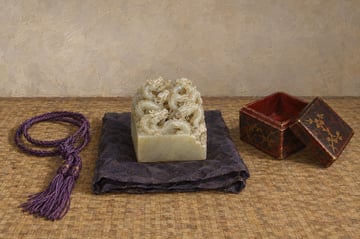
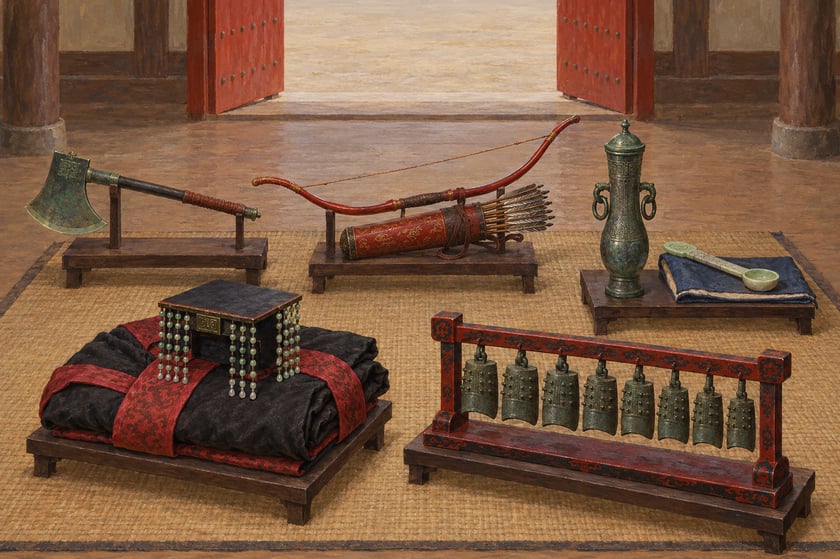
The nine gifts in Emperor Xian’s investiture document were, in order: a grand carriage and a war carriage with two teams of four black stallions; ceremonial robes and a crown, with red shoes; music performed on instruments suspended on three sides, with dances in six rows; vermilion doors; inner steps; three hundred Tiger Guards; execution axes; red bows and arrows and black bows and arrows; and a vessel of black-millet sacrificial wine with a jade libation ladle. Pei Songzhi's commentary says that this investiture document was composed by Pan Xu, Left Assistant Director of the Imperial Secretariat under the Later Han. In the biography of Wei Ji, Pei Songzhi's commentary also quotes Wenzhang zhi: “The investiture document granting the Duke of Wei the Nine Bestowments was composed by Xu”.
An order by Cao Cao preserved in Wei shu and quoted in Pei Songzhi's commentary declared that only the Duke of Zhou deserved to receive the Nine Bestowments and vast territorial grants; Cao Cao declined three times. Xun You, Zhong Yao, Xiahou Dun, Dong Zhao, and others jointly urged him to accept, saying that the fief of Wei and the honor of the Nine Bestowments were still insufficient compared with the rewards of old. Only then did Cao Cao accept the command.
In chapter 61 of Romance of the Three Kingdoms, Cao Cao’s power to reward and punish grows daily at Xuchang, called “Xudu” in this chapter. His Chief Clerk Dong Zhao tells him that his achievements surpass those of the Duke of Zhou and Lü Wang, and that he deserves the title of Duke of Wei and the Nine Bestowments. The novel then lists the Nine Bestowments individually, the ninth being “black-millet sacrificial wine and a jade libation ladle”. Xun Yu remonstrates, and Cao Cao’s expression changes in anger; Dong Zhao nevertheless submits a memorial requesting that Cao Cao be honored as Duke of Wei and granted the Nine Bestowments. The novel then relates that in the tenth month of winter in Jian'an 17 (212), Cao Cao campaigns south while Xun Yu pleads illness and remains at Shouchun. Cao Cao sends him a box of food, but it contains nothing. Xun Yu understands the meaning and takes poison, dying as described in Death of Xun Yu. In chapter 66, when Xun You remonstrates against making Cao Cao King of Wei, he still describes Cao Cao as having “risen in office to Duke of Wei and been honored with the Nine Bestowments”.
Provenance
The Records of the Three Kingdoms records that Emperor Xian of Han’s investiture document made Cao Cao Duke of Wei with ten commanderies in Jizhou as his fief, retained him as Chancellor and concurrent Governor of Jizhou, and granted him the Nine Bestowments; see Cao Cao Elevated to Duke of Wei.
Later, Sun Quan sent envoys bearing a memorial and returned Yu Jin and others. The Wei court sent the Minister of Ceremonies, Xing Zhen, bearing a staff of authority, to appoint Sun Quan General-in-Chief, enfeoff him as King of Wu, and grant him the Nine Bestowments. The nine gifts listed in the investiture document preserved in the biography of the Ruler of Wu were the same as those Cao Cao received, except that there were one hundred Tiger Guards and the provision for music did not mention dances in six rows. Pei Songzhi's commentary, quoting Jiangbiao zhuan, says that Sun Quan’s ministers thought he should not accept enfeoffment from Wei, but Sun Quan cited the Duke of Pei’s acceptance of enfeoffment from Xiang Yu as a parallel and accepted it.
In Jiahe 2 (233), Sun Quan sent the Minister of Ceremonies Zhang Mi, the Bearer of the Gilded Mace Xu Yan, General He Da, and others across the sea with ten thousand troops, carrying gold, treasures, precious goods, and the complete articles of the Nine Bestowments to present to Gongsun Yuan. The ministers of the entire court remonstrated, but Sun Quan would not listen. Gongsun Yuan instead beheaded Zhang Mi and the others, sent their heads to Wei, and seized their troops and supplies. He also submitted a memorial to the Wei court and sent Gongsun Heng, an officer of the Western Section, to deliver to Wei the staff of authority, seal and ribbon, tallies and investiture documents, and articles of the Nine Bestowments that Sun Quan had bestowed.
After the Incident at the Gaoping Tombs in Jiaping 1 (249), the Wei court appointed Grand Tutor Sima Yi Chancellor, but abandoned the appointment after his firm refusal. Pei Songzhi's commentary, quoting Kong Yan’s Han Wei chunqiu, says that an edict subsequently also granted him the honors of the Nine Bestowments. Sima Yi stated that Cao Cao had possessed great merit and virtue before the Han imperial house granted him the Nine Bestowments; this was an exceptional event across the ages, not something for rulers and ministers of later generations to consider. He again declined. The Wei court ordered that General-in-Chief Sima Zhao become Chancellor of State, be enfeoffed as Duke of Jin, and receive the Nine Bestowments, but abandoned the proposal after he declined nine times. In Ganlu 5 (260), an edict again advanced his rank and granted him the Nine Bestowments. He firmly declined, and the empress dowager issued an edict allowing him to maintain his position. In Jingyuan 1 (260), the Wei court again advanced his rank and granted him the honors of the Nine Bestowments, but again abandoned the proposal after his firm refusal. A later entry in the Annals of the Three Young Emperors states only that on the jiayin day of the tenth month in winter, “the General-in-Chief was again ordered to advance in rank and title and receive grants, all in accordance with the previous edict,” without saying that he declined. In the third month of Xianxi 1 (264), the Duke of Jin was elevated to king.
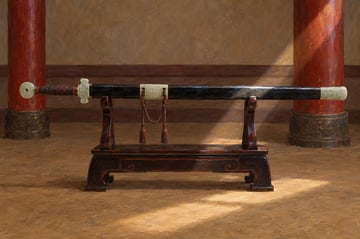
In chapter 82 of Romance of the Three Kingdoms, Cao Pi, emperor of Wei, issues an edict ordering the Minister of Ceremonies Xing Zhen to carry the investiture document enfeoffing Sun Quan as King of Wu and granting him the Nine Bestowments. Liu Ye remonstrates that this is adding wings to a tiger, but Cao Pi does not listen and orders Xing Zhen to accompany the Wu envoy Zhao Zi to Eastern Wu with the investiture document and bestowments. In chapter 107, the Wei ruler Cao Fang appoints Sima Yi Chancellor and grants him the Nine Bestowments. Sima Yi firmly declines, but Cao Fang refuses to permit it and orders him and his two sons to oversee affairs of state together. In chapter 114, in the fourth month of summer in Ganlu 5 (260), Sima Zhao enters the hall wearing his sword. The ministers memorialize that he should become Duke of Jin and receive the Nine Bestowments, while Cao Mao, called “Mao” in this chapter, lowers his head and gives no answer.
Notable Episodes
When his subordinates put forward Liu Bei as King of Hanzhong, their memorial to the Han emperor stated that “his rank and title are not distinguished, and the Nine Bestowments have not been granted to him”.
Pei Songzhi's commentary quotes Zhuge Liang ji: Li Yan once wrote to urge Zhuge Liang to accept the Nine Bestowments and advance in rank to king. Zhuge Liang replied that if he could destroy Wei and behead Rui, “even ten honors could be accepted, let alone nine”.
History and the Romance
The nine gifts: Romance of the Three Kingdoms lists the nine gifts as carriages and horses, clothing, suspended musical instruments, vermilion doors, inner steps, Tiger Guards, execution axes, bows and arrows, and black-millet sacrificial wine with a jade libation ladle. Their order matches Pan Xu’s investiture document, but the descriptions are abbreviated. For instance, where the investiture document says “one vessel of black-millet sacrificial wine, accompanied by a jade libation ladle,” the Romance gives only “black-millet sacrificial wine and a jade libation ladle”.
Death of Xun Yu: The main text of the biography of Xun Yu in the Records of the Three Kingdoms says only that Xun Yu “died of anxiety.” The account of the empty box and his drinking poison comes from Weishi chunqiu, quoted in Pei Songzhi's commentary; chapter 61 of Romance of the Three Kingdoms adopts the latter account.
Scholarship
According to later scholarship, Wang Mang was the first minister in history to receive the Nine Bestowments. Thereafter, recipients often soon usurped the throne, as when Cao Pi supplanted the Han after Cao Cao, and Sima Yan supplanted Wei after Sima Zhao.