Cao Wei · Emperor
Cao Fang
courtesy name 兰卿 · 232–274
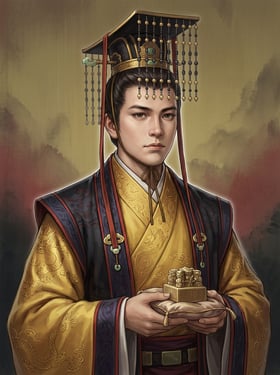
As the adopted son and designated heir of Emperor Ming of Wei, Cao Fang took the throne young, and during his reign was placed under the regency and control of powerful ministers such as Cao Shuang, Sima Yi, and Sima Shi. He was once judged by Wang Ling and Linghu Yu unfit for the throne; under coercion from Sima Shi, he secretly plotted to destroy the traitor, but the plot leaked, leading to the empress being strangled and his own deposition.

Life
In the novel: 4 chapters · In the Records: 11 volumes
Life232–274
239 CE (Jingchu 3)
249 CE (Jiaping 1)
254 CE (Zhengyuan 1)
Allegiance
- Cao Wei
- Life event
- Death
On the boards
Compare with someone →Where this person ranks on each board.
Who they were
Character profile
- Character
- As the adopted son and designated heir of Emperor Ming of Wei, Cao Fang took the throne young, and during his reign was placed under the regency and control of powerful ministers such as Cao Shuang, Sima Yi, and Sima Shi. He was once judged by Wang Ling and Linghu Yu unfit for the throne; under coercion from Sima Shi, he secretly plotted to destroy the traitor, but the plot leaked, leading to the empress being strangled and his own deposition.
- Life
- Cao Fang was the adopted son of Emperor Ming of Wei, styled Lanqing. In the third year of Jingchu he was made crown prince and ascended the imperial throne. In the sixth year of Jiaping he was deposed by Sima Shi to be Prince of Qi, and after the Jin received the abdication he was enfeoffed as Duke of Shaoling County. He died in the tenth year of Taishi, with the posthumous title of Duke Li.
- Anecdotes
- During Cao Fang's reign the regent ministers were successively Cao Shuang, Sima Yi, and Sima Shi. He was the heir entrusted on Emperor Ming of Wei's deathbed, and the third emperor of Cao Wei, reigning during the Jiaping era. In his reign he honored Lady Guo as Empress Dowager, and issued edicts commending men such as Guo Huai, Xu Miao, Hu Zhi, and Tian Yu.
Historical Record
Cao Fang, courtesy name Lanqing, was the third emperor of Cao Wei. Emperor Ming had no sons, so he adopted Cao Fang and Cao Xun, the King of Qin. The palace kept this matter secret; the Records of the Three Kingdoms says that no one at the time knew their origins, and quotes the Spring and Autumn Annals of the Wei as saying that Cao Fang may have been the son of Cao Kai, the King of Rencheng. In the third year of Qinglong, Cao Fang was enfeoffed as the King of Qi. In the first month of the third year of Jingchu, when Emperor Ming was gravely ill, he made Cao Fang crown prince. Cao Fang ascended the throne that same day, and a general amnesty was declared. Emperor Ming left instructions appointing Cao Shuang and Sima Yi to assist in governing. After ascending the throne, Cao Fang honored Empress Guo as empress dowager and issued an edict halting palace construction except where authorized by the late emperor’s edict, and granting freedom to palace bondwomen who had reached the age of sixty.
In the early years of his reign, Cao Fang gradually took a more direct role in government, hearing memorials from the high ministers. Later, he underwent the capping ceremony and made Lady Zhen empress. His edicts show concern for the people’s hardships: he once ordered prison officials to review cases and redress injustices, and, because the people were burdened with too many labor duties, warned officials not to whip the old or young while repairing roads. He also inspected the autumn crops around Luoyang and bestowed gifts on the elderly and those who worked hard in the fields. He also once ordered the gold and silver vessels in the imperial treasury melted down for military use, and decreed the release of elderly and infirm palace slaves.
However, the regents gradually came to dominate the government. In the first year of Jiaping, while Cao Fang’s procession was on its way to pay respects at Gaoping Mausoleum, Sima Yi took control of the capital while Cao Shuang and his brothers were accompanying the emperor, and submitted a memorial calling for Cao Shuang and the others to be dismissed. Cao Shuang and his faction were subsequently executed. Cao Fang remained on the throne, but Sima Yi and his successors held supreme power. In the third year of Jiaping, Wang Ling plotted to depose Cao Fang and replace him with Cao Biao, the King of Chu. After the plot was foiled, Wang Ling killed himself, and Cao Biao was ordered to commit suicide.
In the sixth year of Jiaping, Li Feng and Zhang Ji, the empress’s father, among others at Cao Fang’s court, plotted to replace senior officials, planning to appoint Xiahou Xuan as General-in-Chief. Their scheme was exposed, and those involved were executed. Empress Zhang was deposed, and Lady Wang was subsequently made empress. That same year, Sima Shi plotted to depose Cao Fang and reported the matter to Empress Dowager Guo. She ordered Cao Fang to return to his fief. Deposed as King of Qi, Cao Fang moved to a separate palace; he was twenty-three years old. After the Jin received the abdication, he was enfeoffed as the Duke of Shaoling County. He died in the tenth year of Taishi and was given the posthumous title Duke Li.
In the Novel
Romance of the Three Kingdoms portrays Cao Fang as a young ruler entrusted to regents on Emperor Ming’s deathbed. The novel says he was only eight years old, and has Emperor Ming compare the event to Liu Bei entrusting his son at Baidicheng, committing Cao Fang to the care of Sima Yi and Cao Shuang. Cao Fang clings to Sima Yi’s neck and refuses to let go, a dramatic scene emphasizing the young ruler’s dependence and the emotional bond of the deathbed trust. The historical account records that Emperor Ming, gravely ill, made Cao Fang crown prince, that Cao Fang ascended the throne, and that Cao Shuang and Sima Yi received the late emperor’s instructions to assist in governing. It does not, however, record the scene of Cao Fang clinging to Sima Yi’s neck, nor does it give his age as eight.
The novel then focuses on Cao Fang’s position between powerful ministers. After Cao Shuang took power, He Yan urged him to strip Sima Yi of his military command. During the Gaoping Mausoleum Incident, Cao Fang left the capital with Cao Shuang, while Sima Yi took control of Luoyang and forced Cao Shuang to return to his residence. Later, the novel depicts Cao Fang as being suppressed by Sima Shi and conspiring with Xiahou Xuan, Li Feng, and Zhang Ji. They draft an edict in blood calling for an attack on Sima Shi; when the plot is exposed, Empress Zhang is killed, and Cao Fang is ultimately deposed. These details of the conspiracy, blood-written edict, and palace drama are embellishments of the novel. The historical account instead records that Li Feng and the others’ plot to replace senior officials was foiled, that Lady Zhang was deposed, and that Sima Shi acted on Empress Dowager Guo’s order to depose Cao Fang and send him back to his fief.
Key Relationships
- Emperor Ming Cao Rui: Cao Fang was Emperor Ming’s adopted son. When Emperor Ming was gravely ill, he made Cao Fang crown prince. After Cao Fang ascended the throne, he honored Empress Guo as empress dowager. The novel adds the deathbed entrustment and the scene of the young ruler clinging to Sima Yi’s neck. (The scene of him clinging to Sima Yi is unique to the novel.)
- Cao Shuang and Sima Yi: The two were appointed by Emperor Ming’s final instructions to assist in governing. After the Gaoping Mausoleum Incident, Cao Shuang lost power and was executed, while Sima Yi’s faction gradually took control of the government. Although Cao Fang was emperor, his position was constrained by powerful ministers.
- Empress Dowager Guo and Sima Shi: When Cao Fang was deposed, Sima Shi first reported the matter to Empress Dowager Guo, who ordered him to return to his fief. The historical account identifies the empress dowager’s order and the ministers’ memorial as central to the deposition; it does not record the turmoil over the blood-written edict depicted in the novel.
- Empresses: Cao Fang successively made Lady Zhen, Lady Zhang, and Lady Wang empress. The historical account says that Lady Zhang was deposed after the plot involving Li Feng and the others was exposed. The novel instead depicts Empress Zhang being strangled to death by Sima Shi over the blood-edict case, a detail unique to the novel.
Signature Scenes
- A young ruler ascends the throne: In the first month of the third year of Jingchu, Emperor Ming made Cao Fang crown prince. Cao Fang ascended the throne that same day, a general amnesty was declared, and Cao Shuang and Sima Yi were appointed to assist in governing. This marked Cao Fang’s passage from King of Qi to emperor, while also placing him under the constraints of the regency.
- The Gaoping Mausoleum Incident: Cao Fang’s procession set out to pay respects at Gaoping Mausoleum, and Sima Yi took action in Luoyang, submitting a memorial calling for the dismissal of the Cao Shuang brothers. The novel recasts details such as Cao Fang accompanying the procession and Cao Shuang rejecting Huan Fan’s remonstrance as a tense palace coup. The dramatic dialogue between Cao Fang and Huan Fan is unique to the novel.
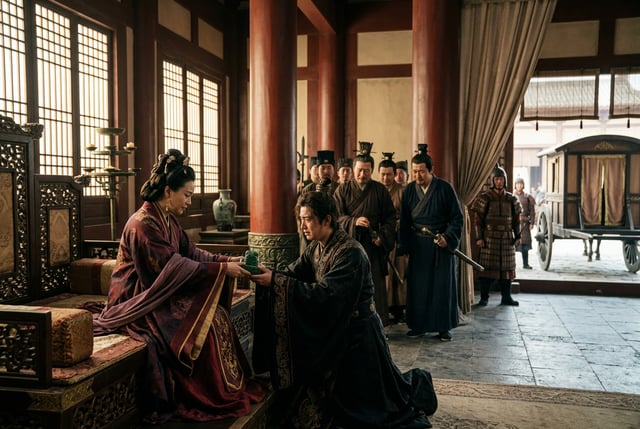
- Return to his fief and departure from the palace: In the sixth year of Jiaping, Empress Dowager Guo ordered Cao Fang deposed and sent back to the kingdom of Qi. He moved to a separate palace at the age of twenty-three. The account quoted in Pei Songzhi’s commentary also says that, after receiving the order, Cao Fang left the palace in a king’s carriage, bade farewell to the empress dowager, and wept. The novel depicts his departure from the throne with the presentation of the imperial seal and his weeping as he rode in the king’s carriage.
Quotes
17 lines in the books · 3 featured
「司馬師視朕如小兒,覷百官如草芥,社稷早晚必歸此人矣!」
This line displays Cao Fang's keen insight into, and helplessness before, Sima Shi's monopoly on power.
「朕祖武皇帝誅董承,蓋爲機事不密也。卿等須謹細,勿洩於外。」
Cao Fang warns by invoking Cao Cao's execution of Dong Cheng, reflecting his wariness of the Sima clan.
「太尉體道正直,盡忠三世,南擒孟達,西破蜀虜,東滅公孫淵,功蓋海內。昔周成建保傅之官,近漢顯宗崇寵鄧禹,所以優隆儁乂,必有尊也。其以太尉為太傅,持節統兵都督諸軍事如故。」
This line embodies Cao Fang's reverence for and attempts to win over Sima Yi, foreshadowing the political situation to come.
- Family
- Lord & vassal
- Enemies
Who is Cao Fang connected to?
Pick someone to see how many steps lie between them and Cao Fang.
History vs. novel
7 points · 3 novel-only
| History | Novel |
|---|---|
| Background and AccessionNovel embellishes | |
Cao Fang, whose courtesy name was Lanqing, was adopted along with Cao Xun, Prince of Qin, because Emperor Ming had no sons. The palace kept his origins secret. After he was made crown prince, he ascended the throne on the same day. vol. 4 | The Romance of the Three Kingdoms also portrays Cao Fang as Cao Rui’s adopted son, with his origins kept secret, and says Sima Yi and Cao Shuang installed him. It further adds details such as Cao Rui’s posthumous title, his burial at the Gaoping Tombs, and the adoption of a new era name. ch. 106 |
| Appointment as Grand TutorSources disagree | |
In recognition of Sima Yi’s achievements—including capturing Meng Da in the south, defeating the Shu army in the west, and destroying Gongsun Yuan in the east—Cao Fang issued an edict elevating him to Grand Tutor, while allowing him to retain command of the troops and oversee military affairs as before. vol. 4 | The Romance of the Three Kingdoms says that Cao Shuang, heeding He Yan’s advice, urged Cao Fang to appoint Sima Yi Grand Tutor in order to strip him of military command, after which Cao Shuang took sole control of power. ch. 106 |
| Taking Personal Charge of the CourtHistory only | |
In the seventh month of the first year of the Zhengshi era, Cao Fang began personally attending court and hearing the ministers’ memorials. vol. 4 | — |
| Incident at the Gaoping TombsNovel only | |
| — | When Sima Yi launched his coup, Cao Fang appeared flustered and helpless as Cao Shuang asked him what to do. Huan Fan urged Cao Shuang to take the emperor to Xu and raise troops, but Cao Shuang did not heed him. ch. 107 |
| Fear of Sima ShiNovel only | |
| — | The Romance of the Three Kingdoms says that Cao Fang trembled with unease whenever Sima Shi came to court. Sima Shi made decisions on court affairs on his own, while Cao Fang withdrew to the rear palace and secretly conferred with Xiahou Xuan, Li Feng, and Zhang Ji about how to counter him. ch. 109 |
| Blood Edict to Eliminate Sima ShiNovel only | |
| — | Cao Fang bit his finger and wrote a blood edict on a piece of clothing, entrusting it to Zhang Ji and ordering everyone to keep it strictly secret. Sima Shi later discovered the edict and exposed the plot. ch. 109 |
| Deposition and AbdicationNovel embellishes | |
Official histories record that Cao Fang was deposed and Cao Mao was installed to succeed Emperor Ming. After the Jin dynasty received the abdication, Cao Fang was enfeoffed as Duke of Shaoling County. He died at the age of forty-three and was posthumously titled Duke Li. vol. 4 | The Romance of the Three Kingdoms elaborates on Sima Shi entering the palace and confronting Cao Fang, then having Empress Zhang strangled in front of him. Cao Fang subsequently surrendered the imperial seal and ribbons, was deposed as Prince of Qi, and left the capital in tears. ch. 109 |
- Background and AccessionNovel embellishes
- History
Cao Fang, whose courtesy name was Lanqing, was adopted along with Cao Xun, Prince of Qin, because Emperor Ming had no sons. The palace kept his origins secret. After he was made crown prince, he ascended the throne on the same day.
vol. 4
- Novel
The Romance of the Three Kingdoms also portrays Cao Fang as Cao Rui’s adopted son, with his origins kept secret, and says Sima Yi and Cao Shuang installed him. It further adds details such as Cao Rui’s posthumous title, his burial at the Gaoping Tombs, and the adoption of a new era name.
ch. 106
- Appointment as Grand TutorSources disagree
- History
In recognition of Sima Yi’s achievements—including capturing Meng Da in the south, defeating the Shu army in the west, and destroying Gongsun Yuan in the east—Cao Fang issued an edict elevating him to Grand Tutor, while allowing him to retain command of the troops and oversee military affairs as before.
vol. 4
- Novel
The Romance of the Three Kingdoms says that Cao Shuang, heeding He Yan’s advice, urged Cao Fang to appoint Sima Yi Grand Tutor in order to strip him of military command, after which Cao Shuang took sole control of power.
ch. 106
- Taking Personal Charge of the CourtHistory only
- History
In the seventh month of the first year of the Zhengshi era, Cao Fang began personally attending court and hearing the ministers’ memorials.
vol. 4
- Incident at the Gaoping TombsNovel only
- Novel
When Sima Yi launched his coup, Cao Fang appeared flustered and helpless as Cao Shuang asked him what to do. Huan Fan urged Cao Shuang to take the emperor to Xu and raise troops, but Cao Shuang did not heed him.
ch. 107
- Fear of Sima ShiNovel only
- Novel
The Romance of the Three Kingdoms says that Cao Fang trembled with unease whenever Sima Shi came to court. Sima Shi made decisions on court affairs on his own, while Cao Fang withdrew to the rear palace and secretly conferred with Xiahou Xuan, Li Feng, and Zhang Ji about how to counter him.
ch. 109
- Blood Edict to Eliminate Sima ShiNovel only
- Novel
Cao Fang bit his finger and wrote a blood edict on a piece of clothing, entrusting it to Zhang Ji and ordering everyone to keep it strictly secret. Sima Shi later discovered the edict and exposed the plot.
ch. 109
- Deposition and AbdicationNovel embellishes
- History
Official histories record that Cao Fang was deposed and Cao Mao was installed to succeed Emperor Ming. After the Jin dynasty received the abdication, Cao Fang was enfeoffed as Duke of Shaoling County. He died at the age of forty-three and was posthumously titled Duke Li.
vol. 4
- Novel
The Romance of the Three Kingdoms elaborates on Sima Shi entering the palace and confronting Cao Fang, then having Empress Zhang strangled in front of him. Cao Fang subsequently surrendered the imperial seal and ribbons, was deposed as Prince of Qi, and left the capital in tears.
ch. 109
Events
Events (6)
Battles and events the texts place this person in, by date.
Other events
Continue
Deposition of Cao Fang
Relationship timeline4 entries ▸
History · vol. 4
Spouse
Installed her as empress.
Novel · ch. 107
- Sima Yi§24
Vassal
Enfeoffed Yi as Chancellor, bestowed the Nine Honors on him, and had the three men, father and sons, jointly manage state affairs
Novel · ch. 109
- Sima Shi§14
Enemy
was intimidated by him; secretly ordered to join in opposing him, but when the plot was exposed, blamed his empress, who was strangled, and was himself deposed
- Sima Shi§21
Betrayer
Reprimanded him for being “excessively debauched and licentious, and consorting intimately with prostitutes and entertainers”; accepted the seal and ribbon and restored his title of Prince of Qi
Inner monologues · AI-generated3 monologues ▸
- I once dwelt atop the ninefold heights, bearing the title Son of Heaven, yet often felt that edicts issued from another’
- During my reign, the court’s actions often had to conform to ritual propriety and be subject to self-scrutiny. I recall
- I was born in the palace, but no one can say for certain where I came from. The *Records of the Three Kingdoms* merely r