



Background
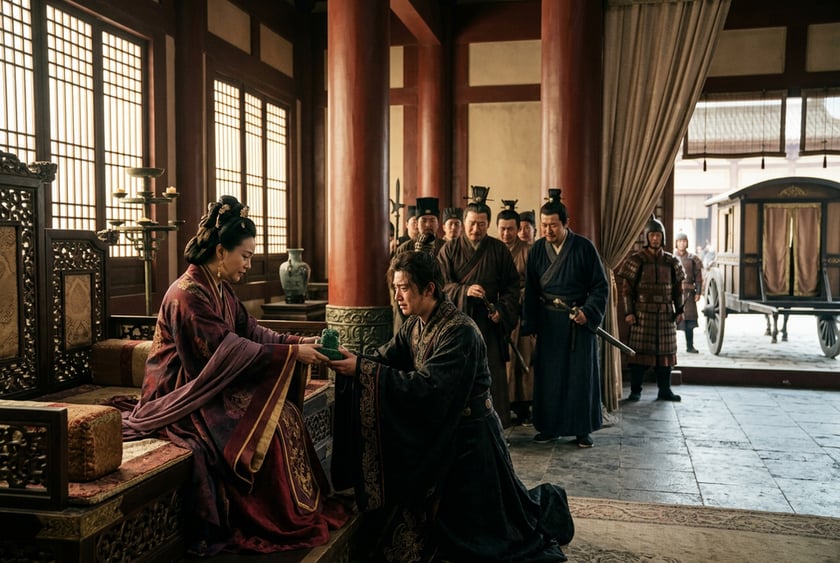
The Deposition of Cao Fang took place in the sixth year of the Jiaping era (254). The supplied passage from Romance of the Three Kingdoms, juan 109, depicts this upheaval as a process in which Sima Shi summoned court officials in the name of the empress dowager, deposed Cao Fang, and installed Cao Mao in his place. In the story, Sima Shi first cites Cao Fang’s “debauchery and lack of virtue,” invoking the precedents of Yi Yin and Huo Guang deposing and installing rulers. He claims that his actions are intended to preserve the state and pacify the realm. The Empress Dowager Guo then endorses Cao Mao, and the court officials follow suit. Thus, the episode concerns not only the fate of an individual emperor, but also how those who control military and political resources present a transfer of power as a legitimate order.
It is important to note that the available quotations come from Romance of the Three Kingdoms, a literary narrative rather than a complete institutional record or a collection of testimony from multiple parties. They show how later storytelling frames the deposition: Cao Fang’s lack of virtue provides the public justification; the empress dowager’s edict and the court officials’ deliberations lend it the appearance of procedure; and Cao Mao’s succession completes the transfer of power. But these two passages alone cannot establish the truth of every accusation, the details of private negotiations among the parties, or the episode’s long-term outcome. Analysis should therefore distinguish the narrative’s “justifying rhetoric” from the sequence of actions that can be directly confirmed.
Key Figures
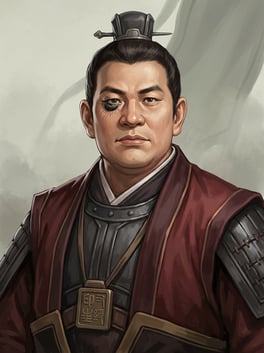
Sima Shi organized the deposition and, in the narrative, was the figure most able to set the agenda. He first proposed the change of ruler to the court officials, then brought his proposal to the Yongning Palace for the empress dowager’s approval. After Cao Fang surrendered the imperial seals and left the palace, Sima Shi was granted extraordinary privileges: the yellow battle-axe, permission to enter court without hurrying, to present memorials without giving his name, and to wear a sword in the palace hall. Taken together, these two stages show that he not only drove the change of emperor but also used the new ruler’s accession to consolidate his own position. His power lay not merely in “putting forward a candidate,” but in deciding when deliberations began, how they were framed, and which outcome became a fait accompli.
Cao Fang is the party stripped of the throne in the story. The Empress Dowager Guo provides the crucial authorization in name: she rejects Cao Ju, whom Sima Shi initially proposes, and instead recommends Cao Mao. In a later scene, she urges Cao Mao to be respectful, frugal, and benevolent. Yet her words do not alter the broader picture of Sima Shi directing the deposition. Cao Mao signals his caution through gestures of deference, walking into the palace and not daring to ride in a carriage; even as he takes the throne, he remains in a political environment where he must accept Sima Shi’s arrangements. As a member of the imperial clan, Sima Fu supports the empress dowager’s choice, lending the Cao Mao proposal greater backing within the court.
The list of participants also identifies Gao Rou as a witness and Li Feng, Xiahou Xuan, and Zhang Ji as victims. However, the two passages provided do not describe these figures’ specific actions in planning the deposition, nor do they explain in detail how their fates were connected to Cao Fang’s removal. A careful reading should not expand their listed roles into events absent from the text. The list instead suggests that the political reach of this coup may have extended beyond the transfer of power within the palace, though the specific connections require verification from other historical sources.
Central Issues
The first issue is how the legitimacy of the deposition was constructed. Sima Shi sums up Cao Fang’s rule as “debauchery and lack of virtue” and an inability to govern the realm, comparing his own action to the regencies and depositions carried out by Yi Yin and Huo Guang. These allusions present a forced change of ruler as a precedent for correcting a sovereign’s failings and protecting the state. Yet the same narrative shows that the proposal, its execution, and its beneficiary were all closely bound to Sima Shi’s own position of power. The dispute, then, is not only whether Cao Fang was fit to rule, but also who had the authority to judge him unfit and who could claim to speak for the state in passing judgment.
The second issue is the divide between procedure and actual power. The empress dowager receives the proposal, court officials voice their support, Cao Fang is summoned, the imperial seals are collected, and a new ruler is installed: together, these steps form an apparently orderly and public ritual. But the text presents no institutional force capable of independently rejecting Sima Shi’s plan. Once informed of the charges against him, Cao Fang surrenders the imperial treasure and leaves the palace, while the court officials’ agreement is portrayed as nearly unanimous. Procedure thus serves both as a means of transferring power and as a gloss on coercive reality: ritual makes the change appear orderly, but does not mean that those taking part had an equal choice.
The third issue is the relationship between the “new ruler” and the “holder of real power.” Cao Mao is portrayed as modest, respectful, and self-effacing, with the bearing of an emperor, while Cao Fang is cast as an unfit ruler. This contrast provides the change of sovereign with a moral narrative. Yet Cao Mao’s accession is followed almost immediately by Sima Shi’s receipt of extraordinary honors, leaving a structural question: did the continuation of the imperial title restore the order of Cao Wei, or did it provide a new framework of legitimacy for the Sima clan’s control of the court? The quotations alone cannot determine Cao Mao’s political abilities or his later fate, but they are enough to show that nominal imperial authority and actual decision-making power need not coincide.
Political Consequences
As far as the immediate results confirmed by the quotations are concerned, Cao Fang lost both the throne and his title as Prince of Qi and was ordered to leave; Cao Mao succeeded him, and the era name was changed to Zhengyuan; Sima Shi received privileges of a higher rank at court. The deposition thus accomplished three political arrangements at once: replacing the emperor, reshaping the narrative of legitimacy, and elevating Sima Shi’s institutional standing. The arrival of a new ruler did not erase the transfer of power; instead, it gave that transfer a new courtly form. If “the outcome of the episode is unclear” means that the available material does not describe the subsequent political course, then the immediate handover is clear, while the long-term outcome cannot be inferred from these two passages.
The narrative also depicts a public performance of political obedience: the court officials voice their approval in unison, Cao Fang weeps as he hands over the seals, and those seeing him off part in tears. The court is presented as outwardly united, yet perhaps divided in feeling. The officials’ assent might express support, or it might reflect a lack of room to refuse in the face of a powerful leader; the text does not provide enough information to distinguish between these possibilities. For modern political-historical analysis, this is a reminder not to equate unanimity in a ritual with genuine consensus, but to ask how opinions were formed, what it cost to dissent, and whether power was subject to checks.
Counterfactual Analysis
If the Empress Dowager Guo had not supported Cao Mao, Sima Shi might still have been able to press ahead with the deposition, but his action would have lost the story’s most important channel of authorization through the imperial household and clan. He might have had to choose another Cao prince, or risk more directly replacing the emperor through force and personal command. Conversely, if any court official had openly refused to assent, the deposition ritual might have ceased to be a performance of acting in accord with Heaven and the people and instead become a signal of division within the court. These are, however, only conditional possibilities based on the narrative’s structure. They do not prove that a viable opposition alliance existed at the time, or that the empress dowager or court officials had the practical power to change the outcome.
Another counterfactual is that, had Cao Fang been able to avoid deposition through concessions, adjustments to his close attendants, or a new power-sharing arrangement with the regent, the conflict might have been postponed. But the underlying problem would have remained: there was no stable boundary of power between the emperor and those who controlled military and political resources. Even if Cao Fang had remained on the throne, he might not have regained independent decision-making; even if Cao Mao had been installed, the continuation of the imperial line would not necessarily have meant an autonomous court. The text offers no institutional mechanism for arbitrating between the parties. The more cautious conclusion, then, is not to claim that any alternative path would necessarily have succeeded, but to note that once the power to depose and install rulers was concentrated in the hands of a single regent, the success of personal compromise depended on the structure of power, not solely on the sovereign’s character.